The Skoda Octavia III Combi 1.2 TSI (105 Hp) DSG: A European Mainstay of Practicality and Efficiency
The Skoda Octavia III Combi 1.2 TSI (105 Hp) DSG, produced between 2013 and 2015, represents a significant chapter in the evolution of Skoda’s highly successful Octavia line. As a third-generation model, this particular variant, with its 1.2-liter turbocharged gasoline engine and sophisticated Direct-Shift Gearbox (DSG), epitomized Skoda’s core values: delivering exceptional practicality, robust engineering, and remarkable efficiency within the fiercely competitive European C-segment. While the Skoda brand is not present in the United States market, the Octavia Combi (the European term for station wagon) has been a cornerstone of the brand’s resurgence and popularity across Europe, establishing itself as a go-to choice for families and fleet operators seeking a spacious, reliable, and cost-effective vehicle.
Positioned as a compact family car, the Octavia III Combi skillfully blended the footprint of a traditional hatchback with the cavernous cargo capacity typically associated with larger vehicles. Built on the Volkswagen Group’s highly versatile MQB platform, shared with contemporaries like the Volkswagen Golf and Audi A3, the Octavia III brought a new level of sophistication, safety, and technological integration to the Skoda lineup. This specific 1.2 TSI DSG model was geared towards buyers prioritizing fuel economy and smooth urban driving without sacrificing adequate performance for longer journeys, making it a highly attractive proposition in its primary markets.
Engine and Performance of the Skoda Octavia III Combi
At the heart of the 2013-2015 Skoda Octavia III Combi 1.2 TSI (105 Hp) DSG lies a refined 1.2-liter (1197 cm3 or 73.05 cu. in.) turbocharged inline-four gasoline engine, internally designated as the EA211 / CJZA. This powerplant, a testament to modern downsizing trends, features direct fuel injection, a turbocharger, and an intercooler, allowing it to produce a respectable 105 horsepower at a broad range of 4500-5500 rpm. The engine’s design prioritizes efficiency and a broad torque curve, delivering 129.07 lb.-ft. of torque from a low 1400 rpm all the way up to 4100 rpm. This wide torque band ensures responsive acceleration and flexible driving characteristics, particularly valuable in everyday traffic conditions.
Power is channeled to the front wheels through a sophisticated 7-speed DSG automatic transmission. This dual-clutch gearbox, a hallmark of Volkswagen Group engineering, is renowned for its lightning-fast and seamless gear changes, contributing significantly to both the vehicle’s fuel efficiency and its dynamic performance. The combination of the peppy 1.2-liter TSI engine and the quick-shifting DSG allows the Octavia III Combi to accelerate from 0 to 60 mph in a respectable 10.1 seconds, with a top speed of 119.92 mph. While not a performance car, these figures demonstrate its capability for confident highway cruising and effortless merging.
Fuel economy was a major selling point for this particular Octavia variant, achieving an impressive combined fuel consumption of 47 US mpg (5 liters per 100 km) under the NEDC testing cycle. Its CO2 emissions of 115 g/km meant it met the stringent Euro 5 emission standard, making it an environmentally conscious choice for the era. Further enhancing its efficiency, the vehicle was equipped with a Start & Stop system, automatically shutting off the engine when stationary to conserve fuel and reduce emissions in urban environments. The engine’s DOHC valvetrain and 10.5:1 compression ratio further contributed to its efficient combustion and overall refinement.
Design and Features
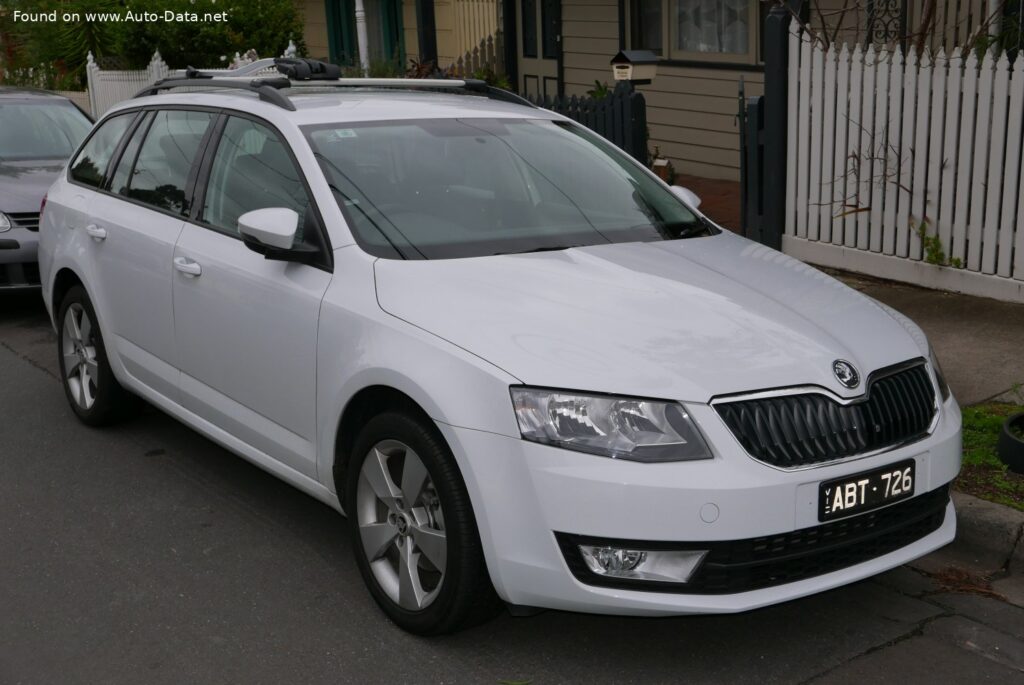
The design of the Skoda Octavia III Combi marked a significant evolution in the brand’s aesthetic language, characterized by sharper lines, a more assertive grille, and a generally more upscale appearance than its predecessors. As a station wagon, or “Combi” in Skoda parlance, its primary design focus was on maximizing interior space and cargo utility. Measuring 183.43 inches in length, 71.42 inches in width (79.41 inches including mirrors), and 57.68 inches in height, the Octavia III Combi struck an excellent balance between exterior compactness and interior roominess. Its generous 105.75-inch wheelbase was key to providing ample passenger legroom in both the front and rear seats.
The interior of the Octavia III Combi was designed with typical Skoda pragmatism, offering a well-laid-out cabin with high-quality materials for its segment. Ergonomics were a strong point, with all controls easily accessible and intuitively placed. However, the true highlight of the Combi variant was its class-leading cargo capacity. With the rear seats in place, it boasted a substantial 21.54 cu. ft. (610 liters) of trunk space. Folding the rear seats down expanded this volume to an enormous 61.45 cu. ft. (1740 liters), making it one of the most practical vehicles in its class, capable of accommodating large items or extensive luggage. The maximum payload capacity was 1421.98 lbs., further underscoring its utility.
From a structural and safety perspective, the Octavia III Combi benefited from the advanced MQB platform, incorporating high-strength steel for enhanced rigidity and crash protection. Standard safety features for the 2013 model year included an Anti-lock Braking System (ABS), and given its modern architecture, it would have offered a comprehensive suite of airbags and electronic stability control systems (though not explicitly detailed in the provided data). The suspension setup featured an independent McPherson strut system with a coil spring and anti-roll bar at the front, paired with a torsion beam rear suspension. This configuration delivered a comfortable ride quality and predictable handling, well-suited for family duties. Electric power steering provided light and precise control, enhancing maneuverability in urban settings. Braking was handled by ventilated discs at the front and solid discs at the rear, ensuring confident stopping power.
Technical Specifications
| Category | Specification | US Equivalent |
|---|---|---|
| General Information | ||
| Brand | Skoda | |
| Model | Octavia III Combi | |
| Type (Engine) | 1.2 TSI (105 Hp) DSG | |
| Production Start | 2013 | |
| Production End | 2015 | |
| Powertrain Architecture | Internal Combustion Engine | |
| Body Type | Station wagon (estate) | |
| Seats | 5 | |
| Doors | 5 | |
| Performance Specifications | ||
| Fuel Consumption (Urban NEDC) | 5.8 l/100 km | 40.6 US mpg |
| Fuel Consumption (Extra Urban NEDC) | 4.5 l/100 km | 52.3 US mpg |
| Fuel Consumption (Combined NEDC) | 5 l/100 km | 47 US mpg |
| CO2 Emissions (NEDC) | 115 g/km | |
| Fuel Type | Petrol (Gasoline) | |
| Acceleration 0 – 60 mph | 10.1 sec | |
| Maximum Speed | 193 km/h | 119.92 mph |
| Emission Standard | Euro 5 | |
| Weight-to-Power Ratio | 11.4 kg/Hp | 87.4 Hp/tonne |
| Weight-to-Torque Ratio | 6.9 kg/Nm | 145.6 Nm/tonne |
| Engine Specifications | ||
| Power | 105 Hp @ 4500-5500 rpm | |
| Power per liter | 87.7 Hp/l | |
| Torque | 175 Nm @ 1400-4100 rpm | 129.07 lb.-ft. @ 1400-4100 rpm |
| Engine Layout | Front, Transverse | |
| Engine Model/Code | EA211 / CJZA | |
| Engine Displacement | 1197 cm3 | 1.2 liters / 73.05 cu. in. |
| Number of Cylinders | 4 | |
| Engine Configuration | Inline | |
| Cylinder Bore | 71 mm | 2.8 in. |
| Piston Stroke | 75.6 mm | 2.98 in. |
| Compression Ratio | 10.5:1 | |
| Valves per Cylinder | 4 | |
| Fuel Injection System | Direct Injection | |
| Engine Aspiration | Turbocharger, Intercooler | |
| Valvetrain | DOHC | |
| Engine Oil Capacity | 4 l | 4.23 US qt |
| Coolant Capacity | 8.9 l | 9.4 US qt |
| Engine Systems | Start & Stop System | |
| Space, Volume and Weights | ||
| Kerb Weight | 1202 kg | 2649.96 lbs. |
| Max. Weight | 1847 kg | 4071.94 lbs. |
| Max Load | 645 kg | 1421.98 lbs. |
| Trunk Space (Min) | 610 l | 21.54 cu. ft. |
| Trunk Space (Max) | 1740 l | 61.45 cu. ft. |
| Fuel Tank Capacity | 50 l | 13.21 US gal |
| Max. Roof Load | 75 kg | 165.35 lbs. |
| Permitted Trailer Load (with brakes 12%) | 1300 kg | 2866.01 lbs. |
| Permitted Trailer Load (without brakes) | 630 kg | 1388.91 lbs. |
| Permitted Towbar Download | 75 kg | 165.35 lbs. |
| Dimensions | ||
| Length | 4659 mm | 183.43 in. |
| Width | 1814 mm | 71.42 in. |
| Width (including mirrors) | 2017 mm | 79.41 in. |
| Height | 1465 mm | 57.68 in. |
| Wheelbase | 2686 mm | 105.75 in. |
| Front Track | 1549 mm | 60.98 in. |
| Rear Track | 1520 mm | 59.84 in. |
| Front Overhang | 886 mm | 34.88 in. |
| Rear Overhang | 1087 mm | 42.8 in. |
| Ride Height (Ground Clearance) | 140 mm | 5.51 in. |
| Drag Coefficient (Cd) | 0.303 | |
| Minimum Turning Circle | 11.05 m | 36.25 ft. |
| Approach Angle | 13.9° | |
| Departure Angle | 12.2° | |
| Drivetrain, Brakes and Suspension | ||
| Drivetrain Architecture | Front-wheel drive, Internal Combustion Engine | |
| Drive Wheel | Front Wheel Drive | |
| Gearbox | 7 gears, automatic transmission DSG | |
| Front Suspension | Independent, McPherson with coil spring and anti-roll bar | |
| Rear Suspension | Coil spring, Torsion beam | |
| Front Brakes | Ventilated Discs | |
| Rear Brakes | Disc | |
| Assisting Systems | ABS (Anti-lock braking system) | |
| Steering Type | Steering rack and pinion | |
| Power Steering | Electric Steering | |
| Tire Size | 195/65 R15; 205/55 R16 | |
| Wheel Rims Size | 6J x 15; 6.5J x 16 | |
Legacy and Market Impact
The Skoda Octavia III Combi, particularly in its 1.2 TSI (105 Hp) DSG configuration, played a pivotal role in solidifying Skoda’s reputation as a purveyor of “Simply Clever” vehicles in the European market. Its legacy is rooted in its ability to offer an unmatched blend of space, comfort, efficiency, and Volkswagen Group engineering quality at a price point that consistently undercut its direct competitors. In a segment dominated by established players, the Octavia Combi stood out as a pragmatic and highly competent alternative.
In its primary European markets, the Octavia III Combi faced stiff competition from rivals such as the Volkswagen Golf Variant (its platform-mate), Ford Focus Estate, Opel Astra Sports Tourer, Peugeot 308 SW, and Renault Megane Estate. Despite this intense rivalry, the Octavia consistently outperformed many of these in terms of sheer cargo volume and overall value for money. It garnered a reputation for its robustness, low running costs, and high residual values, making it a favorite among private buyers, company car fleets, and even taxi operators across the continent.
The historical significance of the Octavia line, and specifically the Combi, cannot be overstated for Skoda. Since its reintroduction in the mid-1990s under Volkswagen Group ownership, the Octavia has been the brand’s best-selling model, acting as a critical bridge between Skoda’s communist-era past and its modern identity as a credible, technologically advanced automaker. The third generation, with its sharper design and advanced MQB platform, further cemented this transformation, proving that Skoda could deliver sophisticated engineering and appealing aesthetics alongside its traditional strengths of practicality and value.
The absence of the Skoda brand and thus the Octavia in the United States market is largely due to strategic decisions by the Volkswagen Group. The American market has different consumer preferences, heavily favoring SUVs and trucks, and establishing a new brand would require significant investment to build brand awareness and a dealer network against well-entrenched competitors. Furthermore, the Octavia’s C-segment station wagon body style, while popular in Europe, has a very niche appeal in the US. Nonetheless, for those familiar with the European automotive landscape, the Skoda Octavia III Combi 1.2 TSI (105 Hp) DSG remains a shining example of a well-engineered, highly practical, and remarkably efficient family car that deserved its widespread success. Its impact continues to be felt in Skoda’s ongoing commitment to delivering intelligent, value-driven automotive solutions.