The Skoda Octavia III Combi (facelift 2017) 2.0 TDI (143 Hp) DSG: A European Workhorse
The Skoda Octavia, a cornerstone model for the Czech automaker within the Volkswagen Group, has long been celebrated for its blend of practicality, value, and robust engineering. The third generation, introduced in 2013, received a significant facelift in 2017, further solidifying its position in the highly competitive European compact segment. This article delves into the specifics of the Skoda Octavia III Combi (facelift 2017) equipped with the 2.0 TDI (143 Hp) diesel engine and the efficient DSG automatic transmission, a variant produced from 2018 to 2019. This model exemplifies Skoda’s commitment to delivering a well-rounded vehicle that caters to the diverse needs of European families and businesses, offering ample space, strong fuel economy, and comfortable performance.
While the Skoda brand itself is not commonly found in the United States market, the Octavia’s underlying architecture and powertrain technologies are shared with many Volkswagen Group vehicles that are familiar to American consumers. The Octavia Combi, or station wagon as it’s known in the US, is a quintessential European offering, prized for its versatile body style that combines the driving dynamics of a sedan with the cargo capacity nearing that of an SUV, without the associated increase in fuel consumption or footprint. The 2017 facelift brought refreshed styling cues, enhanced technology, and subtle refinements to an already successful formula, ensuring the Octavia remained a compelling choice in its segment.
Engine and Performance of the Skoda Octavia III Combi (facelift 2017)
At the heart of this particular Skoda Octavia III Combi (facelift 2017) variant lies the venerable 2.0-liter TDI (Turbocharged Direct Injection) diesel engine, a powerplant renowned for its efficiency and strong torque delivery across the Volkswagen Group. With an engine displacement of 1968 cubic centimeters (120.09 cubic inches), this inline four-cylinder unit produces a respectable 143 horsepower at 3500-4000 revolutions per minute. More critically for a diesel engine, it generates a substantial 236.02 lb.-ft. of torque, available across a broad rev range from 1750 to 3000 rpm. This wide torque band ensures responsive acceleration and effortless cruising, even when the vehicle is fully loaded.
The engine utilizes a sophisticated common rail fuel injection system and is boosted by a turbocharger with an intercooler, optimizing combustion and power output while maintaining excellent fuel economy, a paramount concern in the European market. Power is sent to the front wheels via a 7-speed DSG (Direct Shift Gearbox) automatic transmission. This dual-clutch transmission is celebrated for its rapid, seamless gear changes, contributing to both the car’s dynamic performance and its overall efficiency. The combination of the potent 2.0 TDI engine and the DSG gearbox allows the Octavia Combi to accelerate from 0 to 60 mph in a brisk 8.8 seconds, with a top speed of 128.62 mph. The vehicle’s weight-to-power ratio stands at 9.6 kg/Hp (103.8 Hp/tonne), reflecting its balanced performance for its class.
Design and Features
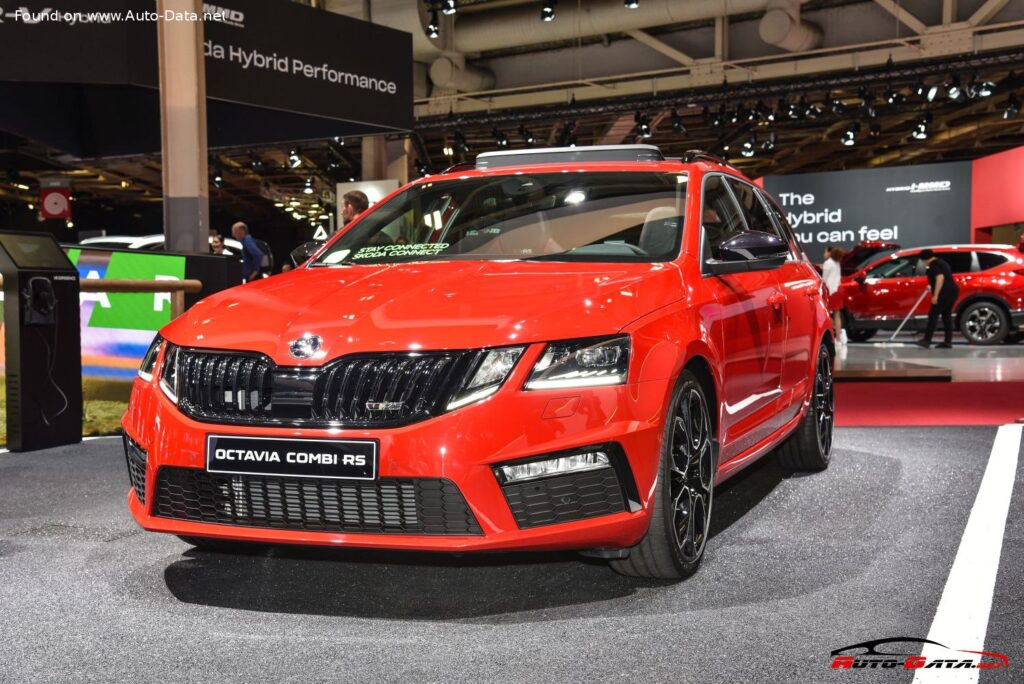
The Skoda Octavia III Combi (facelift 2017) retains its practical and understated design, characteristic of the Skoda brand, while incorporating refreshed elements from the 2017 update. The most noticeable change was the controversial split-headlight design, which gave the Octavia a more distinctive, albeit polarizing, front fascia. Beyond this, the facelift introduced subtle refinements to the grille, bumpers, and tail lights, aligning the car more closely with Skoda’s evolving design language.
As a station wagon (Combi), the Octavia excels in interior space and versatility. It comfortably accommodates five occupants with ample headroom and legroom, even for taller passengers. The real highlight, however, is its cargo capacity. With the rear seats in place, the trunk offers a generous 21.54 cubic feet (610 liters) of space. Folding down the rear seats expands this to an impressive 61.45 cubic feet (1740 liters), making it a highly practical choice for families, tradespeople, or anyone requiring significant hauling capability. This immense practicality is a key differentiator in a market increasingly dominated by SUVs.
Inside, the Octavia featured a well-appointed and ergonomically designed cabin. While specific trim levels would dictate the exact feature set, the facelift models typically offered improved infotainment systems with larger touchscreens, smartphone integration (Apple CarPlay and Android Auto), and a range of connectivity options. Safety features for the era included standard ABS, multiple airbags, and increasingly sophisticated driver-assistance systems such as adaptive cruise control, lane-keeping assist, and front assist, enhancing both safety and driving comfort. The overall build quality and material choices reflect Skoda’s reputation for durable and sensible interiors.
Technical Specifications
| Category | Specification |
|---|---|
| Brand | Skoda |
| Model | Octavia |
| Generation | Octavia III Combi (facelift 2017) |
| Type (Engine) | 2.0 TDI (143 Hp) DSG |
| Start of Production | 2018 year |
| End of Production | 2019 year |
| Powertrain Architecture | Internal Combustion engine |
| Body type | Station wagon (estate) |
| Seats | 5 |
| Doors | 5 |
| Performance Specs | |
| Fuel Type | Diesel |
| Acceleration 0 – 60 mph | 8.8 sec |
| Acceleration 0 – 62 mph (0-100 km/h) | 9.3 sec |
| Maximum speed | 128.62 mph (207 km/h) |
| Weight-to-power ratio | 9.6 kg/Hp, 103.8 Hp/tonne |
| Weight-to-torque ratio | 4.3 kg/Nm, 232.4 Nm/tonne |
| Engine Specs | |
| Power | 143 Hp @ 3500-4000 rpm |
| Power per liter | 72.7 Hp/l |
| Torque | 236.02 lb.-ft. (320 Nm) @ 1750-3000 rpm |
| Engine layout | Front, Transverse |
| Engine Model/Code | CKFB, CRVC |
| Engine displacement | 120.09 cu. in. (1968 cm3) |
| Number of cylinders | 4 |
| Engine configuration | Inline |
| Number of valves per cylinder | 4 |
| Fuel injection system | Diesel Commonrail |
| Engine aspiration | Turbocharger, Intercooler |
| Engine oil capacity | 4.86 US qt (4.6 l) |
| Coolant capacity | 12.26 US qt (11.6 l) |
| Engine systems | Particulate filter |
| Space, Volume and Weights | |
| Kerb Weight | 3035.77 lbs. (1377 kg) |
| Trunk (boot) space – minimum | 21.54 cu. ft. (610 l) |
| Trunk (boot) space – maximum | 61.45 cu. ft. (1740 l) |
| Fuel tank capacity | 13.21 US gal (50 l) |
| Dimensions | |
| Length | 183.74 in. (4667 mm) |
| Width | 71.42 in. (1814 mm) |
| Width including mirrors | 79.41 in. (2017 mm) |
| Height | 57.68 in. (1465 mm) |
| Wheelbase | 105.75 in. (2686 mm) |
| Front track | 60.75 in. (1543 mm) |
| Rear (Back) track | 60.39 in. (1534 mm) |
| Ride height (ground clearance) | 5.55 in. (141 mm) |
| Minimum turning circle (turning diameter) | 34.78 ft. (10.6 m) |
| Approach angle | 14.0° |
| Departure angle | 12.4° |
| Drivetrain, Brakes and Suspension Specs | |
| Drivetrain Architecture | The Internal combustion engine (ICE) drives the front wheels of the vehicle. |
| Drive wheel | Front wheel drive |
| Number of gears and type of gearbox | 7 gears, automatic transmission DSG |
| Front brakes | Ventilated discs |
| Rear brakes | Disc |
| Assisting systems | ABS (Anti-lock braking system) |
| Steering type | Steering rack and pinion |
| Power steering | Electric Steering |
| Tires size | 205/55 R16 |
| Wheel rims size | 16 inches |
Legacy and Market Impact
The Skoda Octavia, particularly in its Combi form, holds a significant legacy as a benchmark for practicality and value in the European automotive landscape. The third generation, including the Skoda Octavia III Combi (facelift 2017), continued to uphold and enhance this reputation. Within its primary markets, the Octavia Combi was a formidable competitor against other popular compact estates such as the Volkswagen Golf Variant (its platform twin), Ford Focus Estate, Opel Astra Sports Tourer, and even entry-level offerings from premium brands like the BMW 3 Series Touring or Mercedes-Benz C-Class Estate, by offering comparable space and features at a more accessible price point.
Skoda’s “Simply Clever” philosophy, which incorporates numerous thoughtful and practical features (like an ice scraper in the fuel filler flap or an umbrella in the door), further endeared the Octavia to its target audience. This commitment to user-friendly design, combined with Volkswagen Group’s proven engineering and robust build quality, contributed to the Octavia’s strong sales performance and high customer satisfaction ratings.
The 2017 facelift helped the Octavia maintain its competitive edge during its production run from 2018 to 2019, bridging the gap to the introduction of the fourth-generation model. This particular 2.0 TDI DSG variant was especially popular among long-distance commuters and fleet operators due to its excellent fuel economy, low running costs, and comfortable highway manners. Its impact solidified Skoda’s transformation from a budget brand to a respected manufacturer known for producing well-engineered, practical, and increasingly stylish vehicles that offer genuine value for money. The Octavia remains a symbol of Skoda’s successful integration into the modern automotive world, demonstrating that sensible design and robust performance can coexist with affordability and widespread appeal.