The Skoda Octavia III Combi (facelift 2017) RS 2.0 TSI (245 Hp): A European Performance Wagon
The Skoda Octavia, a cornerstone of the Czech automaker’s lineup, has long been celebrated for its blend of practicality, value, and robust engineering. Building on this foundation, the third-generation Octavia (Type 5E) received a significant facelift in 2017, introducing a refreshed aesthetic and updated technology. Among the most compelling variants was the Skoda Octavia III Combi (facelift 2017) RS 2.0 TSI (245 Hp), a high-performance station wagon that carved out a niche in the European compact family car segment. Positioned as a “hot wagon,” this model offered impressive performance typically found in sport sedans, combined with the unparalleled versatility of a station wagon body style. Though Skoda models are not officially imported to the United States, the Octavia RS represents a highly regarded example of accessible performance and utility within the fiercely competitive European market, embodying Skoda’s commitment to delivering sophisticated engineering from its parent company, Volkswagen Group.
Engine and Performance of the Skoda Octavia III Combi (facelift 2017) RS 2.0 TSI (245 Hp)
At the heart of the Skoda Octavia III Combi (facelift 2017) RS 2.0 TSI (245 Hp) lies a potent 2.0-liter turbocharged inline-four engine, specifically the EA888 unit (engine codes DLBA, DKTB), renowned for its widespread application across various Volkswagen Group performance models. This sophisticated powertrain utilizes direct injection and a DOHC (Double Overhead Camshaft) valvetrain to deliver a robust 245 horsepower, peaking between 5000 and 6200 rpm. Torque output is equally impressive, with a substantial 272.9 lb.-ft. available from a low 1600 rpm and sustained up to 4300 rpm, ensuring strong, linear acceleration across a broad rev range.
Power is channeled to the front wheels via a precise 6-speed manual transmission, offering an engaging driving experience for enthusiasts. This combination propels the performance wagon from 0 to 60 mph in a swift 6.4 seconds, with a top speed electronically limited to 152.86 mph. Such figures underscore its capability to rival many dedicated sports cars while still offering family-friendly practicality. The engine’s efficiency is aided by a Start & Stop System, contributing to a combined fuel economy of 34.1 to 34.6 US mpg, an admirable figure for a vehicle of its performance caliber. Furthermore, its emissions meet the stringent Euro 6 standard, reflecting modern environmental considerations.
The Octavia RS also boasts an excellent weight-to-power ratio of 5.5 kg per horsepower (180.5 HP per ton), translating to agile handling and responsive acceleration. The front-wheel-drive architecture is complemented by an advanced suspension setup, featuring an independent McPherson strut system with a coil spring and anti-roll bar at the front, and an independent multi-link spring suspension with a stabilizer at the rear. This configuration, coupled with electric power steering and ventilated disc brakes upfront, ensures a dynamic yet comfortable ride, with precise control and confident stopping power.
Design and Features
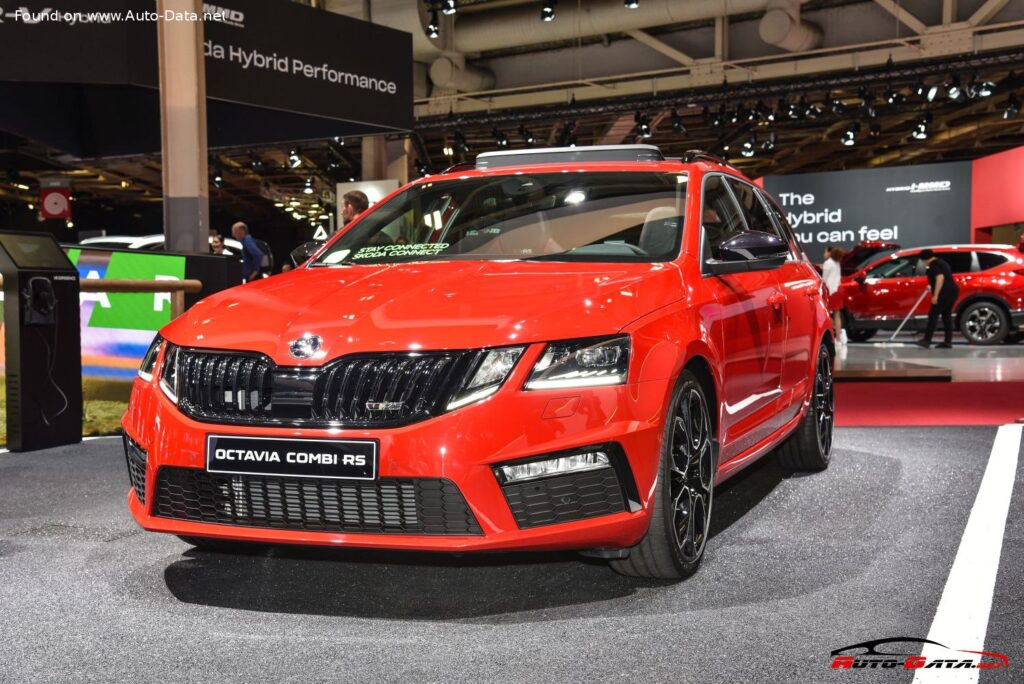
The 2017 facelift brought a sharper and more aggressive aesthetic to the Octavia RS Combi. The most noticeable change was the distinctive split headlight design, giving the front fascia a more contemporary and assertive look. The RS variant further distinguished itself with specific styling elements, including a sportier front bumper with larger air intakes, a blacked-out grille, and a subtle rear diffuser integrated into the bumper. The vehicle’s stance was enhanced by standard 18-inch alloy wheels, with an option for larger 19-inch rims (225/40 R18 or 225/35 R19 tires), filling the wheel arches and complementing its performance aspirations.
As a station wagon, or “Combi” in Skoda’s nomenclature, the Octavia RS excels in practicality. It offers seating for five occupants and an exceptionally generous cargo capacity. The trunk space ranges from 21.54 cubic feet (610 liters) with all seats in place, expanding to a cavernous 61.45 cubic feet (1740 liters) when the rear seats are folded down. This makes it an ideal vehicle for families, outdoor enthusiasts, or anyone requiring ample hauling capability without compromising on driving enjoyment. The interior, while not explicitly detailed in the provided data, would typically feature sporty accents such as bolstered seats, a flat-bottom steering wheel, and RS-specific badging, alongside modern infotainment systems and connectivity options expected in a 2017 model year vehicle.
Dimensions for the Octavia Combi are substantial for its class, with a length of 184.61 inches, a width of 71.42 inches (79.41 inches including mirrors), and a height of 57.17 inches. The 105.51-inch wheelbase contributes to a stable ride and generous interior room. Safety features are comprehensive, including an Anti-lock Braking System (ABS) as standard, alongside a suite of airbags and electronic stability control systems typical of modern Volkswagen Group vehicles, ensuring a high level of occupant protection.
Technical Specifications: Skoda Octavia III Combi (facelift 2017) RS 2.0 TSI (245 Hp)
| Category | Specification |
|---|---|
| Brand | Skoda |
| Model | Octavia III Combi (facelift 2017) RS 2.0 TSI (245 Hp) |
| Generation | Octavia III Combi (facelift 2017) |
| Production Years | 2017 – 2019 |
| Body Type | Station wagon (estate) |
| Seats / Doors | 5 / 5 |
| Performance Specs | |
| Fuel Type | Petrol (Gasoline) |
| Fuel Consumption (Urban) | 26.4 – 26.7 US mpg (8.8-8.9 l/100 km) |
| Fuel Consumption (Extra Urban) | 41.3 – 42 US mpg (5.6-5.7 l/100 km) |
| Fuel Consumption (Combined) | 34.1 – 34.6 US mpg (6.8-6.9 l/100 km) |
| CO2 Emissions | 154-156 g/km (Euro 6) |
| Acceleration 0-60 mph | 6.4 sec |
| Maximum Speed | 152.86 mph (246 km/h) |
| Weight-to-Power Ratio | 5.5 kg/Hp (180.5 Hp/tonne) |
| Weight-to-Torque Ratio | 3.7 kg/Nm (272.7 Nm/tonne) |
| Engine Specs | |
| Power | 245 Hp @ 5000-6200 rpm |
| Torque | 272.9 lb.-ft. (370 Nm) @ 1600-4300 rpm |
| Engine Layout | Front, Transverse |
| Engine Model/Code | EA888 / DLBA, DKTB |
| Engine Displacement | 2.0 liters (1984 cm3 / 121.07 cu. in.) |
| Number of Cylinders | 4, Inline |
| Bore x Stroke | 3.25 in. x 3.65 in. (82.5 mm x 92.8 mm) |
| Compression Ratio | 9.6:1 |
| Valves per Cylinder | 4 |
| Fuel Injection System | Direct injection |
| Engine Aspiration | Turbocharger, Intercooler |
| Valvetrain | DOHC |
| Engine Oil Capacity | 6.02 US qt (5.7 l) |
| Coolant Capacity | 9.09 US qt (8.6 l) |
| Engine Systems | Start & Stop System |
| Space, Volume, and Weights | |
| Kerb Weight | 2991.67 – 3276.07 lbs. (1357-1486 kg) |
| Max. Weight (GVWR) | 4290.2 lbs. (1946 kg) |
| Max. Load Capacity | 1014.13 – 1298.52 lbs. (460-589 kg) |
| Trunk Space (Min/Max) | 21.54 – 61.45 cu. ft. (610 – 1740 l) |
| Fuel Tank Capacity | 13.21 US gal (50 l) |
| Max. Roof Load | 165.35 lbs. (75 kg) |
| Permitted Trailer Load (with brakes 8%) | 3968.32 lbs. (1800 kg) |
| Permitted Trailer Load (with brakes 12%) | 3527.4 lbs. (1600 kg) |
| Permitted Trailer Load (without brakes) | 1609.37 lbs. (730 kg) |
| Permitted Towbar Download | 165.35 lbs. (75 kg) |
| Dimensions | |
| Length | 184.61 in. (4689 mm) |
| Width | 71.42 in. (1814 mm) |
| Width (incl. mirrors) | 79.41 in. (2017 mm) |
| Height | 57.17 in. (1452 mm) |
| Wheelbase | 105.51 in. (2680 mm) |
| Front Track | 60.43 in. (1535 mm) |
| Rear Track | 60.79 in. (1544 mm) |
| Front Overhang | 35.55 in. (903 mm) |
| Rear Overhang | 43.54 in. (1106 mm) |
| Ride Height (Ground Clearance) | 5 in. (127 mm) |
| Drag Coefficient (Cd) | 0.341 |
| Minimum Turning Circle | 34.74 ft. (10.59 m) |
| Approach Angle | 12.8° |
| Departure Angle | 12.5° |
| Drivetrain, Brakes, and Suspension | |
| Drivetrain Architecture | Front-wheel drive (Internal Combustion engine drives the front wheels) |
| Drive Wheel | Front wheel drive |
| Gearbox Type | 6-speed, manual transmission |
| Front Suspension | Independent, McPherson with coil spring and anti-roll bar |
| Rear Suspension | Independent multi-link spring suspension with stabilizer |
| Front Brakes | Ventilated discs |
| Rear Brakes | Disc |
| Assisting Systems | ABS (Anti-lock braking system) |
| Steering Type | Steering rack and pinion (Electric Steering) |
| Tire Sizes | 225/40 R18; 225/35 R19 |
| Wheel Rim Sizes | 7.5J x 18; 7.5J x 19 |
Legacy and Market Impact
The Skoda Octavia RS, and particularly the Skoda Octavia III Combi (facelift 2017) RS 2.0 TSI (245 Hp) variant, holds a significant place in the European automotive landscape. It solidified Skoda’s reputation for offering “smart solutions” – combining the robust, proven engineering of the Volkswagen Group with a distinct focus on practicality, spaciousness, and value. The RS badge itself carries a legacy of accessible performance, tracing back to Skoda’s motorsport heritage, and the third-generation Octavia RS continued this tradition with aplomb.
In its primary European markets, the Octavia RS Combi was a formidable competitor, often lauded as a “sleeper” performance car. It directly challenged rivals such as the Volkswagen Golf R Variant (though often positioned slightly below in price), the SEAT Leon Cupra ST, and other performance-oriented wagons like the Ford Focus ST Wagon and Peugeot 308 GT SW. What set the Octavia RS apart was its unparalleled blend of speed and utility. Few vehicles could match its ability to haul a family and their luggage across continents at high speeds, all while delivering an engaging driving experience and impressive fuel efficiency for its class.
The 2017 facelift further enhanced its appeal, ensuring it remained competitive with updated styling and technology. The 245 Hp version, introduced during this facelift, provided a noticeable bump in power over its predecessor, keeping it relevant in an ever-evolving performance segment. Its success demonstrated that performance didn’t have to come at the expense of everyday usability or affordability, a philosophy that resonates strongly with European consumers. For enthusiasts across the Atlantic, the Octavia RS Combi remains an intriguing example of a highly capable and practical vehicle that, unfortunately, never made its way to American shores, leaving a void for those who appreciate the unique combination of a potent engine and a spacious, family-friendly wagon body.