The Skoda Octavia III Combi RS 2.0 TSI (220 Hp): A Performance Wagon for Europe
The Skoda Octavia III Combi RS 2.0 TSI (220 Hp) represents a compelling blend of practicality and performance, a hallmark of Skoda’s RS (Rally Sport) line. Launched in 2013 as part of the third generation Octavia range, this particular model was a hot station wagon designed primarily for the European market. Skoda, a Czech automobile manufacturer, operates under the umbrella of the Volkswagen Group, benefiting significantly from shared platforms, powertrains, and technological advancements. The Octavia III Combi RS was positioned as an accessible yet engaging family vehicle, offering ample cargo space and everyday usability without compromising on dynamic driving characteristics. Produced from 2013 to 2017, this variant quickly carved out a niche for itself among enthusiasts seeking a versatile and understated performance vehicle.
Engine and Performance
At the heart of the Skoda Octavia III Combi RS 2.0 TSI (220 Hp) lies a potent 2.0-liter turbocharged inline-four engine, internally designated as the EA888 / CHHB. This renowned powerplant, shared with various Volkswagen Group vehicles, is a testament to efficient engineering and robust performance. It delivers a formidable 220 horsepower, available across a broad rev range from 4500 to 6200 rpm, ensuring strong acceleration through the gears. More impressively, the engine produces a substantial 258.15 lb.-ft. of torque, accessible from a remarkably low 1500 rpm all the way up to 4400 rpm. This wide torque band contributes significantly to the car’s effortless drivability and responsive acceleration in real-world conditions.
The engine’s advanced architecture features a DOHC (Double Overhead Camshaft) valvetrain with four valves per cylinder, ensuring optimal airflow and combustion efficiency. Fuel delivery is handled by a sophisticated system combining both direct injection and multi-port manifold injection, a strategy designed to optimize power output, fuel economy, and emissions across different operating conditions. A turbocharger with an intercooler is instrumental in boosting the engine’s power, providing a smooth and linear power delivery without significant turbo lag.
Paired with a crisp-shifting 6-speed manual transmission, the front-wheel-drive Skoda Octavia III Combi RS 2.0 TSI (220 Hp) achieves impressive performance figures. It can accelerate from 0 to 60 mph in a swift 6.6 seconds (0-100 km/h in 6.9 seconds) and reach a top speed of 151.61 mph (244 km/h). Despite its performance credentials, the vehicle maintains a respectable fuel economy, with a combined rating of 37.9 US mpg (6.2 l/100 km). This efficiency is further enhanced by features like a Start & Stop System and compliance with Euro 6 emission standards, boasting CO2 emissions of 142 g/km. The power-to-weight ratio stands at an impressive 160.9 HP per tonne (6.2 kg/HP), highlighting the car’s agile character.
Design and Features
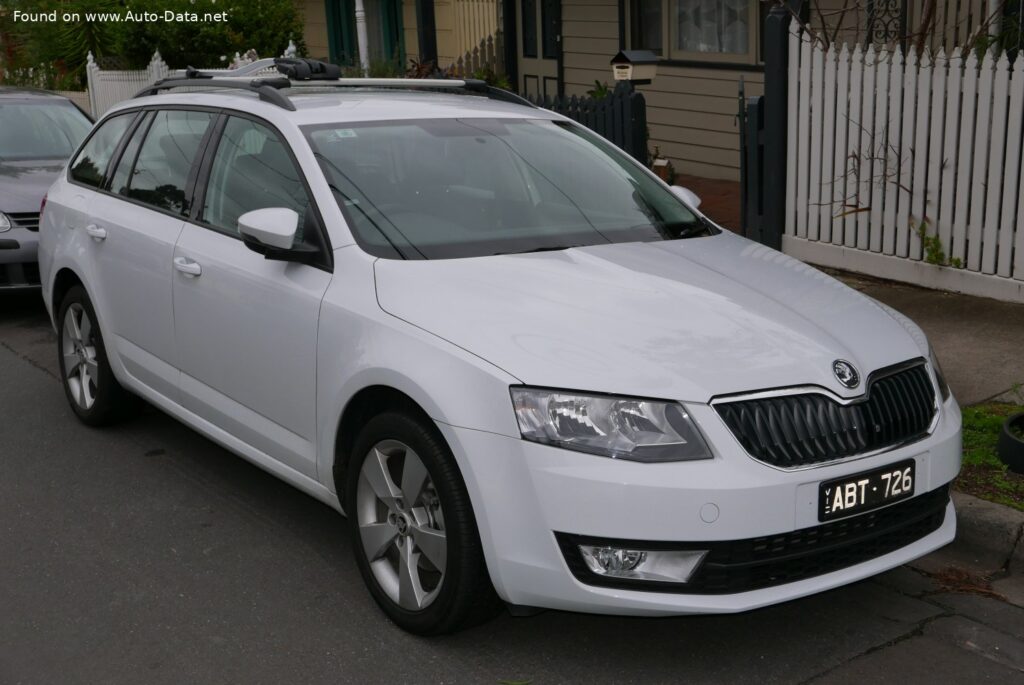
The Skoda Octavia III Combi RS 2.0 TSI (220 Hp) embodies a design philosophy that marries sporty aesthetics with unparalleled practicality. As a station wagon (known as an “estate” in European markets), its five-door, five-seat configuration provides exceptional versatility for families and individuals alike. The exterior styling of the RS model differentiates it from standard Octavia variants with more aggressive bumpers, a unique grille, distinctive RS badging, and larger alloy wheels, typically 7.5J x 17 inches as standard, with optional 7.5J x 19-inch wheels. These visual cues subtly hint at the car’s performance capabilities without being overtly ostentatious.
Measuring 184.45 inches (4685 mm) in length, 71.42 inches (1814 mm) in width (79.41 inches or 2017 mm including mirrors), and 57.17 inches (1452 mm) in height, the Octavia Combi RS offers a substantial footprint. Its 105.51-inch (2680 mm) wheelbase contributes to a stable ride and generous interior space. A key highlight of the Combi body style is its cavernous trunk space, which ranges from 21.54 cubic feet (610 liters) with all seats up to a massive 61.45 cubic feet (1740 liters) with the rear seats folded down. This class-leading cargo capacity was a major selling point, making it an ideal choice for hauling luggage, sports equipment, or even furniture. The fuel tank capacity of 13.21 US gallons (50 liters) ensures a decent range between fill-ups, complementing its fuel-efficient engine.
Underneath, the Octavia RS features a sophisticated chassis setup designed to handle its increased power. The front suspension employs an independent McPherson strut design with coil springs and an anti-roll bar, providing precise steering and good body control. At the rear, an independent multi-link spring suspension with a stabilizer ensures excellent ride comfort and handling dynamics. Braking duties are handled by ventilated discs at the front and solid discs at the rear, offering strong and consistent stopping power, augmented by an Anti-lock Braking System (ABS). The electric power steering system provides accurate feedback and ease of maneuverability, with a minimum turning circle of 36.52 feet (11.13 meters). The car’s kerb weight is 3013.72 lbs. (1367 kg), contributing to its agile feel.
Technical Specifications
| Category | Specification | US Equivalent |
|---|---|---|
| General Information | ||
| Brand | Skoda | |
| Model | Octavia | |
| Generation | Octavia III Combi | |
| Type (Engine) | RS 2.0 TSI (220 Hp) | |
| Start of production | 2013 year | |
| End of production | 2017 year | |
| Powertrain Architecture | Internal Combustion engine | |
| Body type | Station wagon (estate) | |
| Seats | 5 | |
| Doors | 5 | |
| Performance Specs | ||
| Fuel consumption (economy) – urban | 7.7 l/100 km | 30.5 US mpg |
| Fuel consumption (economy) – extra urban | 5.3 l/100 km | 44.4 US mpg |
| Fuel consumption (economy) – combined | 6.2 l/100 km | 37.9 US mpg |
| CO2 emissions | 142 g/km | |
| Fuel Type | Petrol (Gasoline) | |
| Acceleration 0 – 100 km/h | 6.9 sec | |
| Acceleration 0 – 60 mph | 6.6 sec | |
| Maximum speed | 244 km/h | 151.61 mph |
| Emission standard | Euro 6 | |
| Weight-to-power ratio | 6.2 kg/Hp | 160.9 Hp/tonne |
| Weight-to-torque ratio | 3.9 kg/Nm | 256 Nm/tonne |
| Engine Specs | ||
| Power | 220 Hp @ 4500-6200 rpm | |
| Power per liter | 110.9 Hp/l | |
| Torque | 350 Nm @ 1500-4400 rpm | 258.15 lb.-ft. @ 1500-4400 rpm |
| Engine layout | Front, Transverse | |
| Engine Model/Code | EA888 / CHHB | |
| Engine displacement | 1984 cm3 | 121.07 cu. in. |
| Number of cylinders | 4 | |
| Engine configuration | Inline | |
| Cylinder Bore | 82.5 mm | 3.25 in. |
| Piston Stroke | 92.8 mm | 3.65 in. |
| Compression ratio | 9.6:1 | |
| Number of valves per cylinder | 4 | |
| Fuel injection system | Direct injection and Multi-port manifold injection | |
| Engine aspiration | Turbocharger, Intercooler | |
| Valvetrain | DOHC | |
| Engine oil capacity | 5.7 l | 6.02 US qt |
| Coolant | 8.6 l | 9.09 US qt |
| Engine Systems | ||
| Engine systems | Start & Stop System | |
| Space, Volume and Weights | ||
| Kerb Weight | 1367 kg | 3013.72 lbs. |
| Max. weight | 1933 kg | 4261.54 lbs. |
| Max load | 566 kg | 1247.82 lbs. |
| Trunk (boot) space – minimum | 610 l | 21.54 cu. ft. |
| Trunk (boot) space – maximum | 1740 l | 61.45 cu. ft. |
| Fuel tank capacity | 50 l | 13.21 US gal |
| Permitted trailer load with brakes (12%) | 1600 kg | 3527.4 lbs. |
| Permitted trailer load without brakes | 720 kg | 1587.33 lbs. |
| Dimensions | ||
| Length | 4685 mm | 184.45 in. |
| Width | 1814 mm | 71.42 in. |
| Width including mirrors | 2017 mm | 79.41 in. |
| Height | 1452 mm | 57.17 in. |
| Wheelbase | 2680 mm | 105.51 in. |
| Front track | 1535 mm | 60.43 in. |
| Rear (Back) track | 1506 mm | 59.29 in. |
| Front overhang | 899 mm | 35.39 in. |
| Rear overhang | 1106 mm | 43.54 in. |
| Ride height (ground clearance) | 127 mm | 5 in. |
| Minimum turning circle (turning diameter) | 11.13 m | 36.52 ft. |
| Approach angle | 12.8° | |
| Departure angle | 12.3° | |
| Drivetrain, Brakes and Suspension Specs | ||
| Drivetrain Architecture | The Internal combustion engine (ICE) drives the front wheels of the vehicle. | |
| Drive wheel | Front wheel drive | |
| Number of gears and type of gearbox | 6 gears, manual transmission | |
| Front suspension | Independent, type McPherson with coil spring and anti-roll bar | |
| Rear suspension | Independent multi-link spring suspension with stabilizer | |
| Front brakes | Ventilated discs | |
| Rear brakes | Disc | |
| Assisting systems | ABS (Anti-lock braking system) | |
| Steering type | Steering rack and pinion | |
| Power steering | Electric Steering | |
| Tires size | 225/45 R17; 225/35 R19 | |
| Wheel rims size | 7.5J x 17; 7.5J x 19 | |
Legacy and Market Impact
The Skoda Octavia III Combi RS 2.0 TSI (220 Hp) played a significant role in enhancing Skoda’s brand image within the highly competitive European automotive landscape. Historically perceived as a manufacturer of sensible, value-oriented vehicles, the RS line, and particularly the Octavia RS wagon, allowed Skoda to demonstrate its capability in producing genuinely engaging and performance-oriented cars. It provided a unique proposition: the practicality of a large station wagon combined with the driving dynamics and power typically associated with hot hatchbacks, but in a more discreet package.
In its primary markets across Europe, the Octavia RS Combi faced competition from a variety of vehicles, though few offered its exact blend of attributes. Direct rivals might have included the Volkswagen Golf R Variant (though often more powerful and expensive), the Ford Focus ST Wagon, or even some offerings from SEAT, another VW Group brand. What set the Skoda apart was its exceptional value for money, leveraging Volkswagen Group’s proven engineering and robust components, while offering more space than many of its performance-oriented peers. It resonated with buyers who needed the utility of a family car but refused to compromise on driving enjoyment.
The third-generation Octavia RS Combi helped solidify Skoda’s reputation for building well-engineered, reliable, and surprisingly fun-to-drive vehicles. It appealed to a broad demographic, from young families needing space for children and gear, to enthusiasts looking for a “sleeper” performance car that could handle daily commutes and weekend adventures with equal aplomb. Its success contributed to a broader acceptance of Skoda as a legitimate, high-quality contender in mainstream and niche segments alike, dispelling any lingering perceptions of the brand as merely a budget alternative. The Octavia III Combi RS 2.0 TSI (220 Hp) remains a highly regarded model among used car buyers in Europe, celebrated for its durability, performance, and unmatched practicality. Its legacy is one of smart engineering, strategic market positioning, and a quiet yet undeniable passion for driving.