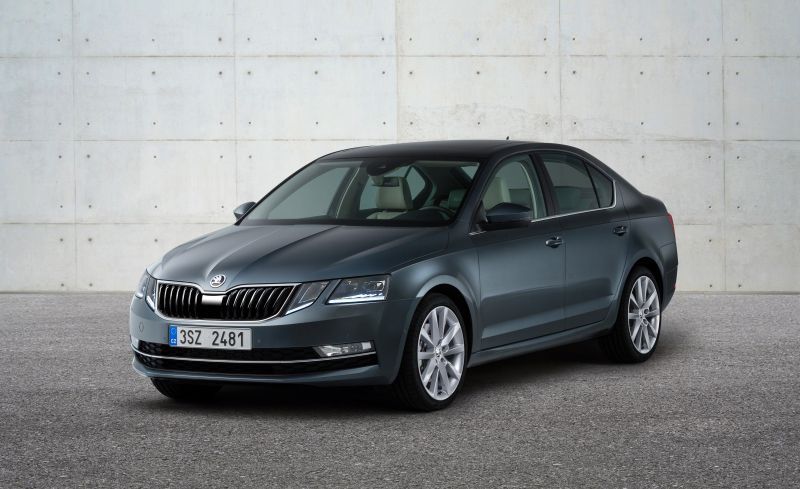
The Skoda Octavia III (facelift 2017) 1.2 TSI (86 Hp) represents a significant iteration of Skoda’s highly successful compact family car, a cornerstone of the Czech automaker’s lineup. Unveiled as part of the refreshed third generation (Type 5E), this particular variant, produced between 2017 and 2018, offered a compelling blend of practicality, efficiency, and value within the European C-segment. While not directly sold in the United States, the Octavia is a crucial model for Skoda, showcasing the brand’s “Simply Clever” philosophy and its strong position within the Volkswagen Group’s global portfolio.
The Octavia has historically been lauded for its spacious interior, extensive trunk capacity, and robust engineering, largely benefiting from shared platforms and powertrains with its VW Group siblings, such as the Volkswagen Golf and SEAT Leon. The 2017 facelift brought a series of aesthetic and technological updates, aiming to sharpen its appeal and maintain its competitive edge in a fiercely contested market. The 1.2 TSI (86 Hp) engine variant served as an entry-level gasoline option, targeting buyers prioritizing fuel economy and lower running costs without sacrificing everyday usability.
Engine and Performance: The Skoda Octavia III (facelift 2017) 1.2 TSI Powertrain
At the heart of this particular Skoda Octavia III (facelift 2017) model lies the EA211 / CYVA engine, a modern 1.2-liter (1197 cm3 or 73.05 cu. in.) turbocharged, direct-injection gasoline (TSI) unit. This inline four-cylinder engine, with its DOHC valvetrain and four valves per cylinder, was engineered for efficiency and smooth power delivery, characteristic of Volkswagen Group’s small-displacement turbocharged engines. It generates a modest but capable 86 horsepower (Hp) at an RPM range of 4300-5300 and a respectable 118.01 lb.-ft. of torque, available across a broad and accessible band from 1400 to 3500 rpm. This low-end torque is crucial for urban driving and provides a feeling of greater responsiveness than its horsepower figure might suggest.
Power is sent to the front wheels via a five-speed manual transmission, a common setup for entry-level models in this segment, emphasizing cost-effectiveness and driver engagement. Despite its relatively modest power output, the Octavia 1.2 TSI manages to accelerate from 0 to 60 mph in a calculated 11.4 seconds, with a top speed of 112.47 mph. These figures position it as a comfortable cruiser for daily commutes and highway travel rather than a performance-oriented vehicle.
Fuel efficiency was a key selling point for this variant. The engine’s advanced design, coupled with features like a turbocharger, intercooler, and a Start & Stop System, contributed to impressive fuel economy ratings under the NEDC cycle. It achieved an urban rating of 39.2 US mpg, an extra-urban rating of 57.4 US mpg, and a combined cycle rating of 49 US mpg. This efficiency translates to a combined CO2 emission figure of 113 g/km, adhering to the Euro 6 emission standard, making it an environmentally conscious choice for its time. The 13.21 US gallon fuel tank capacity further enhanced its long-distance cruising capability, offering a substantial range between fill-ups.
Design and Features
The Skoda Octavia III (facelift 2017) maintained its practical and understated design philosophy, but the 2017 refresh introduced several visual enhancements. The most notable change was the distinctive split headlight design, giving the front fascia a more modern and assertive look. The grille was also subtly revised, along with updated bumper designs, contributing to a fresher appearance. As a five-door hatchback, the Octavia excels in functionality, offering seating for five occupants and exceptional cargo versatility.
Inside, the Octavia continued its tradition of offering a well-built and ergonomic cabin. While specific luxury features might vary by trim, the overall design focused on practicality and user-friendliness. Key features for a modern family car of this era included various storage compartments, comfortable seating, and a robust infotainment system (though specific details are not provided for this base model, modern connectivity options like Bluetooth and USB were standard or optional). Safety was also a priority, with standard features like ABS (Anti-lock Braking System) and a suite of airbags. The car’s robust chassis, featuring an independent McPherson front suspension and a torsion beam rear suspension, provided a balanced ride and predictable handling.
One of the Octavia’s enduring strengths is its cavernous trunk space. With the rear seats in place, it offers a generous 20.84 cubic feet (590 liters) of cargo volume, expanding to an impressive 55.8 cubic feet (1580 liters) with the rear seats folded down. This positions the Octavia as a class leader in practicality, easily accommodating luggage, groceries, or larger items. Practical considerations also extended to a maximum roof load of 165.35 lbs. and a permitted trailer load with brakes of up to 2866.01 lbs., further underscoring its utility.
Dimensions and Practicality
The dimensions of the Skoda Octavia III (facelift 2017) contribute significantly to its commanding presence and interior volume. Measuring 183.86 inches in length, 71.42 inches in width (79.41 inches including mirrors), and 57.52 inches in height, the Octavia struck a balance between a compact footprint and spacious interior. Its 105.75-inch wheelbase was instrumental in providing ample legroom for rear passengers, a common complaint in many C-segment vehicles. With a curb weight of 2535.32 lbs. and a maximum gross weight of 3913.21 lbs., the vehicle was engineered for durability and load-carrying capability. The electric power steering and a relatively tight minimum turning circle of 34.12 feet made it maneuverable in urban environments despite its length.
Technical Specifications
| Category | Specification |
|---|---|
General Information |
|
| Brand | Skoda |
| Model | Octavia |
| Generation | Octavia III (facelift 2017) |
| Type (Engine) | 1.2 TSI (86 Hp) |
| Start of Production | 2017 year |
| End of Production | 2018 year |
| Powertrain Architecture | Internal Combustion Engine |
| Body Type | Hatchback |
| Seats | 5 |
| Doors | 5 |
Performance Specifications |
|
| Fuel Consumption (Urban – NEDC) | 39.2 US mpg (6 l/100 km) |
| Fuel Consumption (Extra Urban – NEDC) | 57.4 US mpg (4.1 l/100 km) |
| Fuel Consumption (Combined – NEDC) | 49 US mpg (4.8 l/100 km) |
| CO2 Emissions (NEDC) | 113 g/km |
| Fuel Type | Petrol (Gasoline) |
| Acceleration 0 – 60 mph | 11.4 sec |
| Acceleration 0 – 62 mph (0-100 km/h) | 12 sec |
| Maximum Speed | 112.47 mph (181 km/h) |
| Emission Standard | Euro 6 |
| Weight-to-Power Ratio | 13.4 kg/Hp, 74.8 Hp/tonne |
| Weight-to-Torque Ratio | 7.2 kg/Nm, 139.1 Nm/tonne |
Engine Specifications |
|
| Power | 86 Hp @ 4300-5300 rpm |
| Power per Liter | 71.8 Hp/l |
| Torque | 118.01 lb.-ft. @ 1400-3500 rpm (160 Nm) |
| Engine Layout | Front, Transverse |
| Engine Model/Code | EA211 / CYVA |
| Engine Displacement | 1.2 liters (1197 cm3 / 73.05 cu. in.) |
| Number of Cylinders | 4 |
| Engine Configuration | Inline |
| Cylinder Bore | 2.8 in. (71 mm) |
| Piston Stroke | 2.98 in. (75.6 mm) |
| Compression Ratio | 10.5:1 |
| Number of Valves per Cylinder | 4 |
| Fuel Injection System | Direct Injection |
| Engine Aspiration | Turbocharger, Intercooler |
| Valvetrain | DOHC |
| Engine Oil Capacity | 4.23 US qt (4 l) |
| Engine Systems | Start & Stop System |
Space, Volume and Weights |
|
| Curb Weight | 2535.32 lbs. (1150 kg) |
| Max. Weight | 3913.21 lbs. (1775 kg) |
| Max Load | 1377.89 lbs. (625 kg) |
| Trunk (Boot) Space – Minimum | 20.84 cu. ft. (590 l) |
| Trunk (Boot) Space – Maximum | 55.8 cu. ft. (1580 l) |
| Fuel Tank Capacity | 13.21 US gal (50 l) |
| Max. Roof Load | 165.35 lbs. (75 kg) |
| Permitted Trailer Load with Brakes (8%) | 2866.01 lbs. (1300 kg) |
| Permitted Trailer Load with Brakes (12%) | 2425.08 lbs. (1100 kg) |
| Permitted Trailer Load without Brakes | 1344.82 lbs. (610 kg) |
| Permitted Towbar Download | 165.35 lbs. (75 kg) |
Dimensions |
|
| Length | 183.86 in. (4670 mm) |
| Width | 71.42 in. (1814 mm) |
| Width Including Mirrors | 79.41 in. (2017 mm) |
| Height | 57.52 in. (1461 mm) |
| Wheelbase | 105.75 in. (2686 mm) |
| Front Track | 60.98 in. (1549 mm) |
| Rear (Back) Track | 60.63 in. (1540 mm) |
| Ride Height (Ground Clearance) | 5.55 in. (141 mm) |
| Drag Coefficient (Cd) | 0.292 |
| Minimum Turning Circle (Turning Diameter) | 34.12 ft. (10.4 m) |
| Approach Angle | 14° |
| Departure Angle | 12.1° |
Drivetrain, Brakes and Suspension Specifications |
|
| Drivetrain Architecture | The Internal Combustion Engine (ICE) drives the front wheels of the vehicle. |
| Drive Wheel | Front Wheel Drive |
| Number of Gears and Type of Gearbox | 5 gears, Manual Transmission |
| Front Suspension | Independent, type McPherson with coil spring and anti-roll bar |
| Rear Suspension | Coil spring, Torsion |
| Front Brakes | Ventilated Discs |
| Rear Brakes | Disc |
| Assisting Systems | ABS (Anti-lock Braking System) |
| Steering Type | Steering Rack and Pinion |
| Power Steering | Electric Steering |
| Tires Size | 195/65 R15 |
| Wheel Rims Size | 6J x 15 |
Legacy and Market Impact
The Skoda Octavia has long been considered the backbone of the Skoda brand, consistently ranking as its best-selling model in Europe and many other international markets. The third-generation Octavia, particularly after its 2017 facelift, continued this legacy, reinforcing Skoda’s reputation for delivering exceptional value, practicality, and robust engineering. The 1.2 TSI (86 Hp) variant, while not the most powerful, played a crucial role as an accessible entry point into the Octavia range, appealing to a broad demographic of buyers, from young families to fleet operators, who prioritized efficiency and affordability.
In the highly competitive European C-segment, the Octavia faced formidable rivals such as the Volkswagen Golf, Ford Focus, Opel Astra, Renault Megane, and Peugeot 308. What set the Octavia apart was its unique blend of a compact footprint with near D-segment levels of interior and trunk space, often at a more attractive price point. This “more car for your money” proposition, combined with the proven reliability and build quality derived from its Volkswagen Group underpinnings, solidified its position as a smart and sensible choice.
The `Skoda Octavia III (facelift 2017)` showcased Skoda’s evolution from a niche Eastern European brand to a respected mainstream automaker. Its success demonstrated the effectiveness of Skoda’s brand strategy, focusing on practical innovation and a commitment to customer needs. Even after the introduction of its successor, the fourth-generation Octavia, the third-generation model, particularly its facelifted version, remains a testament to Skoda’s ability to produce highly competent, reliable, and value-packed vehicles that resonate strongly with consumers in its primary markets. The 1.2 TSI (86 Hp) variant, in particular, highlighted the brand’s dedication to making modern, efficient technology available to a wider audience, contributing significantly to the Octavia’s enduring reputation as a benchmark for practical, family-oriented transport.