The Skoda Octavia III (facelift 2017) 1.5 TSI (150 Hp): A European Mainstay
The Skoda Octavia III (facelift 2017) 1.5 TSI (150 Hp) represents a significant iteration of Skoda’s highly successful compact family car, a model that has become a cornerstone of the European automotive landscape. Produced from 2018 to 2019, this specific variant of the third-generation Octavia, which received a notable mid-cycle refresh, combines practical hatchback utility with efficient, modern powertrain technology. While the Skoda brand itself is not widely distributed in the United States, it is a prominent member of the Volkswagen Group and holds a strong reputation for value, build quality, and clever engineering across Europe and other international markets. The Octavia, in particular, is often lauded for offering near-midsize car space within a compact footprint, making it a popular choice for families and business fleets alike.
The Octavia III’s facelift brought updated styling cues, enhanced technology, and refined powertrains, keeping it competitive in the crowded C-segment. This particular 1.5 TSI variant showcased Skoda’s commitment to delivering a balance of performance and fuel economy, reflecting the broader industry trend towards smaller, turbocharged gasoline engines. Its role in its primary markets was to provide a compelling alternative to more expensive German rivals, offering similar levels of sophistication and practicality at a more accessible price point.
Powertrain and Performance: The 1.5 TSI Engine in the Skoda Octavia III (facelift 2017)
Engine & Performance
At the heart of this particular Skoda Octavia III (facelift 2017) lies the advanced 1.5-liter TSI engine, designated by the internal code EA211evo / DADA. This inline four-cylinder gasoline engine is a prime example of modern powertrain engineering, featuring direct fuel injection, a turbocharger, and an intercooler to maximize efficiency and power output. With an engine displacement of 1498 cm3 (91.41 cubic inches), it generates a robust 150 horsepower (Hp) across a broad rev range from 5000 to 6000 rpm. This impressive power-per-liter figure of 100.1 Hp/l underscores the engine’s advanced design.
Equally critical to its dynamic character is the torque output. The 1.5 TSI delivers a substantial 250 Nm (184.39 lb.-ft.) of torque, available from a remarkably low 1500 rpm and sustained up to 3500 rpm. This wide torque band ensures strong, flexible acceleration in everyday driving conditions, minimizing the need for frequent gear changes. The engine is positioned front, transversely, and drives the front wheels, a common and efficient layout for this class of vehicle.
Performance figures for the Octavia III 1.5 TSI are quite respectable for a family hatchback. It accelerates from 0 to 60 mph in an estimated 7.9 seconds, with 0 to 100 km/h achieved in 8.3 seconds. The top speed is rated at 223 km/h (138.57 mph), demonstrating its capability for sustained highway cruising. The vehicle’s weight-to-power ratio stands at 8.5 kg/Hp (117.2 Hp/tonne), and its weight-to-torque ratio is 5.1 kg/Nm (195.3 Nm/tonne), indicating a well-balanced power delivery for its curb weight of 1280 kg (2821.92 lbs). The engine’s modern design also includes a particulate filter, a key feature for meeting stringent European emissions standards.
Design & Features
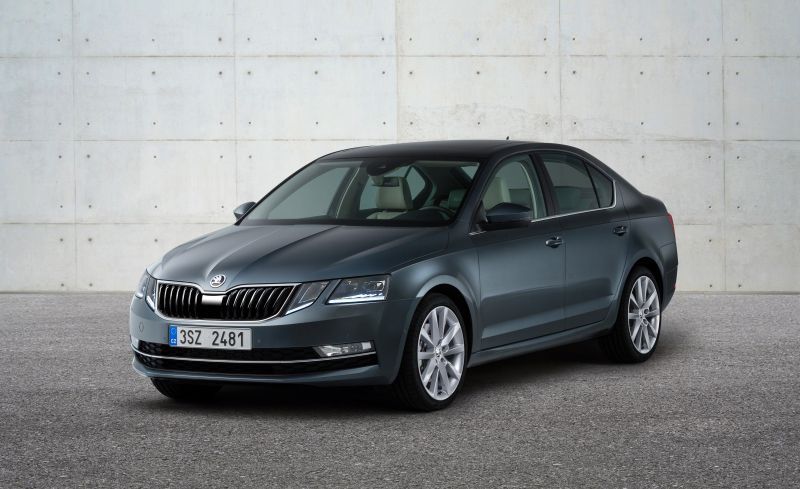
The Skoda Octavia III (facelift 2017) maintains its popular 5-door hatchback body style, renowned for its cavernous interior and practical access. Measuring 4670 mm (183.86 inches) in length, 1814 mm (71.42 inches) in width (2017 mm or 79.41 inches including mirrors), and 1461 mm (57.52 inches) in height, the Octavia strikes an optimal balance between exterior footprint and interior volume. Its wheelbase of 2686 mm (105.75 inches) contributes to a stable ride and generous passenger space for five occupants.
A standout feature of the Octavia is its exceptional cargo capacity. With the rear seats in place, the trunk (boot) offers a minimum of 590 liters (20.84 cubic feet) of space, which expands to an impressive 1580 liters (55.8 cubic feet) with the rear seats folded down. This class-leading practicality is a major selling point for the Octavia, often surpassing competitors in larger segments. The fuel tank capacity is 50 liters (13.21 US gallons), providing a good driving range.
Underneath, the Octavia features a robust chassis with a front-wheel-drive architecture. It utilizes a 6-speed manual transmission, offering precise control and engagement for the driver. Braking is handled by ventilated discs at the front and solid discs at the rear, complemented by an Anti-lock Braking System (ABS) for enhanced safety. The steering system is an electric power-assisted rack and pinion setup, providing light and responsive handling. The vehicle rides on 205/55 R16 tires mounted on 16-inch wheel rims, a common specification for balancing ride comfort and handling dynamics.
While specific interior features are not detailed in the data, the facelifted Octavia III typically came equipped with a range of modern conveniences and safety technologies for its era, including advanced infotainment systems, connectivity options, and an array of driver-assistance features, all aimed at enhancing the driving experience and passenger comfort.
Technical Specifications of the Skoda Octavia III (facelift 2017) 1.5 TSI (150 Hp)
| Category | Specification | Value |
|---|---|---|
| General Information | Brand | Skoda |
| Model | Octavia | |
| Generation | Octavia III (facelift 2017) | |
| Engine Type | 1.5 TSI (150 Hp) | |
| Production Start | 2018 year | |
| Production End | 2019 year | |
| Performance Specs | Fuel Type | Petrol (Gasoline) |
| Acceleration 0 – 60 mph | 7.9 sec | |
| Acceleration 0 – 100 km/h | 8.3 sec | |
| Maximum Speed | 223 km/h (138.57 mph) | |
| Weight-to-power ratio | 8.5 kg/Hp, 117.2 Hp/tonne | |
| Weight-to-torque ratio | 5.1 kg/Nm, 195.3 Nm/tonne | |
| Drivetrain Architecture | Internal Combustion engine (ICE) drives front wheels | |
| Drive Wheel | Front wheel drive | |
| Engine Specs | Power | 150 Hp @ 5000-6000 rpm |
| Power per Liter | 100.1 Hp/l | |
| Torque | 250 Nm @ 1500-3500 rpm (184.39 lb.-ft.) | |
| Engine Layout | Front, Transverse | |
| Engine Model/Code | EA211evo / DADA | |
| Engine Displacement | 1498 cm3 (91.41 cu. in.) | |
| Number of Cylinders | 4, Inline | |
| Number of Valves per Cylinder | 4 | |
| Fuel Injection System | Direct Injection | |
| Engine Aspiration | Turbocharger, Intercooler | |
| Space, Volume & Weights | Kerb Weight | 1280 kg (2821.92 lbs) |
| Trunk (Boot) Space – Minimum | 590 l (20.84 cu. ft.) | |
| Trunk (Boot) Space – Maximum | 1580 l (55.8 cu. ft.) | |
| Fuel Tank Capacity | 50 l (13.21 US gal) | |
| Engine Oil Capacity | 4.3 l (4.54 US qt) | |
| Dimensions | Length | 4670 mm (183.86 in.) |
| Width | 1814 mm (71.42 in.) | |
| Width (incl. mirrors) | 2017 mm (79.41 in.) | |
| Height | 1461 mm (57.52 in.) | |
| Wheelbase | 2686 mm (105.75 in.) | |
| Front Track | 1543 mm (60.75 in.) | |
| Rear Track | 1534 mm (60.39 in.) | |
| Ride Height (Ground Clearance) | 141 mm (5.55 in.) | |
| Minimum Turning Circle | 10.6 m (34.78 ft.) | |
| Doors / Seats | 5 Doors / 5 Seats | |
| Drivetrain, Brakes & Suspension | Gearbox Type | 6 gears, manual transmission |
| Front Brakes | Ventilated Discs | |
| Rear Brakes | Disc | |
| Assisting Systems | ABS (Anti-lock Braking System) | |
| Steering Type | Steering rack and pinion | |
| Power Steering | Electric Steering | |
| Tires Size | 205/55 R16 | |
| Wheel Rims Size | 16 inches |
Legacy & Market Impact of the Skoda Octavia III (facelift 2017)
The Skoda Octavia III (facelift 2017), particularly in its 1.5 TSI (150 Hp) guise, continued to build upon the model’s strong legacy as a smart and practical choice in the European compact segment. Since its reintroduction under Volkswagen Group ownership, the Octavia has consistently been praised for its exceptional value proposition, offering space and refinement often associated with larger, more expensive vehicles, but at a more competitive price point. This particular facelifted version, available for a relatively short production run between 2018 and 2019 before the fourth generation’s arrival, served as a refined bridge, showcasing Skoda’s commitment to continuous improvement.
In its primary markets, the Octavia faced stiff competition from a diverse array of rivals. These included direct C-segment competitors like the Volkswagen Golf (with which it shared many underpinnings), Ford Focus, Opel/Vauxhall Astra, Renault Megane, and Peugeot 308. However, the Octavia carved out a unique niche by offering a hatchback body that verged on wagon-like practicality in terms of cargo volume, appealing to buyers who needed substantial space without the larger footprint or higher price of a traditional midsize sedan or estate. Its subtle, understated design, combined with robust build quality and a reputation for reliability, cemented its appeal among a wide demographic, from private buyers to large fleet operators.
The 1.5 TSI engine specifically played a crucial role in maintaining the Octavia’s relevance. It replaced the previous 1.4 TSI unit, bringing advancements in efficiency and emissions control, including features like active cylinder management (ACT) in some versions, though not explicitly listed for this specific variant. This engine allowed the Octavia to deliver commendable performance while adhering to increasingly strict European emissions regulations, making it an environmentally conscious choice for its time.
The Octavia’s historical significance for Skoda cannot be overstated. It has consistently been the brand’s best-selling model and a key driver of its growth and increased market share across Europe. It embodies Skoda’s brand philosophy of “Simply Clever” – offering practical solutions, thoughtful design, and robust engineering without unnecessary frills. The third-generation facelift, with its technological updates and refined driving dynamics, ensured the Octavia remained a formidable contender, reinforcing Skoda’s position as a respected and desirable automotive manufacturer within the highly competitive global market. Its success paved the way for future generations and further solidified Skoda’s reputation as a purveyor of high-quality, practical, and efficient vehicles.