The Skoda Octavia III (facelift 2017) 2.0 TDI (150 Hp): A European Mainstay of Practicality and Efficiency
The Skoda Octavia, a cornerstone of the Czech automaker’s lineup, received a significant mid-cycle refresh in 2017, marking the evolution of its third generation. The Skoda Octavia III (facelift 2017) 2.0 TDI (150 Hp) variant, the subject of this detailed examination, represented a compelling blend of robust diesel performance, exceptional fuel efficiency, and the brand’s renowned “Simply Clever” practicality. As a key player in the highly competitive European C-segment (often referred to as the compact family car segment in the US, though the Octavia was not sold there), this model solidified Skoda’s reputation for offering Volkswagen Group engineering and quality at a more accessible price point.
Produced between 2017 and 2019, this particular Octavia model, with its 2.0-liter turbocharged diesel engine, was designed to appeal to European consumers prioritizing long-distance comfort, low running costs, and a spacious interior. While unknown to the American market, the Octavia has consistently been Skoda’s best-selling model globally, bridging the gap between a traditional compact sedan and a more versatile station wagon, thanks to its distinctive liftback hatchback body style.
Engine & Performance: The Efficient Heart of the Skoda Octavia III (facelift 2017) 2.0 TDI (150 Hp)
At the core of the Skoda Octavia III (facelift 2017) 2.0 TDI (150 Hp) lies a highly regarded 2.0-liter (1968 cm³, or 120.09 cu. in.) turbocharged diesel engine. This inline four-cylinder unit, identified by engine codes CKFC or CRMB, generated a respectable 150 horsepower, delivering a power output of 76.2 horsepower per liter. More significantly for a diesel, it produced a substantial 250.77 lb.-ft. (340 Nm) of torque, available across a broad rev range from 1750 to 3000 rpm. This ample torque ensured strong, effortless acceleration and excellent pulling power, especially beneficial for highway cruising and carrying heavy loads.
Power was delivered to the front wheels via a precise 6-speed manual transmission, a common choice in European markets for its engaging driving experience and efficiency. The powertrain architecture featured a front, transverse engine layout, optimizing interior space. Performance figures were impressive for its class and intended purpose: the Octavia 2.0 TDI could accelerate from 0 to 60 mph in a brisk 8 seconds, with a top speed reaching 135.46 mph (218 km/h). This blend of power and efficiency was a hallmark of Volkswagen Group’s TDI engines.
Fuel economy was a major selling point. The 2.0 TDI achieved an outstanding combined fuel consumption of 54.7 US mpg (4.3 l/100 km). Urban driving returned 46.1 US mpg (5.1 l/100 km), while extra-urban (highway) figures were even more impressive at 60.3 US mpg (3.9 l/100 km). These figures, coupled with CO2 emissions of 113 g/km, allowed the vehicle to meet the strict Euro 6 emission standard, thanks in part to its advanced Diesel Commonrail fuel injection system and a standard particulate filter.
Design & Features: Practicality Meets Refinement
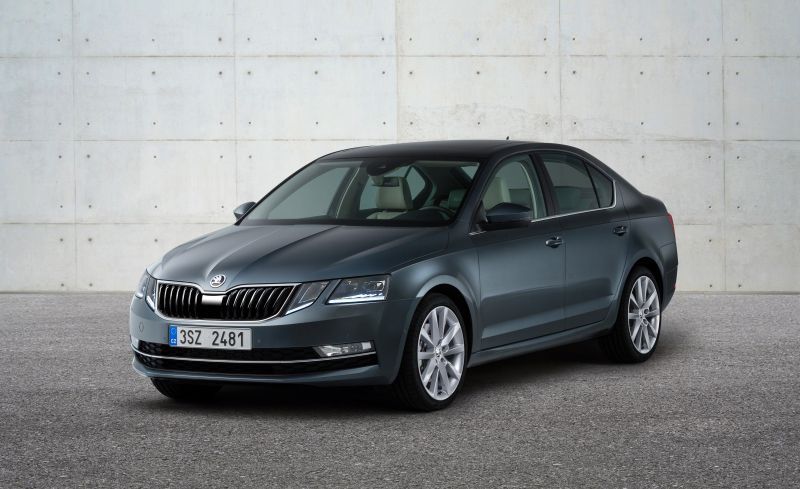
The 2017 facelift brought several key design enhancements to the third-generation Octavia. Most notably, the front fascia was updated with a distinctive split-headlight design, giving the car a more modern and assertive appearance. The grille was also subtly redesigned, and new bumper treatments contributed to a refreshed aesthetic. Despite these visual updates, the Octavia retained its fundamentally practical and understated design philosophy.
Its body type, a 5-door hatchback, was a significant differentiator. While appearing like a conventional sedan at first glance, the Octavia’s large rear tailgate opened to reveal an enormous trunk, offering sedan-like aesthetics with station wagon-rivalling utility. Minimum trunk space stood at an impressive 20.84 cu. ft. (590 liters), which could expand to a cavernous 55.8 cu. ft. (1580 liters) with the rear seats folded down. This practicality was a core tenet of the Octavia’s appeal.
Dimensions for the Octavia III (facelift 2017) were substantial for a compact car: a length of 183.86 inches (4670 mm), a width of 71.42 inches (1814 mm), and a height of 57.52 inches (1461 mm). Its wheelbase measured 105.75 inches (2686 mm), contributing to a stable ride and a spacious cabin for five occupants. The vehicle’s kerb weight was 2771.21 lbs. (1257 kg), which, combined with the 150 horsepower engine, resulted in a favorable weight-to-power ratio of 8.4 kg/Hp.
In terms of features, the Octavia offered a comfortable and well-appointed interior, typical of Skoda’s focus on ergonomics and user-friendliness. Standard safety systems included ABS (Anti-lock Braking System), and the vehicle benefited from electric power steering with a rack and pinion setup, providing precise and responsive handling. Braking was handled by ventilated discs at the front and solid discs at the rear, ensuring confident stopping power.
Technical Specifications: Skoda Octavia III (facelift 2017) 2.0 TDI (150 Hp)
| Category | Specification | US Equivalent |
|---|---|---|
General Information |
||
| Brand | Skoda | Skoda |
| Model | Octavia | Octavia |
| Generation | Octavia III (facelift 2017) | Octavia III (facelift 2017) |
| Type (Engine) | 2.0 TDI (150 Hp) | 2.0 TDI (150 Hp) |
| Start of Production | 2017 year | 2017 |
| End of Production | 2019 year | 2019 |
| Powertrain Architecture | Internal Combustion engine | Internal Combustion engine |
| Body Type | Hatchback | Hatchback |
| Seats | 5 | 5 |
| Doors | 5 | 5 |
Performance Specifications |
||
| Fuel Consumption (Urban) | 5.1 l/100 km | 46.1 US mpg |
| Fuel Consumption (Extra Urban) | 3.9 l/100 km | 60.3 US mpg |
| Fuel Consumption (Combined) | 4.3 l/100 km | 54.7 US mpg |
| CO2 Emissions | 113 g/km | 113 g/km |
| Fuel Type | Diesel | Diesel |
| Acceleration 0 – 60 mph | 8 sec | 8 sec |
| Maximum Speed | 218 km/h | 135.46 mph |
| Emission Standard | Euro 6 | Euro 6 |
| Weight-to-Power Ratio | 8.4 kg/Hp | 119.3 Hp/tonne |
| Weight-to-Torque Ratio | 3.7 kg/Nm | 270.5 Nm/tonne |
Engine Specifications |
||
| Power | 150 Hp | 150 Hp |
| Power per Liter | 76.2 Hp/l | 76.2 Hp/l |
| Torque | 340 Nm @ 1750-3000 rpm | 250.77 lb.-ft. @ 1750-3000 rpm |
| Engine Layout | Front, Transverse | Front, Transverse |
| Engine Model/Code | CKFC, CRMB | CKFC, CRMB |
| Engine Displacement | 1968 cm³ | 120.09 cu. in. (2.0 Liters) |
| Number of Cylinders | 4 | 4 |
| Engine Configuration | Inline | Inline |
| Cylinder Bore | 81 mm | 3.19 in. |
| Piston Stroke | 95.5 mm | 3.76 in. |
| Number of Valves per Cylinder | 4 | 4 |
| Fuel Injection System | Diesel Commonrail | Diesel Commonrail |
| Engine Aspiration | Turbocharger, Intercooler | Turbocharger, Intercooler |
| Engine Oil Capacity | 4.6 l | 4.86 US qt |
| Engine Systems | Particulate filter | Particulate filter |
Space, Volume and Weights |
||
| Kerb Weight | 1257 kg | 2771.21 lbs. |
| Max. Weight | 1882 kg | 4149.1 lbs. |
| Max Load | 625 kg | 1377.89 lbs. |
| Trunk (Boot) Space – Minimum | 590 l | 20.84 cu. ft. |
| Trunk (Boot) Space – Maximum | 1580 l | 55.8 cu. ft. |
| Fuel Tank Capacity | 50 l | 13.21 US gal |
| Max. Roof Load | 75 kg | 165.35 lbs. |
| Permitted Trailer Load with Brakes (12%) | 1600 kg | 3527.4 lbs. |
| Permitted Trailer Load without Brakes | 660 kg | 1455.05 lbs. |
Dimensions |
||
| Length | 4670 mm | 183.86 in. |
| Width | 1814 mm | 71.42 in. |
| Height | 1461 mm | 57.52 in. |
| Wheelbase | 2686 mm | 105.75 in. |
| Front Track | 1543 mm | 60.75 in. |
| Rear (Back) Track | 1534 mm | 60.39 in. |
| Minimum Turning Circle (Turning Diameter) | 10.61 m | 34.81 ft. |
Drivetrain, Brakes and Suspension Specs |
||
| Drivetrain Architecture | The Internal combustion engine (ICE) drives the front wheels of the vehicle. | Front-wheel drive (ICE) |
| Drive Wheel | Front wheel drive | Front wheel drive |
| Number of Gears and Type of Gearbox | 6 gears, manual transmission | 6 gears, manual transmission |
| Front Brakes | Ventilated discs | Ventilated discs |
| Rear Brakes | Disc | Disc |
| Assisting Systems | ABS (Anti-lock braking system) | ABS (Anti-lock braking system) |
| Steering Type | Steering rack and pinion | Steering rack and pinion |
| Power Steering | Electric Steering | Electric Steering |
Legacy & Market Impact: The Octavia’s Enduring European Appeal
The Skoda Octavia has long been considered the backbone of Skoda’s modern resurgence under Volkswagen Group ownership. The third generation, and especially the facelifted 2017 model, continued this tradition, embodying the brand’s core values of reliability, practicality, and exceptional value for money. In its primary European markets, the Octavia competed fiercely with established rivals such as the Volkswagen Golf, Ford Focus, Opel Astra, and Peugeot 308. What set the Octavia apart was its unique combination of a spacious interior, liftback versatility, and competitive pricing, often undercutting its direct competitors while offering comparable, if not superior, levels of equipment and build quality.
The 2.0 TDI (150 Hp) variant was particularly significant. Diesel engines, despite the controversies surrounding “Dieselgate,” remained a popular and practical choice for many European drivers during this period, especially those covering high mileage. The Octavia’s robust diesel powertrain offered the ideal balance of performance, torque, and remarkable fuel efficiency, making it a favorite for fleet operators, company car drivers, and private individuals seeking low running costs. Its ability to tow a permitted trailer load of 3527.4 lbs. (1600 kg) with brakes further underscored its utility.
While the Skoda brand and the Octavia model were never officially imported into the United States, their impact on the global automotive landscape, particularly in Europe and parts of Asia, is undeniable. The Octavia represents the success story of a brand that transformed from a Soviet-era curiosity into a respected purveyor of well-engineered, pragmatic vehicles. The 2017 facelifted Octavia III 2.0 TDI (150 Hp) stands as a testament to Skoda’s commitment to delivering accessible, high-quality, and highly efficient transportation solutions, solidifying its reputation as a smart choice for discerning European consumers.