The Skoda Octavia III (facelift 2017) RS 2.0 TSI (230 Hp): A Performance Hatchback for the European Market
The Skoda Octavia, a cornerstone of the Czech automaker’s lineup, has long been revered for its exceptional blend of practicality, value, and robust engineering, stemming from its integration within the Volkswagen Group. The third generation of the Octavia, particularly its 2017 facelift, further solidified this reputation, introducing a modernized aesthetic and enhanced technology. Among its variants, the Skoda Octavia III (facelift 2017) RS 2.0 TSI (230 Hp) stands out as the performance flagship, offering a compelling package for enthusiasts seeking a sporty yet highly functional family car.
While Skoda is not officially sold in the United States, the Octavia RS has carved a significant niche in European and other international markets. It represents Skoda’s interpretation of the “hot hatch” or “performance sedan” concept, providing exhilarating driving dynamics without compromising on the spaciousness and utility that define the Octavia line. This particular model, produced between 2017 and 2018, embodied the peak of the pre-WLTP (Worldwide Harmonized Light Vehicles Test Procedure) era for this generation, delivering a potent 230 horsepower from its turbocharged 2.0-liter engine, coupled with a standard manual transmission for an engaging driving experience.
Powertrain and Dynamic Performance
At the heart of the Skoda Octavia III (facelift 2017) RS 2.0 TSI (230 Hp) lies the acclaimed EA888 engine, a transversely mounted 2.0-liter (1984 cm3 or 121.07 cu. in.) turbocharged inline-four cylinder unit. This engine, known for its widespread use across the Volkswagen Group’s performance models, delivers a robust 230 horsepower (Hp) across a broad power band, from 4700 to 6200 rpm. Equally impressive is its torque output, peaking at 258.15 lb.-ft. (350 Nm) available from a low 1500 rpm all the way up to 4600 rpm, ensuring strong acceleration and flexible in-gear performance.
The engine’s sophisticated design incorporates a DOHC (Double Overhead Camshaft) valvetrain with four valves per cylinder, optimizing airflow and combustion. It utilizes a dual fuel injection system, combining direct injection with multi-port manifold injection, to achieve both efficiency and power. The turbocharger, paired with an intercooler, ensures rapid throttle response and consistent power delivery, even under demanding conditions. This setup allows the Octavia RS to sprint from 0 to 60 mph in a brisk 6.4 seconds (0-100 km/h in 6.7 seconds), with a top speed electronically limited to 155.34 mph (250 km/h).
Power is channeled to the front wheels via a precise 6-speed manual transmission, offering drivers an engaging and direct connection to the car’s performance. The vehicle also features a Start & Stop System, contributing to its overall fuel efficiency. Despite its performance credentials, the Octavia RS 2.0 TSI maintains respectable fuel economy figures, with a combined rating of 36.2 US mpg (6.5 l/100 km). It complies with the Euro 6 emission standard, emitting 149 g/km of CO2, reflecting a balance between sportiness and environmental consciousness for its era.
Design Evolution and Practicality
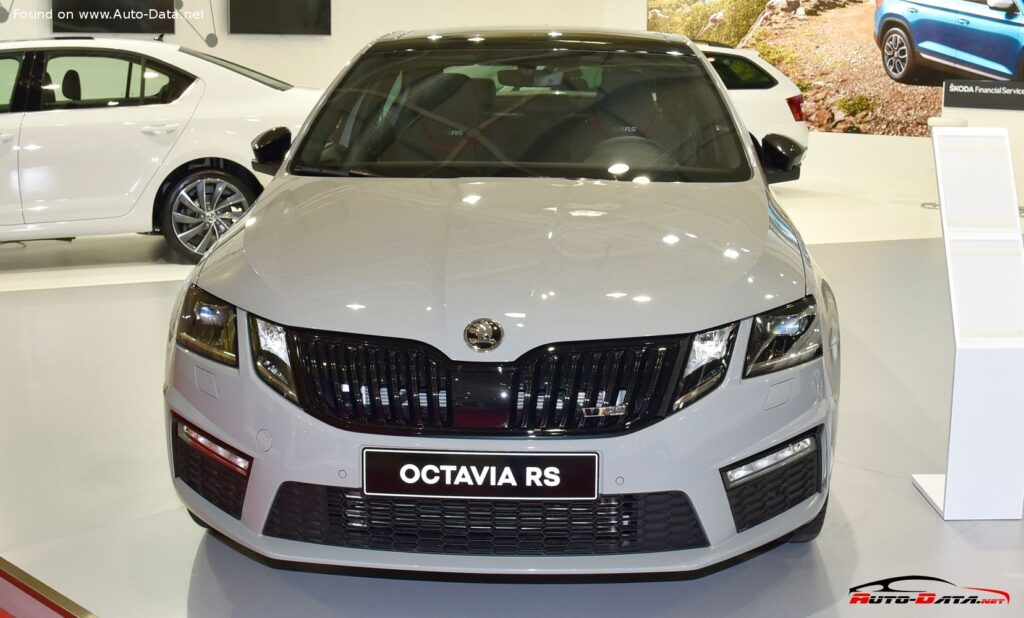
The 2017 facelift brought subtle yet impactful changes to the Octavia’s exterior, most notably a revised front fascia featuring distinctive split headlights that gave it a more aggressive and modern appearance. The RS variant further enhanced this sportiness with unique bumpers, a redesigned grille, and larger alloy wheels (available in 17-inch or 19-inch sizes, with tire specifications like 225/45 R17 or 225/35 R19). The body type remains a versatile 5-door hatchback, offering seating for five occupants.
Measuring 184.61 inches (4689 mm) in length, 71.42 inches (1814 mm) in width (79.41 inches or 2017 mm including mirrors), and 57.01 inches (1448 mm) in height, the Octavia RS maintains a substantial road presence. Its wheelbase of 105.51 inches (2680 mm) contributes to both interior space and stable handling. The car’s practicality is one of its strongest selling points, boasting a cavernous trunk (boot) space ranging from 20.84 cu. ft. (590 liters) with the rear seats up, expanding to an impressive 55.8 cu. ft. (1580 liters) when the seats are folded down. This makes it an ideal choice for families or individuals requiring significant cargo capacity without sacrificing performance.
Underneath, the Octavia RS features a sophisticated suspension setup, with an independent McPherson strut system at the front and an independent multi-link spring suspension at the rear, both equipped with anti-roll bars for enhanced stability and handling precision. Braking power is provided by ventilated discs at the front and solid discs at the rear, complemented by an Anti-lock Braking System (ABS). The electric power steering system, with a rack and pinion setup, offers precise control and feedback, making the RS variant agile despite its family-car dimensions.
Comprehensive Technical Specifications
| Category | Specification |
|---|---|
| Brand | Skoda |
| Model | Octavia |
| Generation | Octavia III (facelift 2017) |
| Type (Engine) | RS 2.0 TSI (230 Hp) |
| Production Years | 2017 – 2018 |
| Powertrain Architecture | Internal Combustion Engine |
| Body type | Hatchback |
| Seats | 5 |
| Doors | 5 |
| Performance Specs | |
| Fuel Consumption (urban) | 7.9 l/100 km (29.8 US mpg) |
| Fuel Consumption (extra urban) | 5.5 l/100 km (42.8 US mpg) |
| Fuel Consumption (combined) | 6.5 l/100 km (36.2 US mpg) |
| CO2 Emissions | 149 g/km |
| Fuel Type | Petrol (Gasoline) |
| Acceleration 0 – 60 mph | 6.4 sec |
| Acceleration 0 – 100 km/h | 6.7 sec |
| Maximum Speed | 250 km/h (155.34 mph), Electronically limited |
| Emission Standard | Euro 6 |
| Weight-to-power ratio | 5.8 kg/Hp (171 Hp/tonne) |
| Weight-to-torque ratio | 3.8 kg/Nm (260.2 Nm/tonne) |
| Engine Specs | |
| Power | 230 Hp @ 4700-6200 rpm |
| Power per liter | 115.9 Hp/l |
| Torque | 350 Nm (258.15 lb.-ft.) @ 1500-4600 rpm |
| Engine layout | Front, Transverse |
| Engine Model/Code | EA888 / CHHA |
| Engine displacement | 1984 cm3 (121.07 cu. in.) |
| Number of cylinders | 4 |
| Engine configuration | Inline |
| Cylinder Bore | 82.5 mm (3.25 in.) |
| Piston Stroke | 92.8 mm (3.65 in.) |
| Compression ratio | 9.6:1 |
| Number of valves per cylinder | 4 |
| Fuel injection system | Direct injection and Multi-port manifold injection |
| Engine aspiration | Turbocharger, Intercooler |
| Valvetrain | DOHC |
| Engine oil capacity | 5.7 l (6.02 US qt) |
| Coolant capacity | 8.6 l (9.09 US qt) |
| Engine systems | Start & Stop System |
| Space, Volume and Weights | |
| Kerb Weight | 1345 kg (2965.22 lbs.) |
| Max. weight | 1887 kg (4160.12 lbs.) |
| Max load | 542 kg (1194.91 lbs.) |
| Trunk (boot) space – minimum | 590 l (20.84 cu. ft.) |
| Trunk (boot) space – maximum | 1580 l (55.8 cu. ft.) |
| Fuel tank capacity | 50 l (13.21 US gal) |
| Max. roof load | 75 kg (165.35 lbs.) |
| Permitted trailer load with brakes (12%) | 1600 kg (3527.4 lbs.) |
| Permitted trailer load without brakes | 710 kg (1565.28 lbs.) |
| Dimensions | |
| Length | 4689 mm (184.61 in.) |
| Width | 1814 mm (71.42 in.) |
| Width including mirrors | 2017 mm (79.41 in.) |
| Height | 1448 mm (57.01 in.) |
| Wheelbase | 2680 mm (105.51 in.) |
| Front track | 1535 mm (60.43 in.) |
| Rear (Back) track | 1544 mm (60.79 in.) |
| Front overhang | 903 mm (35.55 in.) |
| Rear overhang | 1106 mm (43.54 in.) |
| Ride height (ground clearance) | 127 mm (5 in.) |
| Minimum turning circle (turning diameter) | 10.59 m (34.74 ft.) |
| Approach angle | 12.9° |
| Departure angle | 12.8° |
| Drivetrain, Brakes and Suspension Specs | |
| Drivetrain Architecture | Front wheel drive, Internal Combustion Engine |
| Drive wheel | Front wheel drive |
| Number of gears and type of gearbox | 6 gears, manual transmission |
| Front suspension | Independent, type McPherson with coil spring and anti-roll bar |
| Rear suspension | Independent multi-link spring suspension with stabilizer |
| Front brakes | Ventilated discs |
| Rear brakes | Disc |
| Assisting systems | ABS (Anti-lock braking system) |
| Steering type | Steering rack and pinion |
| Power steering | Electric Steering |
| Tires size | 225/45 R17; 225/35 R19 |
| Wheel rims size | 7.5J x 17; 7.5J x 19 |
Legacy, Competitors, and Market Significance
The Skoda Octavia RS has cultivated a strong reputation in markets where it is sold, particularly in Europe, as a “sleeper” performance car. It offers a level of practicality and understated design that often belies its true capabilities, making it an appealing choice for those who desire performance without ostentation. Its primary competitors in the European hot hatch and performance family car segments include the Volkswagen Golf GTI (its platform sibling), Ford Focus ST, SEAT Leon Cupra, and occasionally models like the Opel Astra OPC (Vauxhall Astra VXR in the UK). While some rivals might offer slightly more aggressive styling or marginally sharper dynamics, the Octavia RS consistently stands out for its superior interior space and luggage capacity, often at a more competitive price point.
The 2017 facelifted Octavia RS 2.0 TSI (230 Hp) reinforced Skoda’s commitment to delivering a well-rounded and engaging driving experience. It capitalizes on the Volkswagen Group’s proven engineering prowess, particularly the robust EA888 engine and MQB platform, to deliver reliability and performance. This model’s legacy lies in its ability to offer a compelling blend of speed, sophisticated handling, everyday usability, and exceptional value. It appeals to a broad demographic, from young enthusiasts looking for their first performance car to families needing a practical vehicle that doesn’t compromise on driving enjoyment. The Octavia RS continues to be a crucial model for Skoda, showcasing the brand’s ability to innovate and compete effectively in the performance segment, while staying true to its core values of smart design and practicality.