Skoda Octavia III RS 2.0 TDI (184 Hp) DSG: A European Performance Diesel Standard
The Skoda Octavia III RS 2.0 TDI (184 Hp) DSG represents a compelling blend of performance, practicality, and fuel efficiency within the European automotive landscape. Produced by the Czech Republic-based manufacturer Skoda Auto, a subsidiary of the Volkswagen Group, the Octavia has historically been a cornerstone of the brand’s success, particularly in its home market and across Europe. The third generation Octavia, introduced in 2013, continued this tradition, offering a more refined platform, enhanced technology, and a sharper design. The RS variant, short for “Rally Sport,” has consistently served as the performance flagship of the Octavia range, providing a sportier driving experience without compromising the car’s inherent practicality. This specific iteration, featuring the 2.0-liter TDI diesel engine paired with a dual-clutch automatic (DSG) transmission, catered to a specific niche of buyers seeking robust torque, impressive highway cruising ability, and excellent fuel economy, all wrapped in a discreetly sporty package.
While Skoda vehicles are not officially sold in the United States, the brand holds significant market share and a strong reputation for value, robust engineering, and family-friendly functionality throughout Europe and other global markets. The Octavia III RS, in particular, carved out a unique position as an accessible performance car, often referred to as a “hot hatch” or “sporty family hauler,” capable of spirited driving while remaining a sensible daily driver. Its production run from 2013 to 2017 saw it compete fiercely in the compact executive segment, offering a compelling alternative to more premium European brands by leveraging shared Volkswagen Group architecture and powertrains.
Engine and Performance of the Skoda Octavia III RS 2.0 TDI (184 Hp) DSG
Under the hood, the Skoda Octavia III RS 2.0 TDI (184 Hp) DSG features a potent 2.0-liter (120.09 cubic inches) inline four-cylinder turbodiesel engine, identified by the EA288 / CUNA, CUPA, DJGA engine codes. This direct-injection Commonrail diesel unit is transversely mounted at the front of the vehicle, driving the front wheels. It delivers a robust 184 horsepower at a relatively broad range of 3500-4000 rpm, ensuring accessible power throughout the mid-range. More significantly for a diesel, it produces an impressive 280.27 lb.-ft. of torque, available from a low 1750 rpm up to 3250 rpm. This substantial torque output is a hallmark of modern turbodiesel engines, providing strong acceleration and effortless overtaking capabilities.
The engine’s configuration includes a DOHC (Dual Overhead Camshaft) valvetrain with four valves per cylinder, a compression ratio of 16:1, and a sophisticated turbocharger with an intercooler to maximize power and efficiency. Paired with a 6-speed DSG (Direct Shift Gearbox) automatic transmission, the powertrain offers rapid and smooth gear changes, contributing to both its sporty character and relaxed cruising ability. The performance figures are respectable for a diesel-powered family car: 0 to 60 mph is achieved in a swift 7.5 seconds, with a top speed of 142.92 mph. Despite its performance credentials, the Octavia RS TDI boasts excellent fuel economy, with a combined NEDC rating of 50 US mpg (4.7 l/100 km) and CO2 emissions of 124 g/km, meeting the stringent Euro 6 emission standard. This efficiency is further aided by features like a Start & Stop System and a Particulate filter, highlighting its modern design and environmental consciousness.
Design and Features
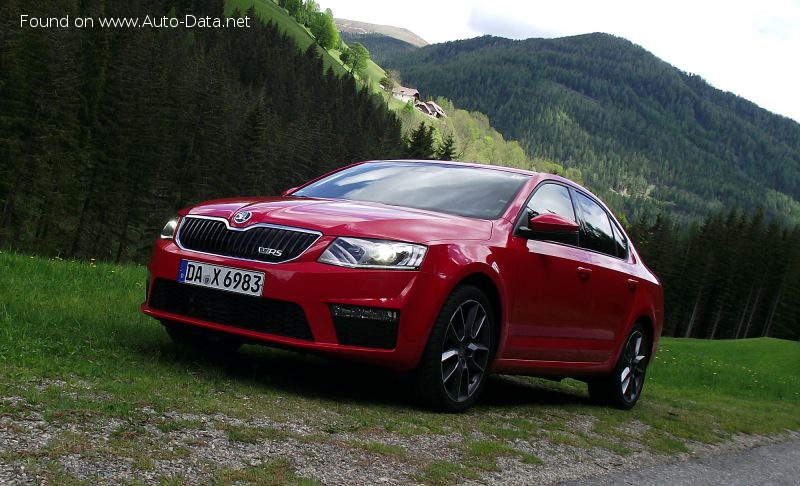
The Skoda Octavia III RS maintains the practical five-door hatchback body style, which is often perceived as a liftback due to its expansive rear opening. Its design is a subtle yet effective evolution from the standard Octavia, incorporating distinctive RS styling cues that hint at its performance capabilities without being overtly aggressive. These include a sportier front bumper with larger air intakes, a unique grille, revised rear bumper with integrated diffuser-style elements, and twin exhaust tips. The vehicle’s stance is enhanced by a slightly lower ride height (5.04 inches) and specific alloy wheel designs, ranging from 17 to 19 inches, shod with performance-oriented tires (225/45 R17, 225/40 R18, 225/35 R19).
Inside, the Octavia RS offers a cabin that balances sporty aesthetics with Skoda’s renowned practicality and robust build quality. RS-specific elements typically include bolstered sport seats, a flat-bottom steering wheel, unique trim accents, and RS badging. As a modern vehicle from its era, the Octavia III RS was equipped with a range of contemporary features. Safety was a priority, with standard ABS (Anti-lock Braking System) and a comprehensive airbag system. Comfort and convenience features would have included an advanced infotainment system (though specific details are not provided in the data, it would typically involve a touchscreen, Bluetooth connectivity, and potentially navigation), automatic climate control, and various driver-assistance systems depending on the trim level and optional packages. The hatchback body offers exceptional versatility, with a generous minimum trunk space of 20.84 cubic feet (590 liters), expandable to a cavernous 55.8 cubic feet (1580 liters) with the rear seats folded, making it a highly practical vehicle for families and active lifestyles.
Technical Specifications
| Category | Specification |
|---|---|
| General Information | |
| Brand | Skoda |
| Model | Octavia |
| Generation | Octavia III |
| Type (Engine) | RS 2.0 TDI (184 Hp) DSG |
| Start of production | 2013 year |
| End of production | 2017 year |
| Powertrain Architecture | Internal Combustion engine |
| Body type | Hatchback |
| Seats | 5 |
| Doors | 5 |
| Performance Specs | |
| Fuel consumption (economy) – urban (NEDC) | 5.6 l/100 km (42 US mpg) |
| Fuel consumption (economy) – extra urban (NEDC) | 4.2 l/100 km (56 US mpg) |
| Fuel consumption (economy) – combined (NEDC) | 4.7 l/100 km (50 US mpg) |
| CO2 emissions (NEDC) | 124 g/km |
| Fuel Type | Diesel |
| Acceleration 0 – 60 mph | 7.5 sec |
| Acceleration 0 – 62 mph (0-100 km/h) | 7.9 sec |
| Maximum speed | 230 km/h (142.92 mph) |
| Emission standard | Euro 6 |
| Weight-to-power ratio | 7.6 kg/Hp (132.4 Hp/tonne) |
| Weight-to-torque ratio | 3.7 kg/Nm (273.4 Nm/tonne) |
| Engine Specs | |
| Power | 184 Hp @ 3500-4000 rpm |
| Power per liter | 93.5 Hp/l |
| Torque | 380 Nm (280.27 lb.-ft.) @ 1750-3250 rpm |
| Engine layout | Front, Transverse |
| Engine Model/Code | EA288 / CUNA, CUPA, DJGA |
| Engine displacement | 1968 cm3 (120.09 cu. in.) |
| Number of cylinders | 4 |
| Engine configuration | Inline |
| Cylinder Bore | 81 mm (3.19 in.) |
| Piston Stroke | 95.5 mm (3.76 in.) |
| Compression ratio | 16:1 |
| Number of valves per cylinder | 4 |
| Fuel injection system | Diesel Commonrail |
| Engine aspiration | Turbocharger, Intercooler |
| Valvetrain | DOHC |
| Engine oil capacity | 4.6 l (4.86 US qt) |
| Coolant capacity | 11.6 l (12.26 US qt) |
| Engine systems | Start & Stop System, Particulate filter |
| Space, Volume and Weights | |
| Kerb Weight | 1390 kg (3064.43 lbs.) |
| Max. weight | 1932 kg (4259.33 lbs.) |
| Max load | 542 kg (1194.91 lbs.) |
| Trunk (boot) space – minimum | 590 l (20.84 cu. ft.) |
| Trunk (boot) space – maximum | 1580 l (55.8 cu. ft.) |
| Fuel tank capacity | 50 l (13.21 US gal) |
| Max. roof load | 75 kg (165.35 lbs.) |
| Permitted trailer load with brakes (12%) | 1600 kg (3527.4 lbs.) |
| Permitted trailer load without brakes | 730 kg (1609.37 lbs.) |
| Permitted towbar download | 75 kg (165.35 lbs.) |
| Dimensions | |
| Length | 4685 mm (184.45 in.) |
| Width | 1814 mm (71.42 in.) |
| Width including mirrors | 2017 mm (79.41 in.) |
| Height | 1449 mm (57.05 in.) |
| Wheelbase | 2680 mm (105.51 in.) |
| Front track | 1535 mm (60.43 in.) |
| Rear (Back) track | 1506 mm (59.29 in.) |
| Front overhang | 899 mm (35.39 in.) |
| Rear overhang | 1106 mm (43.54 in.) |
| Ride height (ground clearance) | 128 mm (5.04 in.) |
| Minimum turning circle (turning diameter) | 11.05 m (36.25 ft.) |
| Approach angle | 12.9° |
| Departure angle | 12.4° |
| Drivetrain, Brakes and Suspension Specs | |
| Drivetrain Architecture | The Internal combustion engine (ICE) drives the front wheels of the vehicle. |
| Drive wheel | Front wheel drive |
| Number of gears and type of gearbox | 6 gears, automatic transmission DSG |
| Front suspension | Independent, type McPherson with coil spring and anti-roll bar |
| Rear suspension | Independent multi-link spring suspension with stabilizer |
| Front brakes | Ventilated discs |
| Rear brakes | Disc |
| Assisting systems | ABS (Anti-lock braking system) |
| Steering type | Steering rack and pinion |
| Power steering | Electric Steering |
| Tires size | 225/45 R17; 225/40 R18; 225/35 R19 |
| Wheel rims size | 7.5J x 17; 7.5J x 18; 7.5J x 19 |
Legacy and Market Impact of the Skoda Octavia III RS 2.0 TDI (184 Hp) DSG
The Skoda Octavia III RS 2.0 TDI (184 Hp) DSG carved out a significant niche in the European market by offering a compelling combination of performance, practicality, and cost-effectiveness. Its legacy is rooted in Skoda’s strategy of providing “more car for your money” – a philosophy that resonated strongly with a broad spectrum of buyers. The RS badge, traditionally associated with gasoline-powered performance, gained credibility with the diesel variant by demonstrating that high torque and respectable acceleration could coexist with outstanding fuel economy, making it an ideal choice for long-distance commuters who still desired a sporty driving experience.
In its segment, the Octavia RS TDI competed against a range of rivals, primarily other performance-oriented diesel vehicles from within the Volkswagen Group and beyond. Key competitors included its platform-mate, the Volkswagen Golf GTD, which offered a similar powertrain in a slightly more compact and premium package. Other rivals might have included the Ford Focus ST Diesel, Opel Astra BiTurbo, or even entry-level diesel variants of more premium brands like the BMW 1 Series or Audi A3 Sportback, though the Skoda typically offered significantly more interior and cargo space for a comparable price point. The Octavia’s impressive 20.84 to 55.8 cubic feet of cargo volume was a major selling point, making it a highly versatile family car that could comfortably accommodate luggage, sports equipment, or even serve light commercial duties with its generous maximum load capacity of 1194.91 lbs. and towing capabilities of up to 3527.4 lbs. with brakes.
The Octavia III RS, particularly in its diesel form, contributed to Skoda’s evolving brand image. It helped shed the brand’s historically utilitarian perception, demonstrating that Skoda could produce vehicles with genuine driver appeal and modern technology. The vehicle’s strong sales performance throughout its production run highlighted the demand for performance-oriented vehicles that didn’t compromise on efficiency or everyday usability. Its independent multi-link rear suspension, a feature often reserved for more expensive cars in its class, further enhanced its driving dynamics and comfort, solidifying its reputation as a well-engineered and capable vehicle. Today, the Skoda Octavia III RS 2.0 TDI (184 Hp) DSG remains a sought-after used car in Europe, prized for its robust powertrain, comfortable ride, vast interior space, and a unique blend of sporty character with exceptional practicality.