Skoda Octavia III Scout 2.0 TDI (150 Hp) 4×4
The Skoda Octavia III Scout 2.0 TDI (150 Hp) 4×4 represents a compelling blend of practicality, efficiency, and light off-road capability within the European automotive landscape. Produced by the Czech automaker Skoda, a subsidiary of the Volkswagen Group, the Octavia Scout is a ruggedized version of the highly successful Octavia station wagon. This particular iteration, part of the third generation (Type 5E) Octavia, was manufactured between 2013 and 2017. While Skoda vehicles are not officially sold in the United States, the Octavia Scout embodies a popular European segment that combines the spaciousness and driving dynamics of a traditional station wagon with the elevated ride height and all-wheel-drive traction typically associated with SUVs or crossovers.
The Octavia III Scout was designed to cater to a diverse clientele, from families needing ample cargo space for daily life to individuals seeking a versatile vehicle capable of handling unpaved roads, challenging weather conditions, or recreational activities requiring moderate off-road prowess. Its 2.0-liter TDI engine, combined with a sophisticated all-wheel-drive system, offered a balanced proposition of performance and fuel economy, making it a highly regarded option in its primary markets across Europe and parts of Asia. The “Scout” designation signifies its enhanced ruggedness, featuring distinctive body cladding, increased ground clearance, and standard all-wheel drive, setting it apart from its standard Octavia siblings.
Engine & Performance of the Skoda Octavia III Scout 2.0 TDI (150 Hp) 4×4
At the heart of the Skoda Octavia III Scout 2.0 TDI (150 Hp) 4×4 lies a robust and efficient 2.0-liter turbocharged direct injection (TDI) diesel engine. This powerplant, identified by engine codes EA288 / CKFC, CRMB, is a four-cylinder inline configuration, renowned within the Volkswagen Group for its strong torque delivery and impressive fuel economy. With an engine displacement of 1968 cubic centimeters (120.09 cu. in.), it produces a respectable 150 horsepower (Hp) between 3500 and 4000 rpm, delivering a power-per-liter output of 76.2 Hp/l.
However, the true strength of this diesel engine lies in its torque. It generates a substantial 340 Newton-meters (Nm), or 250.77 lb.-ft., available across a broad rev range from 1750 to 3000 rpm. This wide torque band is crucial for both effortless highway cruising and confident acceleration, particularly when the vehicle is loaded or navigating varied terrain. The engine employs a Commonrail fuel injection system, combined with a turbocharger and intercooler, to optimize combustion efficiency and power output while minimizing emissions. Its DOHC (Double Overhead Camshaft) valvetrain with four valves per cylinder further enhances engine breathing and performance. The compression ratio of 16.2:1 is typical for a modern diesel engine, balancing power and efficiency.
Mated to a precise 6-speed manual transmission, the powertrain provides an engaging driving experience. The vehicle’s all-wheel-drive architecture is a sophisticated system that primarily drives the front wheels but engages the rear wheels through an electrically or mechanically operated clutch when slippage is detected, ensuring optimal traction in challenging conditions. This setup, often based on a Haldex system, offers the best of both worlds: the fuel efficiency of a front-wheel-drive car under normal conditions and the added grip of all-wheel drive when needed.
In terms of performance, the Octavia III Scout 2.0 TDI (150 Hp) 4×4 accelerates from 0 to 60 mph in a brisk 8.6 seconds (0-100 km/h in 9.1 seconds), and its maximum speed reaches 128.62 mph (207 km/h). These figures demonstrate that despite its rugged aspirations, the Scout doesn’t compromise on on-road dynamism. Fuel efficiency is a strong suit, with a combined NEDC cycle rating of 5.1 liters per 100 kilometers, translating to an impressive 46.1 US mpg. Urban consumption is rated at 6.1 l/100 km (38.6 US mpg), while extra-urban driving yields 4.6 l/100 km (51.1 US mpg). With CO2 emissions of 129 g/km, the vehicle complies with Euro 6 emission standards, showcasing its commitment to environmental responsibility, further aided by a Start & Stop System and a Particulate filter.
Design & Features
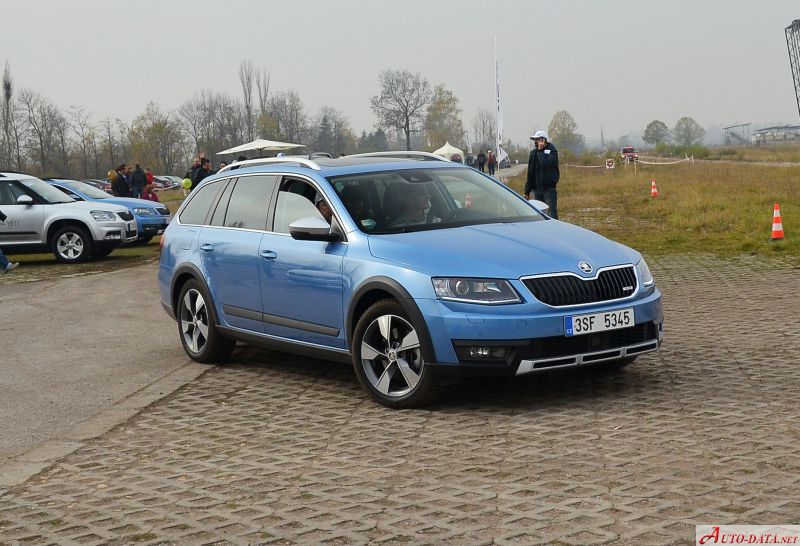
The Skoda Octavia III Scout distinguishes itself from the standard Octavia station wagon through a series of aesthetic and functional enhancements that underscore its crossover identity. With a body type described as both a “station wagon (estate)” and a “crossover,” it skillfully merges the best attributes of both segments. The exterior design features robust plastic cladding around the wheel arches, side sills, and lower bumpers, providing protection against minor scrapes and adding to its rugged visual appeal. Distinctive front and rear bumpers with integrated underbody protection elements further emphasize its adventurous character. The increased ride height of 171 mm (6.73 inches) is a key feature, improving ground clearance for navigating uneven terrain and contributing to a more commanding driving position.
Measuring 4685 mm (184.45 inches) in length, 1814 mm (71.42 inches) in width (2017 mm or 79.41 inches including mirrors), and 1531 mm (60.28 inches) in height, the Octavia Scout maintains a substantial footprint. Its wheelbase of 2679 mm (105.47 inches) contributes to a stable ride and generous interior space. The vehicle offers five doors and seating for five occupants, making it a highly practical family hauler. The spacious cabin is a hallmark of Skoda models, prioritizing ergonomics and functionality. High-quality materials and thoughtful touches are evident throughout, designed to withstand the rigors of an active lifestyle.
Cargo versatility is exceptional, boasting a minimum trunk space of 610 liters (21.54 cu. ft.) with all seats in place. Folding down the rear seats expands this cavernous area to an impressive 1740 liters (61.45 cu. ft.), rivaling much larger SUVs. This makes the Scout ideal for transporting luggage, sports equipment, or even large furniture items. The vehicle also features a maximum roof load of 80 kg (176.37 lbs.) and a substantial permitted trailer load with brakes of 2000 kg (4409.25 lbs.), highlighting its utility as a towing vehicle.
Standard features include 225/50 R17 tires mounted on 7J x 17-inch wheel rims, providing a good balance of comfort and grip. Safety is paramount, with the Octavia III Scout equipped with a comprehensive suite of features for its time. These include an Anti-lock Braking System (ABS) as standard, ventilated disc brakes at the front, and disc brakes at the rear for confident stopping power. The independent McPherson front suspension with a coil spring and anti-roll bar, combined with an independent multi-link rear suspension with a stabilizer, ensures a comfortable ride and agile handling, even with the raised ground clearance. Electric power steering, a steering rack and pinion type, offers precise control and ease of maneuverability, with a minimum turning circle of 10.96 meters (35.96 ft.).
Technical Specifications
| Category | Specification |
|---|---|
| Brand | Skoda |
| Model | Octavia |
| Generation | Octavia III Scout |
| Type (Engine) | 2.0 TDI (150 Hp) 4×4 |
| Production Start | 2013 |
| Production End | 2017 |
| Powertrain Architecture | Internal Combustion Engine |
| Body Type | Station wagon (estate), Crossover |
| Seats | 5 |
| Doors | 5 |
| Fuel Consumption (Urban, NEDC) | 6.1 l/100 km (38.6 US mpg) |
| Fuel Consumption (Extra Urban, NEDC) | 4.6 l/100 km (51.1 US mpg) |
| Fuel Consumption (Combined, NEDC) | 5.1 l/100 km (46.1 US mpg) |
| CO2 Emissions (NEDC) | 129 g/km |
| Fuel Type | Diesel |
| Acceleration 0-60 mph | 8.6 sec |
| Acceleration 0-100 km/h | 9.1 sec |
| Maximum Speed | 207 km/h (128.62 mph) |
| Emission Standard | Euro 6 |
| Weight-to-Power Ratio | 9.7 kg/Hp, 103.4 Hp/tonne |
| Weight-to-Torque Ratio | 4.3 kg/Nm, 234.3 Nm/tonne |
| Power | 150 Hp @ 3500-4000 rpm |
| Power per Liter | 76.2 Hp/l |
| Torque | 340 Nm (250.77 lb.-ft.) @ 1750-3000 rpm |
| Engine Layout | Front, Transverse |
| Engine Model/Code | EA288 / CKFC, CRMB |
| Engine Displacement | 1968 cm3 (120.09 cu. in. / 2.0 L) |
| Number of Cylinders | 4 |
| Engine Configuration | Inline |
| Cylinder Bore | 81 mm (3.19 in.) |
| Piston Stroke | 95.5 mm (3.76 in.) |
| Compression Ratio | 16.2:1 |
| Valves per Cylinder | 4 |
| Fuel Injection System | Diesel Commonrail |
| Engine Aspiration | Turbocharger, Intercooler |
| Valvetrain | DOHC |
| Engine Oil Capacity | 4.6 l (4.86 US qt) |
| Engine Systems | Start & Stop System, Particulate filter |
| Kerb Weight | 1451 kg (3198.91 lbs.) |
| Max. Weight | 2096 kg (4620.89 lbs.) |
| Max Load | 645 kg (1421.98 lbs.) |
| Trunk Space (Min) | 610 l (21.54 cu. ft.) |
| Trunk Space (Max) | 1740 l (61.45 cu. ft.) |
| Fuel Tank Capacity | 55 l (14.53 US gal) |
| Max. Roof Load | 80 kg (176.37 lbs.) |
| Permitted Trailer Load (Braked, 12%) | 2000 kg (4409.25 lbs.) |
| Permitted Trailer Load (Unbraked) | 750 kg (1653.47 lbs.) |
| Permitted Towbar Download | 80 kg (176.37 lbs.) |
| Length | 4685 mm (184.45 in.) |
| Width | 1814 mm (71.42 in.) |
| Width (incl. mirrors) | 2017 mm (79.41 in.) |
| Height | 1531 mm (60.28 in.) |
| Wheelbase | 2679 mm (105.47 in.) |
| Front Track | 1538 mm (60.55 in.) |
| Rear Track | 1506 mm (59.29 in.) |
| Front Overhang | 899 mm (35.39 in.) |
| Rear Overhang | 1107 mm (43.58 in.) |
| Ride Height (Ground Clearance) | 171 mm (6.73 in.) |
| Drag Coefficient (Cd) | 0.32 |
| Minimum Turning Circle | 10.96 m (35.96 ft.) |
| Approach Angle | 16.7° |
| Departure Angle | 13.8° |
| Drivetrain Architecture | ICE drives front wheels permanently; rear wheels driven via clutch when necessary. |
| Drive Wheel | All-wheel drive (4×4) |
| Gearbox | 6 gears, manual transmission |
| Front Suspension | Independent, McPherson with coil spring and anti-roll bar |
| Rear Suspension | Independent multi-link spring suspension with stabilizer |
| Front Brakes | Ventilated discs |
| Rear Brakes | Disc |
| Assisting Systems | ABS (Anti-lock braking system) |
| Steering Type | Steering rack and pinion |
| Power Steering | Electric Steering |
| Tires Size | 225/50 R17 |
| Wheel Rims Size | 7J x 17 |
Legacy & Market Impact of the Skoda Octavia III Scout
The Skoda Octavia III Scout 2.0 TDI (150 Hp) 4×4 carved out a significant niche in the highly competitive European automotive market during its production run from 2013 to 2017. Its reputation was built on a foundation of exceptional practicality, robust engineering derived from the Volkswagen Group, and a compelling value proposition. While the Skoda brand itself is not present in the U.S. market, the Octavia Scout’s concept resonates with American consumers’ affinity for versatile, all-wheel-drive vehicles like the Subaru Outback, albeit with a distinctly European flavor and a strong emphasis on diesel efficiency.
In Europe, the Octavia Scout competed against a range of vehicles, from more conventional station wagons like the Ford Focus Estate or Opel Astra Sports Tourer, to other ruggedized wagons such as the Volkswagen Golf Alltrack (its platform sibling) and the Audi A4 Allroad. Its key differentiator was its ability to offer a near-premium experience and advanced technology at a more accessible price point than some of its direct rivals, particularly those from within the Volkswagen Group. The combination of a powerful yet frugal TDI engine, the secure footing of a permanent all-wheel-drive system (engaging when needed), and an enormous cargo capacity made it a favorite among active families, rural dwellers, and professionals who required a dependable workhorse that could also handle weekend adventures.
The 2.0 TDI (150 Hp) variant was particularly popular, striking an excellent balance between performance and operating costs. Its Euro 6 compliance and low CO2 emissions were significant selling points in environmentally conscious European markets, where diesel engines remained a popular choice for their long-distance efficiency and strong torque. The manual transmission offered a level of driver engagement that many enthusiasts appreciated, further cementing its appeal.
The Octavia III Scout contributed significantly to Skoda’s brand image, reinforcing its reputation for building “simply clever” cars that excel in functionality and value. It demonstrated Skoda’s capability to offer specialized variants that cater to specific market demands, moving beyond its traditional image as a budget brand. The Scout’s success paved the way for subsequent generations and solidified the concept of the ruggedized station wagon as a viable alternative to more conventional SUVs, proving that a vehicle could be both practical and adventurous without sacrificing fuel economy or on-road dynamics. Its legacy is one of a highly competent, versatile, and understated vehicle that delivered far more than its price tag might suggest, becoming a beloved choice for those seeking a reliable and capable companion for both daily life and off-the-beaten-path excursions.