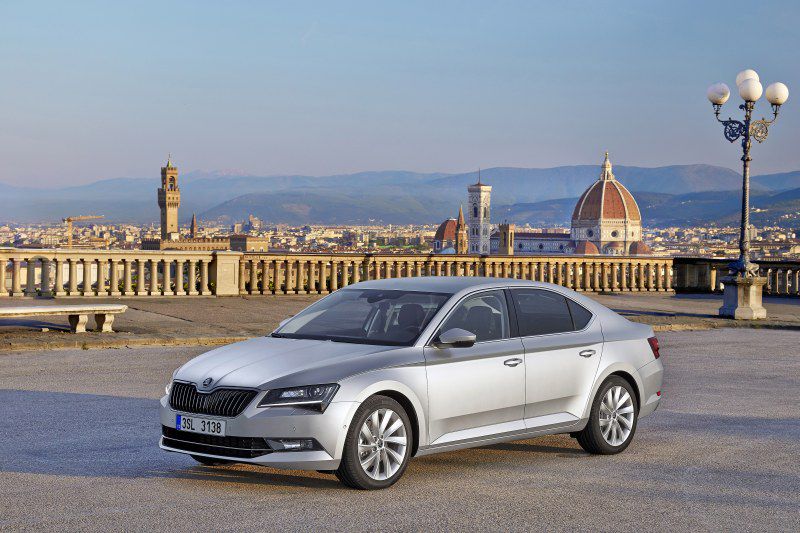
The Skoda Superb III 1.6 TDI (120 Hp) DSG, produced between March 2015 and 2018, represents a significant offering from the Czech automaker, a prominent brand within the Volkswagen Group, primarily targeting European and Asian markets. While not commonly sold in the United States, the Superb is Skoda’s flagship model, renowned for its exceptional interior space, sophisticated engineering, and outstanding value. This third-generation Superb, specifically in its 1.6 TDI (120 Hp) DSG liftback configuration, embodies a blend of executive comfort, practical versatility, and remarkable fuel efficiency, making it a compelling choice in the mid-size executive segment across its primary markets. Its powertrain architecture, based on an internal combustion engine driving the front wheels, combined with a modern automatic transmission, underscores its design philosophy focused on daily usability and long-distance cruising capability.
Engine & Performance of the Skoda Superb III 1.6 TDI (120 Hp) DSG
At the heart of the Skoda Superb III 1.6 TDI (120 Hp) DSG lies a highly efficient and refined 1.6-liter (1598 cm3 or 97.52 cu. in.) inline four-cylinder diesel engine, designated with the internal code EA288 / DCXA. This powerplant delivers a respectable 120 horsepower (Hp) at an engine speed range of 3600-4000 revolutions per minute (rpm), providing a power-per-liter output of 75.1 Hp/l. More critically for a diesel, it produces a robust 250 Newton-meters (Nm) of torque, which translates to 184.39 lb.-ft., available across a broad and accessible rev range of 1500-3250 rpm. This wide torque band ensures strong pulling power from low speeds, enhancing drivability and reducing the need for frequent gear changes, especially in urban environments or when carrying heavy loads.
The engine’s advanced design features a DOHC (Double Overhead Camshaft) valvetrain with four valves per cylinder, optimizing airflow and combustion efficiency. Fuel is delivered via a sophisticated Diesel Commonrail injection system, which precisely meters fuel for improved performance and reduced emissions. Further enhancing its efficiency and power delivery is a turbocharger coupled with an intercooler, ensuring a dense charge of air enters the cylinders for optimal combustion. With a compression ratio of 16.2:1, typical for a modern diesel, the engine is designed for maximum thermal efficiency. Environmental responsibility is addressed through its compliance with the Euro 6 emission standard, aided by a Start & Stop System and a Particulate filter, which collectively reduce both fuel consumption and harmful emissions.
Power is seamlessly transferred to the front wheels via a 7-speed automatic DSG (Direct Shift Gearbox) transmission. This dual-clutch unit is renowned for its rapid, smooth, and precise shifts, contributing significantly to both the driving experience and fuel economy. The combination of the efficient diesel engine and the advanced DSG gearbox allows the Superb III 1.6 TDI to achieve commendable performance figures. It accelerates from 0 to 60 miles per hour (mph) in a competitive 10.5 seconds, with a 0-100 km/h sprint completed in 11 seconds. The vehicle can reach a maximum speed of 128 mph (206 km/h), making it perfectly capable for sustained highway cruising. Despite its size and executive aspirations, the Superb III 1.6 TDI boasts impressive fuel economy. In combined NEDC testing, it achieves 3.9-4.1 liters per 100 kilometers, translating to an excellent 60.3 – 57.4 US mpg. Urban fuel consumption ranges from 53.5 – 51.1 US mpg, while extra-urban driving yields an even more impressive 65.3 – 60.3 US mpg. These figures, coupled with CO2 emissions of 101-108 g/km, highlight its credentials as an environmentally conscious and cost-effective long-distance cruiser.
Design & Features
The Skoda Superb III’s design language, characterized by sharp lines, a bold grille, and elegant proportions, projects an image of understated sophistication. Its body type is a five-door liftback, a clever design choice that merges the sleek profile of a sedan with the practical utility of a hatchback. This liftback configuration provides an enormous trunk opening, vastly improving access to the cargo area compared to a traditional sedan. The vehicle comfortably accommodates five occupants across its two rows of seating, prioritizing passenger comfort and spaciousness, especially in the rear, where it offers class-leading legroom.
Dimensionally, the Superb III is a substantial vehicle, measuring 191.38 inches (4861 mm) in length, 73.39 inches (1864 mm) in width (79.96 inches or 2031 mm including mirrors), and 57.8 inches (1468 mm) in height. A generous wheelbase of 111.85 inches (2841 mm) is key to its expansive interior volume and stable ride. The front track measures 62.36 inches (1584 mm) and the rear track 61.89 inches (1572 mm), contributing to balanced handling. With a minimum turning circle of 38.39 feet (11.7 m), the Superb remains surprisingly maneuverable for its size. The vehicle’s aerodynamic efficiency is notable, with a drag coefficient (Cd) of just 0.288, which aids both fuel economy and interior quietness at higher speeds.
The Superb’s practicality extends to its cargo capacity, which is truly exceptional. The trunk (boot) space starts at a cavernous 22.07 cubic feet (625 liters) with all seats in place, expanding to an enormous 62.15 cubic feet (1760 liters) when the rear seats are folded down. This makes it one of the most capacious vehicles in its segment, rivaling many station wagons. The vehicle’s kerb weight ranges from 3097.49 – 3163.63 lbs (1405-1435 kg), with a maximum permissible weight of 4464.36 – 4530.5 lbs (2025-2055 kg), indicating robust construction and a substantial payload capacity of 1366.87 lbs (620 kg). Its towing capabilities are also impressive, with a permitted trailer load of 3968.32 lbs (1800 kg) with brakes (8% incline) and 3306.93 lbs (1500 kg) with brakes (12% incline).
The ride quality and handling are managed by an independent McPherson strut suspension with coil springs and an anti-roll bar at the front, complemented by an independent multi-link spring suspension with a stabilizer at the rear. This setup provides a comfortable yet composed ride, adept at absorbing road imperfections while maintaining stability. Braking is handled by ventilated discs at the front and solid discs at the rear, augmented by an Anti-lock Braking System (ABS) for enhanced safety and control. The steering system employs an electric power-assisted rack and pinion setup, offering light effort at low speeds for easy parking and more feedback at higher speeds for confident driving. Standard tire sizes include 215/60 R16 or 215/55 R17, mounted on 6.5J x 16 or 7J x 17 wheel rims, respectively, providing a good balance of grip and ride comfort.
Technical Specifications
| Brand | Skoda |
| Model | Superb |
| Generation | Superb III |
| Type (Engine) | 1.6 TDI (120 Hp) DSG |
| Start of production | March, 2015 year |
| End of production | 2018 year |
| Powertrain Architecture | Internal Combustion engine |
| Body type | Liftback |
| Seats | 5 |
| Doors | 5 |
| Fuel consumption (economy) – urban (NEDC) | 4.4-4.6 l/100 km (53.5 – 51.1 US mpg) |
| Fuel consumption (economy) – extra urban (NEDC) | 3.6-3.9 l/100 km (65.3 – 60.3 US mpg) |
| Fuel consumption (economy) – combined (NEDC) | 3.9-4.1 l/100 km (60.3 – 57.4 US mpg) |
| CO2 emissions (NEDC) | 101-108 g/km |
| Fuel Type | Diesel |
| Acceleration 0 – 100 km/h | 11 sec |
| Acceleration 0 – 62 mph | 11 sec |
| Acceleration 0 – 60 mph (Calculated) | 10.5 sec |
| Maximum speed | 206 km/h (128 mph) |
| Emission standard | Euro 6 |
| Weight-to-power ratio | 11.7 kg/Hp (85.4 Hp/tonne) |
| Weight-to-torque ratio | 5.6 kg/Nm (177.9 Nm/tonne) |
| Power | 120 Hp @ 3600-4000 rpm |
| Power per litre | 75.1 Hp/l |
| Torque | 250 Nm @ 1500-3250 rpm (184.39 lb.-ft.) |
| Engine layout | Front, Transverse |
| Engine Model/Code | EA288 / DCXA |
| Engine displacement | 1598 cm3 (97.52 cu. in.) |
| Number of cylinders | 4 |
| Engine configuration | Inline |
| Cylinder Bore | 79.5 mm (3.13 in.) |
| Piston Stroke | 80.5 mm (3.17 in.) |
| Compression ratio | 16.2:1 |
| Number of valves per cylinder | 4 |
| Fuel injection system | Diesel Commonrail |
| Engine aspiration | Turbocharger, Intercooler |
| Valvetrain | DOHC |
| Engine oil capacity | 4.7 l (4.97 US qt) |
| Coolant | 8 l (8.45 US qt) |
| Engine systems | Start & Stop System, Particulate filter |
| Kerb Weight | 1405-1435 kg (3097.49 – 3163.63 lbs) |
| Max. weight | 2025-2055 kg (4464.36 – 4530.5 lbs) |
| Max load | 620 kg (1366.87 lbs) |
| Trunk (boot) space – minimum | 625 l (22.07 cu. ft.) |
| Trunk (boot) space – maximum | 1760 l (62.15 cu. ft.) |
| Fuel tank capacity | 66 l (17.44 US gal) |
| Max. roof load | 100 kg (220.46 lbs) |
| Permitted trailer load with brakes (8%) | 1800 kg (3968.32 lbs) |
| Permitted trailer load with brakes (12%) | 1500 kg (3306.93 lbs) |
| Permitted trailer load without brakes | 750 kg (1653.47 lbs) |
| Permitted towbar download | 90 kg (198.42 lbs) |
| Length | 4861 mm (191.38 in.) |
| Width | 1864 mm (73.39 in.) |
| Width including mirrors | 2031 mm (79.96 in.) |
| Height | 1468 mm (57.8 in.) |
| Wheelbase | 2841 mm (111.85 in.) |
| Front track | 1584 mm (62.36 in.) |
| Rear (Back) track | 1572 mm (61.89 in.) |
| Front overhang | 897 mm (35.31 in.) |
| Rear overhang | 1123 mm (44.21 in.) |
| Ride height (ground clearance) | 149 mm (5.87 in.) |
| Drag coefficient (Cd) | 0.288 |
| Minimum turning circle (turning diameter) | 11.7 m (38.39 ft.) |
| Approach angle | 14° |
| Departure angle | 12.2° |
| Drivetrain Architecture | Internal combustion engine drives the front wheels. |
| Drive wheel | Front wheel drive |
| Number of gears and type of gearbox | 7 gears, automatic transmission DSG |
| Front suspension | Independent, type McPherson with coil spring and anti-roll bar |
| Rear suspension | Independent multi-link spring suspension with stabilizer |
| Front brakes | Ventilated discs |
| Rear brakes | Disc |
| Assisting systems | ABS (Anti-lock braking system) |
| Steering type | Steering rack and pinion |
| Power steering | Electric Steering |
| Tires size | 215/60 R16; 215/55 R17 |
| Wheel rims size | 6.5J x 16; 7J x 17 |