
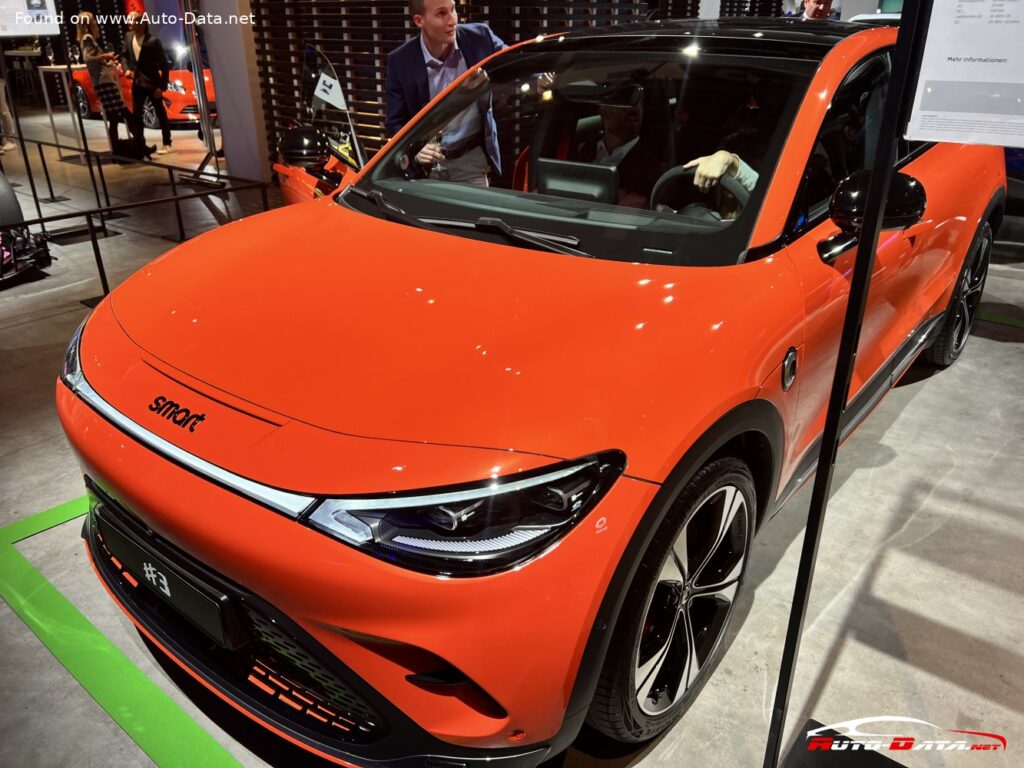
The Smart #3 is a battery electric vehicle (BEV) introduced in December 2023, representing the latest iteration in Smart’s evolving lineup. Positioned as a compact SUV-coupe, the #3 aims to blend sporty aesthetics with the practicality of a five-seater, five-door configuration. While the Smart brand has a history rooted in European urban mobility, particularly through its collaboration with Mercedes-Benz, the #3 marks a significant step towards a fully electric future and a broader global appeal, though its initial market penetration is strongest in Europe and Asia. This vehicle is not currently sold in the United States.
Smart #3: Overview and Market Positioning
The Smart #3 is a key component of Smart’s revitalization under the joint venture between Mercedes-Benz and Geely. It builds upon the foundation laid by the Smart #1, offering a more dynamic and coupe-like profile. The vehicle targets a demographic seeking a stylish, technologically advanced, and environmentally conscious urban vehicle. Its compact dimensions make it well-suited for navigating congested city streets, while its all-electric powertrain provides zero-emission driving. The #3 distinguishes itself with a focus on performance and design, aiming to attract buyers who prioritize both functionality and aesthetics.
Engine & Performance
The Smart #3 is powered by a single electric motor located on the rear axle, delivering 272 horsepower (Hp) and 343 Newton-meters (Nm) of torque, equivalent to 252.98 lb.-ft. This rear-wheel-drive configuration contributes to a sporty driving experience. The powertrain utilizes a lithium nickel manganese cobalt oxides (Li-NMC) battery with a gross capacity of 66 kWh, positioned below the floor to optimize weight distribution and passenger space. Acceleration from 0 to 100 km/h (0-62 mph) is achieved in 5.8 seconds, while 0-60 mph is calculated at 5.5 seconds. The vehicle has a maximum speed of 180 km/h (111.85 mph). The weight-to-power ratio stands at 6.5 kg/Hp, and the weight-to-torque ratio is 5.2 kg/Nm, indicating a responsive and efficient powertrain. The all-electric range, measured using the WLTP standard, is between 435 and 455 kilometers (270.3 – 282.72 miles).
Design & Features
The Smart #3 boasts a coupe-SUV body style, characterized by a sloping roofline and a sporty stance. The vehicle features a modern and minimalist exterior design, with distinctive headlights and a closed-off grille, typical of electric vehicles. Inside, the #3 offers a spacious and technologically advanced cabin. A prominent central touchscreen dominates the dashboard, providing access to infotainment, vehicle settings, and connectivity features. The interior is designed with sustainability in mind, utilizing recycled materials where possible. Practicality is enhanced by a flexible seating arrangement and a generous cargo capacity, ranging from 370 liters (13.07 cu. ft.) with the rear seats up to 1160 liters (40.97 cu. ft.) with them folded down. Safety features include ABS (Anti-lock braking system) and electric power steering. The vehicle is equipped with 19-inch wheel rims and 235/45 R19 tires.
Technical Specifications
| Brand | Smart |
| Model | #3 |
| Generation | #3 |
| Type (Engine) | 66 kWh (272 Hp) BEV |
| Start of production | December, 2023 |
| Powertrain Architecture | BEV (Electric Vehicle) |
| Body type | Coupe, SUV |
| Seats | 5 |
| Doors | 5 |
| Fuel Type | Electricity |
| Acceleration 0 – 100 km/h | 5.8 sec |
| Acceleration 0 – 62 mph | 5.8 sec |
| Acceleration 0 – 60 mph | 5.5 sec |
| Maximum speed | 180 km/h (111.85 mph) |
| Weight-to-power ratio | 6.5 kg/Hp |
| Weight-to-torque ratio | 5.2 kg/Nm |
| Gross battery capacity | 66 kWh |
| Battery technology | Lithium nickel manganese cobalt oxides (Li-NMC) |
| Battery location | Below the floor |
| All-electric range (WLTP) | 435-455 km (270.3 – 282.72 mi) |
| Electric motor power | 272 Hp |
| Electric motor Torque | 343 Nm (252.98 lb.-ft.) |
| Electric motor location | Rear axle, Transverse |
| Electric motor type | Synchronous |
| System power | 272 Hp |
| System torque | 343 Nm (252.98 lb.-ft.) |
| Kerb Weight | 1780-1810 kg (3924.23 – 3990.37 lbs.) |
| Max. weight | 2260 kg (4982.45 lbs.) |
| Max load | 450-480 kg (992.08 – 1058.22 lbs.) |
| Trunk (boot) space – minimum | 370 l (13.07 cu. ft.) |
| Trunk (boot) space – maximum | 1160 l (40.97 cu. ft.) |
| Permitted trailer load with brakes (12%) | 1600 kg (3527.4 lbs.) |
| Permitted trailer load without brakes | 750 kg (1653.47 lbs.) |
| Length | 4400 mm (173.23 in.) |
| Width | 1844 mm (72.6 in.) |
| Height | 1556 mm (61.26 in.) |
| Wheelbase | 2785 mm (109.65 in.) |
| Drivetrain Architecture | One electric motor drives the rear wheels. |
| Drive wheel | Rear wheel drive |
| Number of gears and type of gearbox | 1 gears, automatic transmission |
| Steering type | Steering rack and pinion |
| Power steering | Electric Steering |
| Tires size | 235/45 R19 |
| Wheel rims size | 19 |
The Smart #3 represents a significant evolution for the brand, showcasing a commitment to electric mobility and a design-focused approach. While its availability is currently limited to select markets, it embodies Smart’s ambition to become a leading player in the global electric vehicle landscape. The vehicle’s combination of performance, practicality, and style positions it as a compelling option for urban drivers seeking a sustainable and engaging driving experience.
