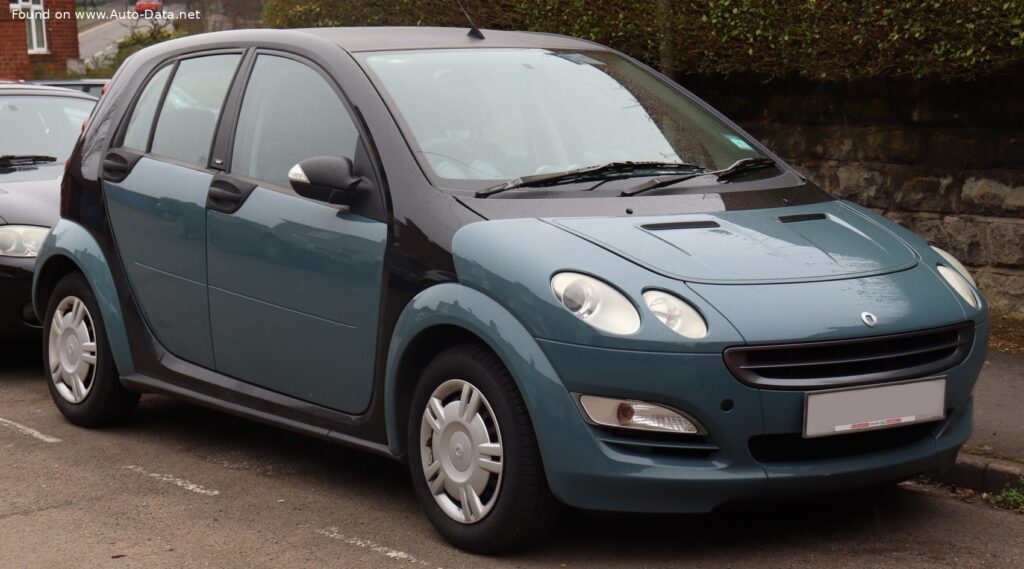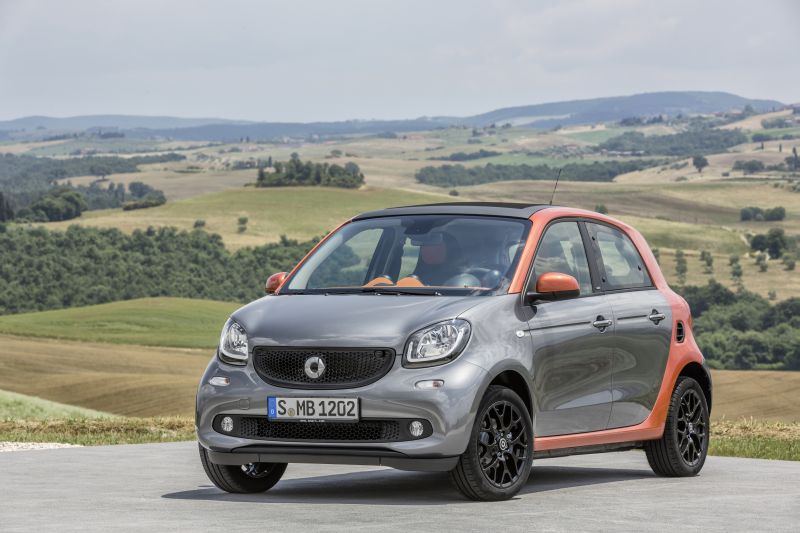
The Smart Forfour II (W453) 1.0, produced from 2015 to 2017, represents the second generation of Smart’s foray into the subcompact hatchback segment. Unlike its predecessor, which was co-developed with Mitsubishi, the W453 Forfour was engineered in collaboration with Renault, sharing its platform and powertrain components with the Renault Twingo. This collaboration marked a significant shift for Smart, aiming to improve economies of scale and offer a more refined and capable city car. While not officially sold in the United States, the Forfour was a popular choice in European markets, particularly for urban commuters seeking a small, fuel-efficient, and maneuverable vehicle. The 1.0-liter engine variant, producing 61 horsepower, was positioned as the entry-level option, prioritizing economy over outright performance.
Smart Forfour II (W453) 1.0: A Detailed Overview
The Forfour II aimed to address criticisms leveled at the first-generation model, offering improved practicality, a more conventional layout, and enhanced driving dynamics. The W453’s rear-wheel-drive configuration, inherited from the Renault Twingo, contributed to its nimble handling and surprisingly spacious interior for its diminutive size. The 1.0-liter engine, while modest in output, proved adequate for city driving, and the Forfour’s compact dimensions made parking and navigating congested streets a breeze. The vehicle’s focus was firmly on providing an affordable and efficient transportation solution for urban environments.
Engine & Performance
The Smart Forfour II 1.0 is powered by a 999 cc inline three-cylinder petrol engine, designated M 281.920. This naturally aspirated engine produces 61 horsepower at 6000 rpm and 91 Nm (67.12 lb-ft) of torque at 2850 rpm. While not a powerhouse, the engine’s power-to-liter ratio of 61.1 hp/l demonstrates a reasonable level of efficiency. The engine utilizes multi-port manifold fuel injection and a compression ratio of 10.5:1. Power is delivered to the rear wheels via a five-speed manual transmission. Performance figures reflect the engine’s modest output: acceleration from 0 to 100 km/h (0-62 mph) takes 16.7 seconds, while 0 to 60 mph is achieved in 15.9 seconds. The maximum speed is rated at 151 km/h (93.83 mph). The weight-to-power ratio of 14.7 kg/Hp and weight-to-torque ratio of 9.8 kg/Nm further illustrate the vehicle’s focus on efficiency rather than outright speed.
Design & Features
The Smart Forfour II (W453) is a five-door hatchback, offering seating for four passengers. Its compact dimensions – 3395 mm (133.66 in) in length and 1665 mm (65.55 in) in width – make it exceptionally maneuverable in urban settings. The vehicle’s design is characterized by its short overhangs and relatively tall stature (1554 mm / 61.18 in). The interior prioritizes practicality, with a focus on maximizing space within the limited footprint. The rear seats can be folded down to expand trunk capacity from a minimum of 185 liters (6.53 cu ft) to a maximum of 975 liters (34.43 cu ft). Safety features include ABS (Anti-lock Braking System), and the vehicle meets Euro 6 emission standards. The Forfour’s styling, while functional, was generally considered more mature and less overtly quirky than the first-generation model. The electric steering system provides light and easy maneuverability, further enhancing the car’s suitability for city driving.
Technical Specifications
| Brand | Smart |
| Model | Forfour |
| Generation | Forfour II (W453) |
| Type (Engine) | 1.0 (61 Hp) |
| Start of production | January, 2015 |
| End of production | July, 2017 |
| Powertrain Architecture | Internal Combustion engine |
| Body type | Hatchback |
| Seats | 4 |
| Doors | 5 |
| Fuel consumption (urban) | 5.8 l/100 km (40.6 US mpg / 48.7 UK mpg / 17.2 km/l) |
| Fuel consumption (extra urban) | 4 l/100 km (58.8 US mpg / 70.6 UK mpg / 25 km/l) |
| Fuel consumption (combined) | 4.7 l/100 km (50 US mpg / 60.1 UK mpg / 21.3 km/l) |
| CO2 emissions | 108 g/km |
| Fuel Type | Petrol (Gasoline) |
| Acceleration 0 – 100 km/h | 16.7 sec |
| Acceleration 0 – 62 mph | 16.7 sec |
| Acceleration 0 – 60 mph | 15.9 sec |
| Maximum speed | 151 km/h (93.83 mph) |
| Emission standard | Euro 6 |
| Weight-to-power ratio | 14.7 kg/Hp |
| Weight-to-torque ratio | 9.8 kg/Nm |
| Power | 61 Hp @ 6000 rpm |
| Torque | 91 Nm @ 2850 rpm (67.12 lb.-ft. @ 2850 rpm) |
| Engine layout | Rear, Transverse |
| Engine Model/Code | M 281.920 |
| Engine displacement | 999 cm3 (60.96 cu. in.) |
| Number of cylinders | 3 |
| Engine configuration | Inline |
| Cylinder Bore | 72.2 mm (2.84 in.) |
| Piston Stroke | 81.3 mm (3.2 in.) |
| Compression ratio | 10.5:1 |
| Fuel injection system | Multi-port manifold injection |
| Engine aspiration | Naturally aspirated engine |
| Engine oil capacity | 3.5 l (3.7 US qt | 3.08 UK qt) |
| Coolant | 7.2 l (7.61 US qt | 6.34 UK qt) |
| Kerb Weight | 895 kg (1973.14 lbs.) |
| Max. weight | 1390 kg (3064.43 lbs.) |
| Max load | 495 kg (1091.29 lbs.) |
| Trunk (boot) space – minimum | 185 l (6.53 cu. ft.) |
| Trunk (boot) space – maximum | 975 l (34.43 cu. ft.) |
| Fuel tank capacity | 28 l (7.4 US gal | 6.16 UK gal) |
| Length | 3395 mm (133.66 in.) |
| Width | 1665 mm (65.55 in.) |
| Height | 1554 mm (61.18 in.) |
| Wheelbase | 2494 mm (98.19 in.) |
| Front track | 1467 mm (57.76 in.) |
| Rear (Back) track | 1429 mm (56.26 in.) |
| Minimum turning circle | 8.65 m (28.38 ft.) |
| Drivetrain Architecture | Rear wheel drive |
| Number of gears | 5 gears, manual transmission |
| Front suspension | Independent, type McPherson with coil spring and anti-roll bar |
| Rear suspension | Independent coil spring |
| Front brakes | Ventilated discs |
| Rear brakes | Drum |
| Steering type | Steering rack and pinion |
| Power steering | Electric Steering |
| Tires size | 165/65 R 15; 185/60 R 15 |
| Wheel rims size | 5.0J x 15; 5.5J x 15 |
In conclusion, the Smart Forfour II 1.0 (W453) offered a compelling package for urban drivers seeking a compact, fuel-efficient, and maneuverable vehicle. While its performance was modest, its practicality, rear-wheel-drive dynamics, and collaborative engineering with Renault made it a significant improvement over its predecessor and a popular choice in European city centers.