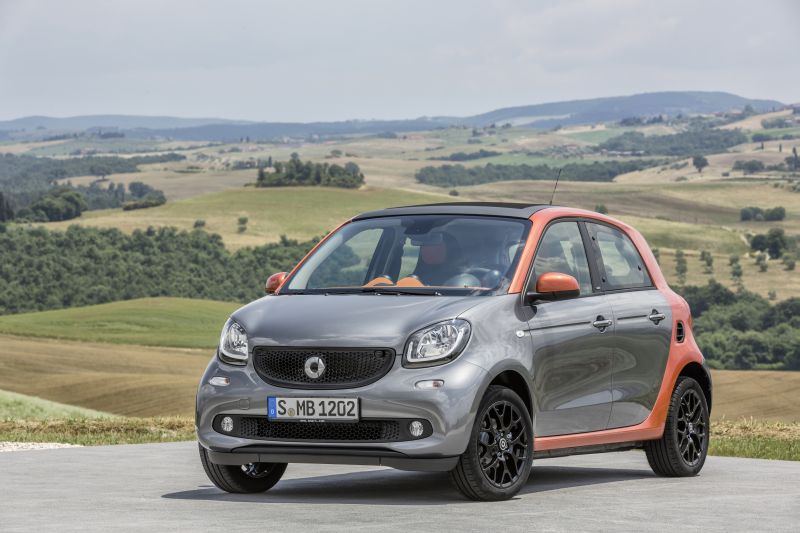
The Smart Forfour II (W453) Brabus 0.9 (109 Hp) Twinamic represents a unique offering in the microcar segment, particularly within the European market. Produced from July 2016 to March 2018, this model is a performance-oriented variant of the second-generation Forfour, a five-door hatchback designed for urban mobility. While Smart vehicles were never widely sold in the United States, the Forfour, and especially the Brabus-tuned version, highlights the brand’s focus on efficient packaging, nimble handling, and surprisingly spirited performance for its size. This article details the technical specifications and characteristics of this specific Forfour variant.
Smart Forfour II (W453) Brabus 0.9: An Overview
The Forfour II, developed under Daimler AG ownership, aimed to provide a more practical and versatile alternative to the two-seater Smart Fortwo. The Brabus variant, as detailed here, elevates the Forfour with a tuned engine, sportier styling cues, and enhanced driving dynamics. It’s important to note that the Forfour was primarily marketed in Europe, where its compact dimensions and fuel efficiency were highly valued in congested city environments. The Brabus model catered to drivers seeking a more engaging driving experience without sacrificing the practicality of a five-door hatchback.
Engine & Performance
At the heart of the Forfour II Brabus 0.9 lies a 898 cc (54.8 cu. in.) inline three-cylinder petrol engine, designated M 281.910. This engine is turbocharged and intercooled, producing 109 horsepower at 5750 rpm and 170 Nm (125.39 lb.-ft.) of torque at 2000 rpm. This translates to a power-to-liter ratio of 121.4 hp/l. The engine is paired with a six-speed automatic transmission, branded ‘Twinamic’, which contributes to a relatively quick acceleration time of 10.5 seconds for the 0-100 km/h (0-62 mph) sprint, and 10 seconds to 60 mph. The Forfour Brabus achieves a maximum speed of 180 km/h (111.85 mph). Fuel economy is a strong point, with combined cycle consumption rated at 4.6 l/100 km (51.1 US mpg, 61.4 UK mpg), and CO2 emissions of 104 g/km, meeting Euro 6 emission standards. The weight-to-power ratio is 10 kg/Hp, and the weight-to-torque ratio is 6.4 kg/Nm.
Design & Features
The Smart Forfour II is a five-door hatchback, offering seating for five passengers. Its compact dimensions – 3525 mm (138.78 in.) in length and 1665 mm (65.55 in.) in width – make it exceptionally maneuverable in urban settings. The Brabus variant typically features distinctive styling elements, including sportier bumpers, side skirts, a rear diffuser, and unique alloy wheels (6J x 17 and 7J x 17). Inside, the Brabus trim often includes upgraded upholstery, sport seats, and Brabus-specific badging. Trunk space is configurable, offering a minimum of 185 liters (6.53 cu. ft.) with the rear seats up and expanding to 975 liters (34.43 cu. ft.) with the seats folded down. Safety features include ABS (Anti-lock braking system) and electric power steering. The Forfour’s design prioritizes practicality and efficient use of space, making it a suitable vehicle for city dwellers.
Technical Specifications
| Brand | Smart |
| Model | Forfour |
| Generation | Forfour II (W453) |
| Type (Engine) | Brabus 0.9 (109 Hp) Twinamic |
| Start of production | July, 2016 |
| End of production | March, 2018 |
| Powertrain Architecture | Internal Combustion engine |
| Body type | Hatchback |
| Seats | 5 |
| Doors | 5 |
| Fuel consumption (urban) | 5.4 l/100 km (43.6 US mpg, 52.3 UK mpg, 18.5 km/l) |
| Fuel consumption (extra urban) | 4.2 l/100 km (56 US mpg, 67.3 UK mpg, 23.8 km/l) |
| Fuel consumption (combined) | 4.6 l/100 km (51.1 US mpg, 61.4 UK mpg, 21.7 km/l) |
| CO2 emissions | 104 g/km |
| Fuel Type | Petrol (Gasoline) |
| Acceleration 0 – 100 km/h | 10.5 sec |
| Acceleration 0 – 62 mph | 10.5 sec |
| Acceleration 0 – 60 mph | 10 sec |
| Maximum speed | 180 km/h (111.85 mph) |
| Emission standard | Euro 6 |
| Weight-to-power ratio | 10 kg/Hp |
| Weight-to-torque ratio | 6.4 kg/Nm |
| Power | 109 Hp @ 5750 rpm |
| Power per litre | 121.4 Hp/l |
| Torque | 170 Nm @ 2000 rpm (125.39 lb.-ft. @ 2000 rpm) |
| Engine layout | Rear, Transverse |
| Engine Model/Code | M 281.910 |
| Engine displacement | 898 cm3 (54.8 cu. in.) |
| Number of cylinders | 3 |
| Engine configuration | Inline |
| Cylinder Bore | 72.2 mm (2.84 in.) |
| Piston Stroke | 73.1 mm (2.88 in.) |
| Compression ratio | 9.5:1 |
| Fuel injection system | Multi-port manifold injection |
| Engine aspiration | Turbocharger, Intercooler |
| Engine oil capacity | 4.3 l (4.54 US qt | 3.78 UK qt) |
| Coolant | 10.9 l (11.52 US qt | 9.59 UK qt) |
| Kerb Weight | 1095 kg (2414.06 lbs.) |
| Max. weight | 1460 kg (3218.75 lbs.) |
| Max load | 365 kg (804.69 lbs.) |
| Trunk (boot) space – minimum | 185 l (6.53 cu. ft.) |
| Trunk (boot) space – maximum | 975 l (34.43 cu. ft.) |
| Fuel tank capacity | 35 l (9.25 US gal | 7.7 UK gal) |
| Length | 3525 mm (138.78 in.) |
| Width | 1665 mm (65.55 in.) |
| Height | 1543 mm (60.75 in.) |
| Wheelbase | 2494 mm (98.19 in.) |
| Front track | 1455 mm (57.28 in.) |
| Rear (Back) track | 1414 mm (55.67 in.) |
| Minimum turning circle | 8.65 m (28.38 ft.) |
| Drivetrain Architecture | Rear wheel drive |
| Number of gears | 6 gears, automatic transmission Twinamic |
| Front suspension | Independent, type McPherson with coil spring and anti-roll bar |
| Rear suspension | Independent coil spring |
| Front brakes | Ventilated discs |
| Rear brakes | Drum |
| Steering type | Steering rack and pinion |
| Power steering | Electric Steering |
| Tires size | 185/45 R17; 205/40 R17 |
| Wheel rims size | 6J x 17; 7J x 17 |
In conclusion, the Smart Forfour II Brabus 0.9 (109 Hp) Twinamic offered a compelling package for urban drivers seeking a stylish, efficient, and surprisingly engaging microcar. While not officially sold in the US market, it represents a significant example of European automotive engineering focused on maximizing space and minimizing environmental impact.