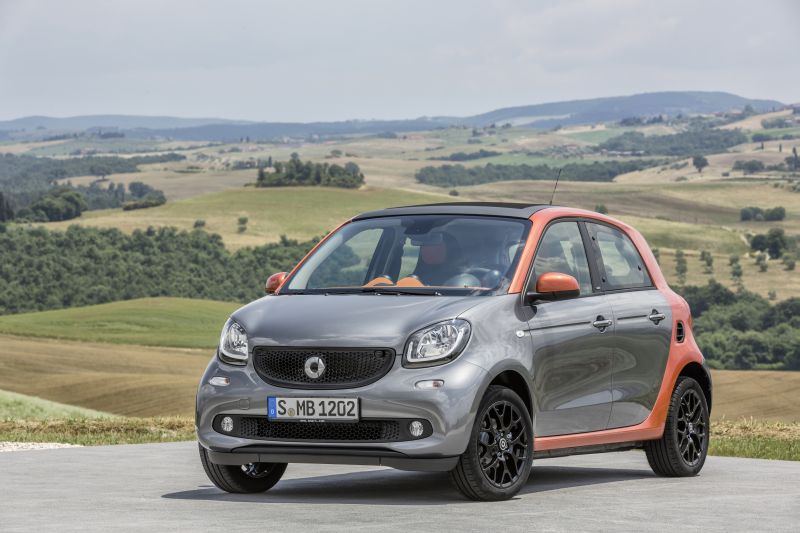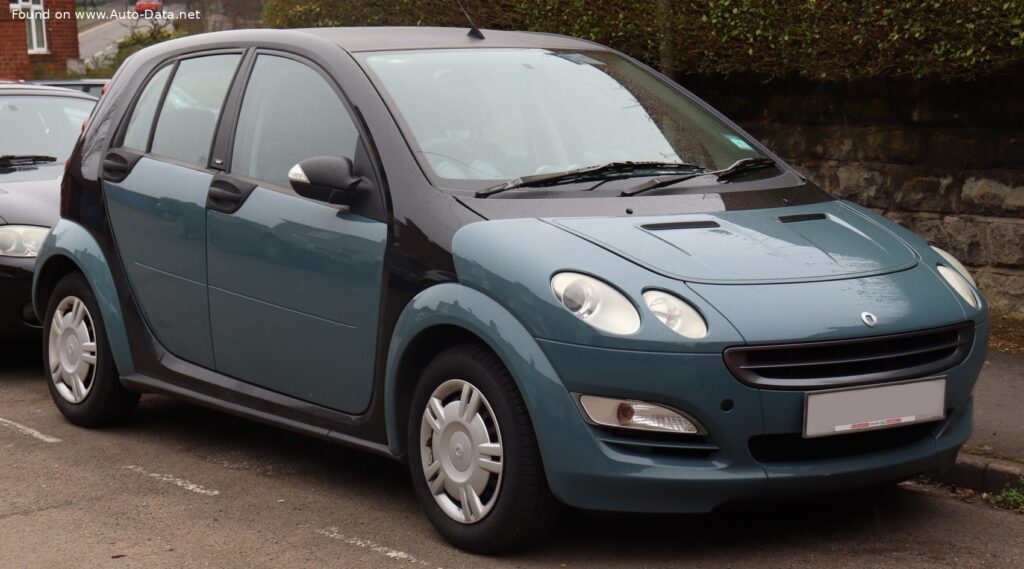
The Smart Forfour (W454) 1.1i, produced between 2004 and 2006, represents a significant, though ultimately short-lived, expansion of the Smart city car brand. Unlike the iconic Smart Fortwo, the Forfour was designed to accommodate four passengers and offered a more conventional hatchback body style. Developed under the ownership of Mercedes-Benz, the W454 Forfour aimed to broaden Smart’s appeal beyond the niche market of ultra-compact urban vehicles, particularly in Europe where small, efficient cars are highly valued. While not officially sold in the United States, understanding the Forfour provides insight into Smart’s ambitions and engineering capabilities during this period.
Smart Forfour (W454) 1.1i: A Detailed Overview
The Forfour was a collaborative project with Mitsubishi Motors, sharing its platform with the Mitsubishi Colt. This partnership allowed Smart to enter the subcompact segment relatively quickly and cost-effectively. The W454 generation Forfour was positioned as a practical and economical city car, emphasizing fuel efficiency and maneuverability. It distinguished itself from the Fortwo by offering increased interior space and passenger capacity, making it suitable for small families or individuals needing occasional rear-seat access. Despite its intentions, the Forfour struggled to gain significant market share and production ceased after only two years, largely due to financial losses and concerns about profitability.
Engine & Performance
The 1.1-liter inline-three cylinder engine, designated M 134.911, is the heart of the Forfour 1.1i. This naturally aspirated engine produces 64 horsepower at 5500 rpm and 92 Nm (67.86 lb.-ft.) of torque at 2500 rpm. While not a performance powerhouse, the engine was designed for efficiency and drivability in urban environments. Power per liter is rated at 56.9 hp/l. The engine utilizes a multi-port manifold fuel injection system and an overhead camshaft (OHC) valvetrain with two valves per cylinder. Acceleration from 0 to 60 mph takes approximately 14.5 seconds, and 0-100 km/h is achieved in 15.3 seconds. The Forfour 1.1i reaches a maximum speed of 158 km/h (98.18 mph). The drivetrain is front-wheel drive, coupled with a five-speed manual transmission. The weight-to-power ratio is 15.1 kg/Hp, and the weight-to-torque ratio is 10.5 kg/Nm.
Design & Features
The Smart Forfour W454 is a five-door hatchback, offering relatively easy access to both front and rear seats. Its compact dimensions – 3752 mm (147.72 in.) in length, 1684 mm (66.3 in.) in width, and 1450 mm (57.09 in.) in height – make it easy to maneuver and park in congested city streets. The wheelbase measures 2500 mm (98.43 in.). The interior, while basic, was designed to maximize space utilization. Rear seats can be folded down to increase cargo capacity from a minimum of 268 liters (9.46 cu. ft.) to a maximum of 910 liters (32.14 cu. ft.). Safety features for the time included ABS (Anti-lock Braking System) and front and rear disc brakes. The Forfour’s design prioritized practicality and functionality over outright style, reflecting its intended role as an affordable and efficient city car. The kerb weight is 965 kg (2127.46 lbs), with a maximum permissible weight of 1450 kg (3196.7 lbs) and a maximum load capacity of 485 kg (1069.24 lbs).
Technical Specifications
| Specification | Value |
| Brand | Smart |
| Model | Forfour |
| Generation | Forfour (W454) |
| Type (Engine) | 1.1i (64 Hp) |
| Start of production | 2004 |
| End of production | 2006 |
| Powertrain Architecture | Internal Combustion engine |
| Body type | Hatchback |
| Seats | 4 |
| Doors | 5 |
| Fuel consumption (urban) | 6.9 l/100 km (34.1 US mpg, 40.9 UK mpg, 14.5 km/l) |
| Fuel consumption (extra urban) | 4.5 l/100 km (52.3 US mpg, 62.8 UK mpg, 22.2 km/l) |
| Fuel consumption (combined) | 5.4 l/100 km (43.6 US mpg, 52.3 UK mpg, 18.5 km/l) |
| Fuel Type | Petrol (Gasoline) |
| Acceleration 0 – 100 km/h | 15.3 sec |
| Acceleration 0 – 62 mph | 15.3 sec |
| Acceleration 0 – 60 mph | 14.5 sec |
| Maximum speed | 158 km/h (98.18 mph) |
| Emission standard | Euro 4 |
| Weight-to-power ratio | 15.1 kg/Hp |
| Weight-to-torque ratio | 10.5 kg/Nm |
| Power | 64 Hp @ 5500 rpm |
| Torque | 92 Nm @ 2500 rpm (67.86 lb.-ft. @ 2500 rpm) |
| Engine Model/Code | M 134.911 |
| Engine displacement | 1124 cm3 (68.59 cu. in.) |
| Number of cylinders | 3 |
| Engine configuration | Inline |
| Number of valves per cylinder | 2 |
| Fuel injection system | Multi-port manifold injection |
| Engine aspiration | Naturally aspirated |
| Engine oil capacity | 3.5 l (3.7 US qt | 3.08 UK qt) |
| Coolant capacity | 4.2 l (4.44 US qt | 3.7 UK qt) |
| Kerb Weight | 965 kg (2127.46 lbs) |
| Max. weight | 1450 kg (3196.7 lbs) |
| Max load | 485 kg (1069.24 lbs) |
| Trunk (boot) space – minimum | 268 l (9.46 cu. ft.) |
| Trunk (boot) space – maximum | 910 l (32.14 cu. ft.) |
| Length | 3752 mm (147.72 in.) |
| Width | 1684 mm (66.3 in.) |
| Height | 1450 mm (57.09 in.) |
| Wheelbase | 2500 mm (98.43 in.) |
| Drivetrain | Front wheel drive |
| Number of gears | 5 |
| Gearbox type | Manual transmission |
| Front brakes | Disc |
| Rear brakes | Disc |
| Assisting systems | ABS (Anti-lock braking system) |
| Tires size | 175/65 R14 |
In conclusion, the Smart Forfour (W454) 1.1i, while a commercial disappointment, represents an interesting chapter in Smart’s history. It demonstrated the brand’s ambition to expand beyond the microcar segment and offer a more practical, family-oriented vehicle. Despite its limited production run, the Forfour remains a notable example of early 21st-century small car design and engineering.