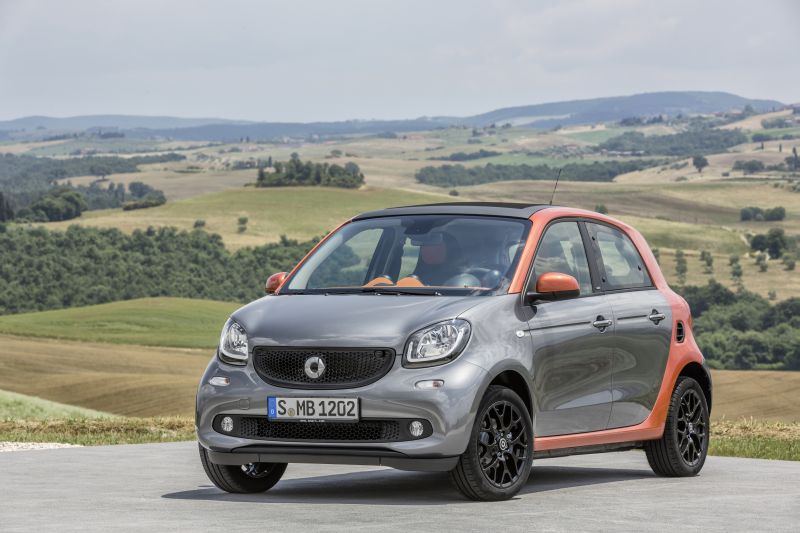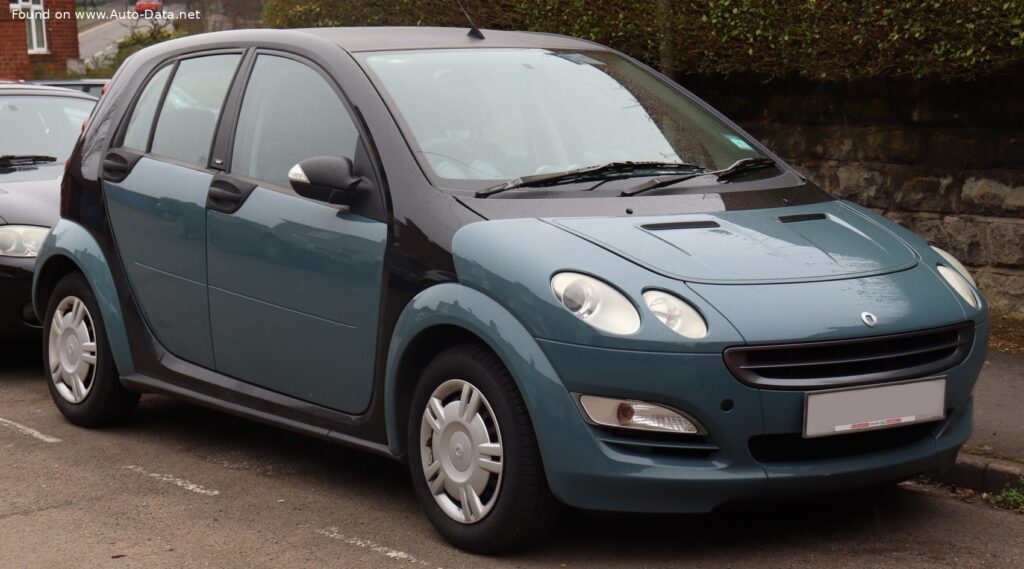
The Smart Forfour (W454) 1.3i, producing 95 horsepower, represents a unique chapter in the history of the Smart marque. Introduced in 2004 and produced until 2006, this model was a significant departure for Smart, being the first four-door, four-seater vehicle offered by the brand. While Smart is widely recognized in North America for the diminutive Fortwo, the Forfour was primarily aimed at the European market, offering a more practical and family-oriented option within the microcar segment. It was designed to compete with vehicles like the Fiat Panda and Renault Twingo, providing an alternative for urban drivers seeking a compact and efficient vehicle.
Smart Forfour (W454) 1.3i: A Detailed Overview
The W454 Forfour was the result of a collaboration between Smart and Mitsubishi Motors. It shared its platform with the Mitsubishi Colt, a decision that allowed Smart to expand its model range without incurring the substantial costs of developing an entirely new architecture. This collaboration was a key factor in bringing a larger, more versatile Smart vehicle to market. The Forfour aimed to address criticisms leveled at the Fortwo regarding its limited passenger and cargo capacity, while still maintaining the core Smart values of fuel efficiency and maneuverability.
Engine & Performance
The 1.3i Forfour is powered by a 1.3-liter inline three-cylinder gasoline engine, designated M 135.930. This engine produces 95 horsepower at 6000 rpm and 125 Nm (92.2 lb.-ft.) of torque at 4000 rpm. While not a performance powerhouse, the engine provides adequate power for urban driving and short trips. The power-to-weight ratio of 10.2 kg/Hp (98.4 Hp/tonne) reflects the vehicle’s relatively lightweight construction. Acceleration from 0 to 100 km/h (0-62 mph) takes 10.8 seconds, and 0 to 60 mph is achieved in approximately 10.3 seconds. The Forfour has a maximum speed of 180 km/h (111.85 mph). Fuel economy is a strong point, with combined cycle consumption rated at 5.8 l/100 km (40.6 US mpg, 48.7 UK mpg, 17.2 km/l). The engine utilizes a multi-port manifold fuel injection system and an overhead camshaft (OHC) valvetrain.
Design & Features
The Smart Forfour (W454) is a five-door hatchback, offering seating for four adults. Its compact dimensions – 3752 mm (147.72 in.) in length and 1684 mm (66.3 in.) in width – make it exceptionally maneuverable in congested city environments. The design, while functional, is relatively understated compared to the more distinctive styling of the Fortwo. The interior prioritizes practicality, with a focus on maximizing space within the vehicle’s small footprint. Trunk space ranges from 268 liters (9.46 cu. ft.) with the rear seats up to 910 liters (32.14 cu. ft.) with the rear seats folded down. Safety features for the time included ABS (Anti-lock Braking System) and front and rear disc brakes. The Forfour’s design was a compromise between maximizing interior space and maintaining the Smart brand’s focus on compact city cars. The vehicle’s kerb weight is 965 kg (2127.46 lbs), with a maximum permissible weight of 1450 kg (3196.7 lbs).
Technical Specifications
| Specification | Value |
| Brand | Smart |
| Model | Forfour |
| Generation | Forfour (W454) |
| Type (Engine) | 1.3i (95 Hp) |
| Start of production | 2004 |
| End of production | 2006 |
| Powertrain Architecture | Internal Combustion engine |
| Body type | Hatchback |
| Seats | 4 |
| Doors | 5 |
| Fuel consumption (urban) | 7.4 l/100 km (31.8 US mpg, 38.2 UK mpg, 13.5 km/l) |
| Fuel consumption (extra urban) | 4.8 l/100 km (49 US mpg, 58.9 UK mpg, 20.8 km/l) |
| Fuel consumption (combined) | 5.8 l/100 km (40.6 US mpg, 48.7 UK mpg, 17.2 km/l) |
| Fuel Type | Petrol (Gasoline) |
| Acceleration 0 – 100 km/h | 10.8 sec |
| Acceleration 0 – 62 mph | 10.8 sec |
| Acceleration 0 – 60 mph | 10.3 sec |
| Maximum speed | 180 km/h (111.85 mph) |
| Emission standard | Euro 4 |
| Weight-to-power ratio | 10.2 kg/Hp, 98.4 Hp/tonne |
| Weight-to-torque ratio | 7.7 kg/Nm, 129.5 Nm/tonne |
| Power | 95 Hp @ 6000 rpm |
| Power per litre | 71.3 Hp/l |
| Torque | 125 Nm @ 4000 rpm (92.2 lb.-ft. @ 4000 rpm) |
| Engine Model/Code | M 135.930 |
| Engine displacement | 1332 cm3 (81.28 cu. in.) |
| Number of cylinders | 3 |
| Engine configuration | Inline |
| Number of valves per cylinder | 2 |
| Fuel injection system | Multi-port manifold injection |
| Engine aspiration | Naturally aspirated engine |
| Valvetrain | OHC |
| Engine oil capacity | 4.5 l (4.76 US qt | 3.96 UK qt) |
| Coolant capacity | 4.6 l (4.86 US qt | 4.05 UK qt) |
| Kerb Weight | 965 kg (2127.46 lbs.) |
| Max. weight | 1450 kg (3196.7 lbs.) |
| Max load | 485 kg (1069.24 lbs.) |
| Trunk (boot) space – minimum | 268 l (9.46 cu. ft.) |
| Trunk (boot) space – maximum | 910 l (32.14 cu. ft.) |
| Fuel tank capacity | 47 l (12.42 US gal | 10.34 UK gal) |
| Length | 3752 mm (147.72 in.) |
| Width | 1684 mm (66.3 in.) |
| Height | 1450 mm (57.09 in.) |
| Wheelbase | 2500 mm (98.43 in.) |
| Drivetrain Architecture | Front wheel drive |
| Number of gears and type of gearbox | 5 gears, manual transmission |
| Front brakes | Disc |
| Rear brakes | Disc |
| Assisting systems | ABS (Anti-lock braking system) |
| Tires size | 175/65 R14 |
The Smart Forfour (W454) 1.3i, despite its relatively short production run, represents an important step in the evolution of the Smart brand. It demonstrated the company’s willingness to expand beyond the microcar niche and offer a more practical vehicle to a wider audience. While it didn’t achieve the same iconic status as the Fortwo, the Forfour remains a noteworthy example of innovative urban transportation.