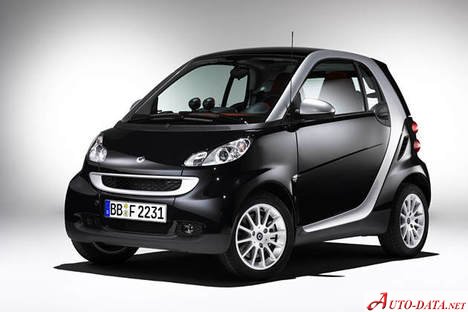
The Smart Fortwo II coupe (C451), specifically the 1.0i (71 Hp) Automatic variant, represents a significant iteration in the evolution of the world’s smallest production automobiles. Produced from 2007 to 2014, this generation of the Fortwo aimed to refine the urban mobility concept pioneered by its predecessor. While not officially sold in the United States during this period, the Fortwo found considerable success in Europe as a niche vehicle designed for congested city environments, offering a unique solution to parking and fuel efficiency challenges. The C451 brought improvements in safety, build quality, and overall refinement compared to the first generation, solidifying the Fortwo’s position as a distinctive and recognizable microcar.
Smart Fortwo II Coupe (C451): A Detailed Overview
The Smart Fortwo II, designated internally as the C451, was a pivotal model for the brand. It represented a move towards greater practicality and a broader appeal within the European market. The 1.0i Automatic version, powered by a small three-cylinder engine, was a popular choice for drivers prioritizing ease of use and fuel economy. The Fortwo’s defining characteristic remained its diminutive size, making it exceptionally maneuverable in tight urban spaces and simplifying parking in crowded cities. The C451 also introduced a more conventional aesthetic compared to the first generation, appealing to a wider range of tastes.
Engine & Performance
The heart of the Smart Fortwo II coupe 1.0i Automatic is a 999 cc (60.96 cubic inches) three-cylinder petrol engine, producing 71 horsepower. This naturally aspirated engine, designated M 132.910, delivers its power to the rear wheels via a five-speed automatic transmission. While not designed for outright speed, the powertrain provides adequate performance for urban driving. The engine’s power-to-weight ratio of 10.6 kg/Hp (94.7 Hp/tonne) contributes to a surprisingly lively driving experience, especially considering the vehicle’s size and weight. The Fortwo II 1.0i can achieve a maximum speed of 145 km/h (90.1 mph). Fuel economy is a key strength, with combined fuel consumption rated at 4.7 l/100 km (50 US mpg, 60.1 UK mpg, 21.3 km/l). This efficiency is further enhanced by the vehicle’s lightweight construction and aerodynamic design.
Design & Features
The Smart Fortwo II coupe is a two-door, two-seater vehicle characterized by its exceptionally short length of 2695 mm (106.1 inches). The body style is a coupe, offering a relatively enclosed cabin. The C451 generation featured a more refined exterior design compared to its predecessor, with smoother lines and a more integrated appearance. Safety features, while limited by the vehicle’s size, were improved in the C451. The inclusion of ABS (Anti-lock Braking System) was standard, enhancing braking performance and stability. The interior, though compact, was designed to maximize space and comfort for its two occupants. Trunk space, while modest, ranges from 220 liters (7.77 cu. ft.) to 340 liters (12.01 cu. ft.) depending on the rear seats configuration. The Fortwo’s unique tridion safety cell – a high-strength steel frame – provides a robust protective structure in the event of a collision.
Technical Specifications
| Brand | Smart |
| Model | Fortwo |
| Generation | Fortwo II coupe (C451) |
| Type (Engine) | 1.0i (71 Hp) Automatic |
| Start of production | 2007 |
| End of production | 2014 |
| Powertrain Architecture | Internal Combustion engine |
| Body type | Coupe |
| Seats | 2 |
| Doors | 2 |
| Fuel consumption (urban) | 6.1 l/100 km (38.6 US mpg, 46.3 UK mpg, 16.4 km/l) |
| Fuel consumption (extra urban) | 4 l/100 km (58.8 US mpg, 70.6 UK mpg, 25 km/l) |
| Fuel consumption (combined) | 4.7 l/100 km (50 US mpg, 60.1 UK mpg, 21.3 km/l) |
| Fuel Type | Petrol (Gasoline) |
| Maximum speed | 145 km/h (90.1 mph) |
| Emission standard | Euro 4 |
| Weight-to-power ratio | 10.6 kg/Hp |
| Power | 71 Hp |
| Power per litre | 71.1 Hp/l |
| Engine Model/Code | M 132.910 |
| Engine displacement | 999 cm3 (60.96 cu. in.) |
| Engine aspiration | Naturally aspirated engine |
| Engine oil capacity | 3.7 l (3.91 US qt | 3.26 UK qt) |
| Kerb Weight | 750 kg (1653.47 lbs.) |
| Max. weight | 1020 kg (2248.72 lbs.) |
| Max load | 270 kg (595.25 lbs.) |
| Trunk (boot) space – minimum | 220 l (7.77 cu. ft.) |
| Trunk (boot) space – maximum | 340 l (12.01 cu. ft.) |
| Fuel tank capacity | 33 l (8.72 US gal | 7.26 UK gal) |
| Length | 2695 mm (106.1 in.) |
| Width | 1559 mm (61.38 in.) |
| Height | 1542 mm (60.71 in.) |
| Wheelbase | 1867 mm (73.5 in.) |
| Drivetrain Architecture | Rear wheel drive, Internal Combustion engine |
| Drive wheel | Rear wheel drive |
| Number of gears and type of gearbox | 5 gears, automatic transmission |
| Front brakes | Disc |
| Rear brakes | Disc |
| Assisting systems | ABS (Anti-lock braking system) |
| Tires size | 155/60 R15; 175/55 R15 |
| Wheel rims size | 15 |
The Smart Fortwo II coupe (C451) 1.0i Automatic remains a compelling example of innovative urban transportation. Its compact size, fuel efficiency, and unique design continue to attract a dedicated following, particularly in European cities where its maneuverability and parking advantages are highly valued. While not a performance vehicle, the Fortwo offers a practical and enjoyable driving experience for those seeking a minimalist and efficient mode of transport.