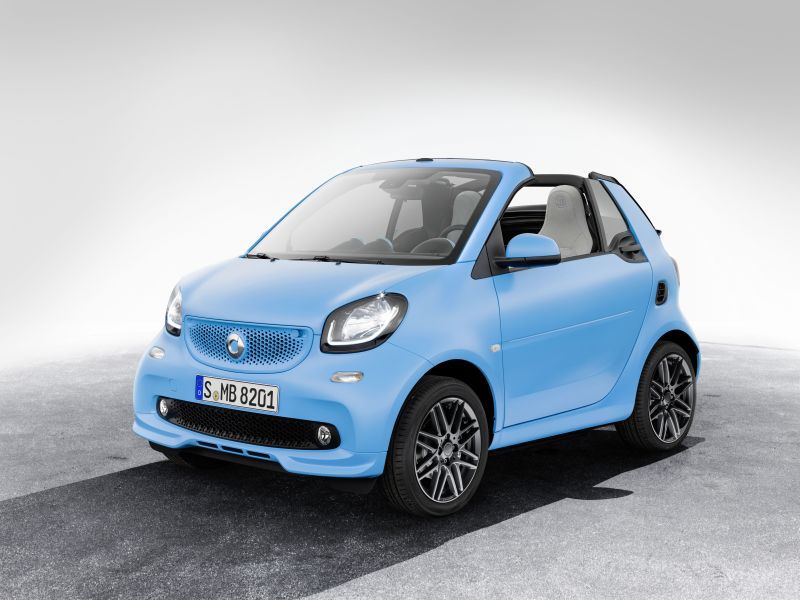
The Smart Fortwo III Cabrio (A453) represents a unique entry in the microcar segment, particularly notable for its fully electric variant. Produced from 2017 to 2018, this generation of the Fortwo Cabrio aimed to provide an environmentally conscious and urban-focused transportation solution. While Smart vehicles were never widely sold in the United States after 2012, the Fortwo III, and specifically the electric Cabrio, represents a significant step in the brand’s commitment to electric mobility, primarily targeting European markets where demand for compact, efficient vehicles is high. This article details the specifications and characteristics of the 17.6 kWh (82 Hp) electric drive version of the A453 Fortwo Cabrio.
Smart Fortwo III Cabrio (A453): An Overview
The Smart Fortwo III, launched in 2014, was a significant redesign of the iconic city car. The Cabrio version offered open-air driving enjoyment in a remarkably small package. The A453 generation brought improvements in safety, fuel efficiency (for gasoline models), and overall refinement. The introduction of the electric powertrain in 2017 further solidified Smart’s position as a pioneer in urban electric mobility. The Fortwo Cabrio’s primary appeal lay in its maneuverability, ease of parking, and reduced environmental impact, making it ideal for congested city environments. The limited production run of the electric Cabrio adds to its collectibility and represents an early example of a mass-market electric convertible.
Engine & Performance
The Smart Fortwo III Cabrio (A453) 17.6 kWh electric drive is powered by a single electric motor located on the rear axle. This motor delivers a maximum power output of 82 horsepower (Hp) and 160 Newton-meters (118.01 lb.-ft.) of torque. The powertrain architecture is a Battery Electric Vehicle (BEV), meaning it relies solely on electricity for propulsion. Acceleration from 0 to 100 km/h (0-62 mph) takes 11.8 seconds, while 0 to 60 mph is achieved in approximately 11.2 seconds. The top speed is electronically limited to 130 km/h (80.78 mph). The weight-to-power ratio is 12.7 kg/Hp, and the weight-to-torque ratio is 6.5 kg/Nm, indicating a relatively efficient power delivery for its size and weight. The rear-wheel-drive configuration contributes to its nimble handling characteristics.
Design & Features
The Smart Fortwo III Cabrio is a two-seater, two-door convertible. Its compact dimensions – a length of 2695 mm (106.1 in.), a width of 1663 mm (65.47 in.), and a height of 1553 mm (61.14 in.) – are central to its appeal. The retractable fabric roof allows for open-air driving, enhancing the sense of spaciousness despite the car’s small footprint. The interior, while minimalist, is functional and features basic amenities. Safety features include ABS (Anti-lock Braking System), essential for a vehicle designed for urban driving. The car’s kerb weight is 1040 kg (2292.81 lbs.), with a maximum weight of 1320 kg (2910.1 lbs.). Trunk space ranges from 260 liters (9.18 cu. ft.) to 340 liters (12.01 cu. ft.) depending on the roof position. The suspension utilizes an independent McPherson strut setup at the front and a De-Dion axle at the rear, providing a comfortable ride despite the short wheelbase.
Technical Specifications
| General Information | |
| Brand | Smart |
| Model | Fortwo |
| Generation | Fortwo III cabrio (A453) |
| Type (Engine) | 17.6 kWh (82 Hp) electric drive |
| Start of production | 2017 |
| End of production | February, 2018 |
| Powertrain Architecture | BEV (Electric Vehicle) |
| Body type | Cabriolet |
| Seats | 2 |
| Doors | 2 |
| Performance Specs | |
| Fuel Type | Electricity |
| Acceleration 0 – 100 km/h | 11.8 sec |
| Acceleration 0 – 62 mph | 11.8 sec |
| Acceleration 0 – 60 mph | 11.2 sec |
| Maximum speed | 130 km/h (80.78 mph) |
| Weight-to-power ratio | 12.7 kg/Hp |
| Weight-to-torque ratio | 6.5 kg/Nm |
| Electric Car Specs | |
| Gross battery capacity | 17.6 kWh |
| Net (usable) battery capacity | 16.7 kWh |
| Battery technology | Lithium-ion (Li-Ion) |
| Battery location | Below the floor |
| All-electric range (NEDC) | 155 km (96.31 mi) |
| Average Energy consumption (NEDC) | 13 kWh/100 km (20.92 kWh/100 mi) |
| MPGe | 161 |
| km/kWh | 7.7 |
| mi/kWh | 4.8 |
| Electric motor power | 82 Hp |
| Electric motor Torque | 160 Nm (118.01 lb.-ft.) |
| Electric motor location | Rear axle, Transverse |
| System power | 82 Hp |
| System torque | 160 Nm (118.01 lb.-ft.) |
| Space, Volume and Weights | |
| Kerb Weight | 1040 kg (2292.81 lbs.) |
| Max. weight | 1320 kg (2910.1 lbs.) |
| Max load | 280 kg (617.29 lbs.) |
| Trunk (boot) space – minimum | 260 l (9.18 cu. ft.) |
| Trunk (boot) space – maximum | 340 l (12.01 cu. ft.) |
| Dimensions | |
| Length | 2695 mm (106.1 in.) |
| Width | 1663 mm (65.47 in.) |
| Height | 1553 mm (61.14 in.) |
| Wheelbase | 1873 mm (73.74 in.) |
| Front track | 1469 mm (57.83 in.) |
| Rear (Back) track | 1430 mm (56.3 in.) |
| Minimum turning circle | 6.95 m (22.8 ft.) |
| Drivetrain, Brakes & Suspension | |
| Drivetrain Architecture | One electric motor drives the rear wheels. |
| Drive wheel | Rear wheel drive |
| Number of gears | 1 |
| Type of gearbox | Automatic transmission |
| Front suspension | Independent type McPherson, Transverse stabilizer |
| Rear suspension | Suspension De-Dion |
| Front brakes | Ventilated discs, 258×22 mm |
| Rear brakes | Drum, 203 mm |
| Steering type | Steering rack and pinion |
| Power steering | Electric |
| Tires size (Front) | 165/65 R15 |
| Tires size (Rear) | 185/60 R15 |
| Wheel rims size (Front) | 5J x 15 |
| Wheel rims size (Rear) | 5.5J x 15 |
The Smart Fortwo III Cabrio (A453) electric drive represents a niche offering in the automotive landscape. Its compact size, electric powertrain, and convertible top combine to create a unique and appealing vehicle for urban dwellers seeking an environmentally friendly and fun-to-drive option. While its limited production run and market availability make it relatively rare, it remains a significant example of Smart’s early foray into electric mobility.