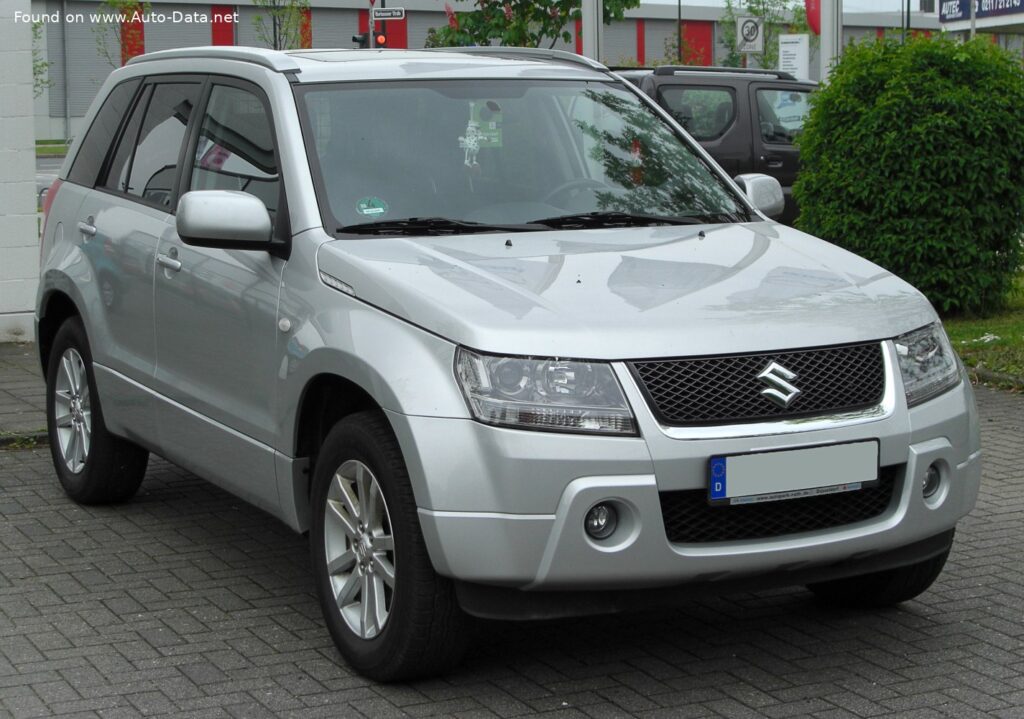
The Suzuki Grand Vitara II, specifically the five-door variant equipped with the 1.9 DDiS (129 Hp) engine, represents a significant chapter in Suzuki’s global strategy for the compact SUV segment. Launched in 2005, this second-generation Grand Vitara moved towards a more refined, car-like driving experience while retaining a respectable level of off-road capability, a hallmark of the Suzuki brand. Primarily aimed at European and Asian markets where diesel powertrains and smaller, more fuel-efficient SUVs were highly favored, the Suzuki Grand Vitara II 5 Door 1.9 DDiS (129 Hp) carved out a niche as a practical, versatile, and robust vehicle. It offered a compelling blend of everyday usability, comfortable seating for five, and the assurance of an all-wheel-drive system, making it a popular choice for families and adventurers alike from its introduction in 2005 until the end of its production run in 2008.
Evolution and Market Positioning of the Suzuki Grand Vitara II 5 Door 1.9 DDiS (129 Hp)
The Grand Vitara lineage has a storied history, originating with the Vitara in 1988, which quickly gained a reputation for its ruggedness and affordability. The second-generation Grand Vitara, introduced in 2005, marked a substantial departure from its predecessor’s more utilitarian roots. While the first generation retained a body-on-frame construction, the Grand Vitara II adopted a unibody construction integrated with a ladder frame, a design choice aimed at improving on-road handling and passenger comfort without completely sacrificing its off-road prowess. This engineering decision made the Suzuki Grand Vitara II 5 Door 1.9 DDiS (129 Hp) a more direct competitor to the growing wave of crossover SUVs, while still offering more serious 4×4 credentials than many rivals. The five-door configuration emphasized its role as a family-friendly vehicle, providing ample space for passengers and cargo, making it a practical choice in its segment.
Engine and Performance: The 1.9 DDiS Powertrain
At the heart of this particular Grand Vitara model was the 1.9-liter DDiS (Direct Diesel Injection System) engine, a four-cylinder inline diesel unit. This powertrain was specifically chosen to cater to markets where diesel fuel was prevalent and favored for its efficiency and torque characteristics. The F9Q engine, as it was internally coded, delivered a respectable 129 horsepower at 3750 revolutions per minute (rpm), making it a competitive offering for its time. More significantly, it produced a robust 221.27 pound-feet (300 Nm) of torque at a low 2000 rpm. This ample low-end torque was crucial for both confident acceleration and effective off-road performance, allowing the Grand Vitara to tackle varied terrains with ease.
The engine’s common rail fuel injection system, coupled with a turbocharger and intercooler, was state-of-the-art for the mid-2000s, contributing to its strong performance and improved fuel economy. Mated to a five-speed manual transmission, the Grand Vitara II 1.9 DDiS offered an engaging driving experience. While not a performance leader, its acceleration from 0 to 60 miles per hour in approximately 12.5 seconds and a top speed of 106.25 mph (171 km/h) were more than adequate for typical driving conditions. Fuel efficiency was a key selling point, with a combined fuel economy rating of 30.5 US miles per gallon (7.7 liters per 100 km), demonstrating the advantages of diesel technology in this segment.
Design and Features: Practicality Meets Capability
The design of the Suzuki Grand Vitara II 5 Door was a clear evolution, presenting a more contemporary and less angular aesthetic than its predecessor. Its SUV body type featured five doors and seating for five occupants, emphasizing its family-oriented appeal. With a length of 175.98 inches (4470 mm), a width of 71.26 inches (1810 mm), and a height of 66.73 inches (1695 mm), it occupied a sweet spot in the compact SUV category, offering a good balance of maneuverability and interior space. The 103.94-inch (2640 mm) wheelbase contributed to a stable ride and generous cabin room.
One of the defining features of the Grand Vitara II was its permanent all-wheel-drive (4×4) system, which included a low-range transfer case in many markets, further cementing its off-road credentials. This capability distinguished it from many softer, front-wheel-drive-based crossovers that were beginning to dominate the market. The suspension system featured spring struts at the front and coil springs at the rear, providing a comfortable ride on pavement while maintaining articulation for uneven surfaces. Braking was handled by ventilated discs at the front and drums at the rear, complemented by an Anti-lock Braking System (ABS) for enhanced safety. The 225/65 R17 tires mounted on 17-inch wheel rims provided a good balance of grip and ride comfort, suitable for both on-road and light off-road excursions.
Technical Specifications
General Information |
|
| Brand | Suzuki |
| Model | Grand Vitara |
| Generation | Grand Vitara II 5 Door |
| Type (Engine) | 1.9 DDiS (129 Hp) |
| Start of Production | 2005 year |
| End of Production | 2008 year |
| Powertrain Architecture | Internal Combustion engine |
| Body type | SUV |
| Seats | 5 |
| Doors | 5 |
Performance Specifications |
|
| Fuel consumption (economy) – urban | 9.4 l/100 km (25 US mpg) |
| Fuel consumption (economy) – extra urban | 6.7 l/100 km (35.1 US mpg) |
| Fuel consumption (economy) – combined | 7.7 l/100 km (30.5 US mpg) |
| Fuel Type | Diesel |
| Acceleration 0 – 60 mph | 12.5 sec |
| Maximum speed | 106.25 mph (171 km/h) |
| Weight-to-power ratio | 12.9 kg/Hp (77.7 Hp/tonne) |
| Weight-to-torque ratio | 5.5 kg/Nm (180.7 Nm/tonne) |
Engine Specifications |
|
| Power | 129 Hp @ 3750 rpm |
| Power per liter | 69 Hp/l |
| Torque | 221.27 lb.-ft. (300 Nm) @ 2000 rpm |
| Engine layout | Front, Longitudinal |
| Engine Model/Code | F9Q |
| Engine displacement | 1.9 liters (1870 cm3, 114.11 cu. in.) |
| Number of cylinders | 4 |
| Engine configuration | Inline |
| Cylinder Bore | 3.15 in. (80 mm) |
| Piston Stroke | 3.66 in. (93 mm) |
| Compression ratio | 17:1 |
| Fuel injection system | Diesel Commonrail |
| Engine aspiration | Turbocharger, Intercooler |
| Engine oil capacity | 5.39 US qt (5.1 l) |
| Coolant capacity | 7.93 US qt (7.5 l) |
Space, Volume and Weights |
|
| Kerb Weight | 3659.67 lbs. (1660 kg) |
| Max. weight | 4563.57 lbs. (2070 kg) |
| Max load | 903.9 lbs. (410 kg) |
| Fuel tank capacity | 17.44 US gal (66 l) |
Dimensions |
|
| Length | 175.98 in. (4470 mm) |
| Width | 71.26 in. (1810 mm) |
| Height | 66.73 in. (1695 mm) |
| Wheelbase | 103.94 in. (2640 mm) |
| Front track | 60.63 in. (1540 mm) |
| Rear (Back) track | 61.81 in. (1570 mm) |
Drivetrain, Brakes and Suspension Specifications |
|
| Drive wheel | All wheel drive (4×4) |
| Number of gears and type of gearbox | 5 gears, manual transmission |
| Front suspension | Spring Strut |
| Rear suspension | Coil spring |
| Front brakes | Ventilated discs |
| Rear brakes | Drum |
| Assisting systems | ABS (Anti-lock braking system) |
| Steering type | Steering rack and pinion |
| Tires size | 225/65 R17 |
| Wheel rims size | 17 inches |
Legacy and Market Impact
The Suzuki Grand Vitara II, particularly the 5 Door 1.9 DDiS (129 Hp) model, left a notable legacy in its primary markets. In Europe and parts of Asia, it was recognized for offering a unique proposition: a compact SUV that bridged the gap between soft-roaders and more traditional, rugged off-road vehicles. Its integrated ladder frame provided a level of durability and off-road capability that many competitors, such as the Honda CR-V, Toyota RAV4, and Nissan X-Trail of the era, could not match, especially those without a low-range transfer case. At the same time, its unibody construction and more refined interior made it a more comfortable and civilized daily driver than older, more truck-like SUVs.
The 1.9 DDiS engine was a crucial factor in its success in diesel-centric markets. It provided excellent fuel economy for its class, combined with the robust torque needed for towing or navigating challenging terrain. This combination of efficiency, capability, and Suzuki’s reputation for reliability made the Grand Vitara a strong contender. While it might not have garnered the same sales volume as some of its more mainstream competitors, it maintained a loyal following among those who valued its genuine all-wheel-drive system and rugged build quality.
The Grand Vitara II’s production run from 2005 to 2008 for this specific diesel variant saw it competing in an increasingly crowded and competitive segment. Its impact was felt in its ability to offer a more authentic SUV experience in a package that was still manageable for urban environments. It solidified Suzuki’s position as a manufacturer capable of producing capable and reliable compact SUVs, influencing subsequent models and reinforcing the brand’s image for durable, adventurous vehicles. Its blend of modern features and traditional SUV strengths ensured its place as a respected and practical choice for its target demographic.