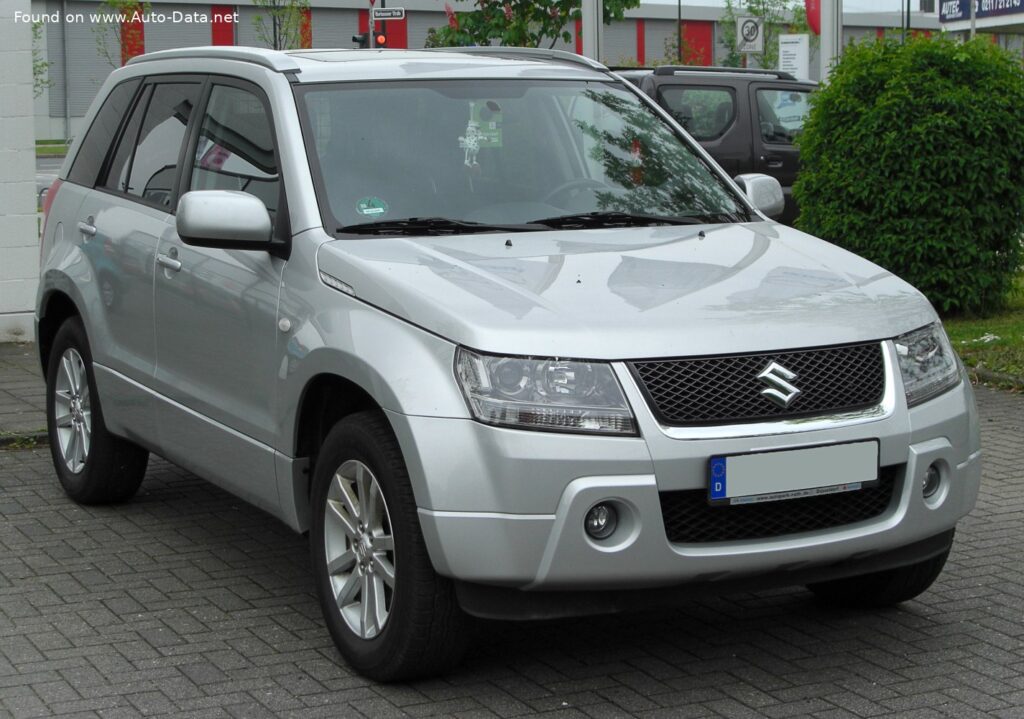
The Suzuki Grand Vitara II 5 Door 2.4 VVT (163 Hp) Automatic: A Global Compact SUV Stalwart
The Suzuki Grand Vitara II 5 Door 2.4 VVT (163 Hp) Automatic represents a significant iteration in Suzuki’s long-standing commitment to producing capable and reliable compact sport utility vehicles. Launched in 2005 and produced through 2008, this second-generation Grand Vitara, specifically the 5-door variant with the 2.4-liter VVT engine and automatic transmission, carved out a distinct niche in the highly competitive global SUV market. Renowned for its blend of on-road comfort, robust off-road capability, and Suzuki’s characteristic value proposition, the Grand Vitara II was a versatile choice for buyers seeking a vehicle equally at home in urban environments or tackling more challenging terrain. While Suzuki’s passenger car presence in the United States eventually concluded, models like the Grand Vitara left an indelible mark, demonstrating the brand’s engineering prowess and commitment to utility.
Engine & Performance: The Power of the 2.4 VVT
At the heart of the Suzuki Grand Vitara II 5 Door 2.4 VVT (163 Hp) Automatic lies its J24B engine, a naturally aspirated 2.4-liter (2393 cm3 or 146.03 cu. in.) inline-four cylinder petrol unit. This engine featured Suzuki’s Variable Valve Timing (VVT) technology, a system designed to optimize valve lift and duration for improved power delivery across the rev range and enhanced fuel efficiency. The VVT system allowed the engine to produce a respectable 163 horsepower at 6000 rpm, providing ample motivation for the compact SUV. Torque output stood at 165.95 lb-ft (225 Nm) peaking at a relatively low 3800 rpm, ensuring good pulling power for acceleration and light towing duties.
Power was delivered to all four wheels via a conventional but reliable 4-speed automatic transmission. This powertrain combination enabled the Grand Vitara II to accelerate from 0 to 60 mph in a computed 10.9 seconds, with a top speed of 105.63 mph (170 km/h). While not a performance leader, these figures were competitive for its segment, emphasizing practicality and everyday usability. Fuel economy, a critical factor for SUV buyers, was rated at a combined 25 US mpg (9.4 l/100 km), with urban consumption at 19.8 US mpg (11.9 l/100 km) and extra-urban at 29.4 US mpg (8 l/100 km). This efficiency, coupled with a 17.44 US gallon (66-liter) fuel tank, offered a decent cruising range. The engine met the Euro 4 emission standard, reflecting its compliance with contemporary environmental regulations.
Design & Features of the Grand Vitara II 5 Door
The second-generation Grand Vitara debuted with a more modern and sophisticated design compared to its predecessors, moving away from a purely utilitarian aesthetic towards a more refined, yet still rugged, appearance. The 5-door SUV body type offered practical access for passengers and cargo. Measuring 180.12 inches (4575 mm) in length, 71.26 inches (1810 mm) in width, and 66.73 inches (1695 mm) in height, the Grand Vitara II presented a compact footprint that was easy to maneuver in city traffic while still offering a commanding view of the road.
A key engineering distinction of the Grand Vitara II was its unique construction: a unibody chassis with an integrated ladder frame. This hybrid approach aimed to combine the rigidity and off-road durability of a traditional body-on-frame SUV with the improved ride comfort, handling, and crash safety of a unibody design. This made the Grand Vitara particularly capable for its class, especially when equipped with its standard full-time all-wheel-drive system (4×4), which included a low-range transfer case for serious off-road excursions. The suspension system featured spring struts at the front and coil springs at the rear, providing a balanced ride. Braking was handled by ventilated discs at the front and solid discs at the rear, complemented by an Anti-lock Braking System (ABS) for enhanced safety. The vehicle rode on 225/65 R17 tires mounted on 17-inch wheel rims, providing a good balance of grip and ride comfort.
Inside, the Suzuki Grand Vitara II 5 Door 2.4 VVT (163 Hp) Automatic offered seating for five occupants. The interior was designed with practicality and ergonomics in mind, featuring durable materials and a straightforward layout. While specific luxury features varied by market and trim level, the Grand Vitara typically included essential amenities for comfort and convenience, upholding Suzuki’s reputation for offering well-equipped vehicles at competitive price points. Its 96.06-inch (2440 mm) wheelbase contributed to a stable ride and adequate interior space for its class.
Technical Specifications
| Category | Specification |
|---|---|
| Brand | Suzuki |
| Model | Grand Vitara |
| Generation | Grand Vitara II 5 Door |
| Type (Engine) | 2.4 VVT (163 Hp) Automatic |
| Start of Production | 2005 year |
| End of Production | 2008 year |
| Powertrain Architecture | Internal Combustion engine |
| Body type | SUV |
| Seats | 5 |
| Doors | 5 |
| Performance Specs | |
| Fuel consumption (economy) – urban | 11.9 l/100 km (19.8 US mpg) |
| Fuel consumption (economy) – extra urban | 8 l/100 km (29.4 US mpg) |
| Fuel consumption (economy) – combined | 9.4 l/100 km (25 US mpg) |
| Fuel Type | Petrol (Gasoline) |
| Acceleration 0 – 60 mph | 10.9 sec |
| Maximum speed | 170 km/h (105.63 mph) |
| Emission standard | Euro 4 |
| Weight-to-power ratio | 8.9 kg/Hp (112.8 Hp/tonne) |
| Weight-to-torque ratio | 6.4 kg/Nm (155.7 Nm/tonne) |
| Engine Specs | |
| Power | 163 Hp @ 6000 rpm |
| Power per liter | 68.1 Hp/l |
| Torque | 225 Nm (165.95 lb.-ft.) @ 3800 rpm |
| Engine layout | Front, Longitudinal |
| Engine Model/Code | J24B |
| Engine displacement | 2393 cm3 (146.03 cu. in. / 2.4 Liters) |
| Number of cylinders | 4 |
| Engine configuration | Inline |
| Cylinder Bore | 92 mm (3.62 in.) |
| Piston Stroke | 90 mm (3.54 in.) |
| Compression ratio | 9.5:1 |
| Number of valves per cylinder | 4 |
| Fuel injection system | Multi-port manifold injection |
| Engine aspiration | Naturally aspirated engine |
| Valvetrain | DOHC |
| Engine oil capacity | 4.8 l (5.07 US qt) |
| Coolant | 7.3 l (7.71 US qt) |
| Space, Volume and Weights | |
| Kerb Weight | 1445 kg (3185.68 lbs.) |
| Max. weight | 1800 kg (3968.32 lbs.) |
| Max load | 355 kg (782.64 lbs.) |
| Fuel tank capacity | 66 l (17.44 US gal) |
| Dimensions | |
| Length | 4575 mm (180.12 in.) |
| Width | 1810 mm (71.26 in.) |
| Height | 1695 mm (66.73 in.) |
| Wheelbase | 2440 mm (96.06 in.) |
| Front track | 1540 mm (60.63 in.) |
| Rear (Back) track | 1570 mm (61.81 in.) |
| Drivetrain, Brakes and Suspension Specs | |
| Drive wheel | All-wheel drive (4×4) |
| Number of gears and type of gearbox | 4 gears, automatic transmission |
| Front suspension | Spring Strut |
| Rear suspension | Coil spring |
| Front brakes | Ventilated discs |
| Rear brakes | Disc |
| Assisting systems | ABS (Anti-lock braking system) |
| Steering type | Steering rack and pinion |
| Tires size | 225/65 R17 |
| Wheel rims size | 17 inches |
Legacy & Market Impact of the Suzuki Grand Vitara II
The Suzuki Grand Vitara II 5 Door 2.4 VVT (163 Hp) Automatic played a crucial role in Suzuki’s global strategy during the mid-2000s. In an era when many competitors were transitioning their compact SUVs to purely car-based unibody platforms, the Grand Vitara retained its more rugged credentials with its integrated ladder frame and sophisticated 4×4 system, making it a standout for those who valued genuine off-road capability. This unique selling proposition helped it compete against rivals like the Toyota RAV4, Honda CR-V, Nissan X-Trail (Rogue in some markets), and Subaru Forester, which often prioritized on-road manners over trail prowess.
In markets like the United States, where Suzuki had a significant, albeit niche, presence, the Grand Vitara was appreciated for its reliability, durability, and value. It offered a compelling alternative to more expensive or less capable compact SUVs. While Suzuki eventually withdrew from the US automotive market, the Grand Vitara’s reputation for being a tough, go-anywhere vehicle persisted. Its mechanical robustness and relatively simple engineering made it a favorite among owners who sought longevity and lower maintenance costs.
Globally, the Grand Vitara II reinforced Suzuki’s image as a specialist in compact SUVs and 4×4 vehicles, a legacy built on models like the original Vitara/Sidekick and Jimny. Its blend of modern design, comfortable interior, and genuine off-road chops ensured its popularity in diverse markets, from Europe to Australia and Asia. The 2.4-liter VVT engine provided a good balance of power and efficiency for its time, contributing to its broad appeal. The Grand Vitara II remains a testament to Suzuki’s engineering philosophy: building capable, dependable, and practical vehicles that punch above their weight in terms of utility and adventure readiness.