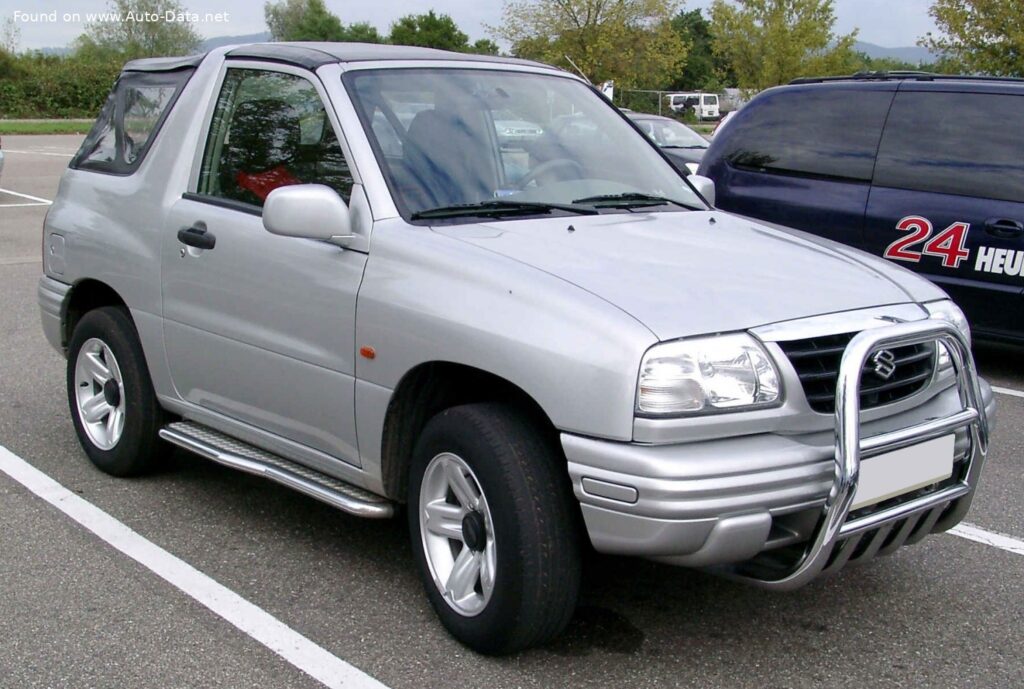
The Suzuki Grand Vitara II (facelift 2008) 3 Door: A Compact Off-Roader for Global Markets
The Suzuki Grand Vitara II, specifically the facelifted 2008 3-door model with the 1.6-liter engine and All-Wheel Drive (AWD), represents a significant iteration of Suzuki’s long-standing compact SUV lineage. While the Grand Vitara nameplate has a varied history in the United States, often sold as the Suzuki Vitara or Grand Vitara with larger engines and 5-door configurations, this particular 3-door variant with its smaller engine displacement was primarily targeted at European, Asian, and other international markets where compact dimensions, fuel efficiency, and lower taxation on smaller engines were more critical. This model, produced from September 2008 to May 2010, retained Suzuki’s renowned off-road capability in a more urban-friendly package, blending the utility of an SUV with the agility of a smaller vehicle.
The second generation Grand Vitara, launched in 2005, marked a departure from its body-on-frame predecessor (the original Vitara/Grand Vitara) by adopting a unibody construction with an integrated ladder frame. This hybrid approach aimed to improve on-road comfort and handling without completely sacrificing the ruggedness and off-road prowess that Suzuki SUVs were known for. The 2008 facelift brought subtle but meaningful updates to the exterior styling, interior finishes, and powertrain options, ensuring the Grand Vitara remained competitive in a rapidly evolving compact SUV segment. The 3-door configuration, in particular, catered to a niche market seeking a more nimble and stylistically distinct SUV, often appealing to younger buyers or those in urban environments needing occasional off-road capability.
Engine and Performance of the Suzuki Grand Vitara II (facelift 2008) 3 Door 1.6 (106 Hp) AWD
At the heart of this specific Grand Vitara II variant is Suzuki’s M16A engine, a naturally aspirated 1.6-liter (1586 cubic centimeters or 96.78 cubic inches) inline-four gasoline unit. This engine delivered a respectable 106 horsepower at 5900 rpm, paired with 106.95 lb.-ft. of torque peaking at 4100 rpm. The power output of 66.8 horsepower per liter was commendable for a naturally aspirated engine of its era, especially one designed for a more utilitarian vehicle.
The M16A engine utilized a multi-port manifold injection fuel system and featured Variable Valve Timing (VVT), a technology that optimized valve lift and duration for improved power delivery across the rev range and enhanced fuel efficiency. With a compression ratio of 10.5:1, the engine was designed to run on petrol (gasoline) and met the Euro 4 emission standard, which was a key regulatory benchmark in European markets at the time. The engine’s front, longitudinal layout contributed to the vehicle’s balanced weight distribution, a factor beneficial for both on-road dynamics and off-road traction.
Power was delivered to all four wheels via a permanent All-Wheel Drive (AWD) system, emphasizing the Grand Vitara’s commitment to genuine off-road capability, a trait that often set it apart from many contemporary crossovers that offered only part-time or demand-based AWD systems. The transmission was a 5-speed manual, offering direct engagement and control, which enthusiasts and off-road drivers often prefer for its robustness and precise gear selection. This powertrain combination resulted in a 0-60 mph acceleration time of approximately 13.7 seconds and a top speed of 99.42 mph (160 km/h). While not a performance leader, these figures were adequate for its intended purpose as a versatile and capable compact SUV.
Fuel economy for the 1.6-liter AWD model, measured under the NEDC (New European Driving Cycle) standard, was rated at 23.1 US mpg in urban conditions, 33.1 US mpg on extra-urban cycles, and a combined average of 28.7 US mpg. These figures, alongside CO2 emissions of 195 g/km, highlighted its efficiency for its class, especially considering its permanent AWD system and SUV stature.
Design and Features
The 2008 facelift of the Suzuki Grand Vitara II 3-door retained the robust yet contemporary styling of the second generation. Its SUV body type, characterized by its compact dimensions (163.39 inches long, 73.62 inches wide, and 66.73 inches high), offered a distinctive and agile presence. The 3-door configuration, with its shorter wheelbase of 96.06 inches, contributed to a tighter turning circle of 33.46 feet, enhancing maneuverability in urban settings and on tight off-road trails.
Despite its compact size, the Grand Vitara’s design emphasized its adventurous spirit. A ground clearance of 8.07 inches provided ample capability for tackling rough terrain, while the choice of tire sizes (215/70 R16 99H; 225/70 R16 102S; 225/70 R16 101H) on 6.5J x 16 wheel rims underscored its robust build. The exterior updates for the facelift included subtle revisions to the grille, bumpers, and possibly lighting elements, keeping its aesthetic fresh.
Inside, the 3-door Grand Vitara was configured with four seats, offering a practical yet cozy cabin. While the primary focus was on utility and durability, the facelift likely introduced updated trim materials and possibly enhanced infotainment options for the era. Cargo flexibility was a key feature, with a minimum trunk space of 18.22 cubic feet, expandable to a generous 34.04 cubic feet with the rear seats folded, making it surprisingly versatile for its size.
Safety features for the 2008 model year included standard ABS (Anti-lock Braking System), a crucial active safety system for preventing wheel lock-up during emergency braking. The braking system comprised ventilated discs at the front for effective stopping power and drum brakes at the rear, a common setup for compact SUVs of that period. The suspension setup featured an independent McPherson type at the front and an independent multi-link suspension at the rear, providing a balance of on-road comfort and off-road articulation. The electric power-assisted rack and pinion steering system offered light and responsive handling, aiding in both city driving and navigating challenging terrains.
Technical Specifications
| Category | Specification |
|---|---|
| Brand | Suzuki |
| Model | Grand Vitara |
| Generation | Grand Vitara II (facelift 2008) 3 Door |
| Type (Engine) | 1.6 (106 Hp) AWD |
| Start of Production | September, 2008 |
| End of Production | May, 2010 |
| Powertrain Architecture | Internal Combustion engine |
| Body type | SUV |
| Seats | 4 |
| Doors | 3 |
| Performance Specs | |
| Fuel consumption (urban NEDC) | 10.2 l/100 km (23.1 US mpg) |
| Fuel consumption (extra urban NEDC) | 7.1 l/100 km (33.1 US mpg) |
| Fuel consumption (combined NEDC) | 8.2 l/100 km (28.7 US mpg) |
| CO2 emissions (NEDC) | 195 g/km |
| Fuel Type | Petrol (Gasoline) |
| Acceleration 0 – 60 mph | 13.7 sec |
| Maximum speed | 99.42 mph (160 km/h) |
| Emission standard | Euro 4 |
| Weight-to-power ratio | 13.3 kg/Hp (75.4 Hp/tonne) |
| Weight-to-torque ratio | 9.7 kg/Nm (103.2 Nm/tonne) |
| Engine Specs | |
| Power | 106 Hp @ 5900 rpm |
| Power per liter | 66.8 Hp/l |
| Torque | 106.95 lb.-ft. @ 4100 rpm (145 Nm) |
| Engine layout | Front, Longitudinal |
| Engine Model/Code | M16A |
| Engine displacement | 1.6 Liters (1586 cm3 / 96.78 cu. in.) |
| Number of cylinders | 4 |
| Engine configuration | Inline |
| Cylinder Bore | 3.07 in. (78 mm) |
| Piston Stroke | 3.27 in. (83 mm) |
| Compression ratio | 10.5:1 |
| Number of valves per cylinder | 4 |
| Fuel injection system | Multi-port manifold injection |
| Engine aspiration | Naturally aspirated engine |
| Valvetrain | VVT |
| Engine oil capacity | 4.86 US qt (4.6 l) |
| Coolant capacity | 7.29 US qt (6.9 l) |
| Space, Volume and Weights | |
| Curb Weight | 3097.49 – 3265.05 lbs. (1405-1481 kg) |
| Max. weight (GVWR) | 4034.46 lbs. (1830 kg) |
| Max load | 769.41 – 936.96 lbs. (349-425 kg) |
| Trunk (boot) space – minimum | 18.22 cu. ft. (516 l) |
| Trunk (boot) space – maximum | 34.04 cu. ft. (964 l) |
| Fuel tank capacity | 14.53 US gal (55 l) |
| Permitted trailer load with brakes (12%) | 3527.4 lbs. (1600 kg) |
| Permitted trailer load without brakes | 1212.54 lbs. (550 kg) |
| Permitted towbar download | 187.39 lbs. (85 kg) |
| Dimensions | |
| Length | 163.39 in. (4150 mm) |
| Width | 73.62 in. (1870 mm) |
| Height | 66.73 in. (1695 mm) |
| Wheelbase | 96.06 in. (2440 mm) |
| Front track | 60.63 in. (1540 mm) |
| Rear (Back) track | 61.81 in. (1570 mm) |
| Ride height (ground clearance) | 8.07 in. (205 mm) |
| Minimum turning circle (turning diameter) | 33.46 ft. (10.2 m) |
| Drivetrain, Brakes and Suspension Specs | |
| Drivetrain Architecture | Permanent All-Wheel Drive (4×4) |
| Drive wheel | All wheel drive (4×4) |
| Number of gears and type of gearbox | 5 gears, manual transmission |
| Front suspension | Independent type McPherson |
| Rear suspension | Independent multi-link suspension |
| Front brakes | Ventilated discs |
| Rear brakes | Drum |
| Assisting systems | ABS (Anti-lock braking system) |
| Steering type | Steering rack and pinion |
| Power steering | Electric Steering |
| Tires size | 215/70 R16 99H; 225/70 R16 102S; 225/70 R16 101H |
| Wheel rims size | 6.5J x 16 |
Legacy and Market Impact
The Suzuki Grand Vitara II (facelift 2008) 3 Door 1.6 (106 Hp) AWD carved out a distinct niche in its primary markets, particularly in Europe and parts of Asia. Its reputation was built on Suzuki’s long-standing heritage of producing reliable, capable, and affordable 4×4 vehicles. Unlike many of its soft-roader competitors, the Grand Vitara offered genuine off-road capability thanks to its permanent AWD system, ample ground clearance, and robust underpinnings. This made it a popular choice for buyers who needed a vehicle that could handle more than just paved roads, whether for light off-roading, towing smaller trailers (with a maximum towing capacity of 3527.4 lbs. with brakes), or navigating challenging winter conditions.
In its segment, the 3-door Grand Vitara faced competition from a variety of vehicles. In Europe, rivals included compact SUVs like the Toyota RAV4 (though often larger and with different engine options), the Honda CR-V (again, typically larger and more road-focused), and more direct competitors like the Dacia Duster (later in its lifecycle, offering similar ruggedness at a lower price point) or even smaller off-roaders like the Suzuki Jimny (though the Jimny was far more specialized). Its unique blend of compact size, 3-door styling, and genuine AWD set it apart from the growing number of front-wheel-drive-biased crossovers.
The Grand Vitara’s historical significance lies in its role as a bridge between traditional, rugged body-on-frame SUVs and the increasingly popular unibody crossovers. Suzuki’s engineering approach with the integrated ladder frame within a unibody structure was an innovative solution for the time, attempting to offer the best of both worlds. While this specific 3-door, 1.6-liter model was never officially imported to the United States (where the larger 5-door models with V6 engines were typically offered), its global impact solidified Suzuki’s image as a manufacturer of capable and durable SUVs.
The 2008 facelift helped extend the relevance of the second-generation Grand Vitara, ensuring it continued to appeal to a loyal customer base valuing practicality, reliability, and genuine all-terrain ability over pure on-road refinement or cutting-edge technology. Its relatively straightforward mechanicals also contributed to its reputation for durability and lower maintenance costs, making it a pragmatic choice for many international buyers. Even today, these models are appreciated in the used car market for their robust construction and off-road prowess, a testament to Suzuki’s engineering philosophy.