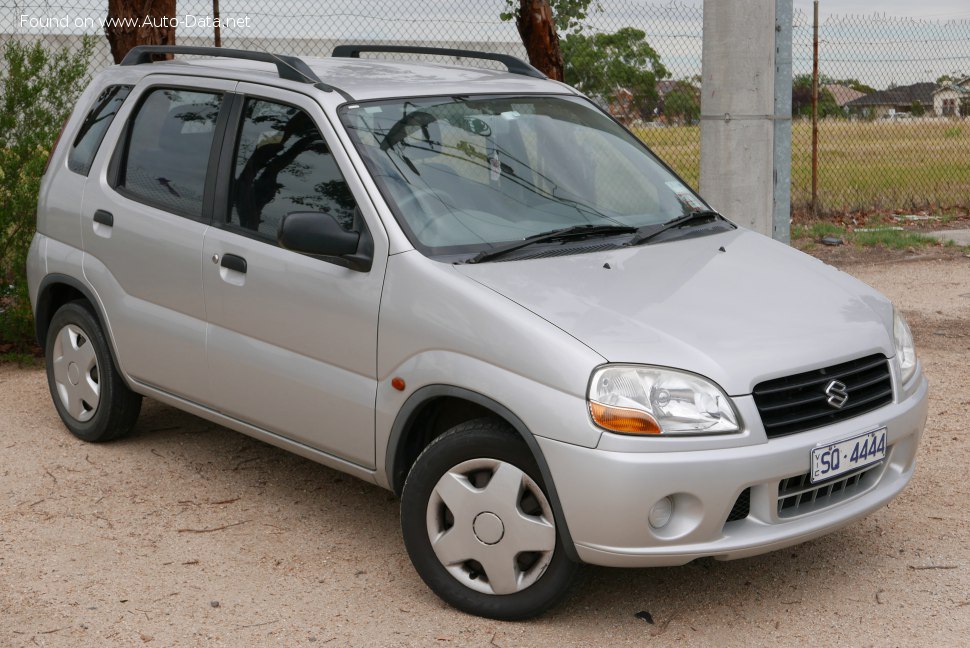
The Suzuki Ignis Hatchback I FH: A Compact Crossover Pioneer
The Suzuki Ignis Hatchback I FH 1.3 i GLS (3 dr) (68 Hp), produced between 2001 and 2003, represents a significant entry in the subcompact segment, particularly within the European and Asian markets. While not extensively marketed in the United States, this first-generation Ignis played a crucial role as a precursor to the modern compact crossover, blending the practicality of a hatchback with a hint of SUV-inspired styling and a notably raised driving position. This specific variant, the 1.3 i GLS with its three-door configuration, was designed to appeal to urban dwellers and young families seeking an economical, versatile, and maneuverable vehicle. It carved out a niche for itself by offering a unique blend of compact dimensions, robust mechanics, and a surprisingly spacious interior for its class.
The Ignis, derived from the Latin word for “fire,” aimed to ignite interest with its fresh approach to the small car segment. It was conceived as a “world car” by Suzuki, intended for various global markets, though its primary impact was felt outside North America. The model’s design ethos prioritized practicality, reliability, and fuel efficiency, characteristics deeply embedded in Suzuki’s automotive philosophy. Its relatively short production run for this specific generation (2001-2003) underscored its transitional nature, paving the way for more refined successors and solidifying Suzuki’s reputation for innovative small vehicles.
Engine and Performance of the Suzuki Ignis Hatchback I FH
Under the hood, the Suzuki Ignis Hatchback I FH 1.3 i GLS was powered by a spirited 1.3-liter (1299 cm³) inline-four engine, designated by Suzuki as the M13A. This naturally aspirated gasoline (petrol) engine was configured with two valves per cylinder and featured a single-point injection fuel system, a common setup for economical vehicles of its era. It delivered a respectable 68 horsepower at 6000 rpm, translating to a power-per-liter output of 52.3 HP/L. Torque figures stood at 99 Nm (73.02 lb.-ft.) at a relatively low 3500 rpm, providing decent low-end grunt for city driving and urban maneuvers.
The engine’s front, transverse layout, coupled with a front-wheel-drive architecture, was a standard and efficient configuration for a vehicle of this size. Power was channeled through a 5-speed manual transmission, offering drivers direct control and contributing to the vehicle’s commendable fuel economy. The Ignis 1.3 i GLS achieved an urban fuel consumption rating of 30.2 US mpg (7.8 l/100 km) and an impressive extra-urban figure of 49 US mpg (4.8 l/100 km). This efficiency made it an attractive option for budget-conscious consumers in its target markets.
While not designed for high-speed performance, the Ignis was capable of reaching a maximum speed of 102.53 mph (165 km/h). Its lightweight construction, with a curb weight of just 1719.61 lbs (780 kg), contributed to a favorable weight-to-power ratio of 11.5 kg/Hp (87.2 Hp/tonne). This combination of a modest but willing engine and light chassis made the Ignis feel agile and responsive in urban environments, perfectly suiting its role as a practical, everyday commuter.
Design and Features
The design of the first-generation Suzuki Ignis Hatchback I FH was distinctive, combining the practicality of a three-door hatchback with a slightly elevated stance that hinted at its crossover aspirations. Measuring 147.44 inches (3745 mm) in length, 62.01 inches (1575 mm) in width, and 53.15 inches (1350 mm) in height, the Ignis boasted compact dimensions ideal for navigating congested city streets and tight parking spaces. Its wheelbase of 89.17 inches (2265 mm) contributed to its maneuverability, further aided by a tight minimum turning circle of 31.5 feet (9.6 m).
Despite its compact exterior, the Ignis offered a surprisingly spacious interior, designed to comfortably accommodate five occupants. The three-door configuration emphasized a sporty, youthful appeal while still providing ample access for passengers. The rear seats could be folded to expand the trunk (boot) space from a practical 9.89 cu. ft. (280 liters) to a generous 21.9 cu. ft. (620 liters), making it highly versatile for carrying groceries, luggage, or sporting equipment.
In terms of chassis and suspension, the Ignis featured a conventional but effective setup for its class. The front suspension employed wishbones, while the rear utilized coil springs, providing a balanced ride quality suitable for various road conditions. Braking duties were handled by disc brakes at the front and drum brakes at the rear, a common and cost-effective arrangement for small cars of this era. Steering was managed by a rack and pinion system with hydraulic power steering, ensuring ease of maneuverability at low speeds and a connected feel on the open road. The vehicle rode on 13-inch wheels fitted with 155/70 R13 tires, a specification that prioritized ride comfort and affordability. The fuel tank capacity of 10.57 US gallons (40 liters) provided a decent cruising range, especially considering its excellent fuel economy.
Technical Specifications
| Category | Specification |
|---|---|
| Brand | Suzuki |
| Model | Ignis |
| Generation | Ignis Hatchback I FH |
| Type (Engine) | 1.3 i GLS (3 dr) (68 Hp) |
| Start of Production | 2001 year |
| End of Production | 2003 year |
| Powertrain Architecture | Internal Combustion engine |
| Body type | Hatchback |
| Seats | 5 |
| Doors | 3 |
| Fuel consumption (economy) – urban | 7.8 l/100 km (30.2 US mpg) |
| Fuel consumption (economy) – extra urban | 4.8 l/100 km (49 US mpg) |
| Fuel Type | Petrol (Gasoline) |
| Maximum speed | 165 km/h (102.53 mph) |
| Weight-to-power ratio | 11.5 kg/Hp (87.2 Hp/tonne) |
| Weight-to-torque ratio | 7.9 kg/Nm (126.9 Nm/tonne) |
| Power | 68 Hp @ 6000 rpm |
| Power per liter | 52.3 Hp/l |
| Torque | 99 Nm @ 3500 rpm (73.02 lb.-ft. @ 3500 rpm) |
| Engine layout | Front, Transverse |
| Engine Model/Code | M13A |
| Engine displacement | 1299 cm³ (79.27 cu. in.) |
| Number of cylinders | 4 |
| Engine configuration | Inline |
| Cylinder Bore | 74 mm (2.91 in.) |
| Piston Stroke | 75.5 mm (2.97 in.) |
| Compression ratio | 9.5:1 |
| Number of valves per cylinder | 2 |
| Fuel injection system | Single-point injection |
| Engine aspiration | Naturally aspirated engine |
| Engine oil capacity | 3.8 l (4.02 US qt) |
| Coolant | 5.6 l (5.92 US qt) |
| Kerb Weight | 780 kg (1719.61 lbs) |
| Max. weight | 1290 kg (2843.96 lbs) |
| Max load | 510 kg (1124.36 lbs) |
| Trunk (boot) space – minimum | 280 l (9.89 cu. ft.) |
| Trunk (boot) space – maximum | 620 l (21.9 cu. ft.) |
| Fuel tank capacity | 40 l (10.57 US gal) |
| Length | 3745 mm (147.44 in.) |
| Width | 1575 mm (62.01 in.) |
| Height | 1350 mm (53.15 in.) |
| Wheelbase | 2265 mm (89.17 in.) |
| Front track | 1365 mm (53.74 in.) |
| Rear (Back) track | 1340 mm (52.76 in.) |
| Minimum turning circle (turning diameter) | 9.6 m (31.5 ft.) |
| Drivetrain Architecture | Front wheel drive. Internal Combustion engine. |
| Drive wheel | Front wheel drive |
| Number of gears and type of gearbox | 5 gears, manual transmission |
| Front suspension | Wishbone |
| Rear suspension | Coil spring |
| Front brakes | Disc |
| Rear brakes | Drum |
| Steering type | Steering rack and pinion |
| Power steering | Hydraulic Steering |
| Tires size | 155/70 R13 |
| Wheel rims size | 13 |
Legacy and Market Impact of the Suzuki Ignis Hatchback I FH
The Suzuki Ignis Hatchback I FH, particularly the 1.3 i GLS (3 dr) (68 Hp) variant, left a notable legacy in its primary markets of Europe and Asia. While it didn’t achieve the same brand recognition in the United States, where Suzuki’s automotive presence was more focused on larger SUVs and sedans, its impact was significant in shaping the perception of small, practical, and fuel-efficient vehicles elsewhere. The Ignis was often seen as an innovative offering that bridged the gap between conventional subcompact hatchbacks and the burgeoning compact SUV segment, a concept that would become immensely popular in subsequent decades.
In Europe, the Ignis competed against a diverse array of established rivals in the supermini and small car categories, such as the Fiat Panda, Renault Twingo, Volkswagen Polo, and various offerings from Ford and Opel. What set the Ignis apart was its slightly elevated ground clearance and more rugged styling cues, which hinted at a capability beyond its front-wheel-drive setup. This unique proposition appealed to buyers looking for something a bit different from the norm, offering easier ingress/egress and a commanding view of the road that was typically associated with larger vehicles.
The Ignis gained a reputation for its inherent Suzuki qualities: reliability, affordability, and low running costs. Its straightforward mechanicals, including the robust M13A engine and manual transmission, contributed to its dependable nature. This made it a popular choice for first-time car buyers, urban commuters, and those seeking a dependable secondary vehicle. Its efficient use of space, combined with good fuel economy, further cemented its appeal in markets where practicality and cost-effectiveness were paramount.
Historically, the first-generation Ignis laid crucial groundwork for Suzuki’s future in the compact crossover segment. It demonstrated Suzuki’s ability to innovate within the small car space, anticipating consumer demand for vehicles that offered more versatility and a bolder aesthetic than traditional hatchbacks. Although its tenure was relatively brief, the lessons learned from the Ignis’s design and market reception undoubtedly influenced the development of subsequent Suzuki models, including later generations of the Ignis itself and other compact SUVs like the SX4. It stands as a testament to Suzuki’s enduring commitment to producing compact, capable, and characterful vehicles for a global audience.