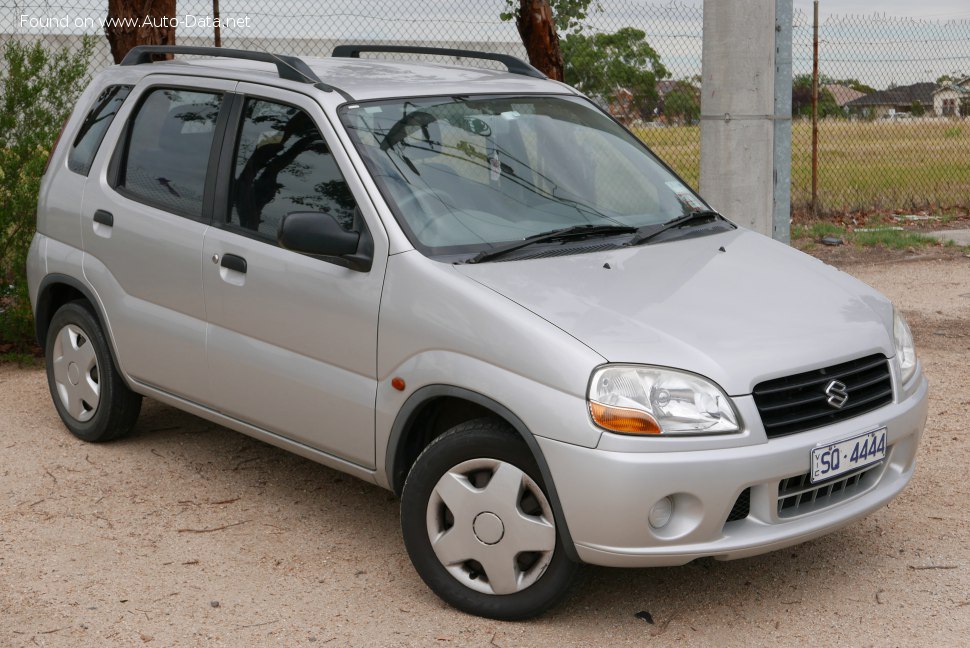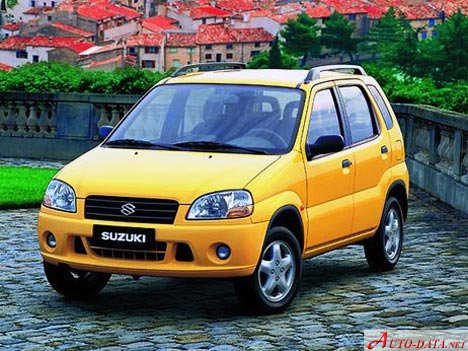
The Suzuki Ignis I FH: A Compact Crossover Pioneer (2000-2003)
The Suzuki Ignis I FH, launched in 2000 and produced until 2003, represented Suzuki’s foray into the burgeoning subcompact crossover segment. Positioned as a versatile and practical vehicle, the first-generation Ignis was primarily aimed at European and Asian markets, where demand for small, fuel-efficient cars with elevated driving positions and optional all-wheel-drive capabilities was growing. While never officially sold in the United States, its design philosophy and mechanical underpinnings influenced later Suzuki models globally, embodying the brand’s reputation for producing reliable and capable small vehicles. The Ignis I FH, specifically the 1.3 i 16V (5 dr) (83 Hp) 4WD variant, combined a modest yet efficient powertrain with a compact five-door hatchback body, making it an agile and accessible option for urban environments and light rural adventuring.
Engine & Performance: The Heart of the Suzuki Ignis I FH
Powering the specified Suzuki Ignis I FH was Suzuki’s M13A engine, a naturally aspirated 1.3-liter (1328 cm3 or 81.04 cu. in.) inline-four cylinder gasoline unit. This 16-valve engine, featuring multi-port manifold injection, was designed for efficiency and reliability, delivering 83 horsepower at 5500 revolutions per minute (rpm). Torque output stood at 110 Nm (81.13 lb.-ft.) at a relatively low 3500 rpm, providing decent low-end grunt for city driving and light off-road excursions. With a compression ratio of 9.5:1 and a bore of 78 mm paired with a piston stroke of 69.5 mm, the engine offered a balance of responsiveness and fuel economy.
The 1.3-liter engine was mated to a five-speed manual transmission, offering direct control over the power delivery. A key differentiator for this particular Ignis variant was its all-wheel-drive (4WD) powertrain architecture, which significantly enhanced its traction and capability, especially in adverse weather conditions or on unpaved roads. Despite its modest power output, the lightweight nature of the Ignis, with a curb weight of just 2193.6 lbs. (995 kg), resulted in a respectable weight-to-power ratio of 12 kg/Hp (83.4 Hp/tonne). This allowed for a top speed of 96.31 mph (155 km/h), making it adequate for highway travel in its target markets. Fuel economy was a strong suit, with a combined rating of 34.1 US mpg (6.9 l/100 km), reflecting its design as an economical daily driver.
Design & Features: Practicality Meets Compact Versatility
The design of the first-generation Suzuki Ignis I FH was characterized by its compact dimensions and functional, somewhat boxy aesthetic, which contributed to its practical interior space. Measuring 142.32 inches (3615 mm) in length, 62.8 inches (1595 mm) in width, and 62.6 inches (1590 mm) in height, the Ignis boasted a relatively tall stance for a subcompact vehicle, providing a commanding view of the road. Its 92.91-inch (2360 mm) wheelbase was optimized for maneuverability, evidenced by a tight minimum turning circle of 32.15 feet (9.8 meters), making it highly suitable for congested urban environments.
As a five-door hatchback, the Ignis offered seating for five occupants, prioritizing accessibility and utility. While the rear seating might have been snug for three adults on longer journeys, it was perfectly adequate for children or shorter trips. The cargo area was versatile, offering a minimum trunk space of 6.39 cu. ft. (181 liters), which could expand to a maximum of 14.8 cu. ft. (419 liters) with the rear seats folded down, enhancing its practicality for hauling groceries or luggage. Standard features for the era included a hydraulic steering rack and pinion system, providing a direct and communicative steering feel. Safety was addressed with disc brakes at the front and drum brakes at the rear, complemented by an Anti-lock Braking System (ABS), a crucial safety feature for its time, especially for a vehicle intended for varied road conditions.
Technical Specifications
| Category | Specification |
|---|---|
| General Information | |
| Brand | Suzuki |
| Model | Ignis |
| Generation | Ignis I FH |
| Type (Engine) | 1.3 i 16V (5 dr) (83 Hp) 4WD |
| Start of Production | 2000 year |
| End of Production | 2003 year |
| Powertrain Architecture | Internal Combustion engine |
| Body Type | Hatchback |
| Seats | 5 |
| Doors | 5 |
| Performance Specs | |
| Fuel Consumption (economy) – urban | 9 l/100 km (26.1 US mpg) |
| Fuel Consumption (economy) – extra urban | 5.7 l/100 km (41.3 US mpg) |
| Fuel Consumption (economy) – combined | 6.9 l/100 km (34.1 US mpg) |
| Fuel Type | Petrol (Gasoline) |
| Maximum Speed | 155 km/h (96.31 mph) |
| Weight-to-power ratio | 12 kg/Hp (83.4 Hp/tonne) |
| Weight-to-torque ratio | 9 kg/Nm (110.6 Nm/tonne) |
| Engine Specs | |
| Power | 83 Hp @ 5500 rpm. |
| Power per liter | 62.5 Hp/l |
| Torque | 110 Nm (81.13 lb.-ft.) @ 3500 rpm. |
| Engine Layout | Front, Transverse |
| Engine Model/Code | M13A |
| Engine Displacement | 1328 cm3 (81.04 cu. in.) |
| Number of Cylinders | 4 |
| Engine Configuration | Inline |
| Cylinder Bore | 78 mm (3.07 in.) |
| Piston Stroke | 69.5 mm (2.74 in.) |
| Compression Ratio | 9.5:1 |
| Number of Valves per Cylinder | 4 |
| Fuel Injection System | Multi-port manifold injection |
| Engine Aspiration | Naturally aspirated engine |
| Engine Oil Capacity | 3.8 l (4.02 US qt) |
| Coolant Capacity | 5.6 l (5.92 US qt) |
| Space, Volume and Weights | |
| Kerb Weight | 995 kg (2193.6 lbs.) |
| Max. Weight | 1430 kg (3152.61 lbs.) |
| Max Load | 435 kg (959.01 lbs.) |
| Trunk (boot) space – minimum | 181 l (6.39 cu. ft.) |
| Trunk (boot) space – maximum | 419 l (14.8 cu. ft.) |
| Fuel Tank Capacity | 41 l (10.83 US gal) |
| Dimensions | |
| Length | 3615 mm (142.32 in.) |
| Width | 1595 mm (62.8 in.) |
| Height | 1590 mm (62.6 in.) |
| Wheelbase | 2360 mm (92.91 in.) |
| Front Track | 1400 mm (55.12 in.) |
| Rear (Back) Track | 1385 mm (54.53 in.) |
| Minimum Turning Circle (turning diameter) | 9.8 m (32.15 ft.) |
| Drivetrain, Brakes and Suspension Specs | |
| Drive Wheel | All-wheel drive (4×4) |
| Number of Gears and Type of Gearbox | 5 gears, manual transmission |
| Front Suspension | Independent type McPherson |
| Rear Suspension | Coil spring |
| Front Brakes | Disc |
| Rear Brakes | Drum |
| Assisting Systems | ABS (Anti-lock braking system) |
| Steering Type | Steering rack and pinion |
| Power Steering | Hydraulic Steering |
| Tires Size | 165/70 R14 |
| Wheel Rims Size | 14 inches |
Legacy & Market Impact: The Enduring Spirit of the Suzuki Ignis I FH
The Suzuki Ignis I FH carved out a niche for itself in the early 2000s, particularly in markets where compact size, fuel efficiency, and the added assurance of all-wheel drive were highly valued. In Europe, it competed against a diverse array of small hatchbacks and emerging mini-SUVs, such as the Fiat Panda 4×4, Daihatsu Terios, and even some variants of its stablemate, the Suzuki Swift. What set the Ignis apart was its unique blend of traditional hatchback practicality with a slightly rugged, elevated stance and available 4WD, providing a compelling option for buyers seeking a versatile urban vehicle capable of handling diverse conditions, from snowy roads to light unpaved trails.
Its reputation was built on Suzuki’s established reliability and durability, traits that resonated strongly with consumers in its primary markets. The Ignis was often praised for its straightforward engineering, ease of maintenance, and surprisingly spacious interior for its exterior footprint. While it wasn’t a performance powerhouse, its agile handling and compact dimensions made it an ideal city car, while the 4WD system offered an extra layer of confidence that many competitors in its class lacked. The Ignis also served as a basis for the Chevrolet Cruze (not related to the later global Cruze) and the Subaru Justy in some markets, highlighting its adaptable platform.
The first-generation Ignis ultimately paved the way for subsequent Suzuki models that continued to blend compact dimensions with SUV-like attributes. Its successor, the second-generation Ignis, was rebranded as the Suzuki Swift in many markets, further solidifying the connection between these two popular Suzuki nameplates. Years later, the Ignis nameplate was revived for a new generation, carrying forward the original model’s spirit of a compact, distinctive, and capable urban crossover. The Ignis I FH, though a relatively short-lived generation, remains a significant chapter in Suzuki’s history, demonstrating the brand’s early vision for the compact crossover segment and its commitment to offering practical, all-weather mobility solutions to a global audience.