The Suzuki Ignis I FH 1.3 i 16V (83 Hp) Automatic: A Global Compact Contender
The Suzuki Ignis I FH 1.3 i 16V (83 Hp) Automatic represents the inaugural generation of Suzuki’s compact and versatile vehicle, produced from 2000 to 2003. Positioned within the burgeoning supermini and subcompact crossover segments, the Ignis I FH was a strategic model for Suzuki, particularly in European and Asian markets, where demand for small, efficient, and practical vehicles was consistently high. While not officially sold in the United States, the Ignis earned a reputation in its primary markets for its urban maneuverability, elevated driving position, and a surprising amount of interior space for its compact footprint. This particular variant, equipped with a 1.3-liter, 16-valve engine and an automatic transmission, aimed to offer a blend of ease of use, reasonable performance, and commendable fuel efficiency for daily commuting and light utility.
The Ignis generation FH, often referred to as the HT51S/HT81S chassis code in some markets, showcased Suzuki’s expertise in developing small cars that punch above their weight in terms of practicality and robust engineering. It was designed to appeal to a broad demographic, from young urban dwellers seeking an agile city car to small families needing a versatile second vehicle. Its distinctive styling, which hinted at SUV characteristics with its relatively tall stance, helped it stand out in a crowded market segment dominated by traditional hatchbacks.
Engine and Performance: The Heart of the Suzuki Ignis I FH
Powering the Suzuki Ignis I FH 1.3 i 16V (83 Hp) Automatic is a naturally aspirated 1.3-liter (1328 cubic centimeters or 81.04 cubic inches) M13A inline-four gasoline engine. This 16-valve unit was a well-regarded powerplant within Suzuki’s lineup, known for its reliability and efficiency. It delivers a respectable 83 horsepower at 5500 revolutions per minute (rpm) and generates 81.13 pound-feet of torque at 3500 rpm. This power output, combined with the vehicle’s relatively light curb weight of 2083.37 pounds (945 kg), results in a weight-to-power ratio of 11.4 kg per horsepower, making it adequately nimble for urban environments.
The engine’s front, transverse layout and multi-port manifold injection system contribute to its efficient operation. Its compression ratio of 9.5:1 ensures a good balance between power and fuel economy. The 4-speed automatic transmission, while not the most advanced by today’s standards, provided smooth and convenient gear changes, making the Ignis an easy car to drive, especially in stop-and-go traffic.
In terms of performance, the Ignis 1.3L Automatic accelerates from 0 to 60 miles per hour in a calculated 13.8 seconds (0-100 km/h in 14.5 seconds), with a maximum speed of 99.42 miles per hour (160 km/h). These figures are indicative of a vehicle designed for practical, everyday driving rather than high-performance thrills. Fuel economy was a key selling point, with combined consumption rated at 31.8 US miles per gallon (7.4 liters per 100 km). Urban driving yielded approximately 24.8 US mpg (9.5 l/100 km), while extra-urban cruising improved significantly to 41.3 US mpg (5.7 l/100 km), showcasing the engine’s efficiency during longer journeys. The 10.83 US gallon (41-liter) fuel tank provided a decent range for its class.
Design and Features of the Suzuki Ignis I FH
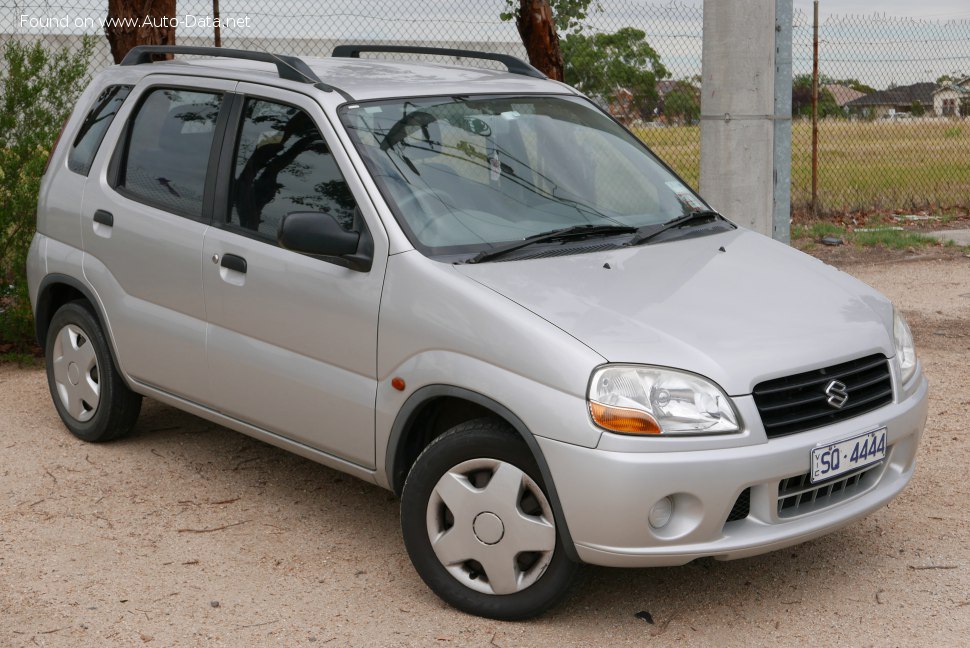
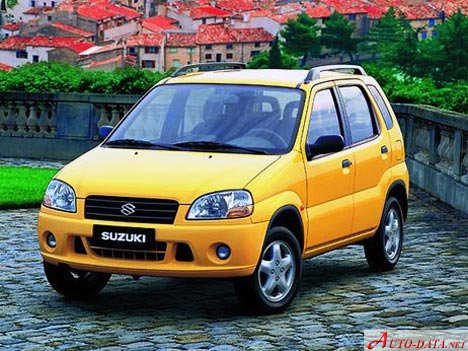
The Suzuki Ignis I FH adopted a 5-door hatchback body style, offering practical access to both front and rear seating. Its design was characterized by a relatively tall and boxy profile, which maximized interior volume within its compact exterior dimensions. Measuring 142.32 inches (3615 mm) in length, 62.8 inches (1595 mm) in width, and 60.63 inches (1540 mm) in height, the Ignis was incredibly maneuverable, boasting a minimum turning circle of 32.15 feet (9.8 meters), ideal for navigating tight city streets and parking spaces. The wheelbase of 92.91 inches (2360 mm) contributed to a stable ride for its size.
Inside, the Ignis I FH offered seating for five occupants. Despite its modest exterior, Suzuki’s intelligent packaging provided a surprisingly airy cabin. The trunk space ranged from 6.39 cubic feet (181 liters) with all seats in place to a more generous 14.8 cubic feet (419 liters) with the rear seats folded down, demonstrating its versatility for hauling groceries or luggage.
From a safety and handling perspective, the Ignis featured front disc brakes and rear drum brakes, supplemented by an Anti-lock Braking System (ABS) as a standard or optional feature, a significant safety enhancement for its time. The front suspension utilized a wishbone design, while the rear featured coil springs, providing a comfortable and compliant ride. Steering was managed by a hydraulic rack and pinion system, offering direct feedback to the driver. The vehicle rode on 165/70 R14 tires, a common size for compact cars, balancing grip with ride comfort and cost-effectiveness. The front-wheel-drive architecture ensured predictable handling and good traction in most conditions.
Technical Specifications: Suzuki Ignis I FH 1.3 i 16V (83 Hp) Automatic
| General Information | |
|---|---|
| Brand | Suzuki |
| Model | Ignis |
| Generation | Ignis I FH |
| Type (Engine) | 1.3 i 16V (83 Hp) Automatic |
| Start of Production | 2000 year |
| End of Production | 2003 year |
| Powertrain Architecture | Internal Combustion engine |
| Body Type | Hatchback |
| Seats | 5 |
| Doors | 5 |
| Performance Specifications | |
| Fuel Consumption (Economy) – Urban | 9.5 l/100 km (24.8 US mpg) |
| Fuel Consumption (Economy) – Extra Urban | 5.7 l/100 km (41.3 US mpg) |
| Fuel Consumption (Economy) – Combined | 7.4 l/100 km (31.8 US mpg) |
| Fuel Type | Petrol (Gasoline) |
| Acceleration 0 – 60 mph | 13.8 sec |
| Acceleration 0 – 100 km/h | 14.5 sec |
| Maximum Speed | 160 km/h (99.42 mph) |
| Weight-to-Power Ratio | 11.4 kg/Hp (87.8 Hp/tonne) |
| Weight-to-Torque Ratio | 8.6 kg/Nm (116.4 Nm/tonne) |
| Engine Specifications | |
| Power | 83 Hp @ 5500 rpm |
| Power per liter | 62.5 Hp/l |
| Torque | 110 Nm @ 3500 rpm (81.13 lb.-ft. @ 3500 rpm) |
| Engine Layout | Front, Transverse |
| Engine Model/Code | M13A |
| Engine Displacement | 1328 cm3 (81.04 cu. in.) |
| Number of Cylinders | 4 |
| Engine Configuration | Inline |
| Cylinder Bore | 78 mm (3.07 in.) |
| Piston Stroke | 69.5 mm (2.74 in.) |
| Compression Ratio | 9.5:1 |
| Number of Valves per Cylinder | 4 |
| Fuel Injection System | Multi-port manifold injection |
| Engine Aspiration | Naturally aspirated engine |
| Engine Oil Capacity | 3.8 l (4.02 US qt) |
| Coolant Capacity | 5.6 l (5.92 US qt) |
| Space, Volume, and Weights | |
| Kerb Weight (Curb Weight) | 945 kg (2083.37 lbs.) |
| Max. Weight (Gross Weight) | 1430 kg (3152.61 lbs.) |
| Max Load | 485 kg (1069.24 lbs.) |
| Trunk (Boot) Space – Minimum | 181 l (6.39 cu. ft.) |
| Trunk (Boot) Space – Maximum | 419 l (14.8 cu. ft.) |
| Fuel Tank Capacity | 41 l (10.83 US gal) |
| Dimensions | |
| Length | 3615 mm (142.32 in.) |
| Width | 1595 mm (62.8 in.) |
| Height | 1540 mm (60.63 in.) |
| Wheelbase | 2360 mm (92.91 in.) |
| Front Track | 1405 mm (55.31 in.) |
| Rear (Back) Track | 1385 mm (54.53 in.) |
| Minimum Turning Circle (Turning Diameter) | 9.8 m (32.15 ft.) |
| Drivetrain, Brakes, and Suspension Specifications | |
| Drivetrain Architecture | Front-wheel drive, Internal Combustion engine |
| Drive Wheel | Front wheel drive |
| Number of Gears and Type of Gearbox | 4 gears, automatic transmission |
| Front Suspension | Wishbone |
| Rear Suspension | Coil spring |
| Front Brakes | Disc |
| Rear Brakes | Drum |
| Assisting Systems | ABS (Anti-lock braking system) |
| Steering Type | Steering rack and pinion |
| Power Steering | Hydraulic Steering |
| Tires Size | 165/70 R14 |
Legacy and Market Impact of the Suzuki Ignis I FH
The Suzuki Ignis I FH 1.3 i 16V (83 Hp) Automatic carved out a notable niche for itself in the highly competitive European and Asian automotive markets during its production run from 2000 to 2003. While it never officially crossed the Atlantic to the United States, its design philosophy and mechanical underpinnings were indicative of global trends towards more versatile and compact vehicles. In its primary markets, the Ignis was often cross-shopped against established superminis like the Toyota Yaris, Honda Jazz (Fit in some markets), Ford Fiesta, and Volkswagen Polo, but it offered a distinct advantage with its slightly elevated ride height and more rugged styling, foreshadowing the eventual boom in subcompact crossovers.
Suzuki’s reputation for building reliable, durable, and cost-effective small cars was a significant asset for the Ignis. The M13A engine, in particular, was lauded for its longevity and ease of maintenance, contributing to lower running costs for owners. The option of an automatic transmission made it particularly appealing in urban environments where driving convenience was prioritized. Its compact dimensions, combined with a tight turning circle, made it an ideal city car, adept at navigating congested streets and fitting into challenging parking spaces.
The Ignis’s slightly higher ground clearance and available all-wheel-drive variants (though not this specific FWD automatic model) gave it a “mini-SUV” appeal, attracting buyers who desired the practicality of a hatchback with a hint of off-road capability or simply a more commanding view of the road. This positioning allowed it to stand out from more conventional hatchbacks. Its design was functional, prioritizing interior space and practicality over aggressive styling, which resonated well with a segment of buyers looking for sensible transportation.
Although the first-generation Ignis had a relatively short production cycle before being replaced by a more refined model, it laid important groundwork for Suzuki’s future compact offerings. Its legacy is one of a practical, no-nonsense vehicle that delivered on its promise of reliable and efficient urban transport. It demonstrated Suzuki’s ability to innovate within the compact segment, offering a compelling package that balanced affordability with utility and a touch of adventurous styling. Today, the Ignis I FH remains a testament to Suzuki’s enduring commitment to compact, high-value vehicles that serve specific market needs effectively.