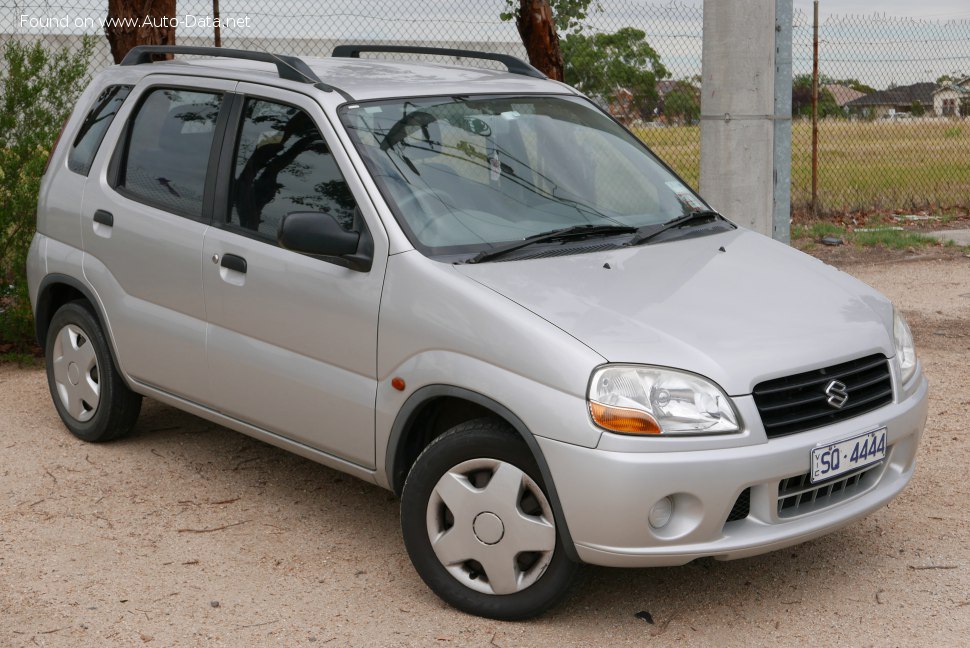
Introduction to the Suzuki Ignis I FH 1.3 i GLX (68 Hp)
The Suzuki Ignis I FH 1.3 i GLX (68 Hp) represents a significant offering from the Japanese automaker Suzuki during the early 2000s. Produced between 2001 and 2003, this particular variant of the first-generation Ignis was designed to cater to the burgeoning demand for compact, economical, and versatile vehicles, primarily in European and Asian markets. While not officially sold in the United States, the Ignis carved out a niche for itself as a practical and nimble subcompact, often blurring the lines between a conventional hatchback and a nascent crossover utility vehicle. This specific model, the 1.3 i GLX, with its 68 horsepower engine, was positioned as an accessible and fuel-efficient option within the Ignis lineup, providing a balance of urban maneuverability and everyday utility for its target demographic. Its compact dimensions and efficient powertrain made it a strong contender in a highly competitive segment focused on value and practicality.
The first-generation Ignis, known internally as the FH series, was globally recognized for its distinctive, somewhat upright styling that hinted at SUV aspirations, despite its small footprint. This design philosophy was a hallmark of Suzuki, a brand celebrated for its expertise in small, robust vehicles. The Suzuki Ignis I FH 1.3 i GLX (68 Hp), as detailed in its specifications, was a 4-door sedan variant, which was a less common body style for the Ignis compared to its more prevalent 5-door hatchback/crossover form in many markets. This particular configuration underscored Suzuki’s strategy to offer diverse options within the Ignis family, adapting to specific regional preferences for trunk capacity and traditional sedan aesthetics, while retaining the core Ignis characteristics of efficiency and compact design.
Engine and Performance Characteristics of the Suzuki Ignis I FH 1.3 i GLX (68 Hp)
Powertrain and Dynamics
Under the hood, the Suzuki Ignis I FH 1.3 i GLX (68 Hp) was powered by Suzuki’s M13A engine, a naturally aspirated inline-four gasoline unit. With an engine displacement of 1299 cubic centimeters (approximately 1.3 liters or 79.27 cubic inches), this powerplant was engineered for reliability and fuel economy, rather than outright speed. It delivered a modest 68 horsepower at 6000 revolutions per minute, providing sufficient motivation for urban commutes and light highway cruising. Torque output stood at 99 Newton-meters (equivalent to 73.02 pound-feet) peaking at a relatively low 3500 rpm, which contributed to good low-end responsiveness, a desirable trait for city driving.
Power was sent to the front wheels via a standard 5-speed manual transmission, a common and robust setup for vehicles in this class during its production era. This drivetrain architecture, combined with the engine’s characteristics, allowed the Ignis 1.3 i GLX to achieve a top speed of 165 kilometers per hour (102.53 miles per hour). While not a performance leader, this speed was entirely adequate for the vehicle’s intended purpose and market.
Fuel efficiency was a key selling point for the Ignis, and the 1.3 i GLX variant delivered commendable figures. It was rated at an urban fuel consumption of 7.8 liters per 100 kilometers (approximately 30.2 US miles per gallon) and an impressive extra-urban (highway) consumption of 4.8 liters per 100 kilometers (around 49 US miles per gallon). These numbers highlighted the vehicle’s economical nature, making it an attractive option for budget-conscious buyers in its primary markets. The engine’s simple, naturally aspirated design with 2 valves per cylinder and single-point fuel injection further emphasized its focus on durability and straightforward maintenance.
Design and Features of the Ignis I FH Generation
Exterior and Interior Practicality
Despite the specific data referencing a “Sedan, 4 Doors” body type, the Suzuki Ignis I FH generation was broadly characterized by its compact, tall-boy design, often offering a slightly elevated driving position and a versatile interior. This particular 4-door sedan variant would have retained the Ignis’s core philosophy of maximizing interior space within a minimal footprint. With a length of 161.22 inches, a width of 62.6 inches, and a height of 54.33 inches, the Ignis 1.3 i GLX was exceptionally compact, making it highly maneuverable in congested city environments and easy to park. Its wheelbase measured 93.11 inches, contributing to its nimble handling.
The exterior design, typical of early 2000s Suzuki, was functional and unpretentious. The compact dimensions were complemented by a clean, straightforward aesthetic that prioritized practicality over flamboyant styling. The 4-door configuration provided convenient access for up to five occupants, a surprising feat given its exterior dimensions. The curb weight of just 1862.91 pounds underscored its lightweight construction, which benefited both fuel economy and agility.
Inside, the Ignis I FH 1.3 i GLX focused on straightforward ergonomics and durable materials. While specific luxury features would have been minimal for this GLX trim, the emphasis was on functional design. The trunk space of 12.89 cubic feet (365 liters) was quite generous for such a compact vehicle, especially for a sedan variant, providing ample room for daily errands or weekend trips. This practical cargo capacity, combined with its 5-seat layout, made it a versatile option for small families or individuals needing flexible space.
In terms of chassis and running gear, the Ignis featured a conventional setup designed for comfort and predictable handling. Both front and rear suspensions utilized coil springs, providing a compliant ride. Braking was handled by disc brakes at the front and drum brakes at the rear, a common and cost-effective combination for vehicles in this segment. Steering was managed by a rack and pinion system with hydraulic power steering, offering ease of maneuverability at low speeds. The vehicle rode on relatively small 13-inch wheels fitted with 155/70 R13 tires, further contributing to its economical operation and comfortable ride quality over varied surfaces.
Technical Specifications
| Category | Specification | US Equivalent |
|---|---|---|
| General Information | ||
| Brand | Suzuki | |
| Model | Ignis | |
| Generation | Ignis I FH | |
| Type (Engine) | 1.3 i GLX (68 Hp) | |
| Start of Production | 2001 year | |
| End of Production | 2003 year | |
| Powertrain Architecture | Internal Combustion engine | |
| Body type | Sedan | |
| Seats | 5 | |
| Doors | 4 | |
| Performance Specs | ||
| Fuel consumption (economy) – urban | 7.8 l/100 km | 30.2 US mpg |
| Fuel consumption (economy) – extra urban | 4.8 l/100 km | 49 US mpg |
| Fuel Type | Petrol (Gasoline) | |
| Maximum speed | 165 km/h | 102.53 mph |
| Weight-to-power ratio | 12.4 kg/Hp | 80.5 Hp/tonne |
| Weight-to-torque ratio | 8.5 kg/Nm | 117.2 Nm/tonne |
| Engine Specs | ||
| Power | 68 Hp @ 6000 rpm. | |
| Power per liter | 52.3 Hp/l | |
| Torque | 99 Nm @ 3500 rpm. | 73.02 lb.-ft. @ 3500 rpm. |
| Engine layout | Front, Transverse | |
| Engine Model/Code | M13A | |
| Engine displacement | 1299 cm3 | 79.27 cu. in. |
| Number of cylinders | 4 | |
| Engine configuration | Inline | |
| Cylinder Bore | 74 mm | 2.91 in. |
| Piston Stroke | 75.5 mm | 2.97 in. |
| Compression ratio | 9.5:1 | |
| Number of valves per cylinder | 2 | |
| Fuel injection system | Single-point injection | |
| Engine aspiration | Naturally aspirated engine | |
| Engine oil capacity | 3.8 l | 4.02 US qt |
| Coolant | 5.6 l | 5.92 US qt |
| Space, Volume and Weights | ||
| Kerb Weight | 845 kg | 1862.91 lbs. |
| Max. weight (Gross Vehicle Weight Rating) | 1340 kg | 2954.19 lbs. |
| Max load | 495 kg | 1091.29 lbs. |
| Trunk (boot) space – minimum | 365 l | 12.89 cu. ft. |
| Fuel tank capacity | 40 l | 10.57 US gal |
| Dimensions | ||
| Length | 4095 mm | 161.22 in. |
| Width | 1590 mm | 62.6 in. |
| Height | 1380 mm | 54.33 in. |
| Wheelbase | 2365 mm | 93.11 in. |
| Front track | 1365 mm | 53.74 in. |
| Rear (Back) track | 1340 mm | 52.76 in. |
| Drivetrain, Brakes and Suspension Specs | ||
| Drivetrain Architecture | The Internal combustion engine (ICE) drives the front wheels of the vehicle. | |
| Drive wheel | Front wheel drive | |
| Number of gears and type of gearbox | 5 gears, manual transmission | |
| Front suspension | Coil spring | |
| Rear suspension | Coil spring | |
| Front brakes | Disc | |
| Rear brakes | Drum | |
| Steering type | Steering rack and pinion | |
| Power steering | Hydraulic Steering | |
| Tires size | 155/70 R13 | |
| Wheel rims size | 13 | |
Legacy and Market Impact of the Suzuki Ignis I FH
The Suzuki Ignis I FH, particularly variants like the 1.3 i GLX (68 Hp), played a crucial role in Suzuki’s global strategy during the early 2000s, especially in markets outside of North America. It represented Suzuki’s commitment to producing affordable, reliable, and highly practical compact vehicles. While the Ignis was not available in the United States, it enjoyed considerable success in Europe, Japan, and other Asian markets, where its blend of compact dimensions, fuel efficiency, and surprising versatility resonated with a broad spectrum of buyers.
In its primary markets, the Ignis competed against a host of established subcompact and supermini vehicles, including popular models like the Toyota Yaris (Vitz), Honda Fit (Jazz), Nissan Micra, Ford Fiesta, and Volkswagen Polo. What set the Ignis apart was its slightly more robust, sometimes mini-SUV-like styling (even if this specific data refers to a sedan variant), which offered a higher seating position and a perceived sense of adventure, appealing to those who wanted something more distinctive than a traditional hatchback. Its lightweight construction and efficient engines ensured low running costs, a significant factor for consumers in these regions.
The reputation of the Ignis I FH was built on its dependability and straightforward mechanics. Owners often praised its nimble handling, ease of parking, and the surprisingly spacious interior for its external size. The 1.3-liter engine, while not powerful, was known for its longevity and fuel economy, making it an ideal choice for daily commuting. The manual transmission offered an engaging driving experience and further contributed to its robust character.
Historically, the Ignis I FH can be seen as a precursor to the modern compact crossover trend. Suzuki, with its strong heritage in 4×4 vehicles and compact cars, was adept at blending these two worlds. Even in its 4-door sedan guise, the underlying principles of compact efficiency and practical utility were paramount. It showcased Suzuki’s ability to innovate within the small car segment, offering vehicles that were both economical to own and surprisingly capable for their size. The Ignis cemented Suzuki’s image as a manufacturer of smart, small vehicles that offered excellent value and reliability, contributing to the brand’s enduring popularity in its key international markets. Its legacy continues in subsequent generations of the Ignis, which have evolved to become more pronounced compact crossovers, demonstrating the lasting impact of this early 2000s pioneer.