Introduction to the Suzuki Ignis I MH
The Suzuki Ignis I MH, specifically the 1.3 i 16V (93 Hp) 4WD variant, represents a significant entry in the burgeoning subcompact crossover segment during its production run from 2003 to 2008. While not officially sold in the United States market, the Ignis carved out a notable niche in Europe, Asia, and other international markets, where demand for compact, versatile, and affordable vehicles with all-wheel-drive capability was strong. This first-generation Ignis (designated MH) was a five-door hatchback that skillfully blended the practicality of a small family car with the elevated ground clearance and robust appeal of an SUV.
Positioned as a practical and economical solution for both urban commuting and light off-road excursions, the Suzuki Ignis I MH offered a compelling package. It provided a higher seating position than conventional hatchbacks, enhancing visibility and ease of entry/exit, while its compact dimensions ensured agility in crowded city environments. The inclusion of a 4WD system, particularly in this 1.3-liter variant, distinguished it from many of its front-wheel-drive competitors, providing enhanced traction and stability in adverse weather conditions or on unpaved roads. The Ignis I MH embodied Suzuki’s long-standing reputation for producing reliable, capable, and value-oriented small vehicles, establishing a foundation for future iterations in the global market.
Powertrain and Performance of the Suzuki Ignis I MH
Engine Characteristics
At the heart of the Suzuki Ignis I MH 1.3 i 16V (93 Hp) 4WD was Suzuki’s M13A engine, a well-regarded 1.3-liter (1328 cm³ or 81.04 cu. in.) inline-four gasoline engine. This powerplant featured a Double Overhead Camshaft (DOHC) valvetrain with 16 valves, ensuring efficient airflow and combustion for its size. Fuel delivery was managed by a multi-port manifold injection system, a common and reliable method for naturally aspirated engines of its era. With a compression ratio of 9.5:1, the engine was designed for optimal performance on regular petrol (gasoline).
The M13A engine produced a respectable 93 horsepower at 6000 revolutions per minute (rpm), translating to a power-per-liter output of 70 horsepower per liter. Peak torque was rated at 87.03 lb.-ft. (118 Nm) delivered at 4100 rpm, providing a good balance of low-end grunt for city driving and sufficient mid-range pull for highway speeds. The engine’s front, transverse layout was typical for a compact front-wheel-drive biased platform, allowing for efficient packaging and maximized interior space.
Drivetrain and Driving Dynamics
A key differentiator for this specific Ignis variant was its all-wheel-drive (4×4) system. Paired with a precise 5-speed manual transmission, this setup provided drivers with confidence and control, particularly in regions prone to snow, ice, or muddy terrain. While not a hardcore off-roader, the 4WD system significantly enhanced the vehicle’s capability beyond that of a standard two-wheel-drive hatchback.
Performance figures for the Ignis I MH 1.3 i 16V (93 Hp) 4WD were pragmatic, reflecting its role as an economical and versatile vehicle. It achieved a maximum speed of 96.31 mph (155 km/h), which was adequate for most driving conditions outside of high-speed autobahns. Fuel economy was a strong point for its class, with urban consumption rated at 27 US mpg (8.7 l/100 km) and extra-urban consumption at an impressive 39.9 US mpg (5.9 l/100 km). This efficiency, combined with a 10.83 US gallon (41 liter) fuel tank, offered a practical driving range for daily use and weekend trips. The vehicle’s lightweight construction, with a curb weight of just 2215.65 lbs. (1005 kg), contributed to its agility and favorable weight-to-power ratio of 10.8 kg/Hp (92.5 Hp/tonne).
Design, Features, and Practicality
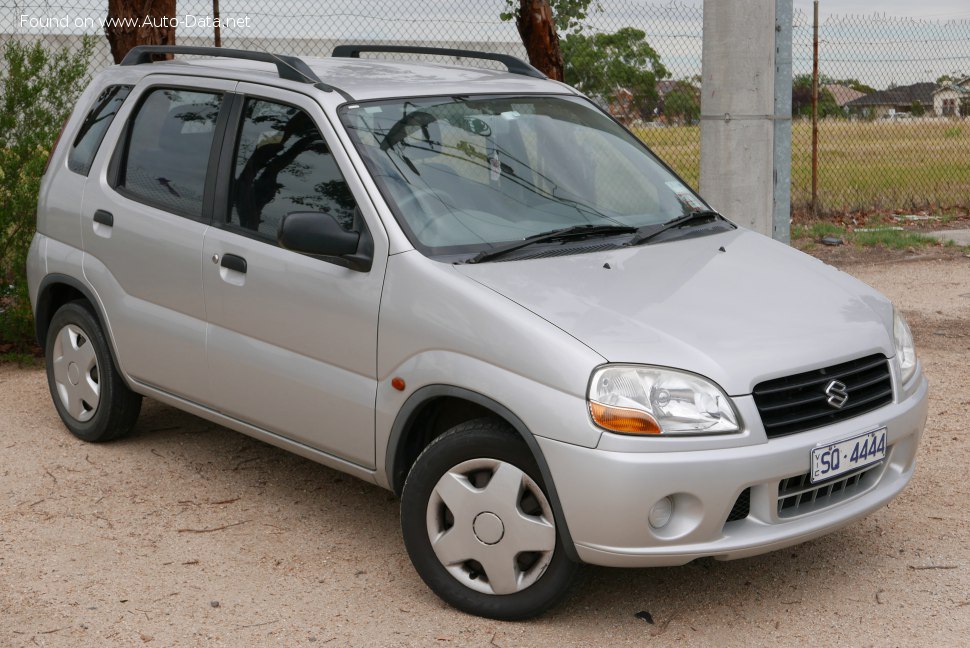
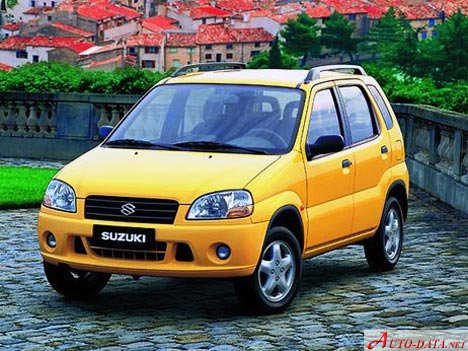
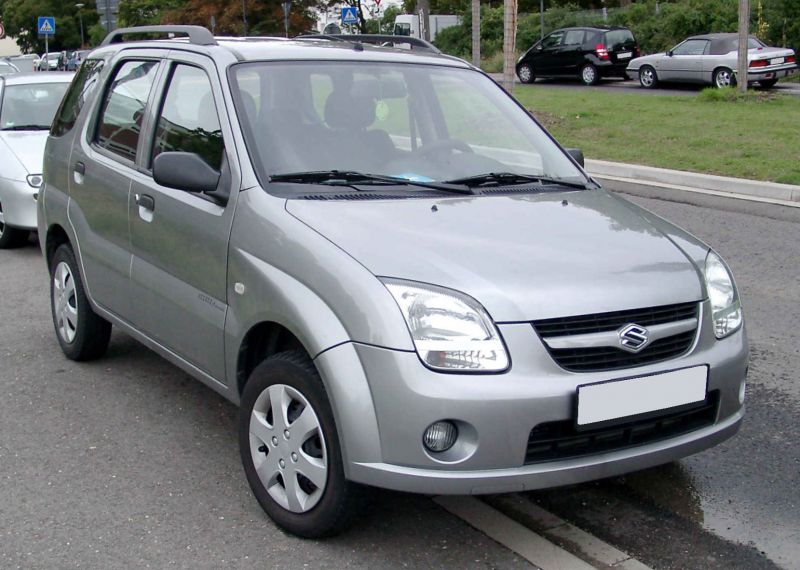
The design of the first-generation Suzuki Ignis I MH was characterized by its distinctive, slightly boxy profile, which contributed to its spacious interior and robust, go-anywhere aesthetic. As a 5-door hatchback, it offered easy access for passengers and cargo. Its dimensions – a length of 148.43 inches (3770 mm), a width of 63.19 inches (1605 mm), and a height of 61.61 inches (1565 mm) – made it exceptionally maneuverable in urban environments while providing a surprisingly commanding view of the road due to its elevated ride height. The wheelbase measured 92.91 inches (2360 mm), optimizing interior space within its compact footprint.
Inside, the Ignis I MH was designed with practicality in mind, offering comfortable seating for five occupants. The cabin layout was straightforward and functional, prioritizing ease of use and durability. Cargo versatility was a key selling point; with all seats in place, the trunk offered 8.33 cubic feet (236 liters) of space. When the rear seats were folded down, this expanded significantly to a generous 35.39 cubic feet (1002 liters), making the Ignis capable of handling larger loads, from groceries to sports equipment.
In terms of features, the Ignis I MH came equipped with essential modern conveniences and safety systems for its time. The steering system utilized a rack and pinion setup, offering direct and responsive handling. Safety was bolstered by the inclusion of an Anti-lock Braking System (ABS), a crucial feature that prevented wheel lock-up during hard braking, maintaining steering control. The suspension system, featuring Spring Struts at both the front and rear, provided a comfortable ride quality while offering sufficient articulation for its light-duty off-road aspirations. Braking was handled by disc brakes at the front and drum brakes at the rear, a common and effective combination for vehicles in this class. The vehicle rode on 165/70 R14 tires mounted on 14-inch wheel rims, a practical choice offering a good balance of comfort, grip, and affordability.
Technical Specifications
| Category | Specification | US Equivalent |
|---|---|---|
| General Information | ||
| Brand | Suzuki | |
| Model | Ignis | |
| Generation | Ignis I MH | |
| Type (Engine) | 1.3 i 16V (93 Hp) 4WD | |
| Start of production | 2003 year | |
| End of production | 2008 year | |
| Powertrain Architecture | Internal Combustion engine | |
| Body type | Hatchback | |
| Seats | 5 | |
| Doors | 5 | |
| Performance Specs | ||
| Fuel consumption (economy) – urban | 8.7 l/100 km | 27 US mpg |
| Fuel consumption (economy) – extra urban | 5.9 l/100 km | 39.9 US mpg |
| Fuel Type | Petrol (Gasoline) | |
| Maximum speed | 155 km/h | 96.31 mph |
| Weight-to-power ratio | 10.8 kg/Hp | 92.5 Hp/tonne |
| Weight-to-torque ratio | 8.5 kg/Nm | 117.4 Nm/tonne |
| Engine Specs | ||
| Power | 93 Hp @ 6000 rpm. | |
| Power per liter | 70 Hp/l | |
| Torque | 118 Nm @ 4100 rpm. | 87.03 lb.-ft. @ 4100 rpm. |
| Engine layout | Front, Transverse | |
| Engine Model/Code | M13A | |
| Engine displacement | 1328 cm³ | 81.04 cu. in. |
| Number of cylinders | 4 | |
| Engine configuration | Inline | |
| Cylinder Bore | 78 mm | 3.07 in. |
| Piston Stroke | 69.5 mm | 2.74 in. |
| Compression ratio | 9.5:1 | |
| Number of valves per cylinder | 4 | |
| Fuel injection system | Multi-port manifold injection | |
| Engine aspiration | Naturally aspirated engine | |
| Valvetrain | DOHC | |
| Engine oil capacity | 4.1 l | 4.33 US qt |
| Coolant | 5.6 l | 5.92 US qt |
| Space, Volume and Weights | ||
| Kerb Weight | 1005 kg | 2215.65 lbs. |
| Max. weight | 1470 kg | 3240.8 lbs. |
| Max load | 465 kg | 1025.15 lbs. |
| Trunk (boot) space – minimum | 236 l | 8.33 cu. ft. |
| Trunk (boot) space – maximum | 1002 l | 35.39 cu. ft. |
| Fuel tank capacity | 41 l | 10.83 US gal |
| Dimensions | ||
| Length | 3770 mm | 148.43 in. |
| Width | 1605 mm | 63.19 in. |
| Height | 1565 mm | 61.61 in. |
| Wheelbase | 2360 mm | 92.91 in. |
| Front track | 1420 mm | 55.91 in. |
| Rear (Back) track | 1419 mm | 55.87 in. |
| Drivetrain, Brakes and Suspension Specs | ||
| Drive wheel | All wheel drive (4×4) | |
| Number of gears and type of gearbox | 5 gears, manual transmission | |
| Front suspension | Spring Strut | |
| Rear suspension | Spring Strut | |
| Front brakes | Disc | |
| Rear brakes | Drum | |
| Assisting systems | ABS (Anti-lock braking system) | |
| Steering type | Steering rack and pinion | |
| Tires size | 165/70 R14 | |
| Wheel rims size | 14 | |
Legacy and Market Impact
The Suzuki Ignis I MH, particularly its 4WD variants like the 1.3 i 16V (93 Hp) model, holds a significant place in the evolution of the compact crossover market outside of North America. During its production years from 2003 to 2008, it cemented Suzuki’s reputation for producing robust, reliable, and highly practical small vehicles capable of tackling more than just urban commutes. Its core appeal lay in its ability to combine the affordability and fuel efficiency of a subcompact hatchback with the added confidence and capability of an all-wheel-drive system and a slightly elevated ride height.
In its primary markets, such as Europe and parts of Asia, the Ignis I MH faced competition from a varied array of vehicles. This included other small hatchbacks like the Toyota Yaris, Honda Jazz (Fit), and Ford Fiesta, which typically lacked AWD options. More direct competitors in the nascent compact crossover space might have included the Fiat Panda 4×4, which offered similar ruggedness in a tiny package, or even smaller, entry-level SUVs from brands like Daihatsu or older Subaru models. However, the Ignis often stood out for its blend of Japanese reliability, compact dimensions, and genuine 4WD capability at an accessible price point.
The Ignis I MH was lauded for its nimble handling, ease of parking, and surprising interior space, especially with the rear seats folded down. Its M13A engine, while not a powerhouse, was known for its durability and economical operation, contributing to low running costs – a critical factor for buyers in its segment. The inclusion of ABS as a standard assisting system was also a noteworthy safety feature for a vehicle of its class and era.
Historically, the first-generation Ignis can be seen as an early pioneer in the global trend towards smaller, more versatile vehicles that blur the lines between hatchbacks and SUVs. It predated the massive surge in popularity of compact crossovers that would dominate the automotive landscape in the following decades. By offering SUV-like aesthetics and functionality in a city-friendly footprint, the Ignis demonstrated a successful formula that many manufacturers would later adopt. Its legacy is one of practicality, affordability, and understated capability, contributing to Suzuki’s enduring image as a maker of smart, dependable, and adventurous small cars. The principles embodied by the Ignis I MH continue to influence Suzuki’s design philosophy for its subsequent generations and other models in its compact SUV lineup.