Introduction to the Suzuki Ignis II 1.2 DualJet
The Suzuki Ignis II 1.2 DualJet represents the second generation of Suzuki’s distinctive subcompact crossover, a vehicle that carved out a unique niche in the global automotive landscape. Introduced in 2016 and produced through December 2019, this iteration of the Ignis was primarily aimed at European and Asian markets, where its compact dimensions, elevated ride height, and impressive fuel efficiency resonated strongly with urban consumers. While Suzuki ceased selling passenger vehicles in the United States prior to the Ignis II’s debut, this model exemplified the brand’s enduring commitment to designing practical, fun-to-drive, and remarkably capable small cars.
Positioned as a “micro-SUV” or “city crossover,” the Suzuki Ignis II 1.2 DualJet blended the maneuverability of a city car with the visual ruggedness and enhanced ground clearance typically associated with sport utility vehicles. Its design stood out from conventional hatchbacks, offering a bold, almost retro-futuristic aesthetic that paid homage to Suzuki’s heritage of small 4x4s while embracing modern efficiency and connectivity. This specific variant, powered by the efficient 1.2-liter DualJet engine, was a cornerstone of the Ignis lineup, offering a compelling balance of performance and economy for its target audience.
Engine and Performance of the Suzuki Ignis II 1.2 DualJet
At the heart of the Suzuki Ignis II 1.2 DualJet lies Suzuki’s K12C engine, a 1.2-liter (1242 cm3 or 75.79 cu. in.) naturally aspirated inline-four gasoline unit. This powertrain was engineered with a strong emphasis on fuel efficiency and low emissions, critical factors in the European market. The “DualJet” designation refers to Suzuki’s advanced fuel injection technology, which features dual injectors per cylinder positioned closer to the intake valves. This design optimizes fuel atomization and combustion efficiency, contributing to improved fuel economy and reduced exhaust emissions.
The engine delivers a respectable 90 horsepower at 6000 rpm, which is a commendable output for its displacement, translating to a power-per-liter ratio of 72.5 HP/l. Torque peaks at 88.51 lb-ft (120 Nm) at 4400 rpm, providing adequate pulling power for city driving and highway cruising. Mated to a precise 5-speed manual transmission, this setup allows the Ignis II to accelerate from 0 to 60 mph in a brisk 11.6 seconds, with a maximum speed of 105.63 mph (170 km/h). While not a performance vehicle, these figures underscore its capability as a nimble and responsive urban commuter.
Fuel economy is a standout feature, with the Ignis II 1.2 DualJet achieving an impressive combined rating of 51.1 US mpg (4.6 l/100 km). Urban driving sees a consumption of 42.8 US mpg (5.5 l/100 km), while extra-urban cycles push this efficiency even further to 57.4 US mpg (4.1 l/100 km). These figures, coupled with CO2 emissions of just 104 g/km, highlight its compliance with stringent Euro 6 emission standards and its eco-friendly credentials, making it an economical choice for everyday use.
Design and Features of the Suzuki Ignis II
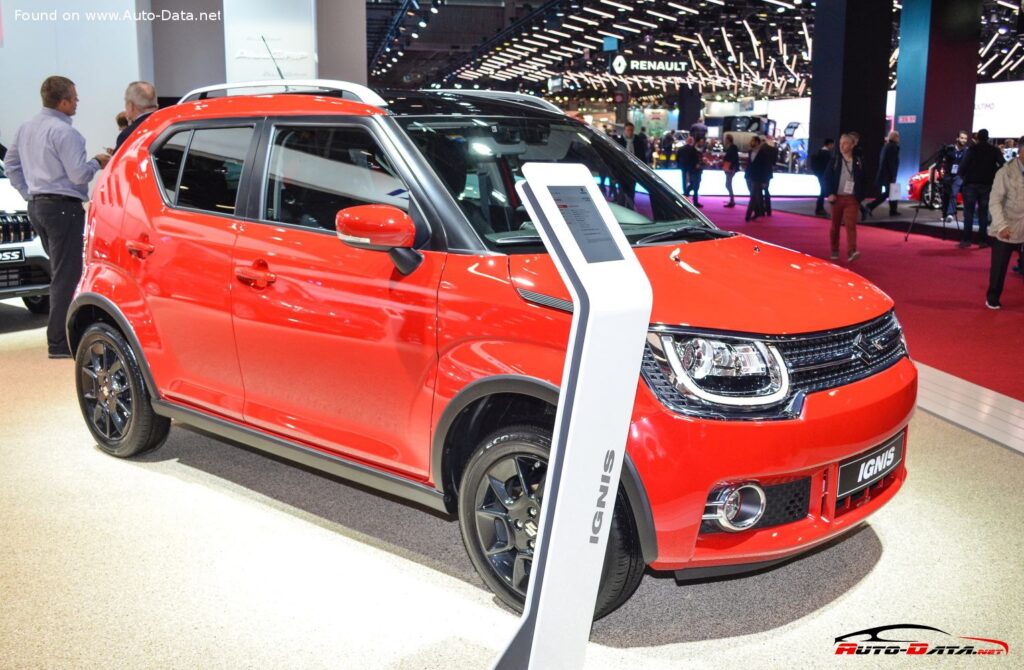
The design of the Suzuki Ignis II is undeniably one of its most distinctive attributes. Adopting an SUV body type with 5 doors and seating for 4 occupants, it presents a visually arresting silhouette that is both compact and robust. Measuring just 145.67 inches in length, 65.35 to 66.54 inches in width, and 62.8 inches in height, the Ignis II is remarkably small, making it incredibly agile in congested city environments and easy to park. Despite its diminutive footprint, its upright stance and generous ground clearance of 7.09 inches give it an undeniable SUV presence, allowing it to confidently tackle speed bumps and light off-road conditions.
Stylistically, the Ignis II blended modern design elements with historical Suzuki cues, such as the triple-slit motif on the C-pillar, reminiscent of Suzuki’s classic SC100 Whizzkid and Vitara models. The interior, while compact, was designed for maximum practicality and versatility. The 4-seat configuration, often featuring sliding rear seats, allowed for flexible cargo and passenger arrangements. With the rear seats in place, the trunk offered 9.18 cu. ft. (260 liters) of space, which could expand significantly to 38.85 cu. ft. (1100 liters) when the rear seats were folded down, demonstrating its surprising utility for a vehicle of its size.
Standard features included an electric power steering system for effortless maneuverability and an Anti-lock Braking System (ABS) with ventilated discs at the front and drum brakes at the rear, ensuring reliable stopping power. The suspension system, featuring an independent McPherson type at the front and a semi-independent coil spring setup at the rear, provided a comfortable ride quality well-suited for varying road surfaces. The vehicle typically rode on 15-inch or 16-inch wheels, shod with tires sized 175/65 R15 or 175/60 R16, respectively, contributing to its stable handling and distinctive appearance.
Technical Specifications
| Category | Specification |
|---|---|
| General Information | |
| Brand | Suzuki |
| Model | Ignis |
| Generation | Ignis II |
| Type (Engine) | 1.2 DualJet (90 Hp) |
| Start of Production | 2016 year |
| End of Production | December, 2019 year |
| Powertrain Architecture | Internal Combustion engine |
| Body Type | SUV |
| Seats | 4 |
| Doors | 5 |
| Performance Specs | |
| Fuel Consumption (Urban) | 42.8 US mpg (5.5 l/100 km) |
| Fuel Consumption (Extra Urban) | 57.4 US mpg (4.1 l/100 km) |
| Fuel Consumption (Combined) | 51.1 US mpg (4.6 l/100 km) |
| CO2 Emissions | 104 g/km |
| Fuel Type | Petrol (Gasoline) |
| Acceleration 0 – 60 mph | 11.6 seconds |
| Maximum Speed | 105.63 mph (170 km/h) |
| Emission Standard | Euro 6 |
| Weight-to-Power Ratio | 9 kg/Hp, 111.1 Hp/tonne |
| Weight-to-Torque Ratio | 6.8 kg/Nm, 148.1 Nm/tonne |
| Engine Specs | |
| Power | 90 Hp @ 6000 rpm |
| Power per Liter | 72.5 Hp/l |
| Torque | 88.51 lb.-ft. (120 Nm) @ 4400 rpm |
| Engine Layout | Front, Transverse |
| Engine Model/Code | K12C |
| Engine Displacement | 1.2 Liters (1242 cm3 / 75.79 cu. in.) |
| Number of Cylinders | 4 |
| Engine Configuration | Inline |
| Cylinder Bore | 2.87 in. (73 mm) |
| Piston Stroke | 2.92 in. (74.2 mm) |
| Compression Ratio | 12.5:1 |
| Number of Valves per Cylinder | 4 |
| Fuel Injection System | Multi-port manifold injection |
| Engine Aspiration | Naturally aspirated engine |
| Engine Oil Capacity | 3.49 US qt (3.3 l) |
| Coolant Capacity | 4.23 US qt (4 l) |
| Space, Volume and Weights | |
| Kerb Weight | 1785.74 – 1884.95 lbs. (810-855 kg) |
| Max. Weight (GVWR) | 2932.15 lbs. (1330 kg) |
| Max Load | 1047.2 – 1146.4 lbs. (475-520 kg) |
| Trunk (Boot) Space – Minimum | 9.18 cu. ft. (260 l) |
| Trunk (Boot) Space – Maximum | 38.85 cu. ft. (1100 l) |
| Fuel Tank Capacity | 8.45 US gal (32 l) |
| Permitted Trailer Load with Brakes (12%) | 2204.62 lbs. (1000 kg) |
| Permitted Trailer Load without Brakes | 881.85 lbs. (400 kg) |
| Permitted Towbar Download | 110.23 lbs. (50 kg) |
| Dimensions | |
| Length | 145.67 in. (3700 mm) |
| Width | 65.35 – 66.54 in. (1660-1690 mm) |
| Height | 62.8 in. (1595 mm) |
| Wheelbase | 95.87 in. (2435 mm) |
| Front Track | 57.48 in. (1460 mm) |
| Rear (Back) Track | 57.87 in. (1470 mm) |
| Ride Height (Ground Clearance) | 7.09 in. (180 mm) |
| Minimum Turning Circle (Turning Diameter) | 30.84 ft. (9.4 m) |
| Approach Angle | 20° |
| Departure Angle | 38.8° |
| Ramp-over (Brakeover) Angle | 18° |
| Drivetrain, Brakes and Suspension Specs | |
| Drivetrain Architecture | Internal Combustion engine drives the front wheels. |
| Drive Wheel | Front-wheel drive |
| Number of Gears and Type of Gearbox | 5 gears, manual transmission |
| Front Suspension | Independent type McPherson |
| Rear Suspension | Semi-independent, coil spring |
| Front Brakes | Ventilated discs |
| Rear Brakes | Drum |
| Assisting Systems | ABS (Anti-lock braking system) |
| Steering Type | Steering rack and pinion |
| Power Steering | Electric Steering |
| Tires Size | 175/65 R15; 175/60 R16 |
| Wheel Rims Size | 15; 16 |
Legacy and Market Impact of the Suzuki Ignis II
The Suzuki Ignis II, particularly the 1.2 DualJet variant, carved out a significant niche in markets where compact, efficient, and versatile vehicles are highly prized. While it was never offered in the United States market due to Suzuki’s earlier withdrawal from passenger car sales there, its impact was keenly felt across Europe, Japan, and other Asian regions. The Ignis II was lauded for its distinctive styling, which successfully blended the rugged appeal of an SUV with the practical dimensions of a city car. This unique proposition allowed it to stand apart from traditional hatchbacks and larger, more conventional crossovers.
Its primary competitors in the European micro-SUV segment included vehicles like the Fiat Panda Cross, Dacia Sandero Stepway, and potentially smaller variants of the Renault Captur. What set the Ignis apart was its authentic Suzuki identity: a reputation for reliability, intelligent packaging, and a surprising degree of off-road capability in its available all-wheel-drive (AllGrip) variants (though this specific 1.2 DualJet model is front-wheel-drive). Its light curb weight (ranging from 1785.74 to 1884.95 lbs.) contributed significantly to its agility, fuel efficiency, and dynamic performance, making the most of its 90 horsepower.
The Ignis II’s legacy is defined by its clever engineering and commitment to sustainable mobility. Its advanced DualJet engine technology and low CO2 emissions were perfectly aligned with evolving environmental regulations and consumer demand for greener vehicles. It demonstrated that a vehicle could be small and economical without sacrificing style, practicality, or a sense of adventure. For many, the Ignis became a symbol of smart urban mobility, offering a higher driving position for better visibility, easy ingress and egress, and sufficient flexibility for varied lifestyles, from daily commutes to weekend getaways. Its continued presence on roads in its primary markets underscores its enduring appeal as a practical, charming, and highly efficient compact crossover.