The Suzuki Ignis II 1.2 DualJet (90 Hp) ALLGRIP 5 Seat: A Compact Crossover for the Global Market
The Suzuki Ignis II 1.2 DualJet (90 Hp) ALLGRIP 5 Seat represents the second generation of Suzuki’s distinctive subcompact crossover, a vehicle primarily designed for and sold in European and Asian markets. Launched in 2016 and produced until December 2019, this iteration of the Ignis quickly carved out a niche for itself as a remarkably compact yet surprisingly capable small SUV. It combines an efficient gasoline engine with Suzuki’s renowned ALLGRIP all-wheel-drive system, offering a compelling package for urban dwellers and those seeking light off-road capability without the bulk of a larger SUV. Its unique styling, efficient powertrain, and practical five-seat configuration made it a notable contender in its segment, emphasizing Suzuki’s expertise in developing lightweight, high-utility vehicles.
Unlike many of its competitors, the Ignis doesn’t shy away from expressing a bold, almost retro-futuristic design language, making it instantly recognizable on the road. Despite its diminutive footprint, it offers a commanding driving position and a versatile interior, challenging the traditional perception of small cars. This particular variant, with its 1.2-liter DualJet engine and ALLGRIP system, highlights Suzuki’s commitment to delivering both fuel economy and enhanced traction, a combination highly valued in diverse driving conditions across its primary markets. While never officially sold in the United States, its engineering principles and market relevance provide valuable insight into global automotive trends and consumer preferences for efficient, adaptable urban vehicles.
Powertrain and Performance of the Suzuki Ignis II 1.2 DualJet
At the heart of the Suzuki Ignis II 1.2 DualJet (90 Hp) ALLGRIP 5 Seat lies a sophisticated K12C series 1.2-liter (1242 cm3 or 75.79 cu. in.) DualJet inline-four gasoline engine. This naturally aspirated power unit is engineered for efficiency and smooth operation, delivering a respectable 90 horsepower at 6000 rpm. The “DualJet” designation refers to Suzuki’s innovative fuel injection system, which positions two fuel injectors per cylinder, placed closer to the inlet valves. This design optimizes fuel atomization and combustion efficiency, contributing significantly to the engine’s impressive fuel economy and lower emissions.
Peak torque for this engine stands at 88.51 lb-ft (120 Nm) at a relatively accessible 4400 rpm. This torque delivery, combined with the vehicle’s remarkably low curb weight ranging from 1918.02 to 1995.18 pounds (870-905 kg), results in a sprightly performance for its class. The Ignis II 1.2 DualJet can accelerate from 0 to 60 mph in approximately 11.3 seconds, with a top speed of 102.53 mph (165 km/h). These figures demonstrate that while not a performance-oriented vehicle, it possesses ample power for urban commuting and comfortable highway cruising.
Power is channeled through a precise 5-speed manual transmission, offering engaging control for the driver. A standout feature of this Ignis variant is its ALLGRIP all-wheel-drive system. This intelligent drivetrain architecture primarily drives the front wheels, engaging the rear wheels through an electrically or mechanically operated clutch only when slippage is detected or anticipated. This on-demand system provides enhanced traction and stability in adverse weather conditions or on unpaved roads, without significantly impacting fuel efficiency during normal driving.
Speaking of efficiency, the Ignis II 1.2 DualJet boasts impressive fuel economy figures. In a combined cycle, it achieves an estimated 47 US mpg (5.0 L/100 km). Urban driving yields approximately 39.9 US mpg (5.9 L/100 km), while extra-urban conditions can see figures as high as 52.3 US mpg (4.5 L/100 km). With CO2 emissions rated at 114 g/km, the vehicle complies with stringent Euro 6 emission standards, underscoring its environmentally conscious design. The lightweight platform, high compression ratio of 12.5:1, and a sophisticated multi-port manifold injection system all contribute to this commendable balance of performance and efficiency.
Design Philosophy and Features
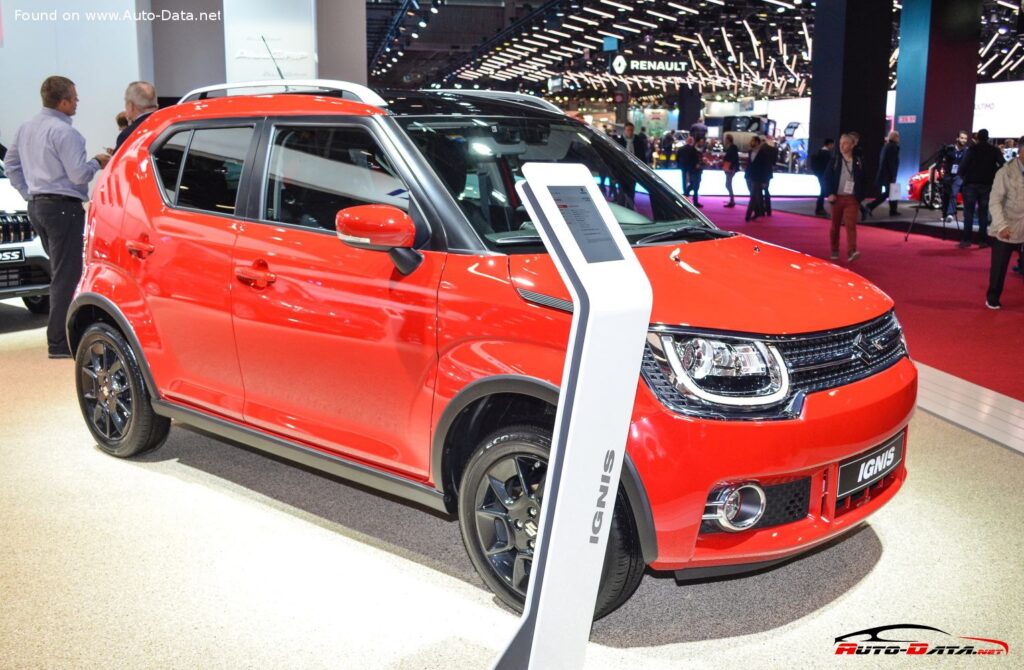
The Suzuki Ignis II is a five-door, five-seat subcompact SUV that stands out with its distinctive and somewhat polarizing design. Suzuki’s designers aimed to blend retro cues with modern aesthetics, resulting in a vehicle that is both playful and practical. Its compact dimensions – a length of 145.67 inches (3700 mm), a width of 66.54 inches (1690 mm), and a height of 62.8 inches (1595 mm) – make it exceptionally agile in congested urban environments, while its relatively tall stance and generous 7.09 inches (180 mm) of ground clearance provide a commanding view of the road and the ability to tackle minor obstacles.
Key exterior design elements include a prominent front grille, distinctive headlamp clusters, and a unique C-pillar treatment with three slits, a nod to classic Suzuki models like the Fronte Coupe. The high beltline and short overhangs further emphasize its SUV character. Despite its small exterior footprint, the interior is surprisingly spacious for its class, offering comfortable seating for five occupants. The cabin layout prioritizes functionality and ease of use, with a straightforward dashboard design and accessible controls.
Practicality is a strong suit for the Ignis. The trunk offers a minimum of 8.02 cubic feet (227 liters) of cargo space, which can expand significantly to 37.29 cubic feet (1056 liters) with the rear seats folded down, showcasing its versatility for hauling luggage or larger items. The standard equipment includes essential safety and convenience features, such as an Anti-lock Braking System (ABS) for enhanced stopping power and electric power steering for effortless maneuverability, especially during parking.
The vehicle’s chassis is built for a balance of comfort and capability. It features an independent McPherson strut front suspension, providing a compliant ride and responsive handling. The rear utilizes a semi-independent coil spring setup, optimized for both load-carrying and ride quality. Braking is handled by ventilated discs at the front for efficient heat dissipation and traditional drum brakes at the rear. The 16-inch wheels, shod with 175/60 R16 tires, contribute to both the vehicle’s aesthetic and its handling characteristics, offering a good compromise between ride comfort and grip. Its impressive approach angle of 20 degrees, departure angle of 38.3 degrees, and ramp-over angle of 19.2 degrees further underscore its genuine, albeit light-duty, off-road credentials.
Technical Specifications
| Category | Specification |
|---|---|
| Brand | Suzuki |
| Model | Ignis |
| Generation | Ignis II |
| Type (Engine) | 1.2 DualJet (90 Hp) ALLGRIP 5 Seat |
| Start of Production | 2016 year |
| End of Production | December, 2019 year |
| Powertrain Architecture | Internal Combustion Engine |
| Body type | SUV |
| Seats | 5 |
| Doors | 5 |
| Performance Specs | |
| Fuel consumption (urban) | 39.9 US mpg (5.9 L/100 km) |
| Fuel consumption (extra urban) | 52.3 US mpg (4.5 L/100 km) |
| Fuel consumption (combined) | 47 US mpg (5.0 L/100 km) |
| CO2 emissions | 114 g/km |
| Fuel Type | Petrol (Gasoline) |
| Acceleration 0 – 60 mph | 11.3 sec |
| Acceleration 0 – 100 km/h | 11.9 sec |
| Maximum speed | 102.53 mph (165 km/h) |
| Emission standard | Euro 6 |
| Weight-to-power ratio | 9.7 kg/Hp, 103.4 Hp/tonne |
| Weight-to-torque ratio | 7.3 kg/Nm, 137.9 Nm/tonne |
| Engine Specs | |
| Power | 90 Hp @ 6000 rpm |
| Power per liter | 72.5 Hp/L |
| Torque | 88.51 lb-ft @ 4400 rpm (120 Nm @ 4400 rpm) |
| Engine layout | Front, Transverse |
| Engine Model/Code | K12C |
| Engine displacement | 1.2 L (1242 cm3, 75.79 cu. in.) |
| Number of cylinders | 4 |
| Engine configuration | Inline |
| Cylinder Bore | 2.87 in (73 mm) |
| Piston Stroke | 2.92 in (74.2 mm) |
| Compression ratio | 12.5:1 |
| Number of valves per cylinder | 4 |
| Fuel injection system | Multi-port manifold injection |
| Engine aspiration | Naturally aspirated engine |
| Engine oil capacity | 3.49 US qt (3.3 L) |
| Engine oil specification | Not specified in data |
| Coolant capacity | 4.23 US qt (4 L) |
| Space, Volume and Weights | |
| Kerb Weight | 1918.02 – 1995.18 lbs (870-905 kg) |
| Max. weight (GVWR) | 2932.15 lbs (1330 kg) |
| Max load | 936.96 – 1014.13 lbs (425-460 kg) |
| Trunk (boot) space – minimum | 8.02 cu. ft. (227 L) |
| Trunk (boot) space – maximum | 37.29 cu. ft. (1056 L) |
| Fuel tank capacity | 7.93 US gal (30 L) |
| Permitted trailer load with brakes (12%) | 2204.62 lbs (1000 kg) |
| Permitted trailer load without brakes | 881.85 lbs (400 kg) |
| Permitted towbar download | 110.23 lbs (50 kg) |
| Dimensions | |
| Length | 145.67 in (3700 mm) |
| Width | 66.54 in (1690 mm) |
| Height | 62.8 in (1595 mm) |
| Wheelbase | 95.87 in (2435 mm) |
| Front track | 57.48 in (1460 mm) |
| Rear (Back) track | 57.48 in (1460 mm) |
| Ride height (ground clearance) | 7.09 in (180 mm) |
| Minimum turning circle (turning diameter) | 30.84 ft (9.4 m) |
| Approach angle | 20° |
| Departure angle | 38.3° |
| Ramp-over (brakeover) angle | 19.2° |
| Drivetrain, Brakes and Suspension Specs | |
| Drivetrain Architecture | The Internal combustion engine (ICE) drives the front wheels permanently, and the rear wheels are driven through an electrically or mechanically operated clutch if necessary. |
| Drive wheel | All-wheel drive (4×4) |
| Number of gears and type of gearbox | 5 gears, manual transmission |
| Front suspension | Independent type McPherson |
| Rear suspension | Semi-independent, coil spring |
| Front brakes | Ventilated discs |
| Rear brakes | Drum |
| Assisting systems | ABS (Anti-lock braking system) |
| Steering type | Steering rack and pinion |
| Power steering | Electric Steering |
| Tires size | 175/60 R16 |
| Wheel rims size | 16 inches |
Legacy and Market Impact
The Suzuki Ignis II 1.2 DualJet (90 Hp) ALLGRIP 5 Seat, despite its absence from the North American market, made a significant impact in its primary sales regions, particularly Europe, Japan, and India. It successfully revived the Ignis nameplate, which had been dormant for several years, and re-established Suzuki’s presence in the burgeoning subcompact crossover segment. Its unique blend of compact size, distinctive styling, surprising practicality, and the availability of all-wheel drive set it apart from many rivals.
In Europe, the Ignis competed against a diverse range of small cars and crossovers, including the Fiat Panda 4×4, Dacia Sandero Stepway, and entry-level versions of models like the Renault Captur and Nissan Juke. What allowed the Ignis to stand out was its genuine 4×4 capability in a truly small package, offering a rugged image and practical benefits without the associated fuel consumption or parking difficulties of larger SUVs. Its excellent fuel economy, thanks to the DualJet engine, was a major selling point in markets with high fuel prices and emission-based taxation. The option of ALLGRIP all-wheel drive made it particularly appealing in regions with challenging winter conditions or rural areas where occasional off-pavement driving was common.
In its home market of Japan, the Ignis resonated with consumers looking for a versatile city car that could also handle weekend adventures. Its compact dimensions made it ideal for narrow streets and tight parking spaces, while the elevated driving position and optional AWD offered reassurance and utility. In India, where it was sold as the Maruti Suzuki Ignis, it quickly became a popular choice among younger buyers and urban families, thanks to its modern styling, feature-rich interior, and Suzuki’s reputation for reliability and low running costs.
The Ignis II’s legacy is one of smart packaging and focused engineering. It demonstrated Suzuki’s enduring ability to produce small, capable, and characterful vehicles that meet specific market