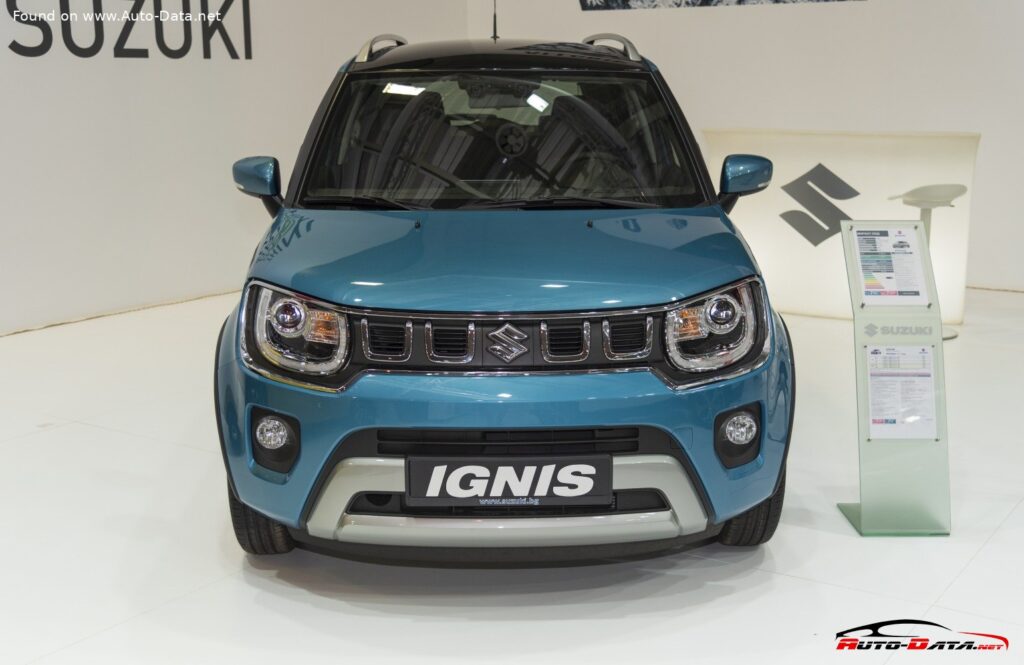
The Suzuki Ignis II (facelift 2020) 1.2 (91 Hp) Mild Hybrid CVT: A Global Urban Crossover
The Suzuki Ignis II (facelift 2020) 1.2 (91 Hp) Mild Hybrid CVT represents a compelling offering in the subcompact crossover segment, primarily targeting urban consumers in markets across Europe, Asia, and other regions where Suzuki maintains a strong presence. Unveiled in February 2020 as a refreshed iteration of the second-generation Ignis, this model embodies Suzuki’s philosophy of creating compact, lightweight, and highly efficient vehicles. While not available in the United States market, the Ignis has carved out a significant niche internationally as a practical, stylish, and economical small SUV, perfectly suited for navigating congested city streets and offering a surprisingly versatile package for its diminutive size. Its distinctive design, coupled with a forward-thinking mild-hybrid powertrain, positions it as an intelligent choice for drivers seeking a blend of SUV-like aesthetics, nimble handling, and impressive fuel efficiency.
The Suzuki Ignis II (facelift 2020) 1.2 Mild Hybrid CVT is more than just a city car; it’s a micro-SUV that cleverly maximizes interior space and utility within a compact footprint. This particular variant, featuring a 1.2-liter engine paired with a mild-hybrid system and a continuously variable transmission (CVT), highlights Suzuki’s commitment to powertrain innovation aimed at reducing emissions and improving economy without sacrificing everyday usability. Its market success outside the U.S. underscores a global demand for affordable, robust, and environmentally conscious personal transportation solutions.
Engine & Performance: The Efficient Heart of the Suzuki Ignis II (facelift 2020)
At the core of the Suzuki Ignis II (facelift 2020) 1.2 (91 Hp) Mild Hybrid CVT lies a meticulously engineered powertrain designed for optimal efficiency and responsive urban driving. The primary motivator is Suzuki’s K12C 1.2-liter (1242 cm3 or 75.79 cu. in.) inline four-cylinder gasoline engine. This sophisticated unit is equipped with Dual Overhead Camshafts (DOHC) and Variable Valve Timing (VVT), ensuring a broad power band and improved fuel combustion. It delivers a respectable 91 horsepower at 6000 rpm, with a power per liter rating of 73.3 Hp/l, showcasing its energetic nature for a small displacement engine. Peak torque from the internal combustion engine stands at 87.03 lb.-ft. (118 Nm) at 4400 rpm, providing ample thrust for city driving and highway merges.
What truly sets this Ignis variant apart is its Mild Hybrid Electric Vehicle (MHEV) architecture. This system employs an electric motor to assist the gasoline engine, particularly during acceleration and deceleration. The electric motor contributes an additional 3 horsepower at 1000 rpm and a significant 36.88 lb.-ft. (50 Nm) of torque at a low 100 rpm. While it cannot power the vehicle solely on electricity, this “power-assist” or “battery-assisted” hybrid system significantly enhances the vehicle’s overall efficiency by reducing the load on the gasoline engine and recovering energy during braking. The integrated starter generator (ISG) also enables smoother engine restarts for the automatic start-stop system, further contributing to fuel savings in stop-and-go traffic.
Power is delivered to the front wheels via a continuously variable transmission (CVT), which offers seamless acceleration and helps keep the engine operating in its most efficient rpm range. This combination of a lightweight body and an efficient mild-hybrid powertrain results in impressive fuel economy figures under the WLTP standard. At low speeds, the Ignis achieves approximately 37.3 US mpg (6.3 l/100 km); at medium speeds, it improves to 48 US mpg (4.9 l/100 km); and at high speeds, it reaches an remarkable 51.1 US mpg (4.6 l/100 km). These figures underscore its credentials as a highly economical vehicle in its class. Furthermore, with a kerb weight ranging from 1873.93 to 1940.07 lbs. (850-880 kg), the Ignis boasts an excellent weight-to-power ratio of 9.3 kg/Hp (107.1 Hp/tonne), contributing to its nimble handling and responsive feel.
Design & Features: Urban Style Meets Practicality
The Suzuki Ignis II (facelift 2020) maintains its distinctive “micro-SUV” styling, blending rugged crossover cues with a compact, urban-friendly footprint. Its body type is a 5-door crossover, offering seating for five occupants, a testament to Suzuki’s ability to package space efficiently. Measuring just 145.67 inches (3700 mm) in length, 65.35 to 66.54 inches (1660-1690 mm) in width, and 63.19 inches (1605 mm) in height, the Ignis is incredibly maneuverable, making it ideal for navigating tight city streets and parking in constrained spaces. Its wheelbase of 95.87 inches (2435 mm) contributes to a stable ride, while a minimum turning circle of 30.84 feet (9.4 m) ensures exceptional agility.
Visually, the facelifted Ignis features a refreshed front grille and bumper design, giving it a more robust and contemporary appearance. The elevated ride height of 7.09 inches (180 mm) provides a commanding view of the road and enhances its crossover appeal, allowing it to tackle minor urban obstacles with ease. Inside, the Ignis offers a surprisingly spacious and practical cabin for its size. The design emphasizes usability, with intuitive controls and durable materials. While specific interior features vary by trim, the focus remains on essential comforts and connectivity for its target demographic.
Underneath its compact exterior, the Ignis is built on a robust platform. The front suspension utilizes an independent McPherson strut setup, known for its balance of comfort and handling, while the rear features a torsion beam, a space-efficient and cost-effective solution for compact vehicles. Braking is handled by ventilated discs at the front and drum brakes at the rear, complemented by an Anti-lock Braking System (ABS) for enhanced safety. The standard tire sizes are 175/65 R15 84H or 175/60 R16 82H, mounted on 15 or 16-inch wheel rims, providing a good balance of grip and ride comfort for its segment.
Technical Specifications
| Category | Specification | US Equivalent |
|---|---|---|
| General Information | ||
| Brand | Suzuki | |
| Model | Ignis | |
| Generation | Ignis II (facelift 2020) | |
| Type (Engine) | 1.2 (91 Hp) Mild Hybrid CVT | |
| Start of production | February, 2020 year | |
| Powertrain Architecture | MHEV (Mild Hybrid Electric Vehicle, power-assist hybrid, battery-assisted hybrid vehicles, BAHV) | |
| Body type | Crossover | |
| Seats | 5 | |
| Doors | 5 | |
| Performance Specs | ||
| Fuel consumption at Low speed (WLTP) | 6.3 l/100 km | 37.3 US mpg |
| Fuel consumption at Medium speed (WLTP) | 4.9 l/100 km | 48 US mpg |
| Fuel consumption at high speed (WLTP) | 4.6 l/100 km | 51.1 US mpg |
| Fuel Type | Petrol (Gasoline) | |
| Weight-to-power ratio | 9.3 kg/Hp | 107.1 Hp/tonne |
| Weight-to-torque ratio | 7.2 kg/Nm | 138.8 Nm/tonne |
| Electric Cars and Hybrids Specs | ||
| Electric motor 1 power | 3 Hp @ 1000 rpm | |
| Electric motor Torque | 50 Nm @ 100 rpm | 36.88 lb.-ft. @ 100 rpm |
| Internal Combustion Engine Specs | ||
| Power | 91 Hp @ 6000 rpm | |
| Power per liter | 73.3 Hp/l | |
| Torque | 118 Nm @ 4400 rpm | 87.03 lb.-ft. @ 4400 rpm |
| Engine layout | Front, Transverse | |
| Engine Model/Code | K12C | |
| Engine displacement | 1242 cm3 | 1.2 l (75.79 cu. in.) |
| Number of cylinders | 4 | |
| Engine configuration | Inline | |
| Cylinder Bore | 73 mm | 2.87 in. |
| Piston Stroke | 74.2 mm | 2.92 in. |
| Compression ratio | 12.5:1 | |
| Number of valves per cylinder | 4 | |
| Fuel injection system | Multi-port manifold injection | |
| Valvetrain | DOHC, VVT | |
| Engine oil capacity | 3.3 l | 3.49 US qt |
| Coolant | 4.2 l | 4.44 US qt |
| Space, Volume and Weights | ||
| Kerb Weight | 850-880 kg | 1873.93 – 1940.07 lbs. |
| Fuel tank capacity | 32 l | 8.45 US gal |
| Dimensions | ||
| Length | 3700 mm | 145.67 in. |
| Width | 1660-1690 mm | 65.35 – 66.54 in. |
| Height | 1605 mm | 63.19 in. |
| Wheelbase | 2435 mm | 95.87 in. |
| Front track | 1460 mm | 57.48 in. |
| Rear (Back) track | 1470 mm | 57.87 in. |
| Ride height (ground clearance) | 180 mm | 7.09 in. |
| Minimum turning circle (turning diameter) | 9.4 m | 30.84 ft. |
| Drivetrain, Brakes and Suspension Specs | ||
| Drivetrain Architecture | The Internal combustion engine (ICE) and electric motor drive the front wheels of the car with the ability to work only in mixed mode. | |
| Drive wheel | Front wheel drive | |
| Number of gears and type of gearbox | automatic transmission CVT | |
| Front suspension | Independent type McPherson | |
| Rear suspension | Torsion | |
| Front brakes | Ventilated discs | |
| Rear brakes | Drum | |
| Assisting systems | ABS (Anti-lock braking system) | |
| Tires size | 175/65 R15 84H; 175/60 R16 82H | |
| Wheel rims size | 15; 16 | |
Legacy & Market Impact
The Suzuki Ignis, particularly the updated Ignis II (facelift 2020) with its mild-hybrid powertrain, enjoys a strong and positive reputation in its primary markets, which predominantly include Europe, Japan, India, and Australia. It is widely regarded as a practical, reliable, and exceptionally fuel-efficient vehicle that offers a unique blend of compact dimensions and SUV-inspired styling. Its lightweight construction and efficient powertrain make it an agile performer in urban environments, while its relatively high ground clearance and robust build quality appeal to those who appreciate a sense of adventure, even if it’s mostly confined to city limits.
In its segment, the Ignis competes with a diverse range of vehicles, from traditional city cars to other compact crossovers. Key competitors in various international markets might include models like the Fiat Panda Cross, Hyundai Casper (in select Asian markets), Dacia Sandero Stepway, and increasingly, smaller urban SUVs from brands like Toyota (e.g., Aygo X). What differentiates the Ignis is its distinct character – a blend of retro-inspired styling cues with modern technology, coupled with Suzuki’s long-standing reputation for building durable and dependable small cars and 4x4s.
The historical significance of the Ignis lies in its continuation of Suzuki’s legacy of producing highly functional and affordable vehicles for a global audience. Suzuki has consistently excelled in creating small, efficient, and often surprisingly capable automobiles, and the Ignis is a prime example of this expertise. While Suzuki withdrew its passenger car operations from the United States market in 2012, primarily due to shifting consumer preferences towards larger vehicles and intense competition, the brand continues to thrive globally by focusing on segments where its strengths—such as compact engineering, fuel efficiency, and value—are highly valued. The Ignis epitomizes this strategy, offering a compelling package that resonates with buyers in regions where practicality, economy, and maneuverability are paramount.
The Suzuki Ignis II (facelift 2020) 1.2 Mild Hybrid CVT therefore stands as a testament to Suzuki’s enduring commitment to innovation in compact vehicle design. It addresses contemporary demands for lower emissions and better fuel economy through its mild-hybrid technology, while maintaining the brand’s core values of reliability and utility. Its continued evolution ensures its relevance in a dynamic global automotive landscape, solidifying its place as a smart and stylish choice for urban explorers worldwide.