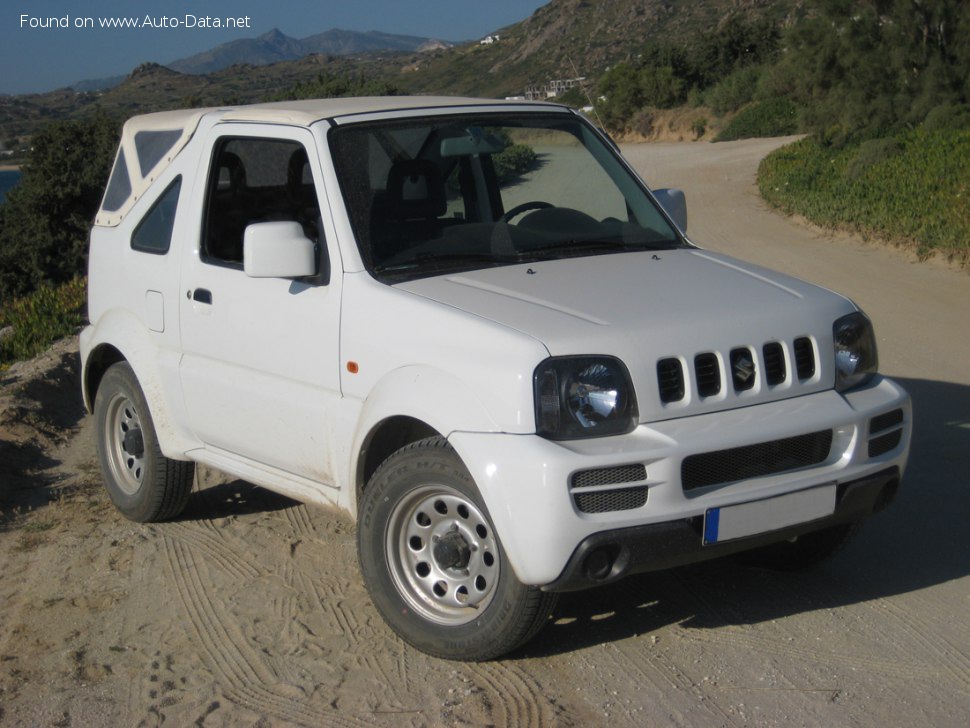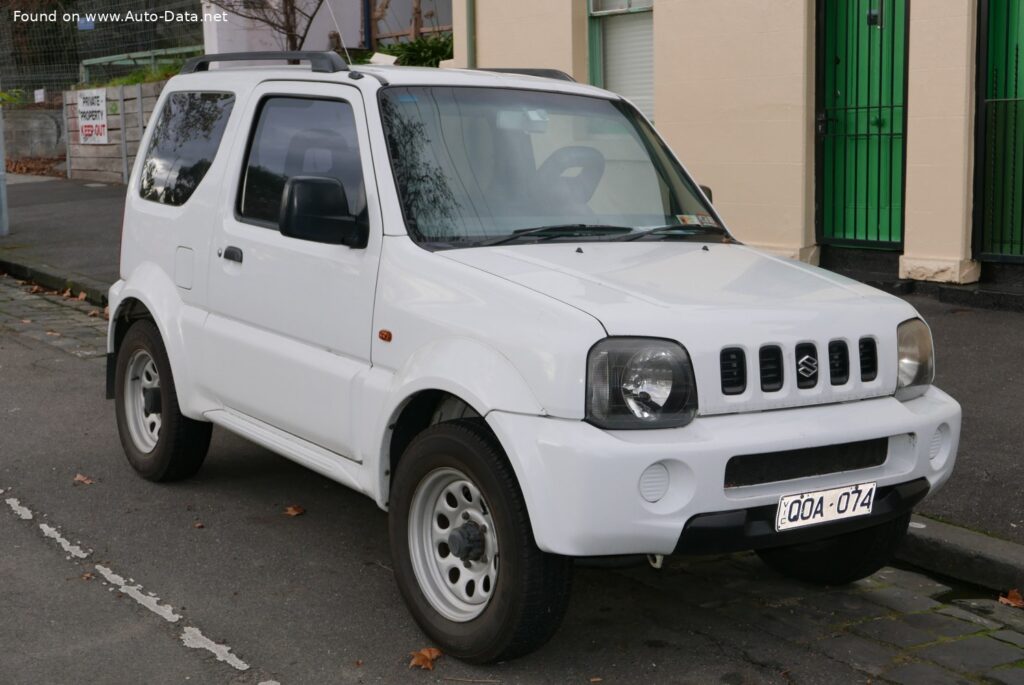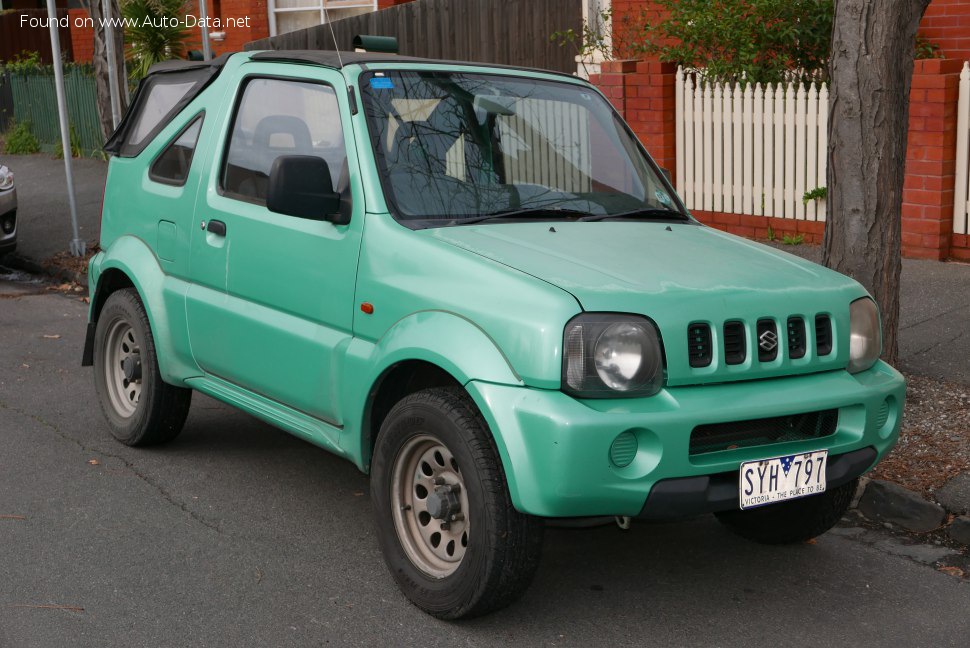
Introduction to the Suzuki Jimny Cabrio III 1.3 16V (80 Hp) 4WD
The Suzuki Jimny, a name synonymous with compact yet highly capable off-road vehicles, has enjoyed a storied history across global markets. The third generation of this venerable series, particularly the Suzuki Jimny Cabrio III 1.3 16V (80 Hp) 4WD, represents a significant chapter in its evolution. Produced from 1999 to 2005, this iteration continued the Jimny’s legacy as a lightweight, rugged, and remarkably agile all-terrain vehicle. While not a mainstream offering in the United States, the Jimny Cabrio III carved out a formidable niche in Europe, Asia, and other international markets, celebrated for its unique combination of a go-anywhere attitude and an open-air driving experience. It seamlessly blended the practicality of an off-road utility vehicle with the fun factor of a convertible, making it a distinctive proposition in its segment.
This specific model, characterized by its 1.3-liter 16-valve engine and robust 4WD system, reinforced Suzuki’s reputation for building durable and affordable 4x4s. It stood as a testament to the brand’s commitment to delivering genuine off-road capability in a package that was both compact and accessible. The Jimny Cabrio III was more than just a vehicle; it was an invitation to adventure, offering a no-nonsense approach to tackling challenging terrains while allowing occupants to immerse themselves in their surroundings.
Engine & Performance: Powering the Suzuki Jimny Cabrio III
Under the hood of the Suzuki Jimny Cabrio III lies a robust and proven powertrain, specifically the G13BB engine. This 1.3-liter (1298 cm3 or 79.21 cu. in.) inline four-cylinder petrol (gasoline) unit is naturally aspirated and features a Single Overhead Camshaft (SOHC) valvetrain with 16 valves, four per cylinder. It produces a modest but effective 80 horsepower at 6000 rpm, which, when combined with its lightweight chassis, results in a respectable power-to-weight ratio of 79.2 Hp per tonne (or 12.6 kg/Hp). Torque output stands at 76.71 lb.-ft. (104 Nm) at 4500 rpm, providing sufficient grunt for off-road maneuvers and city driving.
The engine’s layout is front and longitudinal, contributing to a balanced weight distribution and optimal drivetrain geometry for a 4×4. Power is delivered to the wheels via a durable 5-speed manual transmission, offering direct control and engagement, which is particularly appreciated by off-road enthusiasts. The drivetrain architecture is a part-time all-wheel-drive system, meaning the internal combustion engine permanently drives the rear wheels, with the front wheels engaged through an electrically or mechanically operated clutch when additional traction is required. This setup allows for improved fuel efficiency in two-wheel-drive mode on paved surfaces and superior grip when venturing off-road.
Despite its off-road focus, the Jimny Cabrio III delivers reasonable fuel economy for its class. The combined fuel consumption is rated at 31.4 US mpg (7.5 l/100 km), with urban figures at 25 US mpg (9.4 l/100 km) and extra-urban at 36.8 US mpg (6.4 l/100 km). This efficiency, coupled with a 10.57 US gallon (40 l) fuel tank, provides a decent range for both daily commutes and adventurous excursions. The vehicle’s maximum speed is 86.99 mph (140 km/h), reflecting its design priorities toward utility and capability rather than outright speed. It meets the Euro 3 emission standard, characteristic of vehicles from its production era.
Design & Features: Form Meets Function
The design of the Suzuki Jimny Cabrio III is a masterclass in functional aesthetics, embodying the rugged spirit of a true off-road vehicle while offering the unique appeal of a convertible. Its body type is officially categorized as an “Off-road vehicle, Cabriolet,” featuring three doors and seating for four occupants. This open-top configuration, a rarity in the compact 4×4 segment, allowed for an immersive driving experience, whether traversing dusty trails or cruising along coastal roads.
Compact dimensions are a hallmark of the Jimny. Measuring 142.72 inches (3625 mm) in length, 62.99 inches (1600 mm) in width, and 65.16 inches (1655 mm) in height, with a wheelbase of 88.58 inches (2250 mm), the Jimny Cabrio III is exceptionally maneuverable in tight spaces, both urban and wilderness. Its true off-road prowess is highlighted by impressive ground clearance of 7.48 inches (190 mm) and outstanding approach (42°), departure (46°), and ramp-over (31°) angles. These figures are crucial for navigating challenging obstacles without scraping the undercarriage or bumpers.
The Jimny’s robust construction is evident in its suspension and braking systems. It employs a rigid axle suspension with coil springs at both the front and rear, a setup favored for its durability and articulation in extreme off-road conditions. Braking is handled by disc brakes at the front and drum brakes at the rear, supplemented by an Anti-lock Braking System (ABS) for enhanced safety and control during emergency stops. The steering system is a cone worm with recirculation balls, aided by hydraulic power steering, providing a direct and robust feel, essential for precise control on varied terrains. Standard tire size is 205/70 R15 on 6J x 15 wheel rims, offering a good balance of on-road comfort and off-road grip.
Inside, the cabin is utilitarian yet functional, designed to withstand the rigors of off-road adventures. While not opulent, it provides all necessary controls and gauges in an ergonomic layout. The modest trunk space of 3.99 cu. ft. (113 liters) reflects its compact nature, prioritizing passenger space and off-road capability over cargo volume. The kerb weight of 2226.67 lbs. (1010 kg) further underscores its lightweight design, which is a significant advantage for off-road performance and fuel efficiency.
Technical Specifications: Suzuki Jimny Cabrio III 1.3 16V (80 Hp) 4WD
| Category | Specification |
|---|---|
| General Information | |
| Brand | Suzuki |
| Model | Jimny |
| Generation | Jimny Cabrio III |
| Type (Engine) | 1.3 16V (80 Hp) 4WD |
| Start of Production | 1999 |
| End of Production | 2005 |
| Powertrain Architecture | Internal Combustion Engine |
| Body type | Off-road vehicle, Cabriolet |
| Seats | 4 |
| Doors | 3 |
| Performance Specs | |
| Fuel Consumption (Economy) – Urban | 25 US mpg (9.4 l/100 km) |
| Fuel Consumption (Economy) – Extra Urban | 36.8 US mpg (6.4 l/100 km) |
| Fuel Consumption (Economy) – Combined | 31.4 US mpg (7.5 l/100 km) |
| CO2 Emissions | 179 g/km |
| Fuel Type | Petrol (Gasoline) |
| Maximum Speed | 86.99 mph (140 km/h) |
| Emission Standard | Euro 3 |
| Weight-to-Power Ratio | 12.6 kg/Hp, 79.2 Hp/tonne |
| Weight-to-Torque Ratio | 9.7 kg/Nm, 103 Nm/tonne |
| Engine Specs | |
| Power | 80 Hp @ 6000 rpm |
| Power per liter | 61.6 Hp/l |
| Torque | 76.71 lb.-ft. (104 Nm) @ 4500 rpm |
| Engine Layout | Front, Longitudinal |
| Engine Model/Code | G13BB |
| Engine Displacement | 1.3 Liters (1298 cm3, 79.21 cu. in.) |
| Number of Cylinders | 4 |
| Engine Configuration | Inline |
| Cylinder Bore | 2.91 in. (74 mm) |
| Piston Stroke | 2.97 in. (75.5 mm) |
| Compression Ratio | 9.5:1 |
| Number of Valves per Cylinder | 4 |
| Fuel Injection System | Multi-port manifold injection |
| Engine Aspiration | Naturally aspirated engine |
| Valvetrain | SOHC |
| Engine Oil Capacity | 3.91 US qt (3.7 l) |
| Engine Oil Specification | Not specified in data |
| Coolant Capacity | 4.76 US qt (4.5 l) |
| Space, Volume and Weights | |
| Kerb Weight | 2226.67 lbs. (1010 kg) |
| Max. Weight (Gross Vehicle Weight) | 3130.56 lbs. (1420 kg) |
| Max Load | 903.9 lbs. (410 kg) |
| Trunk (Boot) Space – Minimum | 3.99 cu. ft. (113 l) |
| Fuel Tank Capacity | 10.57 US gal (40 l) |
| Permitted Trailer Load with Brakes (12%) | 2866.01 lbs. (1300 kg) |
| Permitted Trailer Load without Brakes | 771.62 lbs. (350 kg) |
| Permitted Towbar Download | 165.35 lbs. (75 kg) |
| Dimensions | |
| Length | 142.72 in. (3625 mm) |
| Width | 62.99 in. (1600 mm) |
| Height | 65.16 in. (1655 mm) |
| Wheelbase | 88.58 in. (2250 mm) |
| Front Track | 53.35 in. (1355 mm) |
| Rear (Back) Track | 53.74 in. (1365 mm) |
| Front Overhang | 25 in. (635 mm) |
| Rear Overhang | 29.13 in. (740 mm) |
| Ride Height (Ground Clearance) | 7.48 in. (190 mm) |
| Minimum Turning Circle (Turning Diameter) | 32.15 ft. (9.8 m) |
| Approach Angle | 42° |
| Departure Angle | 46° |
| Ramp-over (Breakover) Angle | 31° |
| Drivetrain, Brakes and Suspension Specs | |
| Drivetrain Architecture | The Internal combustion engine (ICE) drives the rear wheels permanently, and the front wheels are driven through an electrically or mechanically operated clutch if necessary. |
| Drive Wheel | All-wheel drive (4×4) |
| Number of Gears and Type of Gearbox | 5 gears, manual transmission |
| Front Suspension | Coil spring, Rigid axle suspension |
| Rear Suspension | Rigid axle suspension, Coil spring |
| Front Brakes | Disc |
| Rear Brakes | Drum |
| Assisting Systems | ABS (Anti-lock braking system) |
| Steering Type | Cone worm with recirculation balls |
| Power Steering | Hydraulic Steering |
| Tires Size | 205/70 R15 |
| Wheel Rims Size | 6J x 15 |
Legacy & Market Impact: The Enduring Appeal of the Jimny Cabrio III
The Suzuki Jimny Cabrio III, and indeed the entire Jimny lineage, holds a unique and respected position in the global automotive landscape. Its market impact, particularly in regions outside the US, was significant, establishing it as a benchmark for compact, affordable, and genuinely capable off-roaders. In its primary markets like Europe, Japan, Australia, and parts of Asia, the Jimny Cabrio III competed against a varied, though often less specialized, set of vehicles. While larger SUVs like the Toyota RAV4 or Honda CR-V offered more comfort and on-road refinement, they could not match the Jimny’s sheer off-road prowess in such a diminutive package. Direct competitors were few, perhaps including vehicles like the Daihatsu Terios or, in spirit, the Lada Niva, but none truly offered the Jimny’s blend of compact dimensions, convertible fun, and robust ladder-frame chassis with live axles.
The reputation of the Suzuki Jimny Cabrio III 1.3 16V (80 Hp) 4WD was built on its unwavering reliability, low running costs, and exceptional capabilities when the pavement ended. Its lightweight nature and short wheelbase made it incredibly agile on tight trails, allowing it to navigate terrain that would challenge much larger and more powerful 4x4s. This earned it a loyal following among outdoor enthusiasts, farmers, and anyone needing a dependable vehicle for challenging environments. The convertible option further enhanced its appeal, offering a sensory experience that few other off-roaders could provide, connecting drivers and passengers more intimately with their surroundings.
Historically, the Jimny Cabrio III built upon the solid foundation laid by its predecessors, the LJ and SJ series, which had cemented Suzuki’s status as a pioneer in small 4x4s. It carried forward the philosophy of simplicity, durability, and mechanical integrity. Its enduring design, which saw only minor updates throughout its production run, speaks to the effectiveness of its original concept. Even after its production ended in 2005, the Jimny name continued with a refreshed model, and its legacy continues to this day with the highly acclaimed fourth-generation Jimny.
Today, the Jimny Cabrio III remains a sought-after vehicle in the used car market in many parts of the world, particularly by those who appreciate its classic off-road character and the increasingly rare open-top 4×4 experience. It represents an era where automotive design prioritized function and ruggedness, making it a beloved icon for those who value adventure over luxury. Its impact extends beyond sales figures, influencing a generation of compact SUVs and reinforcing the idea that true capability doesn’t always require a colossal footprint or an exorbitant price tag.