The Suzuki Jimny Cabrio III: A Compact Off-Road Icon
The Suzuki Jimny Cabrio III 1.3 i 16V (80 Hp) 4WD Automatic represents a significant chapter in the legacy of compact, capable off-road vehicles. Produced between 1998 and 2000, this specific variant of the third-generation Jimny combined Suzuki’s proven expertise in rugged 4×4 engineering with the open-air appeal of a convertible. While not officially sold in the United States, the Jimny series, including this Cabriolet version, carved out a strong niche in European, Asian, and other international markets, continuing the tradition set by its predecessors like the Suzuki SJ series and Samurai. It was celebrated for its diminutive size, genuine off-road prowess, and a no-nonsense approach to adventure, offering an accessible entry into the world of four-wheel drive.
This particular model, with its 1.3-liter engine and automatic transmission, aimed to broaden the Jimny’s appeal, providing a more relaxed driving experience without compromising its fundamental go-anywhere capability. The third generation of the Jimny, internally designated as the JB33/JB43 series, moved towards a slightly more refined package compared to its utilitarian ancestors, yet retained the critical body-on-frame construction and robust live axles that are hallmarks of serious off-roaders. The Cabriolet variant further enhanced its recreational appeal, making it a popular choice for those seeking a fun, versatile vehicle for both urban exploration and weekend escapades into nature.
Engine and Performance of the Suzuki Jimny Cabrio III
Under the hood of the Suzuki Jimny Cabrio III 1.3 i 16V (80 Hp) 4WD Automatic lay the venerable G13BB engine. This naturally aspirated, 1.3-liter (1298 cm³ or 79.21 cu. in.) inline four-cylinder powerplant was a well-regarded unit known for its reliability and adequate performance for the Jimny’s intended applications. Featuring an Overhead Camshaft (OHC) valvetrain and multi-port manifold injection, it delivered 80 horsepower at 6000 rpm and 104 Nm (76.71 lb.-ft.) of torque at 4500 rpm. While these figures might seem modest by modern standards, they were perfectly suited to the Jimny’s lightweight chassis and off-road bias, where torque at lower RPMs and manageable power delivery are often more crucial than outright speed.
The engine’s design, with its relatively high compression ratio of 9.5:1 and 4 valves per cylinder, ensured efficient combustion and a responsive feel for its displacement. Power was routed through a 4-speed automatic transmission, a notable convenience feature for a vehicle of this segment in its era. This automatic gearbox made the Jimny more user-friendly in city traffic and less fatiguing during longer drives, while still offering the flexibility needed for off-road maneuvering. The powertrain architecture was a traditional front, longitudinal engine layout, driving all four wheels via a robust 4WD system, complete with a transfer case for low-range gearing (a feature typical of serious off-road vehicles, though not explicitly detailed in the provided data, it’s a standard Jimny characteristic of the era).
Performance figures reflected its utilitarian nature rather than a focus on speed. The Jimny Cabrio III accelerated from 0 to 60 mph in approximately 16 seconds, with a top speed of 86.99 mph (140 km/h). Fuel economy was respectable for a 4WD vehicle of its time, with a combined rating of 31.4 US mpg (7.5 l/100 km), making it an economical choice for daily driving and adventurous excursions alike. The engine’s simplicity also contributed to its reputation for durability and ease of maintenance, appealing to owners who valued reliability in remote areas.
Design and Features
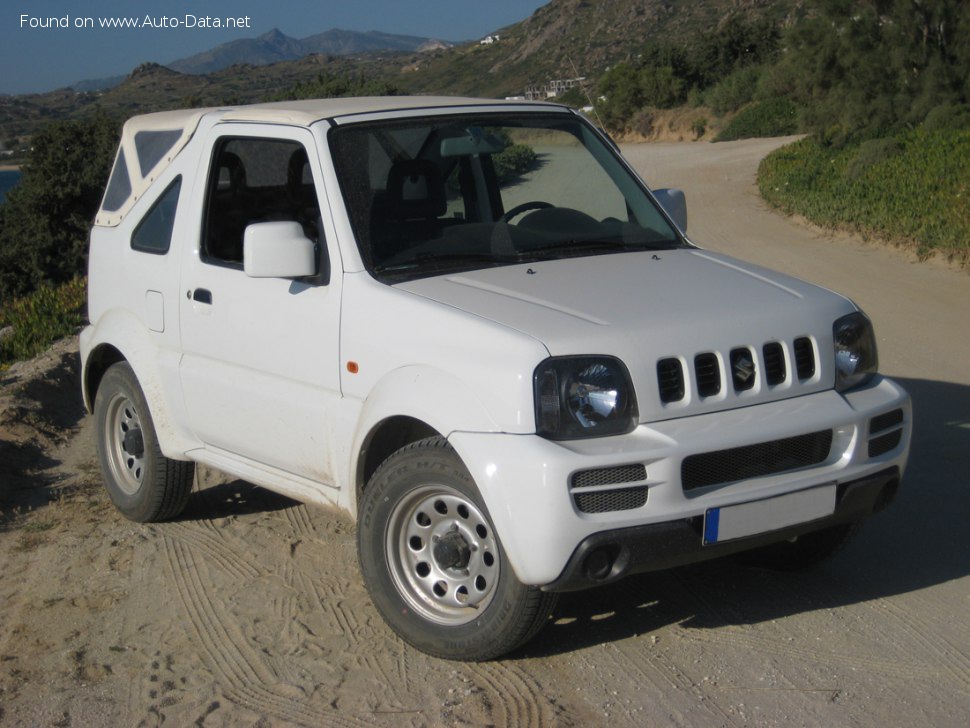
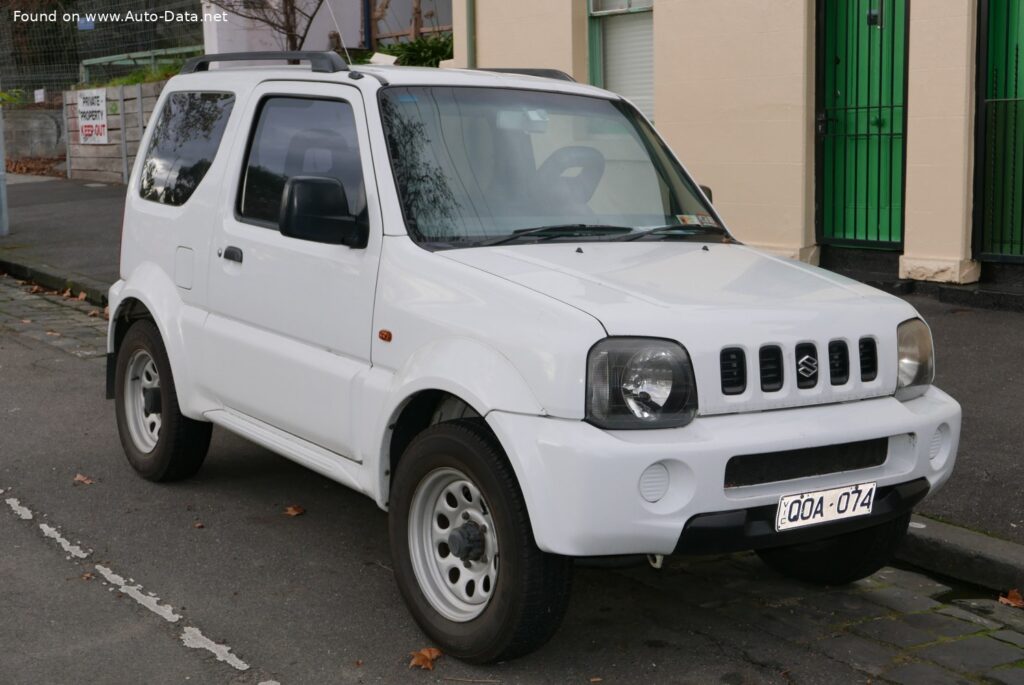
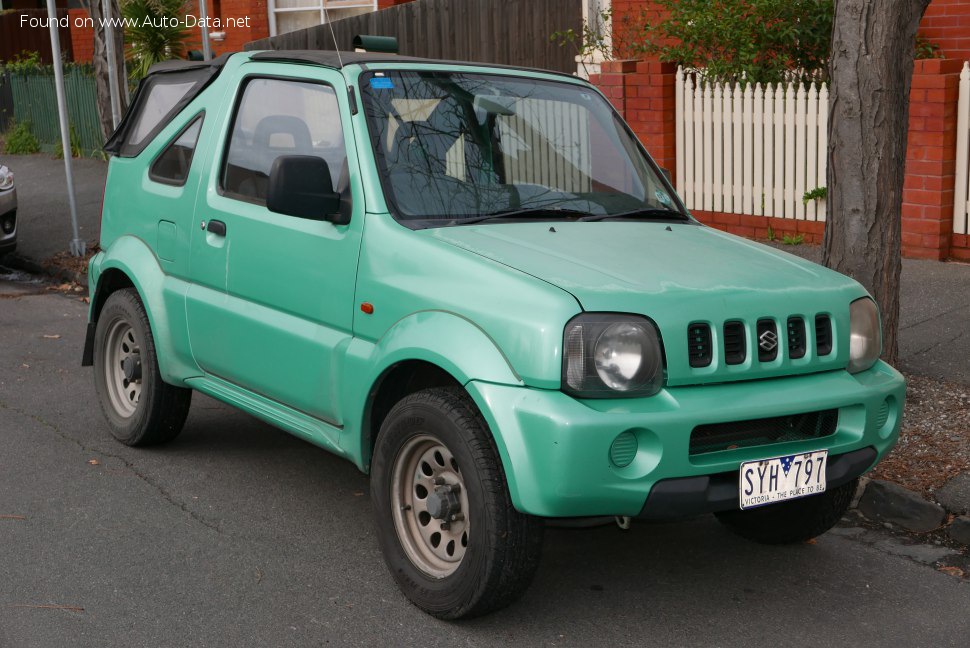
The design of the Suzuki Jimny Cabrio III was unmistakably rugged yet charmingly compact. Its body type was a unique combination of an off-road vehicle and a cabriolet, featuring three doors and, surprisingly for its size, seating for five occupants. This configuration offered a blend of practicality and open-air enjoyment that few competitors could match. The convertible top, typically a soft-top design, allowed owners to quickly transform the vehicle from a closed cabin to an open-air cruiser, enhancing the sense of adventure.
Dimensionally, the Jimny Cabrio III was incredibly agile, measuring just 142.72 inches (3625 mm) in length, 62.99 inches (1600 mm) in width, and 65.55 inches (1665 mm) in height. Its short wheelbase of 88.58 inches (2250 mm) and tight minimum turning circle of 32.15 feet (9.8 m) were instrumental in its legendary maneuverability on tight trails and in congested urban environments. These compact dimensions, combined with short front and rear overhangs, provided excellent approach and departure angles, crucial for serious off-road driving.
The chassis featured a traditional body-on-frame construction, providing the robustness required for challenging terrain. Suspension duties were handled by an independent wishbone setup at the front and a more rugged coil spring arrangement at the rear, typically involving a solid axle for maximum articulation and durability. Braking was managed by front disc brakes and rear drum brakes, supplemented by an Anti-lock Braking System (ABS), which was a significant safety feature for a vehicle of this class in the late 1990s. The hydraulic power steering system, using a rack and pinion setup, offered precise control, while the 205/70 R15 S tires provided a good balance of on-road comfort and off-road grip. The interior, while functional and straightforward, was designed to withstand the rigors of off-road use and the elements when the top was down, focusing on durability and ease of cleaning.
Technical Specifications
| Category | Specification |
|---|---|
| General Information | |
| Brand | Suzuki |
| Model | Jimny |
| Generation | Jimny Cabrio III |
| Type (Engine) | 1.3 i 16V (80 Hp) 4WD Automatic |
| Start of Production | 1998 year |
| End of Production | 2000 year |
| Powertrain Architecture | Internal Combustion engine |
| Body type | Off-road vehicle, Cabriolet |
| Seats | 5 |
| Doors | 3 |
| Performance Specs | |
| Fuel consumption (economy) – urban | 9.4 l/100 km (25 US mpg) |
| Fuel consumption (economy) – extra urban | 6.4 l/100 km (36.8 US mpg) |
| Fuel consumption (economy) – combined | 7.5 l/100 km (31.4 US mpg) |
| Fuel Type | Petrol (Gasoline) |
| Acceleration 0 – 60 mph | 16 sec |
| Acceleration 0 – 100 km/h | 16.8 sec |
| Maximum speed | 140 km/h (86.99 mph) |
| Weight-to-power ratio | 13.8 kg/Hp (72.7 Hp/tonne) |
| Weight-to-torque ratio | 10.6 kg/Nm (94.5 Nm/tonne) |
| Engine Specs | |
| Power | 80 Hp @ 6000 rpm |
| Power per liter | 61.6 Hp/l |
| Torque | 104 Nm (76.71 lb.-ft.) @ 4500 rpm |
| Engine layout | Front, Longitudinal |
| Engine Model/Code | G13BB |
| Engine displacement | 1298 cm³ (1.3 l / 79.21 cu. in.) |
| Number of cylinders | 4 |
| Engine configuration | Inline |
| Cylinder Bore | 74 mm (2.91 in.) |
| Piston Stroke | 75.5 mm (2.97 in.) |
| Compression ratio | 9.5:1 |
| Number of valves per cylinder | 4 |
| Fuel injection system | Multi-port manifold injection |
| Engine aspiration | Naturally aspirated engine |
| Valvetrain | OHC |
| Engine oil capacity | 3.7 l (3.91 US qt) |
| Coolant | 4.5 l (4.76 US qt) |
| Space, Volume and Weights | |
| Kerb Weight | 1100 kg (2425.08 lbs.) |
| Max. weight | 1420 kg (3130.56 lbs.) |
| Max load | 320 kg (705.48 lbs.) |
| Trunk (boot) space – minimum | 85 l (3 cu. ft.) |
| Trunk (boot) space – maximum | 620 l (21.9 cu. ft.) |
| Fuel tank capacity | 40 l (10.57 US gal) |
| Dimensions | |
| Length | 3625 mm (142.72 in.) |
| Width | 1600 mm (62.99 in.) |
| Height | 1665 mm (65.55 in.) |
| Wheelbase | 2250 mm (88.58 in.) |
| Front track | 1355 mm (53.35 in.) |
| Rear (Back) track | 1365 mm (53.74 in.) |
| Minimum turning circle (turning diameter) | 9.8 m (32.15 ft.) |
| Drivetrain, Brakes and Suspension Specs | |
| Drive wheel | All wheel drive (4×4) |
| Number of gears and type of gearbox | 4 gears, automatic transmission |
| Front suspension | Wishbone |
| Rear suspension | Coil spring |
| Front brakes | Disc |
| Rear brakes | Drum |
| Assisting systems | ABS (Anti-lock braking system) |
| Steering type | Steering rack and pinion |
| Power steering | Hydraulic Steering |
| Tires size | 205/70 R15 S |
Legacy and Market Impact
The Suzuki Jimny Cabrio III, particularly the 1.3 i 16V (80 Hp) 4WD Automatic variant, continued Suzuki’s long-standing tradition of producing highly capable yet affordable compact off-road vehicles. Its reputation was built on its unwavering reliability, remarkable off-road prowess for its size, and a charmingly unpretentious character. In markets outside the U.S., where it was primarily sold, the Jimny carved out a unique niche, appealing to a diverse range of buyers from city dwellers needing a compact, robust commuter to adventure seekers desiring a genuine 4×4 for weekend expeditions.
Competitors in its primary markets were few that could match its specific blend of size, convertible option, and off-road capability. While vehicles like the Lada Niva offered similar ruggedness and affordability, they often lacked the modern refinements and reliability of the Jimny. Other compact SUVs, such as some Daihatsu models (e.g., Feroza/Rocky), were perhaps more direct rivals, but the Jimny often stood out for its more dedicated off-road architecture and a more playful image, especially in its Cabriolet form. Its closest spiritual cousin might have been a highly optioned, small-engine version of the Jeep Wrangler, but the Jimny consistently offered a more accessible price point and a significantly smaller footprint.
The historical significance of the Jimny Cabrio III lies in its role as a bridge between the more rudimentary SJ/Samurai series and the increasingly refined yet still incredibly capable modern Jimny generations. It demonstrated that a small, lightweight vehicle could still be a serious contender off-road, challenging the notion that bigger is always better for conquering tough terrain. Its enduring design, robust mechanicals, and the sheer fun factor of an open-top 4×4 cemented its status as an iconic vehicle in many parts of the world. Even after its production ended in 2000, the third-generation Jimny continued to be highly sought after in the used car market, a testament to its lasting appeal and the strong community of enthusiasts it fostered. The Jimny’s legacy is one of rugged individualism, proving that true adventure can come in a compact and wonderfully capable package.