The Suzuki Jimny III 1.3 (80 Hp) 4WD: A Compact Off-Road Icon
The Suzuki Jimny III 1.3 (80 Hp) 4WD represents the third generation of Suzuki’s venerable compact off-road vehicle, a lineage celebrated globally for its rugged capability and diminutive footprint. Produced from 1998 to 2000, this particular variant, equipped with an 80 horsepower 1.3-liter engine and a robust four-wheel-drive system, quickly established itself as a go-to choice for enthusiasts and professionals requiring a genuinely capable vehicle in challenging terrains. While never officially sold in the United States market during this generation, the Jimny III carved out a significant niche in Europe, Asia, Australia, and other regions, continuing the legacy of its predecessors like the LJ and SJ series (known in some markets as the Samurai). It stood as a testament to Suzuki’s philosophy of building lightweight, durable, and exceptionally agile 4x4s, proving that immense off-road prowess doesn’t require a large, fuel-guzzling machine.
The Jimny III, and specifically the 1.3 (80 Hp) 4WD model, was designed from the ground up to conquer obstacles rather than simply navigate paved roads. Its compact dimensions, paired with a traditional body-on-frame construction, rigid axles, and a selectable four-wheel-drive system, made it an uncompromising tool for adventure. This generation marked a significant evolution in terms of refinement and safety features compared to its forebears, yet it retained the core mechanical simplicity and reliability that had endeared the Jimny nameplate to a loyal global following. Its introduction in 1998 was met with anticipation, as it modernized the classic small 4×4 concept for a new era, balancing improved on-road manners with undiminished off-road credentials.
Powertrain and Off-Road Prowess of the Suzuki Jimny III 1.3 (80 Hp) 4WD
Engine and Performance Characteristics
At the heart of the Suzuki Jimny III 1.3 (80 Hp) 4WD lies the G13BB engine, a naturally aspirated 1.3-liter (1298 cm³ or 79.21 cu. in.) inline-four gasoline unit. This engine delivered a respectable 80 horsepower at 6000 rpm, translating to a power-per-liter output of 61.6 Hp/l. Torque figures stood at 76.71 lb.-ft. (104 Nm) at 4500 rpm, providing ample low-end grunt crucial for navigating steep inclines and uneven terrain. The engine utilized a Multi-port manifold injection system and a Single Overhead Camshaft (SOHC) valvetrain with four valves per cylinder, striking a balance between efficiency and robust performance. With a compression ratio of 9.5:1, the G13BB was designed for reliability and ease of maintenance, capable of running on widely available petrol (gasoline).
Power was channeled through a durable 5-speed manual transmission, offering direct control over the engine’s output and allowing the driver to select the optimal gear for any situation, whether crawling over rocks or cruising on a dirt track. The powertrain architecture featured a part-time all-wheel-drive system, meaning the internal combustion engine permanently drove the rear wheels, with the front wheels engaged as needed via an electrically or mechanically operated clutch. This traditional 4×4 setup, coupled with a low-range transfer case (a standard feature on most Jimny models, though not explicitly detailed in the provided data, it’s a hallmark of its off-road capability), provided exceptional traction and control in challenging conditions.
Performance metrics for the 1.3 (80 Hp) 4WD variant reflected its utilitarian purpose. The vehicle achieved a maximum speed of 86.99 mph (140 km/h), indicating it was not built for high-speed highway sprints but rather for reliable, consistent performance off the beaten path. Fuel economy was rated at a combined 28.7 US mpg (8.2 l/100 km), with urban consumption at 23.1 US mpg (10.2 l/100 km) and extra-urban at 33.1 US mpg (7.1 l/100 km). CO2 emissions were 190 g/km, reflecting a balance between its engine size, 4WD system, and the emission standards of its time. With a kerb weight of just 2204.62 lbs. (1000 kg), the Jimny boasted a favorable weight-to-power ratio of 12.5 kg/Hp (80 Hp/tonne), contributing to its nimble feel and impressive off-road agility.
Design Philosophy and Practicality
Exterior and Interior Features
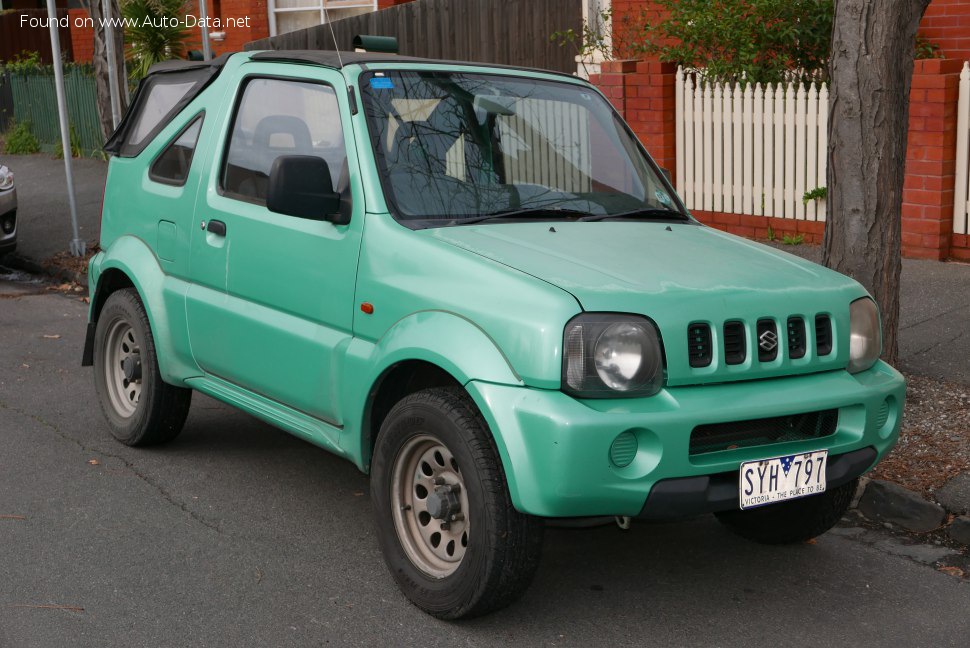
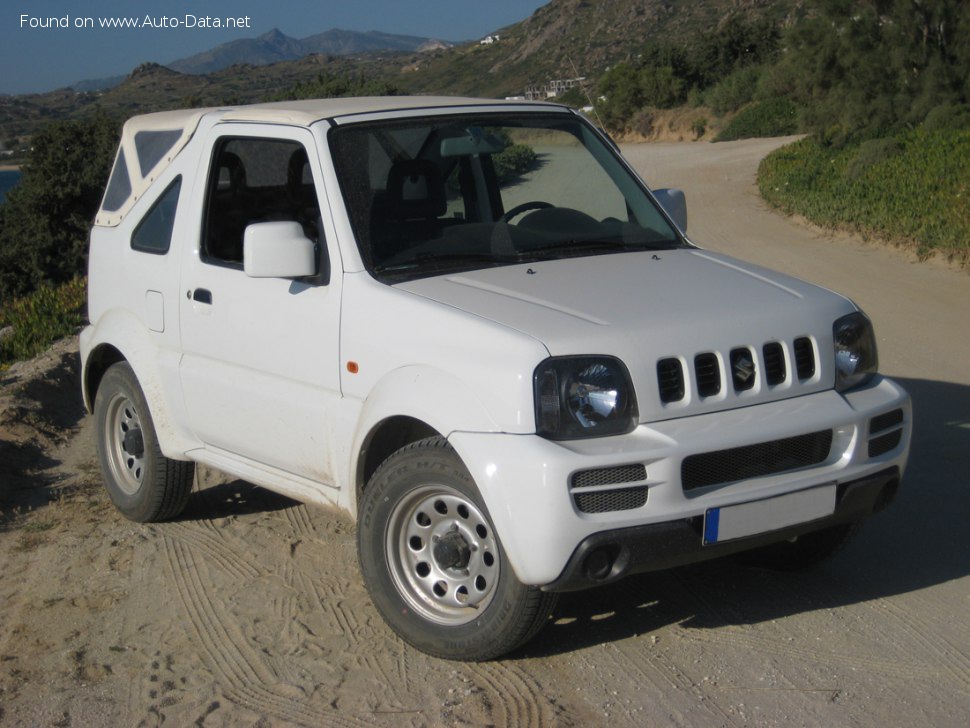
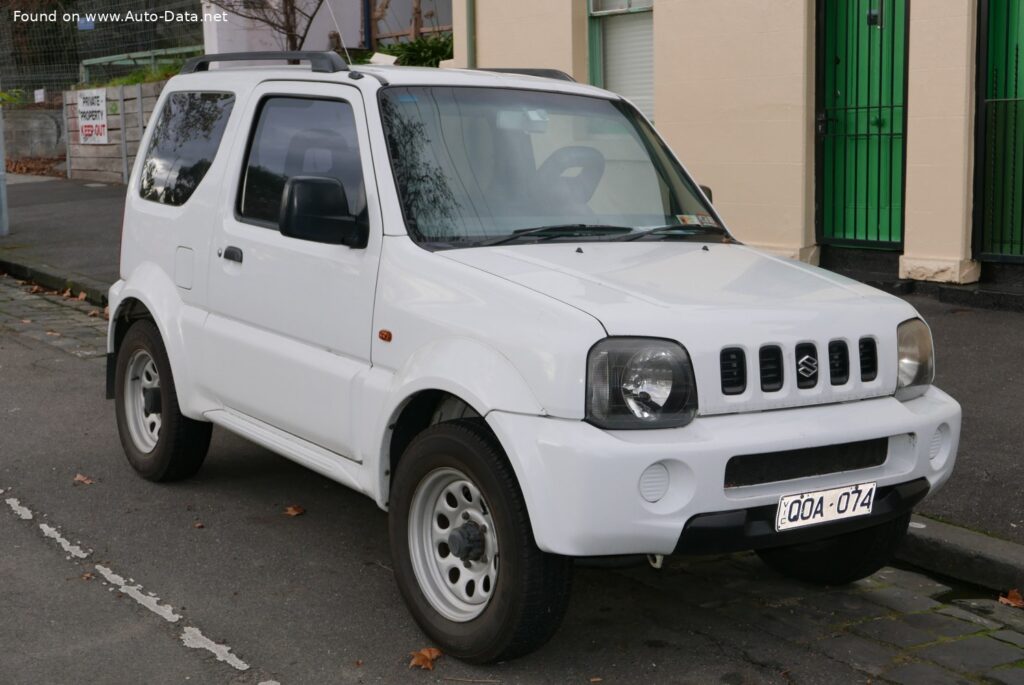
The design of the Suzuki Jimny III 1.3 (80 Hp) 4WD was a clear evolution from its predecessors, adopting a more rounded, yet still distinctly boxy and functional aesthetic. As a 3-door off-road vehicle with seating for four, its compact dimensions were a key attribute. It measured 142.72 inches (3625 mm) in length, 62.99 inches (1600 mm) in width, and 67.13 inches (1705 mm) in height, making it incredibly maneuverable in tight spaces, both urban and wilderness. The wheelbase of 88.58 inches (2250 mm) contributed to its excellent breakover angle, a critical factor for off-road performance.
True to its off-road heritage, the Jimny III featured a high ground clearance of 7.48 inches (190 mm), allowing it to clear obstacles with ease. Its approach angle of 42°, departure angle of 46°, and ramp-over (breakover) angle of 31° were exceptionally good for a vehicle of its size, enabling it to tackle challenging inclines, descents, and crests without scraping. These figures are typically found on much larger, more expensive dedicated off-road vehicles, underscoring the Jimny’s serious intent. The vehicle rode on 205/70 R15 tires mounted on 6J x 15 wheel rims, providing a good balance of on-road comfort and off-road grip.
Underneath, the Jimny III maintained its rugged foundation with a rigid axle suspension system both front and rear, utilizing coil springs. This setup, while potentially offering a firmer ride on pavement compared to independent suspensions, provided superior articulation and durability for off-road driving. Braking duties were handled by disc brakes at the front and drum brakes at the rear, a common and effective combination for light utility vehicles of its era. An Anti-lock Braking System (ABS) was included as an assisting system, enhancing safety during emergency stops, especially on varied surfaces. Steering was managed by a cone worm with recirculation balls system, complemented by hydraulic power steering, ensuring ease of maneuverability despite its rugged construction. The interior, though utilitarian, was designed for durability and functionality, capable of withstanding the rigors of off-road adventures.
Technical Specifications
| Suzuki Jimny III 1.3 (80 Hp) 4WD (1998-2000) | |
|---|---|
| General Information | |
| Brand | Suzuki |
| Model | Jimny |
| Generation | Jimny III |
| Type (Engine) | 1.3 (80 Hp) 4WD |
| Start of production | 1998 year |
| End of production | 2000 year |
| Powertrain Architecture | Internal Combustion engine |
| Body type | Off-road vehicle |
| Seats | 4 |
| Doors | 3 |
| Performance Specs | |
| Fuel consumption (economy) – urban | 10.2 l/100 km (23.1 US mpg) |
| Fuel consumption (economy) – extra urban | 7.1 l/100 km (33.1 US mpg) |
| Fuel consumption (economy) – combined | 8.2 l/100 km (28.7 US mpg) |
| CO2 emissions | 190 g/km |
| Fuel Type | Petrol (Gasoline) |
| Maximum speed | 140 km/h (86.99 mph) |
| Weight-to-power ratio | 12.5 kg/Hp, 80 Hp/tonne |
| Weight-to-torque ratio | 9.6 kg/Nm, 104 Nm/tonne |
| Engine Specs | |
| Power | 80 Hp @ 6000 rpm |
| Power per liter | 61.6 Hp/l |
| Torque | 104 Nm @ 4500 rpm (76.71 lb.-ft. @ 4500 rpm) |
| Engine layout | Front, Longitudinal |
| Engine Model/Code | G13BB |
| Engine displacement | 1298 cm³ (1.3 L / 79.21 cu. in.) |
| Number of cylinders | 4 |
| Engine configuration | Inline |
| Cylinder Bore | 74 mm (2.91 in.) |
| Piston Stroke | 75.5 mm (2.97 in.) |
| Compression ratio | 9.5:1 |
| Number of valves per cylinder | 4 |
| Fuel injection system | Multi-port manifold injection |
| Engine aspiration | Naturally aspirated engine |
| Valvetrain | SOHC |
| Engine oil capacity | 3.7 l (3.91 US qt) |
| Engine oil specification | Not specified in provided data |
| Coolant | 4.5 l (4.76 US qt) |
| Space, Volume and Weights | |
| Kerb Weight | 1000 kg (2204.62 lbs.) |
| Max. weight | 1420 kg (3130.56 lbs.) |
| Max load | 420 kg (925.94 lbs.) |
| Fuel tank capacity | 40 l (10.57 US gal) |
| Permitted trailer load with brakes (12%) | 1100 kg (2425.08 lbs.) |
| Permitted trailer load without brakes | 350 kg (771.62 lbs.) |
| Permitted towbar download | 75 kg (165.35 lbs.) |
| Dimensions | |
| Length | 3625 mm (142.72 in.) |
| Width | 1600 mm (62.99 in.) |
| Height | 1705 mm (67.13 in.) |
| Wheelbase | 2250 mm (88.58 in.) |
| Front track | 1355 mm (53.35 in.) |
| Rear (Back) track | 1365 mm (53.74 in.) |
| Front overhang | 635 mm (25 in.) |
| Rear overhang | 740 mm (29.13 in.) |
| Ride height (ground clearance) | 190 mm (7.48 in.) |
| Minimum turning circle (turning diameter) | 9.8 m (32.15 ft.) |
| Approach angle | 42° |
| Departure angle | 46° |
| Ramp-over (brakeover) angle | 31° |
| Drivetrain, Brakes and Suspension Specs | |
| Drivetrain Architecture | The Internal combustion engine (ICE) drives the rear wheels permanently, and the front wheels are driven through an electrically or mechanically operated clutch if necessary. |
| Drive wheel | All wheel drive (4×4) |
| Number of gears and type of gearbox | 5 gears, manual transmission |
| Front suspension | Coil spring, Rigid axle suspension |
| Rear suspension | Rigid axle suspension, Coil spring |
| Front brakes | Disc |
| Rear brakes | Drum |
| Assisting systems | ABS (Anti-lock braking system) |
| Steering type | Cone worm with recirculation balls |
| Power steering | Hydraulic Steering |
| Tires size | 205/70 R15 |
| Wheel rims size | 6J x 15 |
Legacy and Global Impact
The Suzuki Jimny III, particularly the 1.3 (80 Hp) 4WD variant, continued and enhanced a proud legacy of compact, capable off-roaders that began decades earlier. It built upon the reputation for reliability and go-anywhere ability established by its predecessors, the Jimny LJ and SJ series (known as the Suzuki Samurai in North America and other markets). For many, the Jimny III represented a significant modernization, offering improved comfort, safety features like ABS, and a more refined driving experience without compromising its core off-road DNA. Its body-on-frame construction, live axles, and part-time 4×4 system with a low-range transfer case ensured it remained a serious contender in the world of true utility vehicles, distinguishing it from the growing trend of car-based crossover SUVs.
In its primary markets across Europe, Asia, Australia, and parts of Africa and South America, the Jimny III was highly regarded. It competed against a sparse field of truly compact and affordable off-road vehicles. While larger, more powerful 4x4s like the Land Rover Defender or Jeep Wrangler existed, they occupied a different price point and segment. The Jimny’s closest rivals were often other small utility vehicles, such as the Lada Niva (though the Niva was older in design) or, in some markets, the Daihatsu Terios, which offered a more road-oriented approach. What set the Jimny apart was its unwavering commitment to off-road capability in a package that was incredibly light, fuel-efficient for a 4×4, and remarkably durable. Its low running costs and ease of maintenance further cemented its appeal in regions where vehicle longevity and practicality were paramount.
The Jimny III developed a cult following among off-road enthusiasts, who appreciated its simplicity, robust engineering, and vast aftermarket support for modifications. It became a favorite for rock crawling, trail driving, and as a reliable workhorse for farmers, foresters, and park rangers. Its ability to navigate narrow trails and dense bush, where larger vehicles struggled, made it indispensable in many rural and remote communities. The Jimny’s relatively low kerb weight also meant it was less prone to getting bogged down in soft terrain and easier to recover if it did.
Despite its global success, the Jimny III was not offered in the United States market during this generation. This decision likely stemmed from a combination