Suzuki Jimny III (facelift 2012) 1.3 VVT (85 Hp) 4WD: A Detailed Overview
The Suzuki Jimny III (facelift 2012) 1.3 VVT (85 Hp) 4WD represents a significant refresh of the third-generation Jimny, a vehicle renowned globally for its unwavering commitment to off-road capability in a compact package. Launched in 2012 and produced until 2015, this iteration continued the Jimny’s legacy as a rugged, no-nonsense off-road vehicle, primarily serving markets in Europe, Asia, and other regions where its small footprint, robust construction, and genuine four-wheel-drive system made it an invaluable tool for both adventurous individuals and those needing reliable transportation in challenging terrain. While not widely sold in the United States, the Jimny holds a near-legendary status internationally, standing apart from the increasingly car-like crossover SUVs with its body-on-frame chassis and solid axles.
This particular model, equipped with the 1.3-liter VVT engine, offered a blend of modest power and exceptional agility, embodying the core philosophy of the Jimny: go anywhere, with minimal fuss. The 2012 facelift brought subtle but effective updates, enhancing its appeal while retaining the mechanical integrity that had earned it a loyal following since the third generation’s initial launch in 1998. It continued to be a practical and affordable option for those seeking true off-road performance without the bulk or cost of larger competitors.
Engine and Performance: The Heart of the Suzuki Jimny III (facelift 2012) 1.3 VVT (85 Hp) 4WD
Powertrain Architecture and Drivetrain
At the core of the Suzuki Jimny III (facelift 2012) 1.3 VVT (85 Hp) 4WD lies a dependable internal combustion engine, specifically the M13A unit. This powertrain architecture drives the rear wheels permanently under normal conditions, with the front wheels engaged through an electrically or mechanically operated clutch when four-wheel drive is selected. This part-time 4×4 system, a hallmark of serious off-roaders, allows the driver to switch between two-wheel drive (2WD) for fuel efficiency on paved roads and four-wheel drive high (4H) or four-wheel drive low (4L) for maximum traction in adverse conditions. The manual transmission, featuring 5 gears, further emphasizes driver control and engagement, a preference for many off-road enthusiasts.
Engine Specifications and Output
The M13A engine is a 1.3-liter (1328 cm³ or 81.04 cu. in.) naturally aspirated inline-four gasoline unit, featuring a Double Overhead Camshaft (DOHC) valvetrain with Variable Valve Timing (VVT). This configuration helps optimize engine breathing across the rev range, contributing to a respectable power output of 85 horsepower (Hp) at 6000 rpm. Its power per liter stands at 64 Hp/l, a decent figure for a naturally aspirated engine of its era. Torque is rated at 110 Nm (81.13 lb.-ft.) delivered at 4100 rpm, providing the necessary grunt for navigating tricky off-road situations, especially when combined with the low-range gearing of the 4WD system. The engine employs a multi-port manifold injection system and operates with a compression ratio of 9.5:1.
Performance Metrics and Fuel Economy
While outright speed is not the Jimny’s primary focus, its performance figures are adequate for its intended use. The vehicle can accelerate from 0 to 60 mph in a calculated 13.4 seconds (0-100 km/h in 14.1 seconds) and achieve a maximum speed of 86.99 mph (140 km/h). Fuel economy, measured under the NEDC cycle, reflects its utilitarian nature: 26.4 US mpg (8.9 l/100 km) in urban settings, 39.2 US mpg (6 l/100 km) on the extra-urban cycle, and a combined average of 33.1 US mpg (7.1 l/100 km). CO2 emissions are rated at 162 g/km, meeting Euro 5 emission standards. These figures underscore the Jimny’s design as a practical, rather than performance-oriented, vehicle.
Design and Features: Form Follows Function
Body Type and Dimensions
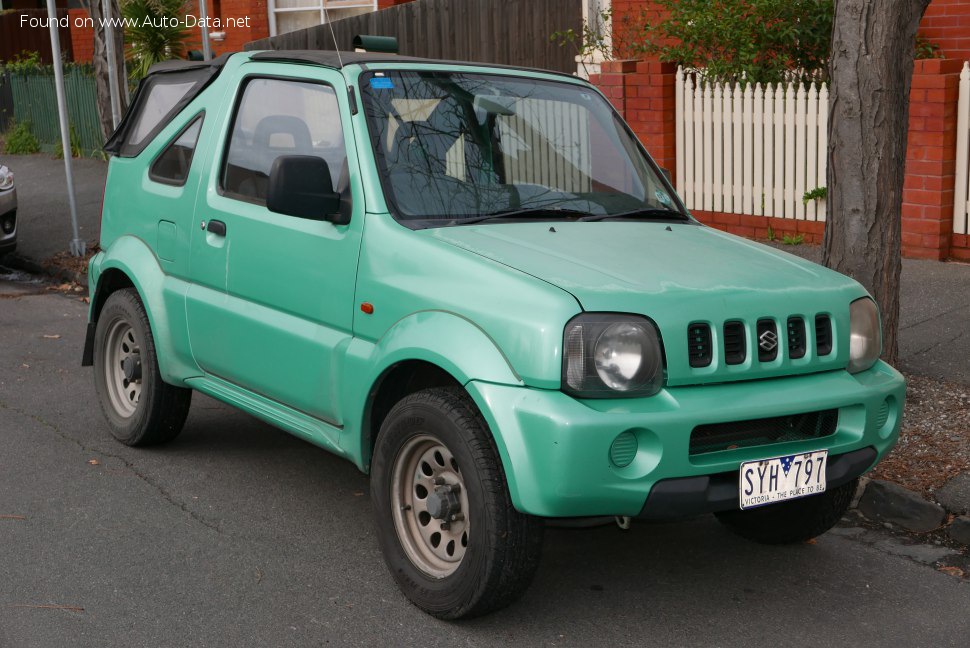
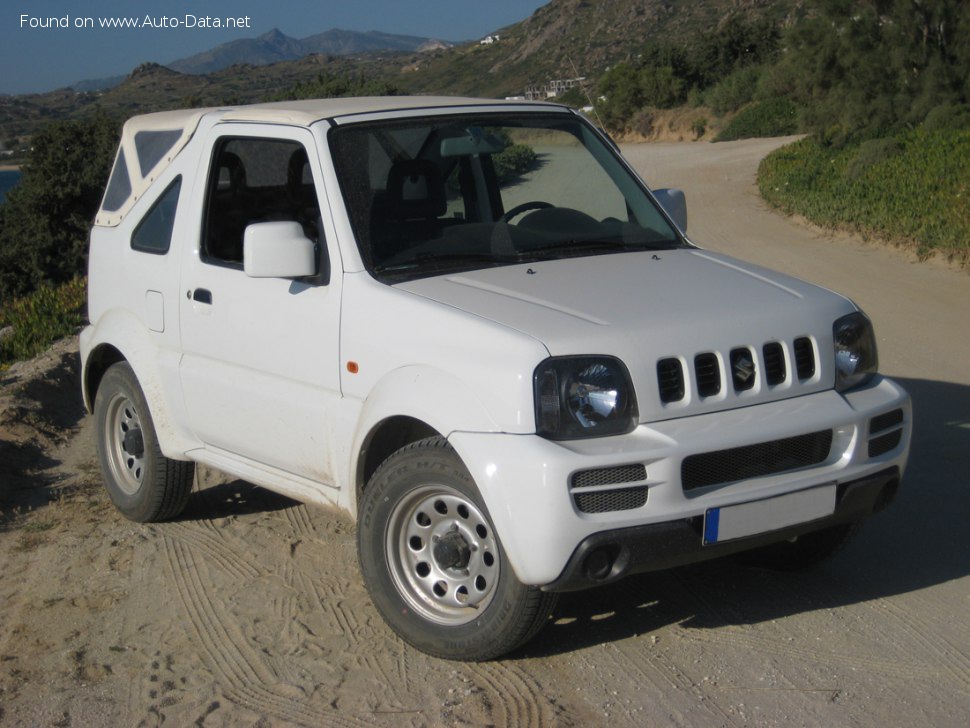
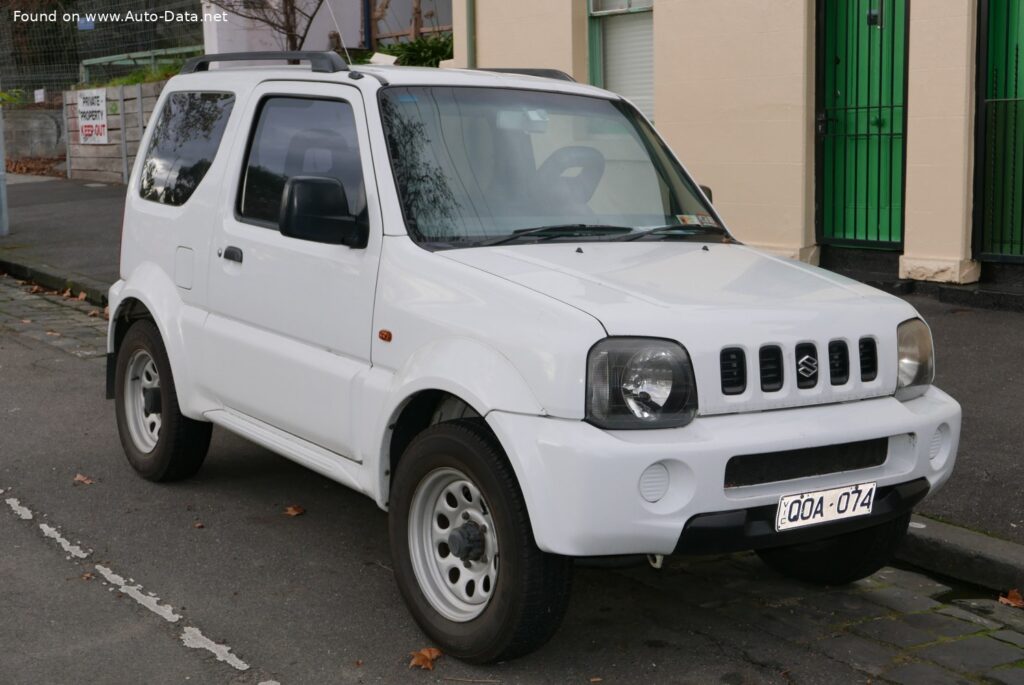
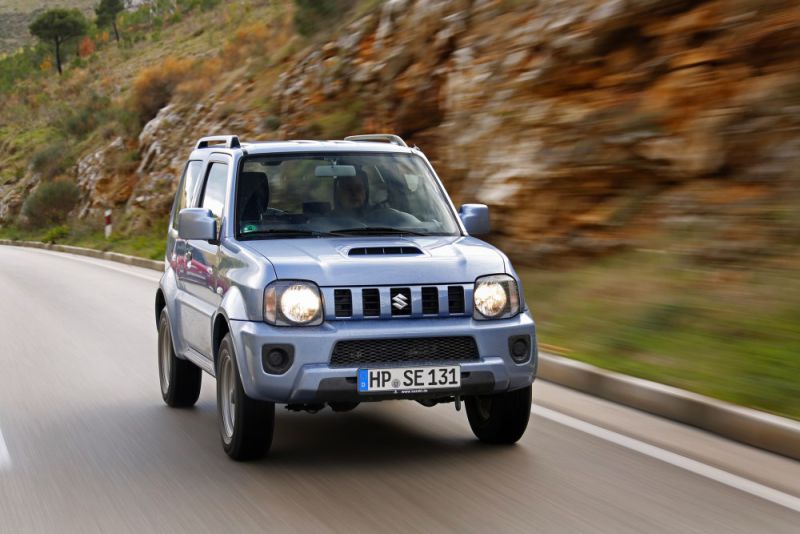
The Suzuki Jimny III (facelift 2012) 1.3 VVT (85 Hp) 4WD maintains the iconic, boxy, three-door off-road vehicle silhouette that has defined the Jimny lineage. Its compact dimensions are key to its agility and maneuverability, especially off-road and in congested urban environments. With a length of 144.69 inches (3675 mm), a width of 62.99 inches (1600 mm), and a height of 67.13 inches (1705 mm), it’s significantly smaller than most modern SUVs. The short wheelbase of 88.58 inches (2250 mm) is crucial for its impressive breakover angle, while the narrow tracks (front: 53.35 in / 1355 mm; rear: 53.74 in / 1365 mm) allow it to navigate tight trails.
Off-Road Prowess and Practicality
Designed from the ground up for challenging terrain, the Jimny boasts exceptional off-road geometry. Its ground clearance of 7.48 inches (190 mm) is complemented by an impressive approach angle of 34°, a departure angle of 46°, and a ramp-over (breakover) angle of 31°. These figures are typically found on much larger, more expensive dedicated off-road vehicles. The rigid axle suspension with coil springs at both front and rear ensures durability and articulation, vital for maintaining wheel contact over uneven surfaces. The steering system is a hydraulic rack and pinion setup, providing direct feedback. Braking is handled by front discs and rear drums, assisted by an Anti-lock Braking System (ABS). The vehicle rides on 205/70 R15 tires mounted on 5.5J x 15 wheel rims, offering a good balance of road manners and off-road grip.
Interior and Features
Inside, the Jimny offers seating for four, with a focus on durability and functionality rather than luxury. The interior design of the 2012 facelift saw minor updates to materials and ergonomics, aimed at improving comfort and usability without compromising its rugged character. Cargo space is modest, with a minimum trunk capacity of 3.99 cu. ft. (113 liters), expandable to 11.44 cu. ft. (324 liters) with the rear seats folded, reflecting its compact nature. Despite its small size, the Jimny’s robust construction and simple, reliable mechanicals make it a dependable companion for arduous journeys.
Technical Specifications
| Category | Specification | Metric Value | US/Imperial Value |
|---|---|---|---|
| General Information | |||
| Brand | Suzuki | ||
| Model | Jimny | ||
| Generation | Jimny III (facelift 2012) | ||
| Type (Engine) | 1.3 VVT (85 Hp) 4WD | ||
| Start of production | 2012 year | ||
| End of production | 2015 year | ||
| Powertrain Architecture | Internal Combustion engine | ||
| Body type | Off-road vehicle | ||
| Seats | 4 | ||
| Doors | 3 | ||
| Performance Specs | |||
| Fuel consumption (economy) – urban (NEDC) | 8.9 l/100 km | 26.4 US mpg | |
| Fuel consumption (economy) – extra urban (NEDC) | 6 l/100 km | 39.2 US mpg | |
| Fuel consumption (economy) – combined (NEDC) | 7.1 l/100 km | 33.1 US mpg | |
| CO2 emissions (NEDC) | 162 g/km | ||
| Fuel Type | Petrol (Gasoline) | ||
| Acceleration 0 – 100 km/h | 14.1 sec | ||
| Acceleration 0 – 62 mph | 14.1 sec | ||
| Acceleration 0 – 60 mph (Calculated) | 13.4 sec | ||
| Maximum speed | 140 km/h | 86.99 mph | |
| Emission standard | Euro 5 | ||
| Weight-to-power ratio | 12.5 kg/Hp | 80.2 Hp/tonne | |
| Weight-to-torque ratio | 9.6 kg/Nm | 103.8 Nm/tonne | |
| Engine Specs | |||
| Power | 85 Hp | @ 6000 rpm | |
| Power per liter | 64 Hp/l | ||
| Torque | 110 Nm | 81.13 lb.-ft. @ 4100 rpm | |
| Engine layout | Front, Longitudinal | ||
| Engine Model/Code | M13A | ||
| Engine displacement | 1328 cm³ | 81.04 cu. in. | |
| Number of cylinders | 4 | ||
| Engine configuration | Inline | ||
| Cylinder Bore | 78 mm | 3.07 in. | |
| Piston Stroke | 69.5 mm | 2.74 in. | |
| Compression ratio | 9.5:1 | ||
| Number of valves per cylinder | 4 | ||
| Fuel injection system | Multi-port manifold injection | ||
| Engine aspiration | Naturally aspirated engine | ||
| Valvetrain | DOHC | ||
| Engine oil capacity | 4 l | 4.23 US qt | 3.52 UK qt | |
| Engine oil specification | Not specified in data | ||
| Coolant | 5.9 l | 6.23 US qt | 5.19 UK qt | |
| Space, Volume and Weights | |||
| Kerb Weight | 1060-1090 kg | 2336.9 – 2403.04 lbs. | |
| Max. weight | 1420 kg | 3130.56 lbs. | |
| Max load | 330-360 kg | 727.53 – 793.66 lbs. | |
| Trunk (boot) space – minimum | 113 l | 3.99 cu. ft. | |
| Trunk (boot) space – maximum | 324 l | 11.44 cu. ft. | |
| Fuel tank capacity | 40 l | 10.57 US gal | 8.8 UK gal | |
| Permitted trailer load with brakes (12%) | 1300 kg | 2866.01 lbs. | |
| Permitted trailer load without brakes | 350 kg | 771.62 lbs. | |
| Permitted towbar download | 75 kg | 165.35 lbs. | |
| Dimensions | |||
| Length | 3675 mm | 144.69 in. | |
| Width | 1600 mm | 62.99 in. | |
| Height | 1705 mm | 67.13 in. | |
| Wheelbase | 2250 mm | 88.58 in. | |
| Front track | 1355 mm | 53.35 in. | |
| Rear (Back) track | 1365 mm | 53.74 in. | |
| Ride height (ground clearance) | 190 mm | 7.48 in. | |
| Minimum turning circle (turning diameter) | 9.8 m | 32.15 ft. | |
| Approach angle | 34° | ||
| Departure angle | 46° | ||
| Ramp-over (brakeover) angle | 31° | ||
| Drivetrain, Brakes and Suspension Specs | |||
| Drivetrain Architecture | The Internal combustion engine (ICE) drives the rear wheels permanently, and the front wheels are driven through an electrically or mechanically operated clutch if necessary. | ||
| Drive wheel | All wheel drive (4×4) | ||
| Number of gears and type of gearbox | 5 gears, manual transmission | ||
| Front suspension | Coil spring, Rigid axle suspension | ||
| Rear suspension | Rigid axle suspension, Coil spring | ||
| Front brakes | Disc | ||
| Rear brakes | Drum | ||
| Assisting systems | ABS (Anti-lock braking system) | ||
| Steering type | Steering rack and pinion | ||
| Power steering | Hydraulic Steering | ||
| Tires size | 205/70 R15 | ||
| Wheel rims size | 5.5J x 15 | ||
Legacy and Market Impact
The Suzuki Jimny, and specifically the third generation including the Suzuki Jimny III (facelift 2012) 1.3 VVT (85 Hp) 4WD, has carved out a unique and enduring niche in the global automotive landscape. Its legacy is one of uncompromising off-road capability packed into an incredibly small and affordable vehicle. In markets across Europe, Asia, Australia, and South America, the Jimny became a beloved workhorse and adventure companion, often serving as a primary mode of transport in rural areas where its robust 4×4 system was not just a feature, but a necessity.
Its primary competitors were few and far between, mainly consisting of other small, rugged 4x4s like the Lada Niva in some Eastern European markets, or older, used larger SUVs. However, none truly matched the Jimny’s unique blend of compact dimensions, body-on-frame construction, solid axles, and selectable low-range gearing. This made it a favorite among off-road enthusiasts who appreciated its simplicity, ease of maintenance, and almost unparalleled ability to tackle challenging terrain where larger, more complex vehicles might struggle.
The 2012 facelift, while subtle, ensured the Jimny remained competitive and refreshed during the latter half of its lengthy production run. It cemented the third generation’s reputation for reliability and durability, further contributing to its cult following. Despite its modest on-road performance and utilitarian interior, the Jimny’s purpose-built design resonated deeply with a segment of the market that valued function over form, and genuine capability over perceived luxury.
The Jimny’s historical significance lies in its demonstration that true off-road prowess doesn’t require a massive vehicle or a hefty price tag. It proved that a lightweight, agile platform with the right mechanical components could outmaneuver many larger, more powerful SUVs when the going got tough. Its enduring appeal eventually led to the highly anticipated fourth-generation Jimny, which continued the tradition, albeit with modern refinements. The Jimny III (facelift 2012) 1.3 VVT (85 Hp) 4WD, therefore, stands as a crucial chapter in the story of a vehicle that defied conventional automotive trends to become a true icon of the compact off-roader segment.