
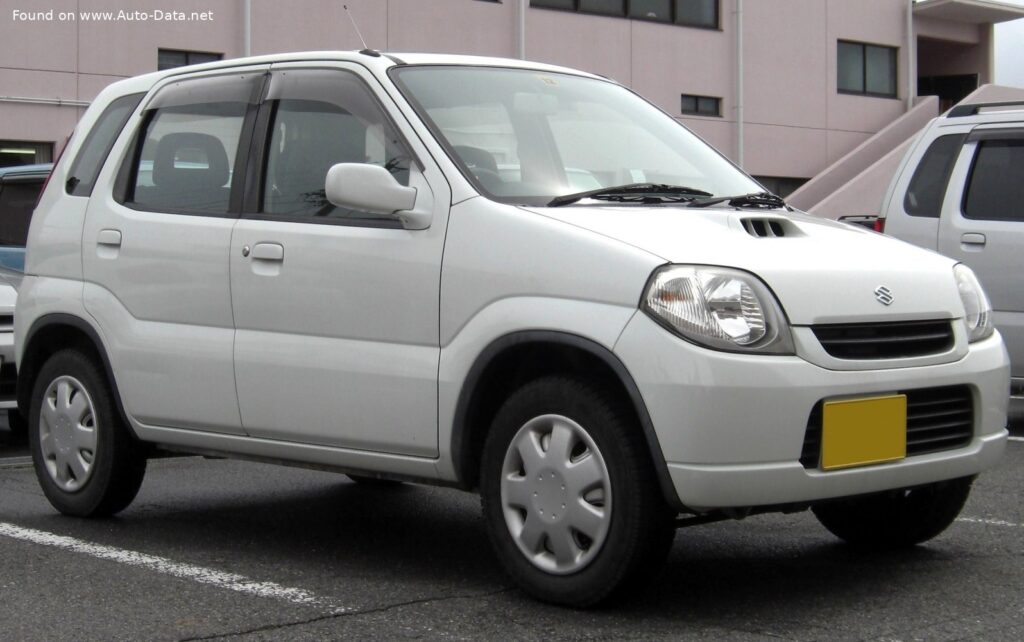
The Suzuki Kei (HN): A Pillar of Japanese Urban Mobility
The Suzuki Kei (HN) represents a significant chapter in the history of Japan’s distinctive Kei car segment. Introduced in 1998, the Kei (HN) generation, specifically the 0.7 i 12V (54 Hp) variant, was a compact and versatile hatchback designed to navigate the congested urban landscapes of Japan with unparalleled efficiency and practicality. While never officially sold in the United States, the Suzuki Kei played a crucial role in its home market, embodying the spirit of the Kei car regulations that define a class of lightweight, small-dimensioned vehicles with engine displacements capped at 660 cubic centimeters. Its production run, spanning over a decade until 2009, solidified its reputation as a reliable and economical choice for a wide range of Japanese consumers, from young professionals to small families.
The Kei car category, to which the Suzuki Kei belonged, is unique to Japan and was established to promote affordable and space-efficient transportation. These regulations provide tax and insurance benefits, making Kei cars particularly attractive. The Kei (HN) was Suzuki’s answer to this demand, offering a blend of a tall-boy hatchback design with surprisingly spacious interiors for its diminutive footprint. This article delves into the technical specifications, design philosophy, and market impact of this enduring Japanese mini-car, providing an international expert’s perspective on its engineering and legacy.
Engine and Performance of the Suzuki Kei (HN)
At the heart of the Suzuki Kei (HN) 0.7 i 12V (54 Hp) model was Suzuki’s venerable K6A engine, a naturally aspirated, inline three-cylinder gasoline unit. This engine, with a displacement of 658 cubic centimeters (40.15 cubic inches), was meticulously engineered to comply with the strict Kei car regulations while delivering optimal performance for its class. Generating 54 horsepower at a brisk 6500 revolutions per minute, the K6A was a testament to Suzuki’s expertise in developing high-revving, efficient small engines. Its power per liter stood at an impressive 82.1 Hp/l, showcasing its advanced design for its era.
Torque output for this compact powerhouse was 61 Nm (44.99 lb.-ft.) delivered at a relatively low 4000 rpm, providing adequate thrust for city driving and light highway use. The engine’s layout was front, transverse, driving the front wheels through a precise 5-speed manual transmission. This powertrain architecture was typical for Kei cars, prioritizing efficiency, packaging, and cost-effectiveness. The DOHC (Double Overhead Camshaft) valvetrain with 4 valves per cylinder allowed for better airflow and combustion efficiency, contributing to both its power output and fuel economy.
With a curb weight of just 1631.42 pounds (740 kg), the Kei (HN) achieved a commendable weight-to-power ratio of 13.7 kg/Hp, or 73 Hp/tonne. This lightweight construction, combined with its modest power, meant the Kei was agile and responsive in urban environments, perfectly suited for stop-and-go traffic and tight parking situations. The multi-port manifold injection system ensured precise fuel delivery, optimizing combustion and minimizing emissions, a crucial consideration for a vehicle designed for dense urban areas. The engine oil capacity was a modest 3 liters (3.17 US quarts), reflecting the small scale of the powerplant.
Design and Features of the Suzuki Kei (HN)
The design of the Suzuki Kei (HN) was a direct reflection of its purpose: to maximize interior space and utility within the stringent external dimensions dictated by Japan’s Kei car regulations. Classified as a 5-door hatchback, the Kei offered seating for five occupants, a remarkable feat given its compact size. Its exterior dimensions were incredibly constrained: a length of 133.66 inches (3395 mm), a width of 58.07 inches (1475 mm), and a height of 60.83 inches (1545 mm). These measurements were precisely engineered to fit within the Kei car class limits, which in turn allowed owners to benefit from significant tax advantages.
Despite its small footprint, the Kei’s tall-boy design philosophy allowed for a surprisingly airy cabin and generous headroom, enhancing comfort for both front and rear passengers. The wheelbase measured 92.91 inches (2360 mm), contributing to a stable ride for its size, while the front and rear tracks were 50.98 inches (1295 mm) and 50.79 inches (1290 mm), respectively. Its minimum turning circle of 30.18 feet (9.2 meters) made it exceptionally maneuverable, a critical attribute for navigating narrow Japanese streets and tight parking spaces.
In terms of features, the Suzuki Kei (HN) was equipped with a practical array of components designed for everyday usability and safety. The braking system featured ventilated discs at the front for effective stopping power and traditional drum brakes at the rear, a cost-effective and reliable setup for a vehicle of this class. An Anti-lock Braking System (ABS) was available, enhancing safety by preventing wheel lock-up during hard braking. Steering was handled by a rack and pinion system, assisted by hydraulic power steering, providing ease of control at low speeds, which is invaluable in urban driving. The Kei rode on 155/80 R13 tires mounted on 13-inch wheel rims, a common and economical tire size for small cars. The fuel tank capacity was 30 liters (7.93 US gallons), offering a decent range for a car focused on efficiency.
Technical Specifications
| Category | Specification | Value |
|---|---|---|
General Information |
||
| Brand | Suzuki | |
| Model | Kei | |
| Generation | Kei (HN) | |
| Type (Engine) | 0.7 i 12V (54 Hp) | |
| Start of Production | 1998 year | |
| End of Production | 2009 year | |
| Powertrain Architecture | Internal Combustion engine | |
| Body Type | Hatchback | |
| Seats | 5 | |
| Doors | 5 | |
Performance Specifications |
||
| Fuel Type | Petrol (Gasoline) | |
| Weight-to-power ratio | 13.7 kg/Hp, 73 Hp/tonne | |
| Weight-to-torque ratio | 12.1 kg/Nm, 82.4 Nm/tonne | |
Engine Specifications |
||
| Power | 54 Hp @ 6500 rpm. | |
| Power per liter | 82.1 Hp/l | |
| Torque | 61 Nm (44.99 lb.-ft.) @ 4000 rpm. | |
| Engine Layout | Front, Transverse | |
| Engine Model/Code | K6A | |
| Engine Displacement | 658 cm3 (40.15 cu. in.) | |
| Number of Cylinders | 3 | |
| Engine Configuration | Inline | |
| Cylinder Bore | 68 mm (2.68 in.) | |
| Piston Stroke | 60.4 mm (2.38 in.) | |
| Compression Ratio | 10.5:1 | |
| Number of Valves per Cylinder | 4 | |
| Fuel Injection System | Multi-port manifold injection | |
| Engine Aspiration | Naturally aspirated engine | |
| Valvetrain | DOHC | |
| Engine Oil Capacity | 3 l (3.17 US qt) | |
Space, Volume and Weights |
||
| Kerb Weight | 740 kg (1631.42 lbs.) | |
| Max. Weight | 960 kg (2116.44 lbs.) | |
| Max Load | 220 kg (485.02 lbs.) | |
| Fuel Tank Capacity | 30 l (7.93 US gal) | |
Dimensions |
||
| Length | 3395 mm (133.66 in.) | |
| Width | 1475 mm (58.07 in.) | |
| Height | 1545 mm (60.83 in.) | |
| Wheelbase | 2360 mm (92.91 in.) | |
| Front Track | 1295 mm (50.98 in.) | |
| Rear (Back) Track | 1290 mm (50.79 in.) | |
| Minimum Turning Circle | 9.2 m (30.18 ft.) | |
Drivetrain, Brakes and Suspension |
||
| Drivetrain Architecture | Internal combustion engine (ICE) drives the front wheels. | |
| Drive Wheel | Front wheel drive | |
| Number of Gears and Type of Gearbox | 5 gears, manual transmission | |
| Front Suspension | Coil spring | |
| Rear Suspension | Coil spring | |
| Front Brakes | Ventilated discs | |
| Rear Brakes | Drum | |
| Assisting Systems | ABS (Anti-lock braking system) | |
| Steering Type | Steering rack and pinion | |
| Power Steering | Hydraulic Steering | |
| Tires Size | 155/80 R13 | |
| Wheel Rims Size | 13 inches | |
Legacy and Market Impact of the Suzuki Kei (HN)
The Suzuki Kei (HN) cemented its place in Japanese automotive history as a highly successful and influential Kei car. Its long production run from 1998 to 2009 is a testament to its enduring appeal and robust engineering. In the fiercely competitive Kei car segment, where manufacturers like Daihatsu (with models like the Mira and Move), Honda (Life), and Mitsubishi (Minica) were strong contenders, the Kei carved out a significant niche. It was often praised for its blend of practicality, fuel efficiency, and Suzuki’s reputation for reliability.
The Kei (HN) represented an evolution in Kei car design, moving towards a more substantial, almost SUV-like stance, despite adhering to the strict dimensional limits. This “kei-SUV” aesthetic, while subtle, offered a perception of greater robustness and versatility compared to more traditional Kei hatchbacks. This design choice resonated well with consumers seeking a vehicle that could handle urban duties while also offering a hint of adventure. Its elevated ride height and slightly more rugged styling cues contributed to its unique identity within the segment.
Its impact on the market was profound, providing an accessible and economical form of personal transportation for millions of Japanese citizens. The Kei (HN) was particularly popular in urban areas where its compact dimensions made parking and navigating narrow streets effortless. The low running costs, thanks to the efficient 0.7-liter engine and favorable Kei car tax incentives, made it an attractive option for budget-conscious buyers. Furthermore, its versatility as a 5-door hatchback with seating for five, albeit snugly, made it a viable primary vehicle for small families or a reliable second car for many households.
Beyond its direct sales, the Suzuki Kei (HN) contributed to the overall development and refinement of the Kei car concept. Its longevity demonstrated that a well-engineered, compact, and efficient vehicle could remain relevant for over a decade in a rapidly evolving market. The K6A engine, in particular, became a benchmark for small-displacement engine design, known for its durability and responsiveness. Even after its discontinuation, the principles embodied by the Kei – maximum utility, minimal footprint, and exceptional efficiency – continued to influence subsequent generations of Kei cars and compact vehicles globally. The Suzuki Kei (HN) remains a quintessential example of Japanese automotive ingenuity, perfectly tailored to its specific market needs and leaving a lasting legacy of practical, affordable, and smart urban mobility.
