
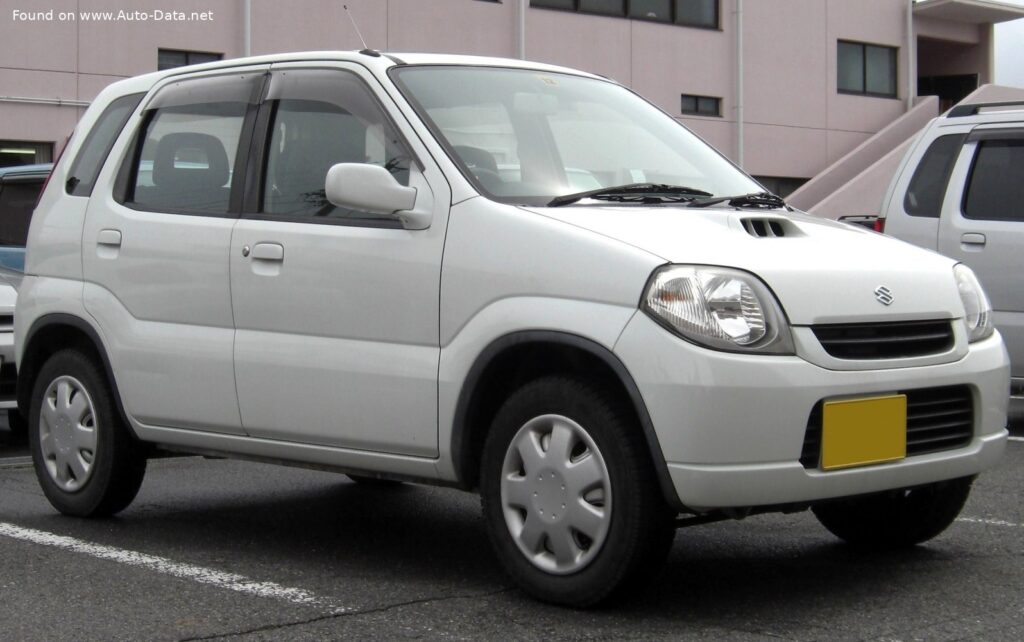
The Suzuki Kei (HN): A Pillar of Japanese Urban Mobility
The Suzuki Kei (HN) represents a quintessential example of the Japanese Kei car, a class of mini-vehicles specifically designed to comply with strict government regulations regarding size, engine displacement, and power output. Produced by Suzuki Motor Corporation from 1998 to 2009, the Kei (HN) generation carved out a significant niche in its domestic market as a practical, economical, and highly maneuverable urban commuter. This particular variant, the 0.7 i 12V (54 Hp) Automatic, embodies the core principles of the Kei car segment: maximizing interior space and efficiency within incredibly compact exterior dimensions. While never officially sold in the United States due to its unique specifications and market focus, the Suzuki Kei (HN) offers a fascinating insight into automotive engineering tailored for specific national requirements, showcasing Suzuki’s expertise in compact vehicle design.
Engine and Performance of the Suzuki Kei (HN)
At the heart of the Suzuki Kei (HN) 0.7 i 12V (54 Hp) Automatic lies Suzuki’s venerable K6A engine, a compact yet sophisticated powertrain engineered to meet the demanding Kei car regulations. This specific iteration features a 658 cm³ (approximately 0.7-liter) naturally aspirated inline three-cylinder engine. Despite its diminutive size, the K6A benefits from a Double Overhead Camshaft (DOHC) valvetrain with 4 valves per cylinder, a configuration typically found in larger, more performance-oriented engines. This design choice contributes to improved engine breathing and efficiency, allowing the small engine to produce a respectable 54 horsepower at 6500 rpm. Its power per liter stands at an impressive 82.1 Hp/l, highlighting the engine’s optimized design for its displacement.
Torque output for this variant is 61 Nm (44.99 lb.-ft.) delivered at 4000 rpm. While these figures may seem modest by American automotive standards, they are perfectly suited for the Kei car’s intended purpose: navigating congested city streets and performing daily errands. The engine’s front, transverse layout efficiently packages the powertrain within the vehicle’s tight dimensions, contributing to a favorable weight distribution for a front-wheel-drive vehicle. Fueling is handled by a multi-port manifold injection system, ensuring precise fuel delivery and combustion for optimal efficiency and emissions control. The compression ratio of 10.5:1 further aids in extracting maximum energy from the gasoline fuel.
Power is transmitted to the front wheels via a 3-speed automatic transmission. While a modern observer might expect more gears for efficiency, this simpler automatic gearbox was a common and cost-effective solution for Kei cars of its era, prioritizing ease of driving in stop-and-go urban traffic over high-speed cruising efficiency. The drivetrain architecture, with the internal combustion engine driving the front wheels, is a practical and space-saving choice for a vehicle of this size, offering predictable handling and good traction in various conditions.
Design and Features: The Practicality of the Suzuki Kei (HN)
The design of the Suzuki Kei (HN) is a masterclass in packaging efficiency, dictated primarily by Japan’s stringent Kei car regulations. Classified as a 5-door hatchback, the Kei (HN) measures a mere 3395 mm (133.66 inches) in length, 1475 mm (58.07 inches) in width, and 1545 mm (60.83 inches) in height. These dimensions are crucial, as exceeding them would place the vehicle in a higher tax bracket, diminishing its primary appeal. Despite its exterior compactness, the Kei (HN) manages to offer seating for five, a testament to clever interior design and the “tall boy” styling trend prevalent in Kei cars, which maximizes headroom and creates a surprisingly airy cabin feel.
The vehicle’s wheelbase of 2360 mm (92.91 inches) contributes to its exceptional maneuverability, exemplified by a minimum turning circle of just 9.2 meters (30.18 feet). This agility is invaluable in narrow Japanese streets and tight parking spaces. The suspension system, featuring coil springs at both the front and rear, provides a comfortable ride for urban conditions, while the hydraulic power steering with a rack and pinion setup ensures light and responsive handling.
Safety features, though basic by today’s global standards, included an Anti-lock Braking System (ABS), which was a significant enhancement for vehicles in this class during its production run. The braking system consists of ventilated discs at the front for improved heat dissipation and traditional drum brakes at the rear, a cost-effective and adequate solution for a lightweight vehicle. The choice of 155/80 R13 S tires reflects the car’s focus on fuel efficiency and comfortable urban travel rather than high-performance dynamics. The modest 30-liter (7.93 US gallon) fuel tank capacity is appropriate for a vehicle designed for short commutes, ensuring that trips to the gas station are infrequent for the typical Kei car owner.
Technical Specifications
| Category | Specification |
|---|---|
| General Information | |
| Brand | Suzuki |
| Model | Kei |
| Generation | Kei (HN) |
| Type (Engine) | 0.7 i 12V (54 Hp) Automatic |
| Start of Production | 1998 year |
| End of Production | 2009 year |
| Powertrain Architecture | Internal Combustion engine |
| Body Type | Hatchback |
| Seats | 5 |
| Doors | 5 |
| Performance Specs | |
| Fuel Type | Petrol (Gasoline) |
| Weight-to-Power Ratio | 13.7 kg/Hp, 73 Hp/tonne |
| Weight-to-Torque Ratio | 12.1 kg/Nm, 82.4 Nm/tonne |
| Engine Specs | |
| Power | 54 Hp @ 6500 rpm |
| Power per Liter | 82.1 Hp/l |
| Torque | 61 Nm (44.99 lb.-ft.) @ 4000 rpm |
| Engine Layout | Front, Transverse |
| Engine Model/Code | K6A |
| Engine Displacement | 658 cm³ (40.15 cu. in.) |
| Number of Cylinders | 3 |
| Engine Configuration | Inline |
| Cylinder Bore | 68 mm (2.68 in.) |
| Piston Stroke | 60.4 mm (2.38 in.) |
| Compression Ratio | 10.5:1 |
| Number of Valves per Cylinder | 4 |
| Fuel Injection System | Multi-port manifold injection |
| Engine Aspiration | Naturally aspirated engine |
| Valvetrain | DOHC |
| Engine Oil Capacity | 3 l (3.17 US qt) |
| Space, Volume and Weights | |
| Kerb Weight | 740 kg (1631.42 lbs.) |
| Max. Weight | 960 kg (2116.44 lbs.) |
| Max Load | 220 kg (485.02 lbs.) |
| Fuel Tank Capacity | 30 l (7.93 US gal) |
| Dimensions | |
| Length | 3395 mm (133.66 in.) |
| Width | 1475 mm (58.07 in.) |
| Height | 1545 mm (60.83 in.) |
| Wheelbase | 2360 mm (92.91 in.) |
| Front Track | 1295 mm (50.98 in.) |
| Rear (Back) Track | 1290 mm (50.79 in.) |
| Minimum Turning Circle | 9.2 m (30.18 ft.) |
| Drivetrain, Brakes and Suspension Specs | |
| Drivetrain Architecture | The Internal combustion engine (ICE) drives the front wheels of the vehicle. |
| Drive Wheel | Front wheel drive |
| Number of Gears and Type of Gearbox | 3 gears, automatic transmission |
| Front Suspension | Coil spring |
| Rear Suspension | Coil spring |
| Front Brakes | Ventilated discs |
| Rear Brakes | Drum |
| Assisting Systems | ABS (Anti-lock braking system) |
| Steering Type | Steering rack and pinion |
| Power Steering | Hydraulic Steering |
| Tires Size | 155/80 R13 S |
Legacy and Market Impact of the Suzuki Kei (HN)
The Suzuki Kei (HN) played a crucial role in the highly competitive Japanese Kei car market throughout its production run from 1998 to 2009. In Japan, Kei cars are not merely small vehicles; they are an economic necessity for many, offering significant tax advantages, lower insurance premiums, and reduced parking requirements. This regulatory framework fosters intense innovation among Japanese automakers to maximize utility and appeal within these strict constraints. The Kei (HN) was a direct competitor to other popular models in the segment, such as the Daihatsu Mira, Honda Life, and Mitsubishi eK, each vying for market share by offering unique blends of style, practicality, and efficiency.
Suzuki, with its long history of producing compact and efficient vehicles, positioned the Kei (HN) as a reliable and affordable option for urban dwellers and small families. Its reputation for durability and low running costs made it a popular choice for those seeking practical, no-nonsense transportation. The “tall boy” design, common among Kei cars of this era, allowed the Kei (HN) to offer surprising interior volume for passengers and cargo, despite its minimal footprint. This design philosophy effectively addressed one of the main challenges of ultra-compact vehicles: perceived lack of space.
The historical significance of the Suzuki Kei (HN) lies in its embodiment of the Kei car concept’s evolution. It showcased how manufacturers could continuously refine small engines for better power output and fuel economy while adhering to strict environmental standards. The integration of features like ABS, even in such an economical package, reflected a commitment to improving safety across all vehicle segments. While the 3-speed automatic transmission might seem rudimentary now, it was a practical choice that simplified driving for millions of Japanese commuters, contributing to the car’s accessibility.
From an international perspective, the Suzuki Kei (HN) serves as an excellent case study in market-specific automotive design. Its specialized nature meant it was never intended for export to markets like the United States, where consumer preferences for larger vehicles, higher power outputs, and differing safety and emissions standards would render it uncompetitive. However, its success in its home market underscores the ingenuity involved in creating vehicles that perfectly meet the unique demands of their intended environment. The Kei (HN) stands as a testament to Suzuki’s prowess in compact car engineering and its enduring contribution to efficient, urban mobility solutions in Japan. Its legacy continues through subsequent generations of Suzuki’s Kei car lineup, which remain vital to the Japanese automotive landscape.
