
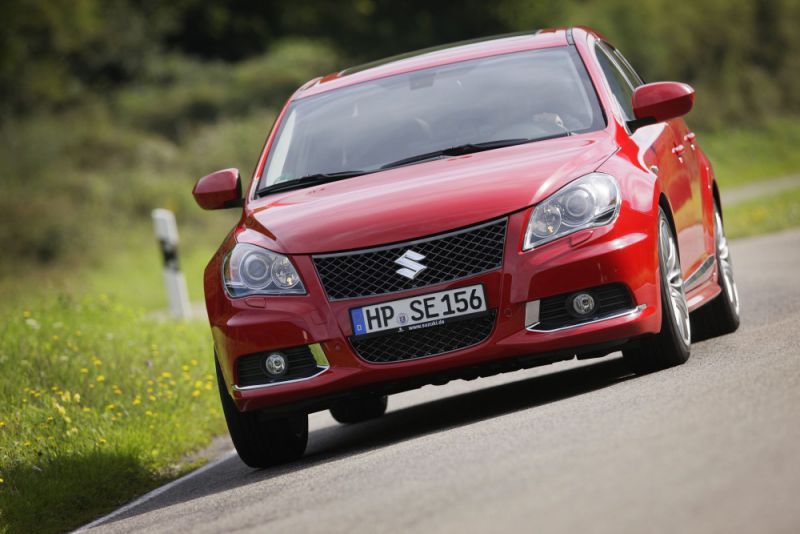
The Suzuki Kizashi: A Bold Attempt in the Mid-Size Segment
The Suzuki Kizashi, specifically the 2.4 (178 Hp) 4×4 CVT variant, represents a significant and often overlooked chapter in the history of the Japanese automaker’s global passenger car offerings. Launched in 2009, the Kizashi was Suzuki’s ambitious foray into the highly competitive mid-size sedan market, a segment dominated by established giants like the Honda Accord and Toyota Camry. Positioned as a sportier, more upscale alternative, the Kizashi aimed to blend European driving dynamics with Japanese reliability and an attractive standard feature set, including a highly capable all-wheel-drive system. Produced until 2016, it was the sole generation of the Kizashi nameplate, signifying Suzuki’s most earnest effort to elevate its brand image beyond economy cars and SUVs in many markets, including North America, Europe, and Australia.
For the American market, the Kizashi was a critical test of Suzuki’s ability to compete in a segment where brand loyalty and perceived value are paramount. It arrived with a distinctive design, a well-appointed interior, and the promise of engaging performance, particularly with its available all-wheel-drive (AWD) system and continuously variable transmission (CVT). Despite receiving positive reviews from automotive journalists for its handling and quality, the Kizashi faced an uphill battle against deeply entrenched rivals and Suzuki’s relatively small dealer network and marketing budget in the United States. Ultimately, it became one of the last passenger vehicles sold by Suzuki in the U.S. before the company withdrew from the American automobile market in 2012.
Engine and Performance of the Suzuki Kizashi
Powering the Suzuki Kizashi 2.4 (178 Hp) 4×4 CVT is Suzuki’s J24B engine, a 2.4-liter (2393 cm³ or 146.03 cu. in.) naturally aspirated inline-four cylinder unit. This engine was engineered to deliver a balance of performance and efficiency for the mid-size sedan segment. It features a DOHC (Dual Overhead Camshaft) valvetrain with VVT-i (Variable Valve Timing with intelligence), optimizing valve timing for improved power output and fuel economy across the rev range. The engine produces a respectable 178 horsepower at 6500 rpm, which was competitive for a non-turbocharged four-cylinder in its class. Torque output stands at 169.64 lb.-ft. (230 Nm) at a relatively accessible 4000 rpm, providing decent responsiveness in everyday driving scenarios.
The powertrain is mated to a Continuously Variable Transmission (CVT), which contributes to the vehicle’s fuel efficiency by keeping the engine in its optimal operating range. While CVTs are often criticized for their “rubber band” feel, Suzuki’s unit in the Kizashi was designed to offer smooth power delivery. The standout feature for this particular variant is its advanced 4×4 (all-wheel-drive) system. This intelligent AWD system could automatically send power to the rear wheels when slip was detected, or it could be manually engaged by the driver, providing enhanced traction and stability in adverse weather conditions or during spirited driving.
In terms of raw performance, the Kizashi 2.4 (178 Hp) 4×4 CVT demonstrated competent acceleration for its class, achieving 0 to 60 mph in an estimated 8.4 seconds. Its maximum speed was rated at 127.38 mph (205 km/h). Fuel economy figures for the combined cycle were 28.3 US mpg (8.3 l/100 km), with urban consumption at 20.8 US mpg (11.3 l/100 km) and extra-urban at 35.6 US mpg (6.6 l/100 km). These figures, combined with its Euro 5 emission standard compliance and CO2 emissions of 191 g/km, highlighted Suzuki’s effort to deliver a modern, efficient, and environmentally conscious vehicle for its time. The engine’s robust design, with a 10:1 compression ratio and multi-port manifold injection, underscored Suzuki’s engineering prowess.
Design and Features
The Suzuki Kizashi was conceived as a sleek and sophisticated four-door sedan, designed to stand out in a crowded market. Its exterior styling borrowed cues from European design philosophies, featuring a bold front grille, swept-back headlights, and a muscular stance. The overall length of 183.07 inches (4650 mm), width of 71.65 inches (1820 mm), and height of 57.87 inches (1470 mm) gave it a substantial road presence. The 106.3-inch (2700 mm) wheelbase contributed to a comfortable ride and stable handling characteristics.
Standard on this variant were 18-inch alloy wheels, fitted with 235/45 R18 94W tires, which not only enhanced its sporty appearance but also provided excellent grip. The suspension system was engineered for a dynamic driving experience, featuring an independent McPherson strut setup with coil springs and an anti-roll bar at the front, complemented by an independent multi-link suspension at the rear. This sophisticated suspension design contributed to the Kizashi’s widely praised handling and ride quality, offering a blend of comfort and agility. Braking performance was handled by ventilated discs at the front and solid discs at the rear, supported by an Anti-lock Braking System (ABS) for enhanced safety and control.
Inside, the Kizashi offered a well-appointed cabin with seating for five occupants. Suzuki made a conscious effort to use higher-quality materials than typically found in their previous models, creating an interior that felt more premium. Key features included supportive seats, a logically laid-out dashboard, and a good ergonomic design for controls. While specific interior features like infotainment systems or advanced driver-assistance systems (ADAS) are not detailed in the provided data, for a 2009-2016 model, one could expect features like automatic climate control, a decent audio system, and power accessories to be available, especially in higher trim levels. The trunk space of 16.28 cu. ft. (461 liters) offered practical storage for luggage, and the 16.64 US gallon (63 liters) fuel tank provided a reasonable cruising range. Safety was a priority, with the robust body structure and standard ABS, along with the inherent stability provided by the AWD system.
Technical Specifications
| Category | Specification |
|---|---|
| General Information | |
| Brand | Suzuki |
| Model | Kizashi |
| Generation | Kizashi |
| Type (Engine) | 2.4 (178 Hp) 4×4 CVT |
| Start of Production | 2009 year |
| End of Production | 2016 year |
| Powertrain Architecture | Internal Combustion engine |
| Body type | Sedan |
| Seats | 5 |
| Doors | 4 |
| Performance Specs | |
| Fuel Consumption (economy) – urban | 20.8 US mpg (11.3 l/100 km) |
| Fuel Consumption (economy) – extra urban | 35.6 US mpg (6.6 l/100 km) |
| Fuel Consumption (economy) – combined | 28.3 US mpg (8.3 l/100 km) |
| CO2 emissions | 191 g/km |
| Fuel Type | Petrol (Gasoline) |
| Acceleration 0 – 60 mph | 8.4 sec |
| Acceleration 0 – 100 km/h | 8.8 sec |
| Maximum speed | 127.38 mph (205 km/h) |
| Emission standard | Euro 5 |
| Weight-to-power ratio | 9 kg/Hp, 110.9 Hp/tonne |
| Weight-to-torque ratio | 7 kg/Nm, 143.3 Nm/tonne |
| Engine Specs | |
| Power | 178 Hp @ 6500 rpm |
| Power per liter | 74.4 Hp/l |
| Torque | 169.64 lb.-ft. (230 Nm) @ 4000 rpm |
| Engine layout | Front, Transverse |
| Engine Model/Code | J24B |
| Engine displacement | 2.4 liters (2393 cm³, 146.03 cu. in.) |
| Number of cylinders | 4 |
| Engine configuration | Inline |
| Cylinder Bore | 3.62 in. (92 mm) |
| Piston Stroke | 3.54 in. (90 mm) |
| Compression ratio | 10:1 |
| Number of valves per cylinder | 4 |
| Fuel injection system | Multi-port manifold injection |
| Engine aspiration | Naturally aspirated engine |
| Valvetrain | DOHC – VVT-i |
| Engine oil capacity | 4.76 US qt (4.5 l) |
| Coolant | 6.97 US qt (6.6 l) |
| Space, Volume and Weights | |
| Kerb Weight | 3538.42 lbs. (1605 kg) |
| Max. weight (GVWR) | 4475.38 lbs. (2030 kg) |
| Max load | 936.96 lbs. (425 kg) |
| Trunk (boot) space – maximum | 16.28 cu. ft. (461 l) |
| Fuel tank capacity | 16.64 US gal (63 l) |
| Dimensions | |
| Length | 183.07 in. (4650 mm) |
| Width | 71.65 in. (1820 mm) |
| Height | 57.87 in. (1470 mm) |
| Wheelbase | 106.3 in. (2700 mm) |
| Front track | 61.61 in. (1565 mm) |
| Rear (Back) track | 62.01 in. (1575 mm) |
| Ride height (ground clearance) | 5.31 in. (135 mm) |
| Minimum turning circle (turning diameter) | 36.09 ft. (11 m) |
| Drivetrain, Brakes and Suspension Specs | |
| Drive wheel | All-wheel drive (4×4) |
| Front suspension | Independent, type McPherson with coil spring and anti-roll bar |
| Rear suspension | Independent multi-link suspension |
| Front brakes | Ventilated discs |
| Rear brakes | Disc |
| Assisting systems | ABS (Anti-lock braking system) |
| Steering type | Steering rack and pinion |
| Tires size | 235/45 R18 94W |
| Wheel rims size | 8J x 18 |
Legacy and Market Impact of the Suzuki Kizashi
The Suzuki Kizashi, particularly the 2.4 (178 Hp) 4×4 CVT variant, holds a unique place in automotive history as Suzuki’s most earnest and arguably best attempt to produce a competitive mid-size sedan for global markets. In the United States, its launch represented a pivot for Suzuki, aiming to shed its image as solely a maker of small, inexpensive cars and SUVs. Reviews from the automotive press were largely positive, praising the Kizashi for its surprisingly sporty handling, comfortable ride, solid build quality, and the sophistication of its available all-wheel-drive system. Many critics noted its European feel and compared its driving dynamics favorably to more expensive sedans.
Despite its critical acclaim, the Kizashi struggled to gain significant market traction. Its primary competitors in the mid-size sedan segment were formidable: the Honda Accord, Toyota Camry, Nissan Altima, Mazda6, and Subaru Legacy. These vehicles benefited from decades of established brand recognition, extensive dealer networks, and diverse powertrain options, including V6 engines and hybrids, which the Kizashi lacked. Suzuki’s relatively limited marketing budget and a smaller, less visible dealer footprint in North America made it difficult for the Kizashi to break through the noise. Potential buyers, often unfamiliar with Suzuki’s passenger car offerings, were hesitant to choose a Kizashi over a more established alternative.
Ultimately, the Kizashi’s sales performance was insufficient to sustain Suzuki’s passenger car operations in the U.S., contributing to the company’s decision to withdraw from the American automobile market in 2012. While the Kizashi continued production for other markets until 2016, its American legacy is that of an “underdog” and a “hidden gem” – a well-engineered and engaging car that simply couldn’t overcome the immense challenges of its market segment and its brand’s position. For enthusiasts, the Kizashi remains a testament to what Suzuki was capable of, offering a distinctive, capable, and often overlooked alternative to the mainstream. Its standard AWD system and engaging chassis dynamics make it a compelling used car proposition for those seeking something different.
