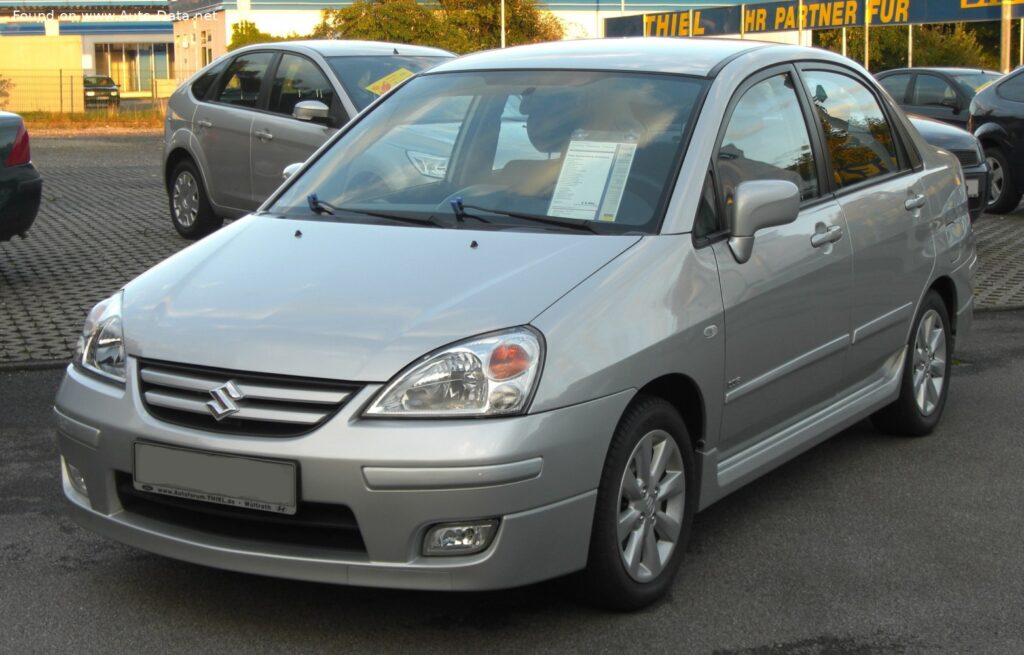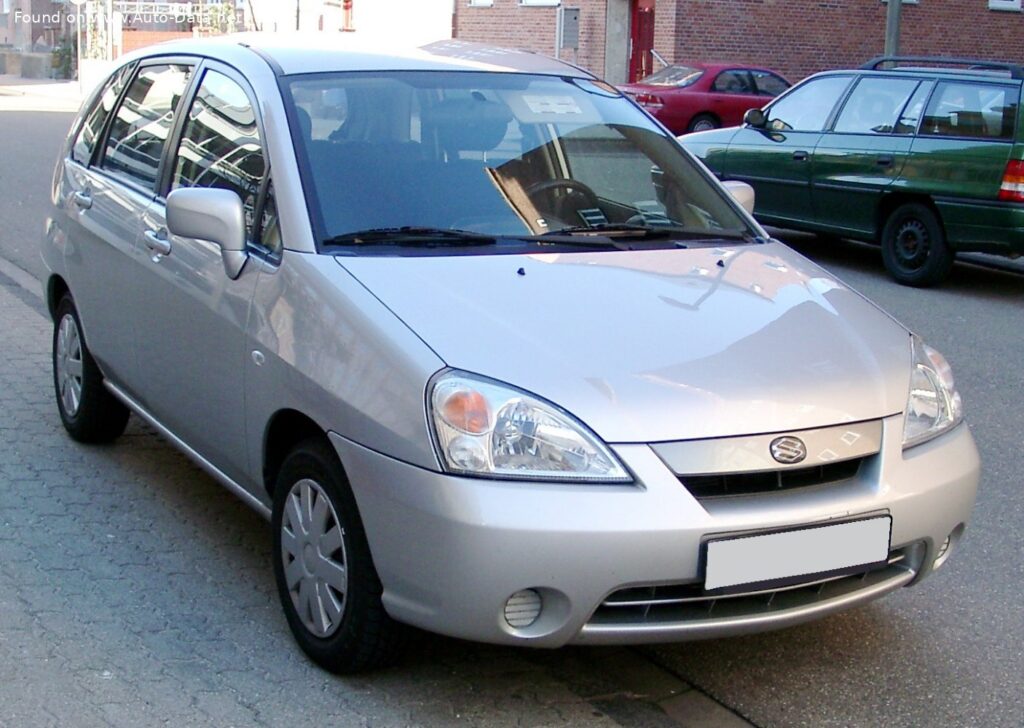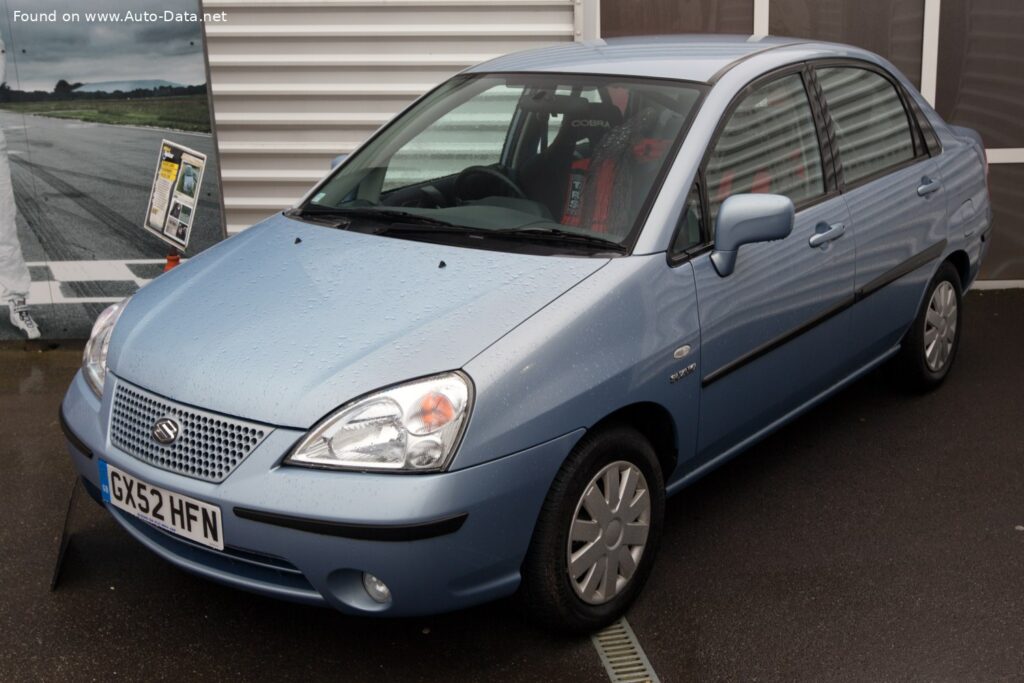
The Suzuki Liana Sedan I 1.6 (103 Hp): A Global Contender in Practicality
The Suzuki Liana Sedan I 1.6 (103 Hp) represents a significant offering from the Japanese automaker Suzuki, introduced in 2001. Known in some markets as the Suzuki Aerio, the Liana (an acronym for “Life In A New Age”) was designed as a compact family car, targeting a broad international audience, particularly in European and Asian markets where it served as a practical and economical choice. While not officially sold in the United States, the Liana was a staple in Suzuki’s global lineup, providing a spacious interior, reliable mechanics, and an accessible price point. This first-generation sedan, produced until 2004, aimed to blend the versatility of a hatchback with the traditional appeal of a sedan, offering a compelling package for families and individuals seeking a dependable daily driver.
Engine and Performance of the Suzuki Liana Sedan I 1.6 (103 Hp)
Powering the Suzuki Liana Sedan I 1.6 (103 Hp) is Suzuki’s M16A engine, a naturally aspirated inline-four gasoline unit with a displacement of 1586 cm³ (96.78 cu. in.). This engine, renowned for its robustness and efficiency, is configured with a DOHC (Double Overhead Camshaft) valvetrain and four valves per cylinder, ensuring optimal airflow and combustion. Fuel is delivered via a multi-port manifold injection system, a common and reliable setup for the early 2000s, contributing to smooth power delivery and decent fuel economy.
The M16A engine generates a respectable 103 horsepower at 5500 rpm, providing adequate power for both urban commuting and highway cruising. Torque peaks at 106.21 lb.-ft. at 4000 rpm, offering sufficient low-end grunt for responsive acceleration in city traffic. Mated to a 5-speed manual transmission, the Liana 1.6 (103 Hp) delivers power to all four wheels, an uncommon but welcome feature in its segment, enhancing traction and stability in varying road conditions.
Performance figures for this sedan include an acceleration time from 0 to 60 mph in 11.9 seconds, with a top speed reaching 99.42 mph. While not a performance-oriented vehicle, these figures were competitive for its class, emphasizing practicality over outright speed. Fuel economy was a key selling point, with urban consumption rated at 25.6 US mpg and extra-urban (highway) driving achieving an impressive 36.8 US mpg, making it an economical choice for long-distance travel. The 13.21 US gallon fuel tank capacity further extended its range between fill-ups.
Design and Features
The design of the Suzuki Liana Sedan I is characterized by its functional and unpretentious aesthetic, reflecting its role as a practical family vehicle. The sedan body type offers four doors and seating for five occupants, prioritizing interior space and comfort. With an overall length of 171.26 inches, a width of 66.54 inches, and a height of 60.83 inches, the Liana presented a compact footprint that was easy to maneuver in crowded city environments, yet offered surprising interior volume. The wheelbase of 97.64 inches contributed to a stable ride and adequate legroom for rear passengers.
Inside, the Liana focused on ergonomics and utility. The dashboard layout was straightforward, with controls placed intuitively. A significant advantage of the Liana’s design was its generous cargo capacity, boasting a minimum trunk space of 16.95 cu. ft., which was highly competitive for its segment and provided ample room for luggage or groceries.
In terms of chassis and safety, the Liana Sedan I featured a coil spring suspension system at both the front and rear, designed to provide a comfortable ride quality suitable for varied road surfaces. Braking duties were handled by ventilated discs at the front and drum brakes at the rear, complemented by an Anti-lock Braking System (ABS) for enhanced stopping power and control under emergency braking situations. Steering was managed by a hydraulic rack and pinion system, offering direct feedback to the driver. The vehicle rode on 195/55 R15 tires, mounted on 15-inch wheel rims, providing a balance of grip and ride comfort.
Technical Specifications
| Category | Specification | US Equivalent / Notes |
|---|---|---|
| General Information | ||
| Brand | Suzuki | |
| Model | Liana | |
| Generation | Liana Sedan I | |
| Type (Engine) | 1.6 (103 Hp) | |
| Start of Production | 2001 year | |
| End of Production | 2004 year | |
| Powertrain Architecture | Internal Combustion engine | |
| Body Type | Sedan | |
| Seats | 5 | |
| Doors | 4 | |
| Performance Specs | ||
| Fuel Consumption (Urban) | 9.2 l/100 km | 25.6 US mpg |
| Fuel Consumption (Extra Urban) | 6.4 l/100 km | 36.8 US mpg |
| Fuel Type | Petrol (Gasoline) | |
| Acceleration 0 – 60 mph | 11.9 sec | |
| Maximum Speed | 160 km/h | 99.42 mph |
| Weight-to-Power Ratio | 11.6 kg/Hp | 86.2 Hp/tonne |
| Weight-to-Torque Ratio | 8.3 kg/Nm | 120.5 Nm/tonne |
| Engine Specs | ||
| Power | 103 Hp @ 5500 rpm | |
| Power per Liter | 64.9 Hp/l | |
| Torque | 144 Nm @ 4000 rpm | 106.21 lb.-ft. @ 4000 rpm |
| Engine Layout | Front, Transverse | |
| Engine Model/Code | M16A | |
| Engine Displacement | 1586 cm³ | 1.6 Liters (96.78 cu. in.) |
| Number of Cylinders | 4 | |
| Engine Configuration | Inline | |
| Cylinder Bore | 78 mm | 3.07 in. |
| Piston Stroke | 83 mm | 3.27 in. |
| Compression Ratio | 9.7:1 | |
| Number of Valves per Cylinder | 4 | |
| Fuel Injection System | Multi-port manifold injection | |
| Engine Aspiration | Naturally aspirated engine | |
| Valvetrain | DOHC | |
| Engine Oil Capacity | 4.1 l | 4.33 US qt |
| Coolant Capacity | 6.5 l | 6.87 US qt |
| Space, Volume and Weights | ||
| Kerb Weight | 1195 kg | 2634.52 lbs. |
| Max. Weight | 1670 kg | 3681.72 lbs. |
| Max Load | 475 kg | 1047.2 lbs. |
| Trunk (Boot) Space – Minimum | 480 l | 16.95 cu. ft. |
| Fuel Tank Capacity | 50 l | 13.21 US gal |
| Dimensions | ||
| Length | 4350 mm | 171.26 in. |
| Width | 1690 mm | 66.54 in. |
| Height | 1545 mm | 60.83 in. |
| Wheelbase | 2480 mm | 97.64 in. |
| Front Track | 1450 mm | 57.09 in. |
| Rear (Back) Track | 1445 mm | 56.89 in. |
| Drivetrain, Brakes and Suspension Specs | ||
| Drive Wheel | All wheel drive (4×4) | |
| Number of Gears and Type of Gearbox | 5 gears, manual transmission | |
| Front Suspension | Coil spring | |
| Rear Suspension | Coil spring | |
| Front Brakes | Ventilated discs | |
| Rear Brakes | Drum | |
| Assisting Systems | ABS (Anti-lock braking system) | |
| Steering Type | Steering rack and pinion | |
| Power Steering | Hydraulic Steering | |
| Tires Size | 195/55 R15 | |
| Wheel Rims Size | 15 |
Legacy and Market Impact
The Suzuki Liana Sedan I 1.6 (103 Hp) carved out a niche for itself in the highly competitive compact car segment during its production run from 2001 to 2004. In markets like Europe and Asia, where Suzuki has a strong presence, the Liana was positioned as a sensible alternative to more mainstream offerings from manufacturers like Toyota (Corolla), Honda (Civic), Opel (Astra), and Ford (Focus). Its unique selling proposition often included its standard all-wheel-drive system, which was rare for a car of its class and price point, providing an added layer of security and capability, especially in regions with challenging weather conditions.
The Liana gained a degree of international recognition, notably for its stint as the “Reasonably Priced Car” on the popular British automotive show, Top Gear. This exposure, while often playful and critical, highlighted its sturdy build and straightforward mechanics to a global audience, inadvertently reinforcing its reputation as a no-frills, dependable vehicle.
Suzuki’s brand ethos, often associated with reliability, affordability, and compact utility, was well-represented by the Liana. It appealed to buyers who prioritized practicality, low running costs, and a spacious interior over cutting-edge design or high performance. Its mechanical simplicity and robust M16A engine contributed to a reputation for durability, making it a popular choice in secondary markets long after its initial production.
Ultimately, the Liana served as an important bridge in Suzuki’s passenger car lineup, offering a comfortable and capable sedan option between smaller city cars and larger SUVs. While it may not have achieved the iconic status of some of its rivals, its consistent performance, family-friendly features, and value proposition ensured its relevance and contributed to Suzuki’s global sales success in the early 2000s. It laid the groundwork for future Suzuki models that continued to emphasize compact efficiency and practical design.