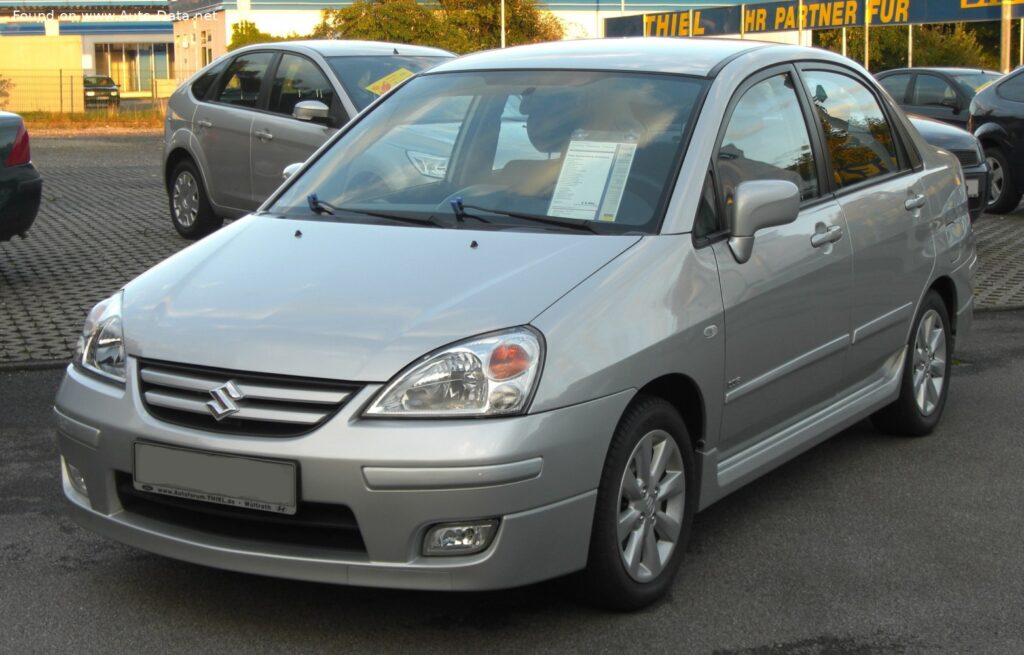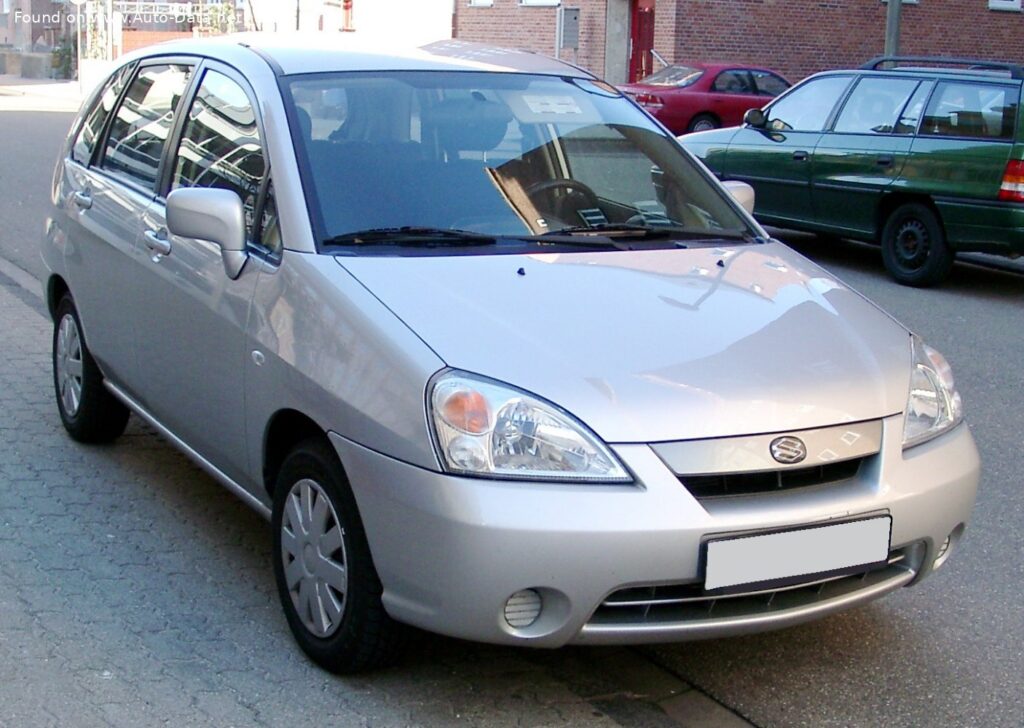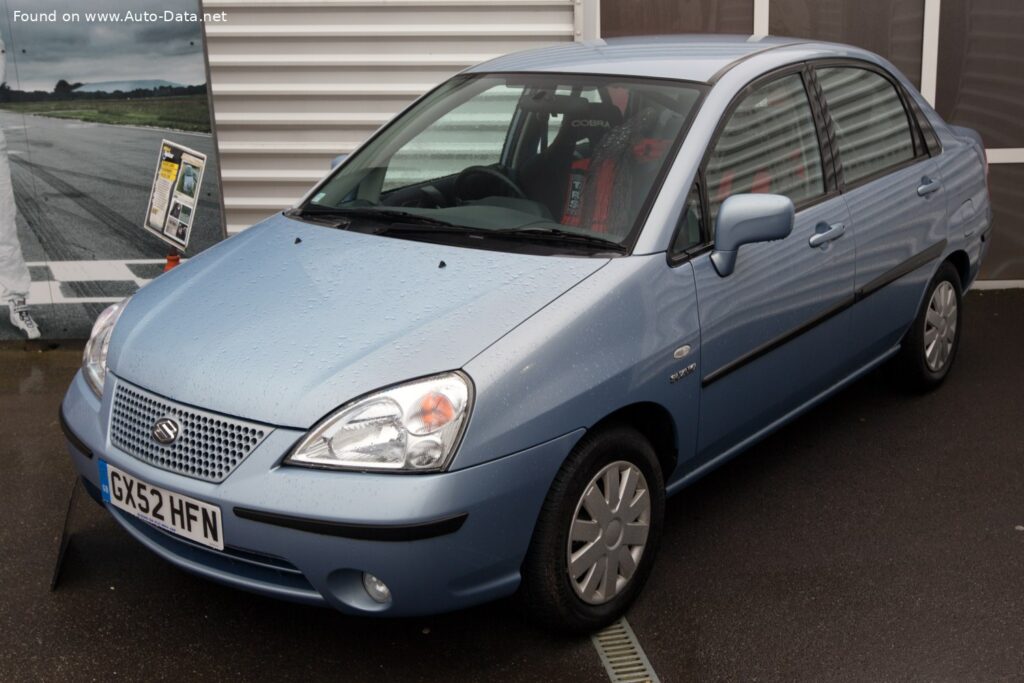
Introduction to the Suzuki Liana Sedan I 1.6 i 16V GL (103 Hp)
The Suzuki Liana, an acronym for “Life In A New Age,” represented Suzuki’s concerted effort to offer a versatile and practical compact vehicle for the global market, particularly targeting European and Asian consumers. Introduced in 2001, the first generation, known as the Suzuki Liana Sedan I, was conceived as a family-friendly car that balanced affordability with a respectable level of comfort and utility. This specific variant, the 1.6 i 16V GL, featuring a 103 horsepower engine, was a key offering in the lineup, providing a capable and economical option for daily driving.
While the Liana was also marketed as the Aerio in North America, its primary impact and sales success were concentrated in markets where compact sedans and hatchbacks formed the backbone of the automotive landscape. The Sedan I, produced from 2001 to 2004, aimed to compete in a highly competitive segment, offering a sensible alternative to more established players. It was designed from the ground up to be a practical proposition, emphasizing interior space, ease of use, and dependable mechanicals, rather than outright performance or luxury. Its slightly taller stance, particularly in hatchback form, also hinted at a crossover-like versatility, though the sedan maintained more conventional proportions.
Engine and Performance of the Suzuki Liana Sedan I
Powering the Suzuki Liana Sedan I 1.6 i 16V GL was Suzuki’s M16A engine, a robust and well-regarded 1.6-liter (1586 cm3 or 96.78 cubic inches) inline four-cylinder unit. This naturally aspirated engine featured a Double Overhead Camshaft (DOHC) valvetrain with 16 valves, four per cylinder, a configuration common for efficient power delivery in its class. With a compression ratio of 9.7:1 and a multi-port manifold injection system, the engine was tuned for a balance of power and fuel efficiency.
The M16A produced a respectable 103 horsepower at 5500 rpm, which was competitive for a compact sedan of its era. Torque output stood at 106.21 lb.-ft. (144 Nm) delivered at 4000 rpm, providing adequate pulling power for city driving and highway cruising. This powertrain architecture, with the engine mounted transversely at the front and driving the front wheels, contributed to efficient packaging and a predictable driving dynamic.
In terms of performance, the Liana Sedan I 1.6 i 16V GL was not designed to be a speed demon, but rather a reliable commuter. It achieved 0 to 60 mph in a calculated 11.4 seconds, with a top speed of 105.63 mph (170 km/h). These figures placed it firmly in the mainstream compact sedan category, suitable for the daily demands of its target demographic.
Fuel economy was a strong suit for the Liana, especially in extra-urban driving conditions. The official figures indicated an urban consumption of 25.8 US mpg (9.1 liters/100 km) and an impressive extra-urban consumption of 40.6 US mpg (5.8 liters/100 km). This efficiency, combined with a 13.21 US gallon (50 liter) fuel tank, offered a practical driving range, appealing to budget-conscious buyers.
Power was transferred to the front wheels via a smooth-shifting 5-speed manual transmission, a common and reliable choice for this segment. The combination of a lightweight body (kerb weight of 2524.29 lbs or 1145 kg) and the M16A engine resulted in a weight-to-power ratio of 11.1 kg/Hp, or approximately 90 Hp per tonne, contributing to its nimble feel despite its modest power output.
Design and Features
The Suzuki Liana Sedan I adopted a conventional four-door sedan body style, designed with practicality and interior space as primary considerations. Its dimensions—171.26 inches in length, 66.54 inches in width, and 60.83 inches in height—made it a compact yet surprisingly roomy vehicle. The design, while not groundbreaking, was clean and functional, aiming for broad appeal rather than distinctive styling cues.
The interior of the Liana Sedan I was configured for five occupants, with a focus on ergonomics and ease of use. The slightly taller cabin design, a characteristic shared with its hatchback sibling, provided good headroom for all passengers. The trunk space was generous for its class, offering 16.95 cubic feet (480 liters) of cargo volume, making it suitable for families or individuals needing ample storage for luggage or groceries.
Underneath, the Liana featured an independent suspension setup, utilizing coil springs at both the front and rear, designed to provide a comfortable ride and stable handling. The braking system consisted of ventilated discs at the front for effective stopping power and traditional drum brakes at the rear, a cost-effective and reliable solution for a vehicle of this type. An Anti-lock Braking System (ABS) was included as an assisting system, enhancing safety by preventing wheel lock-up during hard braking.
Steering was managed by a rack and pinion system, aided by hydraulic power steering, which provided a direct feel and assisted maneuverability at lower speeds. The vehicle rode on 185/65 R14 tires mounted on 14-inch wheel rims, a common size that offered a good balance of grip, comfort, and replacement cost.
For its time and market segment, the GL trim level would have included essential features aimed at convenience and basic comfort, reinforcing its position as a reliable, no-frills family car. While specific interior amenities might vary by market, the overall design ethos prioritized durability and straightforward functionality.
Technical Specifications: Suzuki Liana Sedan I 1.6 i 16V GL (103 Hp)
The following table details the comprehensive technical specifications for the Suzuki Liana Sedan I 1.6 i 16V GL (103 Hp) model, produced from 2001 to 2004:
| Feature | Specification |
|---|---|
General Information |
|
| Brand | Suzuki |
| Model | Liana |
| Generation | Liana Sedan I |
| Type (Engine) | 1.6 i 16V GL (103 Hp) |
| Production Start | 2001 |
| Production End | 2004 |
| Powertrain Architecture | Internal Combustion Engine |
| Body Type | Sedan |
| Seats | 5 |
| Doors | 4 |
Performance Specifications |
|
| Fuel Consumption (Urban) | 25.8 US mpg (9.1 l/100 km) |
| Fuel Consumption (Extra Urban) | 40.6 US mpg (5.8 l/100 km) |
| Fuel Type | Petrol (Gasoline) |
| Acceleration 0 – 60 mph | 11.4 seconds |
| Acceleration 0 – 62 mph (0-100 km/h) | 12 seconds |
| Maximum Speed | 105.63 mph (170 km/h) |
| Weight-to-Power Ratio | 11.1 kg/Hp (90 Hp/tonne) |
| Weight-to-Torque Ratio | 8 kg/Nm (125.8 Nm/tonne) |
Engine Specifications |
|
| Power | 103 Hp @ 5500 rpm |
| Power per liter | 64.9 Hp/l |
| Torque | 106.21 lb.-ft. (144 Nm) @ 4000 rpm |
| Engine Layout | Front, Transverse |
| Engine Model/Code | M16A |
| Engine Displacement | 1.6 liters (1586 cm3 / 96.78 cu. in.) |
| Number of Cylinders | 4 |
| Engine Configuration | Inline |
| Cylinder Bore | 3.07 inches (78 mm) |
| Piston Stroke | 3.27 inches (83 mm) |
| Compression Ratio | 9.7:1 |
| Number of Valves per Cylinder | 4 |
| Fuel Injection System | Multi-port manifold injection |
| Engine Aspiration | Naturally aspirated |
| Valvetrain | DOHC |
| Engine Oil Capacity | 4.33 US qt (4.1 l) |
| Coolant Capacity | 6.87 US qt (6.5 l) |
Space, Volume, and Weights |
|
| Kerb Weight | 2524.29 lbs (1145 kg) |
| Maximum Weight | 3615.58 lbs (1640 kg) |
| Max Load | 1091.29 lbs (495 kg) |
| Trunk (Boot) Space – Minimum | 16.95 cu. ft. (480 l) |
| Fuel Tank Capacity | 13.21 US gal (50 l) |
Dimensions |
|
| Length | 171.26 inches (4350 mm) |
| Width | 66.54 inches (1690 mm) |
| Height | 60.83 inches (1545 mm) |
| Wheelbase | 97.64 inches (2480 mm) |
| Front Track | 57.09 inches (1450 mm) |
| Rear (Back) Track | 56.89 inches (1445 mm) |
Drivetrain, Brakes, and Suspension |
|
| Drivetrain Architecture | Front-wheel drive, Internal Combustion Engine |
| Drive Wheel | Front-wheel drive |
| Number of Gears and Type of Gearbox | 5 gears, manual transmission |
| Front Suspension | Coil spring |
| Rear Suspension | Coil spring |
| Front Brakes | Ventilated discs |
| Rear Brakes | Drum |
| Assisting Systems | ABS (Anti-lock braking system) |
| Steering Type | Steering rack and pinion |
| Power Steering | Hydraulic Steering |
| Tires Size | 185/65 R14 |
| Wheel Rims Size | 14 inches |
Legacy and Market Impact
The Suzuki Liana Sedan I, particularly the 1.6 i 16V GL variant, carved out a niche for itself as a highly practical and no-nonsense compact family car in its primary markets. While it might not have captured the imagination with groundbreaking design or segment-leading performance, its strength lay in its dependability, spacious interior, and cost-effectiveness—qualities that resonate strongly with a significant portion of car buyers globally.
In Europe and Asia, where Suzuki has a strong reputation for producing reliable and affordable vehicles, the Liana competed against a host of well-established rivals. Its competitors included popular models such as the Toyota Corolla, Honda Civic, Opel Astra, and Ford Focus. Against these, the Liana often stood out for its slightly taller stance (in some variants), which offered easier ingress/egress and a more commanding view of the road, along with its competitive pricing.
The Liana’s reputation was built on its solid mechanicals, particularly the M16A engine, which proved to be a durable and low-maintenance unit. This reliability, combined with reasonable running costs and good fuel economy, made it a popular choice for families and fleet operators alike. Its straightforward design and construction also meant that maintenance and repairs were generally less complex and more affordable than some of its more technologically advanced competitors.
Historically, the Liana played a crucial role in Suzuki’s global strategy during the early 2000s. It demonstrated Suzuki’s capability to produce a versatile platform that could serve both as a conventional sedan and a more practical hatchback, appealing to diverse market preferences. Although it was eventually succeeded by the SX4, which leaned more heavily into the burgeoning crossover segment, the Liana’s contribution to Suzuki’s presence in the compact car market was significant.
Today, the Suzuki Liana Sedan I is remembered as a testament to Suzuki’s philosophy of building robust, functional, and value-oriented vehicles. It may not be a collector’s item, but its legacy endures in its reputation as a dependable workhorse that reliably served the transportation needs of countless owners across various international markets.