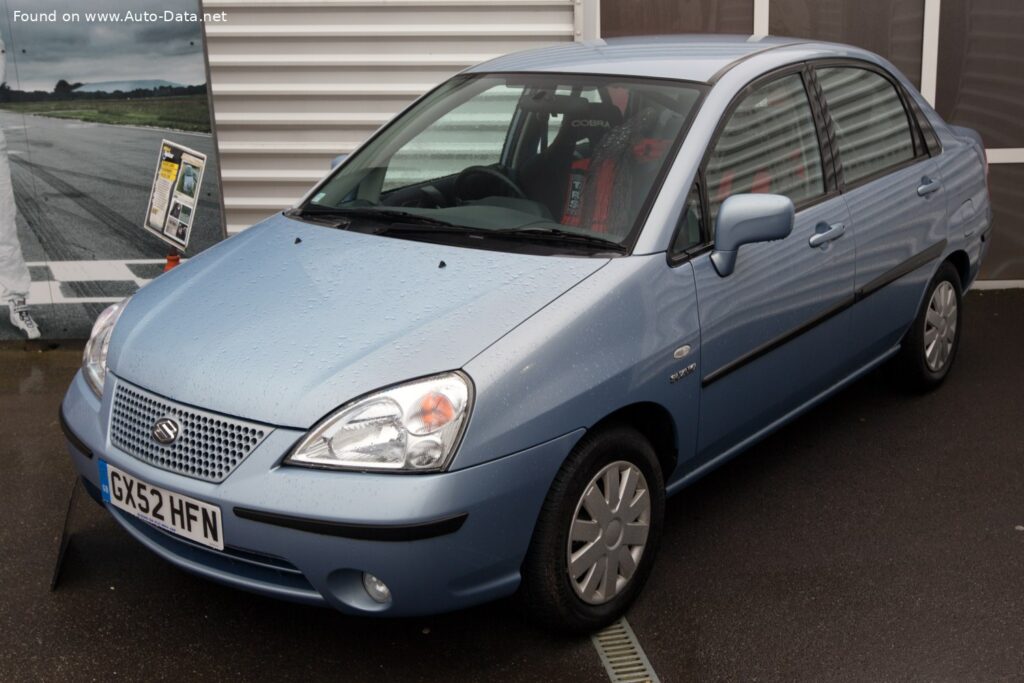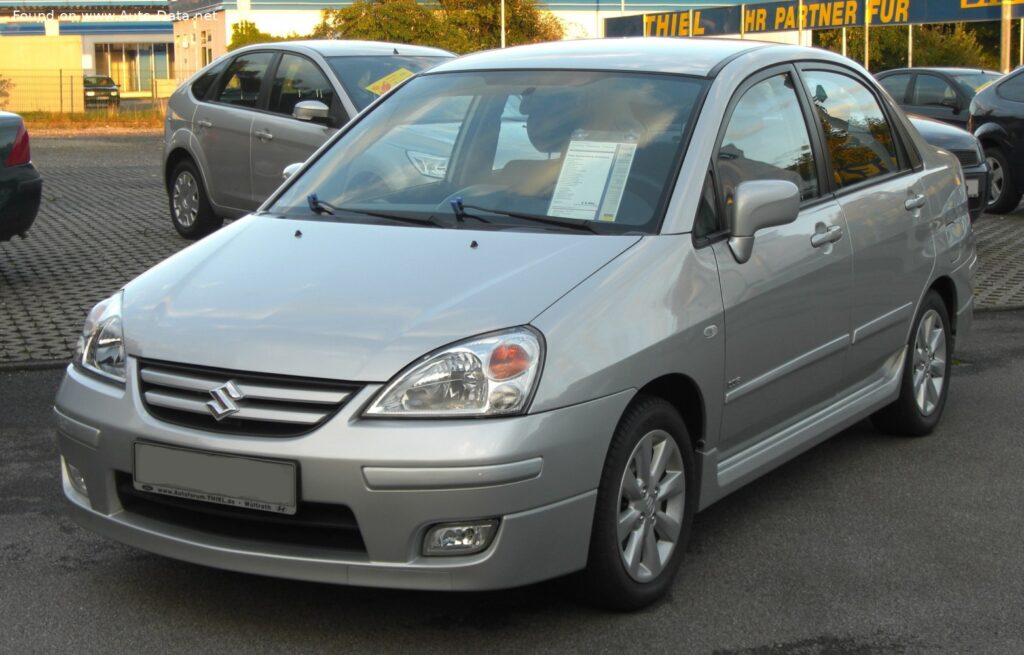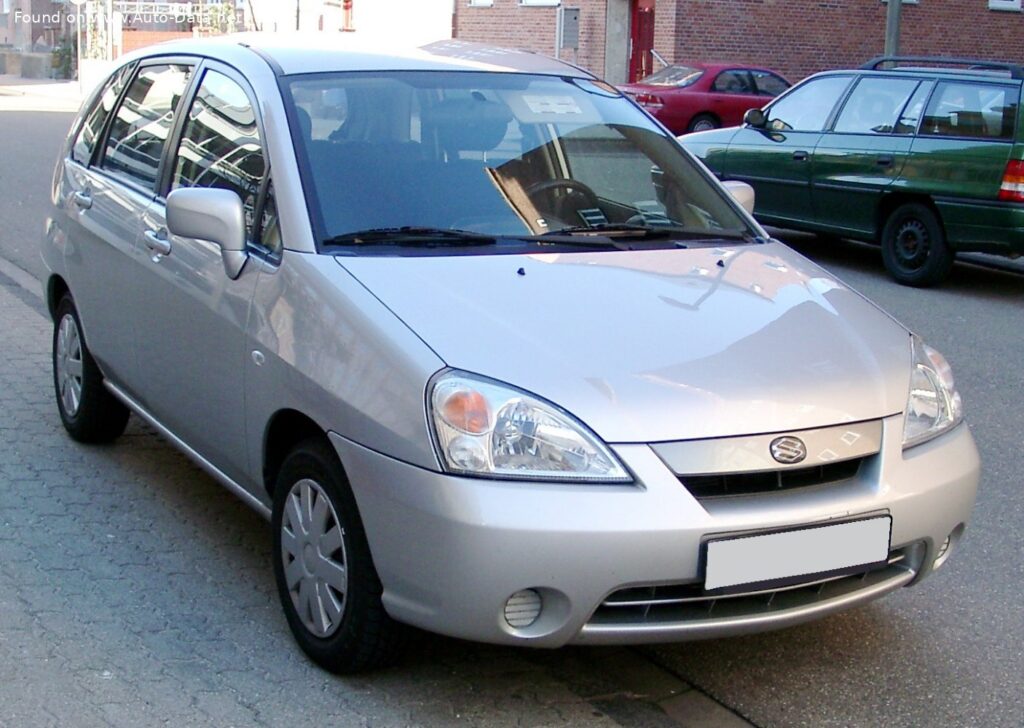
Suzuki Liana Wagon I 1.3 i 16V 2WD (90 Hp): A Global Contender
The Suzuki Liana Wagon I 1.3 i 16V 2WD (90 Hp) represents a significant, albeit often understated, chapter in Suzuki’s global automotive strategy during the early 2000s. Launched in 2001 and produced until 2004, this first-generation Liana Wagon was designed to cater to a diverse international audience, particularly excelling in European and Asian markets where compact, practical, and economical family vehicles were highly sought after. While known as the Aerio in North America, this specific 1.3-liter wagon variant was primarily a staple in regions prioritizing fuel efficiency and versatile cargo capacity within a modest footprint. It positioned itself as a sensible alternative in the compact segment, offering a blend of reliability, affordability, and utilitarian design, distinguishing itself from its more common sedan and hatchback counterparts.
Engineering and Performance of the Suzuki Liana Wagon I
At the heart of the Suzuki Liana Wagon I 1.3 i 16V 2WD (90 Hp) lay Suzuki’s M13A engine, a robust and well-regarded 1.3-liter (1328 cm³ or 81.04 cu. in.) inline-four cylinder unit. This powerplant was engineered for efficiency and dependable performance, characteristic of Suzuki’s compact vehicle philosophy. Featuring a Double Overhead Camshaft (DOHC) valvetrain with 16 valves (four per cylinder), the engine benefited from multi-port manifold fuel injection, ensuring precise fuel delivery and optimal combustion. As a naturally aspirated engine, it delivered a respectable 90 horsepower at 5750 revolutions per minute (rpm) and a peak torque of 85.56 lb.-ft. (116 Nm) at 4750 rpm. This output, while not designed for blistering acceleration, provided ample power for daily driving, city commutes, and light highway travel.
Power was transmitted to the front wheels via a smooth-shifting 5-speed manual transmission, a common and reliable choice for vehicles in this class. This front-wheel-drive architecture contributed to predictable handling and good traction in various conditions. In terms of performance metrics, the Liana Wagon I 1.3 i 16V 2WD achieved a 0-60 mph acceleration in a modest 12.6 seconds, reaching a maximum speed of 102.53 mph (165 km/h). These figures underscored its role as a practical family car rather than a performance-oriented machine. Fuel economy was a strong suit, with a combined rating of 35.1 US mpg (6.7 l/100 km), making it an attractive option for budget-conscious consumers.
The vehicle’s weight-to-power ratio stood at 13.5 kg/Hp, or 74.1 Hp/tonne, indicating an efficient use of its modest horsepower. The engine oil capacity was 4.1 liters (4.33 US qt), and the cooling system held 6.5 liters (6.87 US qt), reflecting standard maintenance requirements for its class. The M13A engine, with its 9.5:1 compression ratio and well-engineered bore and stroke (78 mm x 69.5 mm), was known for its longevity and low running costs, further enhancing the Liana’s appeal in its target markets.
Design and Features of the Liana Wagon I
The Suzuki Liana Wagon I adopted a practical and functional station wagon body style, a popular choice in markets outside North America for its blend of passenger comfort and cargo versatility. With four doors and seating for five occupants, it offered a family-friendly configuration. Its exterior dimensions were compact yet efficient: 166.54 inches (4230 mm) in length, 66.54 inches (1690 mm) in width, and 61.02 inches (1550 mm) in height. The relatively tall stance for a compact wagon, combined with a 97.64-inch (2480 mm) wheelbase, contributed to a surprisingly spacious interior and a comfortable ride.
Inside, the Liana Wagon was designed for practicality. While not luxurious, the cabin prioritized ergonomics and utility, offering sufficient headroom and legroom for its class. The true strength of the wagon body was its cargo capacity. With the rear seats in place, it offered a respectable 12.29 cubic feet (348 liters) of trunk space, which could be expanded significantly to 37.5 cubic feet (1062 liters) by folding down the rear seats. This flexibility made it ideal for families, small businesses, or individuals requiring ample space for luggage, groceries, or sports equipment.
Underneath, the Liana Wagon featured a front wishbone suspension for precise steering and handling, paired with a coil spring rear suspension designed to provide a comfortable ride, even when loaded. Braking duties were handled by ventilated discs at the front for effective stopping power and drum brakes at the rear, a common setup for compact vehicles of this era. An Anti-lock Braking System (ABS) was included as an assisting system, enhancing safety by preventing wheel lock-up during hard braking. The hydraulic power steering system, employing a rack and pinion setup, offered responsive and light steering, making the Liana easy to maneuver in urban environments. The vehicle rode on 185/65 R14 T tires mounted on 14-inch wheel rims, a practical choice balancing ride comfort and cost-effectiveness.
Technical Specifications
| Category | Specification |
|---|---|
| Brand | Suzuki |
| Model | Liana Wagon I |
| Engine Type | 1.3 i 16V 2WD (90 Hp) |
| Production Start | 2001 |
| Production End | 2004 |
| Powertrain Architecture | Internal Combustion engine |
| Body Type | Station wagon (estate) |
| Seats | 5 |
| Doors | 4 |
| Performance Specs | |
| Fuel Consumption (Urban) | 8.6 l/100 km (27.4 US mpg) |
| Fuel Consumption (Extra Urban) | 5.6 l/100 km (42 US mpg) |
| Fuel Consumption (Combined) | 6.7 l/100 km (35.1 US mpg) |
| Fuel Type | Petrol (Gasoline) |
| Acceleration 0-60 mph | 12.6 seconds |
| Maximum Speed | 102.53 mph (165 km/h) |
| Weight-to-Power Ratio | 13.5 kg/Hp (74.1 Hp/tonne) |
| Weight-to-Torque Ratio | 10.5 kg/Nm (95.5 Nm/tonne) |
| Engine Specs | |
| Power | 90 Hp @ 5750 rpm |
| Power per liter | 67.8 Hp/l |
| Torque | 85.56 lb.-ft. (116 Nm) @ 4750 rpm |
| Engine Layout | Front, Transverse |
| Engine Model/Code | M13A |
| Engine Displacement | 1.3 liters (1328 cm³ / 81.04 cu. in.) |
| Number of Cylinders | 4 |
| Engine Configuration | Inline |
| Cylinder Bore | 3.07 in. (78 mm) |
| Piston Stroke | 2.74 in. (69.5 mm) |
| Compression Ratio | 9.5:1 |
| Valves per Cylinder | 4 |
| Fuel Injection System | Multi-port manifold injection |
| Engine Aspiration | Naturally aspirated |
| Valvetrain | DOHC |
| Engine Oil Capacity | 4.1 liters (4.33 US qt) |
| Coolant Capacity | 6.5 liters (6.87 US qt) |
| Dimensions, Volume & Weights | |
| Kerb Weight | 2678.62 lbs. (1215 kg) |
| Max. Weight (GVWR) | 3615.58 lbs. (1640 kg) |
| Max Load | 936.96 lbs. (425 kg) |
| Trunk Space (Minimum) | 12.29 cu. ft. (348 l) |
| Trunk Space (Maximum) | 37.5 cu. ft. (1062 l) |
| Fuel Tank Capacity | 13.21 US gal (50 l) |
| Length | 166.54 in. (4230 mm) |
| Width | 66.54 in. (1690 mm) |
| Height | 61.02 in. (1550 mm) |
| Wheelbase | 97.64 in. (2480 mm) |
| Front Track | 57.09 in. (1450 mm) |
| Rear Track | 56.89 in. (1445 mm) |
| Drivetrain, Brakes & Suspension | |
| Drivetrain Architecture | Front-wheel drive (ICE drives front wheels) |
| Drive Wheel | Front-wheel drive |
| Gearbox Type | 5 gears, manual transmission |
| Front Suspension | Wishbone |
| Rear Suspension | Coil spring |
| Front Brakes | Ventilated discs |
| Rear Brakes | Drum |
| Assisting Systems | ABS (Anti-lock braking system) |
| Steering Type | Steering rack and pinion |
| Power Steering | Hydraulic Steering |
| Tires Size | 185/65 R14 T |
| Wheel Rims Size | 14 inches |
Legacy and Market Impact of the Suzuki Liana Wagon I
The Suzuki Liana, particularly in its wagon guise, carved out a niche for itself in the highly competitive global compact car market. Its primary impact was felt most strongly in Europe and Asia, where Suzuki aimed to offer a more conventional, family-oriented vehicle beyond its traditional strengths in small cars and SUVs. In these markets, the Liana Wagon competed against established players like the Toyota Corolla Wagon, Opel Astra Wagon, Ford Focus Wagon, and various small MPVs or compact crossovers. Its value proposition was rooted in its reputation for reliability, low running costs, and practical interior space.
While it didn’t achieve the same iconic status as some of its competitors, the Liana Wagon was a solid, no-nonsense choice for consumers prioritizing utility and economy over flashy design or high performance. Its robust M13A engine, shared with other Suzuki models, contributed to its reputation for mechanical soundness and ease of maintenance. The vehicle’s simple, honest design and straightforward engineering appealed to a demographic looking for a dependable workhorse capable of handling diverse family needs.
In terms of historical significance, the Liana represented Suzuki’s effort to expand its global footprint in the compact segment, offering a product that could appeal to a broader audience than its more specialized models. Although it was superseded by newer designs, the Liana’s legacy lies in its contribution to Suzuki’s image as a manufacturer of reliable, practical, and fuel-efficient vehicles. It demonstrated Suzuki’s capability to produce a competent and competitive compact wagon, serving as a utilitarian and economical choice for many households across continents, embodying the brand’s commitment to delivering value and dependability in everyday motoring.