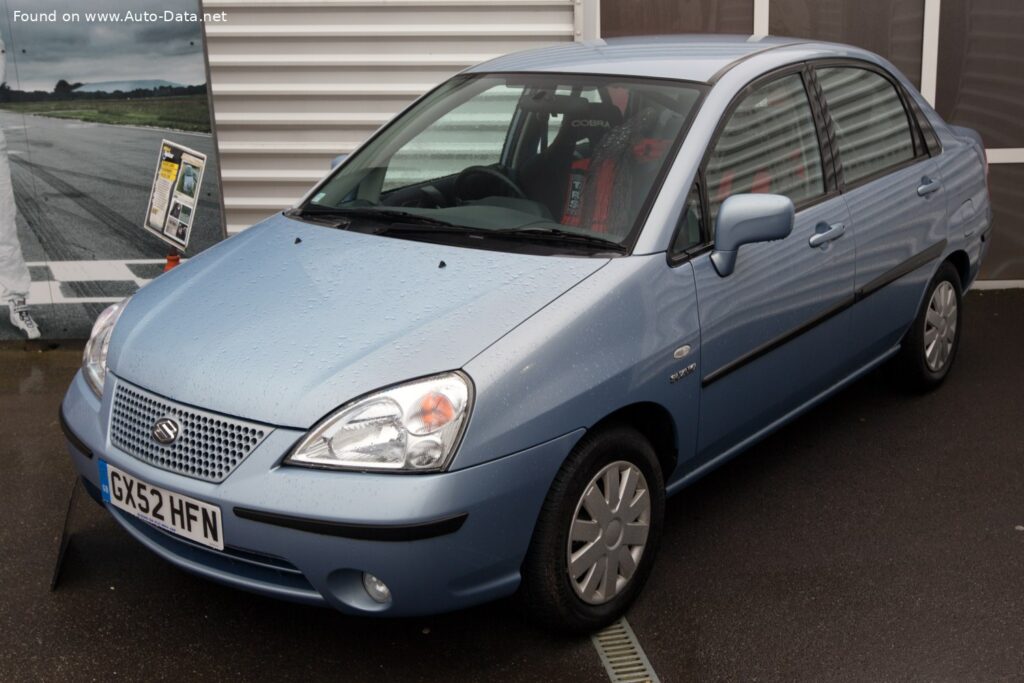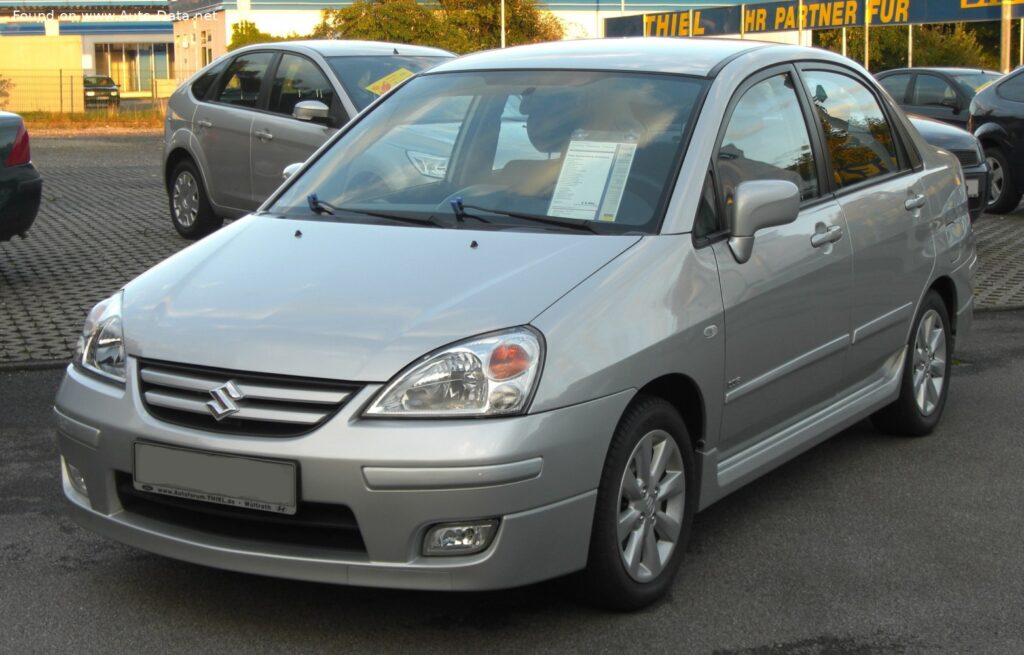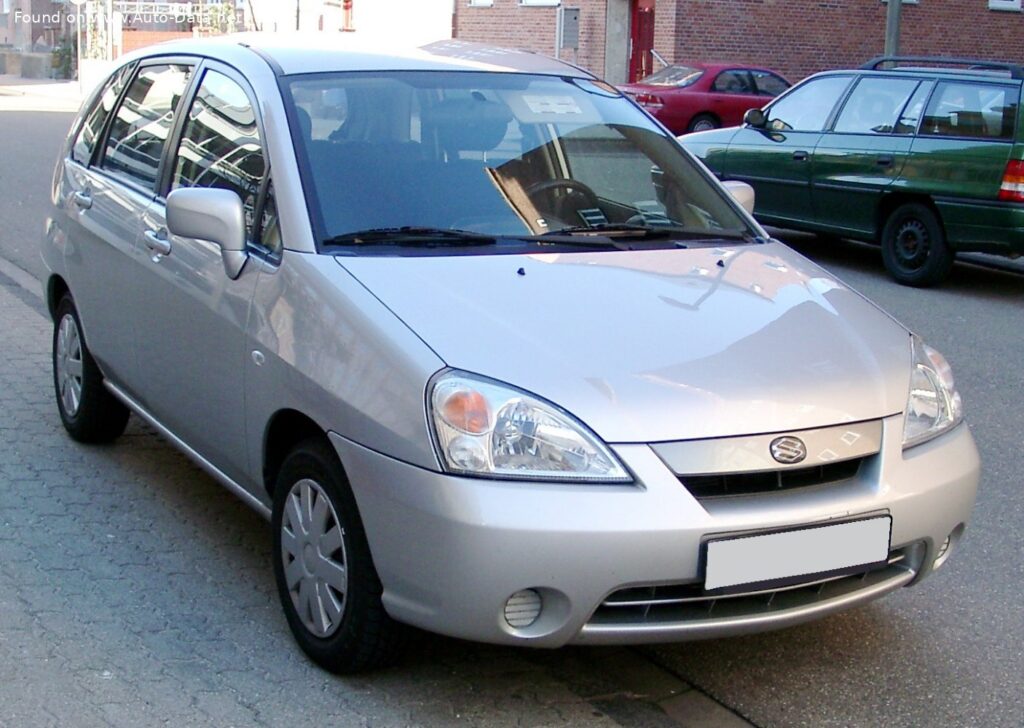
The Suzuki Liana Wagon I 1.6 i 16V 2WD (103 Hp): An Overview
The Suzuki Liana, an acronym for “Life In A New Age,” represented Suzuki’s entrant into the compact car segment, offering a versatile and practical solution for families and individuals seeking an affordable yet well-equipped vehicle. Introduced in 2001, the first generation Liana Wagon, specifically the 1.6 i 16V 2WD (103 Hp) variant, quickly established itself in various international markets, particularly in Europe and Asia, as a no-nonsense, reliable compact station wagon.
In the North American market, the Liana was marketed as the Suzuki Aerio, available in both sedan and “SX” crossover-like hatchback forms, sharing much of its mechanical underpinnings and design philosophy. However, the dedicated station wagon body style, as described here, was more prevalent in markets outside the United States. Positioned as a value-oriented alternative to established players, the Liana aimed to combine compact dimensions with surprising interior space and practicality, catering to a demographic that prioritized utility and economy without demanding high-performance luxury.
Produced from 2001 to 2004, this particular Liana Wagon I generation showcased Suzuki’s engineering prowess in developing robust, fuel-efficient powertrains within a practical and user-friendly package. Its design philosophy emphasized functionality, ease of ownership, and a comfortable ride, making it a competitive option in its segment during the early 2000s.
The Suzuki Liana Wagon I 1.6 i 16V 2WD (103 Hp): Engineering and Performance
At the heart of the Suzuki Liana Wagon I 1.6 i 16V 2WD (103 Hp) lay a dependable and efficient powertrain designed for everyday usability. The vehicle was propelled by Suzuki’s M16A engine, a 1.6-liter (1586 cm³ or 96.78 cu. in.) naturally aspirated inline four-cylinder unit. This engine featured a Dual Overhead Camshaft (DOHC) valvetrain with 4 valves per cylinder, a configuration known for its efficiency and smooth power delivery across the rev range. Fuel was delivered via a multi-port manifold injection system, ensuring precise fuel metering and combustion.
The M16A engine generated a respectable 103 horsepower at 5500 rpm, providing adequate power for urban commuting and highway cruising. Torque output stood at 106.21 lb.-ft. (144 Nm) at 4000 rpm, offering sufficient low-end grunt for responsive acceleration from a standstill. The engine’s compression ratio was 9.7:1, a common figure for naturally aspirated gasoline engines of its era, balancing power with fuel efficiency.
Power was directed to the front wheels through a 5-speed manual transmission, a choice that underscored the Liana’s focus on driver engagement and fuel economy. This drivetrain architecture, with the engine mounted transversely at the front, was typical for compact front-wheel-drive vehicles, maximizing interior space and simplifying the mechanical layout. The Liana Wagon I 1.6 i 16V 2WD could accelerate from 0 to 60 mph in a reasonable 11.1 seconds, with a top speed of 105.63 mph (170 km/h). While not a performance car, these figures were competitive for a compact family wagon of its time.
Fuel efficiency was a key selling point for the Liana. The combined fuel economy was rated at an impressive 33.1 US mpg (7.1 l/100 km), with urban consumption at 25.6 US mpg (9.2 l/100 km) and extra-urban figures reaching 39.9 US mpg (5.9 l/100 km). These numbers highlight the M16A engine’s efficient design and the vehicle’s relatively light curb weight of 2678.62 lbs (1215 kg), contributing to lower running costs for owners. The fuel tank capacity of 13.21 US gallons (50 liters) ensured a practical driving range between fill-ups.
Design and Features
The Suzuki Liana Wagon I was designed with practicality and interior volume as primary considerations. Its body type was a classic 4-door, 5-seat station wagon, offering a versatile platform for both passenger transport and cargo hauling. The exterior design, while not overtly stylish, was clean and functional, characterized by a relatively tall profile that contributed to excellent headroom for all occupants.
Dimensions of the Liana Wagon I were compact yet efficient for its class: a length of 166.54 inches (4230 mm), a width of 66.54 inches (1690 mm), and a height of 61.02 inches (1550 mm). The wheelbase measured 97.64 inches (2480 mm), providing a stable ride and contributing to the spacious cabin. Despite its modest exterior footprint, the Liana offered a surprisingly generous interior, particularly in terms of cargo capacity. The trunk space ranged from a minimum of 12.29 cubic feet (348 liters) with all seats in place, expanding significantly to 37.5 cubic feet (1062 liters) when the rear seats were folded down, making it highly adaptable for various hauling needs.
Underneath, the Liana featured a conventional but effective suspension setup. The front suspension utilized a wishbone design, known for its ability to provide a good balance of ride comfort and handling stability. The rear suspension employed coil springs, a common and reliable solution for compact wagons, designed to handle varying loads without significant compromise to ride quality. Braking performance was managed by ventilated discs at the front, offering strong and consistent stopping power, complemented by drum brakes at the rear. An Anti-lock Braking System (ABS) was a standard or optional safety feature, enhancing control during emergency braking maneuvers.
The steering system was a hydraulic rack and pinion setup, providing a direct and communicative feel to the driver, assisted by power steering for ease of maneuverability in urban environments. The vehicle rode on 185/65 R14 T tires, mounted on 14-inch wheel rims, a practical choice that offered a comfortable ride and readily available replacement options.
Inside, the Liana’s cabin was designed for functionality and durability. While lacking the premium materials of more expensive rivals, the interior was well-assembled with user-friendly controls. Seating for five passengers was comfortable for its class, and the tall roofline ensured ample headroom. Standard features typically included air conditioning, power windows, and a basic audio system, reflecting its positioning as a practical and value-for-money family car.
Technical Specifications
| Category | Specification |
|---|---|
| Brand | Suzuki |
| Model | Liana |
| Generation | Liana Wagon I |
| Type (Engine) | 1.6 i 16V 2WD (103 Hp) |
| Start of Production | 2001 year |
| End of Production | 2004 year |
| Powertrain Architecture | Internal Combustion engine |
| Body type | Station wagon (estate) |
| Seats | 5 |
| Doors | 4 |
| Performance Specs | |
| Fuel Consumption (economy) – urban | 9.2 l/100 km (25.6 US mpg) |
| Fuel Consumption (economy) – extra urban | 5.9 l/100 km (39.9 US mpg) |
| Fuel Consumption (economy) – combined | 7.1 l/100 km (33.1 US mpg) |
| Fuel Type | Petrol (Gasoline) |
| Acceleration 0 – 60 mph | 11.1 sec |
| Maximum Speed | 170 km/h (105.63 mph) |
| Weight-to-power ratio | 11.8 kg/Hp, 84.8 Hp/tonne |
| Weight-to-torque ratio | 8.4 kg/Nm, 118.5 Nm/tonne |
| Engine Specs | |
| Power | 103 Hp @ 5500 rpm |
| Power per liter | 64.9 Hp/l |
| Torque | 144 Nm @ 4000 rpm (106.21 lb.-ft. @ 4000 rpm) |
| Engine layout | Front, Transverse |
| Engine Model/Code | M16A |
| Engine displacement | 1586 cm³ (1.6 liters / 96.78 cu. in.) |
| Number of cylinders | 4 |
| Engine configuration | Inline |
| Cylinder Bore | 78 mm (3.07 in.) |
| Piston Stroke | 83 mm (3.27 in.) |
| Compression ratio | 9.7:1 |
| Number of valves per cylinder | 4 |
| Fuel injection system | Multi-port manifold injection |
| Engine aspiration | Naturally aspirated engine |
| Valvetrain | DOHC |
| Engine oil capacity | 4.1 l (4.33 US qt) |
| Coolant | 6.5 l (6.87 US qt) |
| Space, Volume and Weights | |
| Kerb Weight | 1215 kg (2678.62 lbs.) |
| Max. weight | 1640 kg (3615.58 lbs.) |
| Max load | 425 kg (936.96 lbs.) |
| Trunk (boot) space – minimum | 348 l (12.29 cu. ft.) |
| Trunk (boot) space – maximum | 1062 l (37.5 cu. ft.) |
| Fuel tank capacity | 50 l (13.21 US gal) |
| Dimensions | |
| Length | 4230 mm (166.54 in.) |
| Width | 1690 mm (66.54 in.) |
| Height | 1550 mm (61.02 in.) |
| Wheelbase | 2480 mm (97.64 in.) |
| Front track | 1450 mm (57.09 in.) |
| Rear (Back) track | 1445 mm (56.89 in.) |
| Drivetrain, Brakes and Suspension Specs | |
| Drivetrain Architecture | The Internal combustion engine (ICE) drives the front wheels of the vehicle. |
| Drive wheel | Front wheel drive |
| Number of gears and type of gearbox | 5 gears, manual transmission |
| Front suspension | Wishbone |
| Rear suspension | Coil spring |
| Front brakes | Ventilated discs |
| Rear brakes | Drum |
| Assisting systems | ABS (Anti-lock braking system) |
| Steering type | Steering rack and pinion |
| Power steering | Hydraulic Steering |
| Tires size | 185/65 R14 T |
| Wheel rims size | 14 |
Legacy and Market Impact
The Suzuki Liana Wagon I 1.6 i 16V 2WD (103 Hp) carved out a niche for itself as a highly practical, reliable, and economical compact family car during its production run from 2001 to 2004. While it may not have garnered the same critical acclaim for styling or driving dynamics as some European competitors, its strength lay in its straightforward approach to motoring and exceptional value proposition.
In its primary markets, the Liana competed with a wide array of compact wagons and hatchbacks. Key rivals included models such as the Toyota Corolla Wagon, Honda Civic Wagon, Opel Astra Wagon, Ford Focus Wagon, and the Hyundai Elantra Wagon. Against these competitors, the Liana often stood out for its competitive pricing, generous standard features, and Suzuki’s reputation for mechanical dependability. Its “tall wagon” design, which blurred the lines between a traditional station wagon and a small multi-purpose vehicle (MPV), offered a distinct advantage in terms of interior volume and ease of access compared to lower-slung sedans and hatchbacks.
The Liana’s legacy is primarily one of quiet competence. It was never designed to excite with blistering performance or luxurious appointments, but rather to serve as a faithful workhorse for families and individuals needing reliable transportation with ample space. Its M16A engine proved to be a durable and fuel-efficient unit, contributing to low running costs, a significant factor for buyers in this segment. The robust build quality and straightforward engineering also meant that maintenance was typically manageable and affordable.
Perhaps one of the most unexpected aspects of the Liana’s cultural impact came from its role as the “Reasonably Priced Car” on the popular British automotive show, Top Gear. While this typically involved a sedan version and often highlighted its rather unassuming character, it inadvertently brought the Liana into the public consciousness, exposing it to a global audience and showcasing its robust nature as it endured numerous celebrity laps.
Ultimately, the Suzuki Liana Wagon I, particularly the 1.6 i 16V 2WD (103 Hp) model, represented Suzuki’s commitment to providing practical, affordable, and reliable vehicles. It successfully offered a compelling package of space, economy, and dependability, solidifying its position as a sensible choice for consumers prioritizing utility and value in the competitive compact segment of the early 2000s. Its successor models continued to build upon this foundation, adapting to evolving market demands while retaining Suzuki’s core values.