Introduction: The Suzuki Liana Wagon I (facelift 2004)
The Suzuki Liana, an acronym for “Life In A New Age,” represented Suzuki’s concerted effort to offer a practical and versatile compact family car to global markets, particularly in Europe, Asia, and Australia, during the early 2000s. While not a household name in the United States, where Suzuki’s automotive presence was more niche, the Liana played a significant role in its primary markets as a dependable and value-oriented proposition. The model under scrutiny, the Suzuki Liana Wagon I (facelift 2004) with its 1.6i (107 Hp) engine, represents the mid-cycle refresh of the first-generation Liana, which debuted in 2001. This facelift, introduced in 2004, aimed to keep the Liana competitive in the bustling compact segment, offering subtle styling enhancements and minor technical refinements to maintain its appeal until the end of its production run in 2007, when it was largely succeeded by the Suzuki SX4.
As a compact station wagon, the Liana was designed to cater to families and individuals seeking a balance of urban maneuverability, respectable fuel economy, and practical cargo capacity. Its unassuming yet functional design, coupled with Suzuki’s reputation for reliability and affordability, positioned it as a sensible choice against more established European and Japanese rivals in its class. This article delves into the specifics of the 2004 facelifted Liana Wagon, examining its powertrain, design philosophy, and its place within the broader automotive landscape of its era.
Engine and Performance of the Suzuki Liana Wagon I (facelift 2004)
At the heart of the Suzuki Liana Wagon I (facelift 2004) 1.6i variant lies Suzuki’s M16A engine, a naturally aspirated, 1.6-liter (1586 cm³ or 96.78 cu. in.) inline four-cylinder powerplant. This engine, known for its robust and straightforward design, features a Double Overhead Camshaft (DOHC) valvetrain with four valves per cylinder, optimizing airflow for efficiency and responsiveness. Fuel delivery is managed by a multi-port manifold injection system, a common and reliable method for its time, ensuring precise fuel metering and combustion.
The M16A engine in this configuration produces a respectable 107 horsepower at 5500 revolutions per minute (rpm), providing adequate power for daily driving and light highway cruising. Torque output stands at 144 Nm (106.21 lb.-ft.) at 4000 rpm, delivering a usable powerband that makes the Liana feel capable in most scenarios, particularly with its relatively light curb weight of 2711.69 lbs (1230 kg). This results in a weight-to-power ratio of 11.5 kg/Hp, or approximately 87 Hp per tonne, underscoring its efficiency-focused engineering.
Power is transmitted to the front wheels via a standard 5-speed manual transmission, a choice that emphasizes driver engagement and allows for optimal control over the engine’s power delivery. This drivetrain architecture, coupled with front-wheel drive, contributes to predictable handling characteristics and good traction in varied conditions. The Liana Wagon 1.6i is capable of reaching a maximum speed of 170 km/h (105.63 mph), a respectable figure for a vehicle of its class and purpose.
From an efficiency standpoint, the Liana Wagon 1.6i demonstrates competitive fuel economy for its era. It achieves an urban fuel consumption rating of 8.8 liters per 100 kilometers (26.7 US mpg), an extra-urban rating of 5.8 liters per 100 kilometers (40.6 US mpg), and a combined cycle rating of 7 liters per 100 kilometers (33.6 US mpg). These figures highlight its economical operation, a key selling point in markets where fuel costs are a significant consideration. Furthermore, the engine meets the Euro 4 emission standard, reflecting its compliance with contemporary environmental regulations.
Design and Features
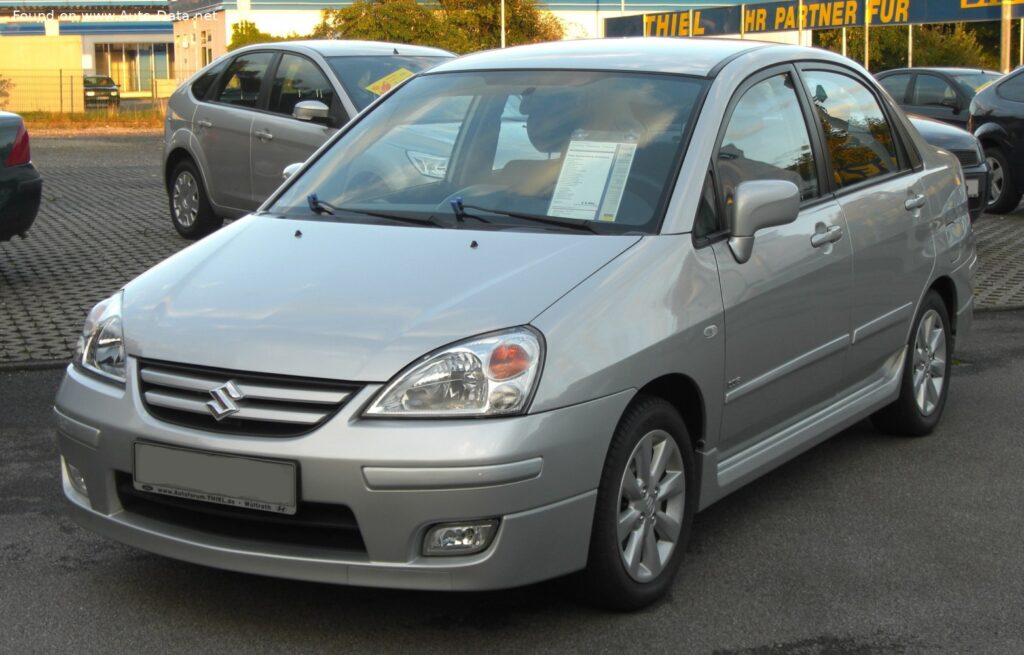
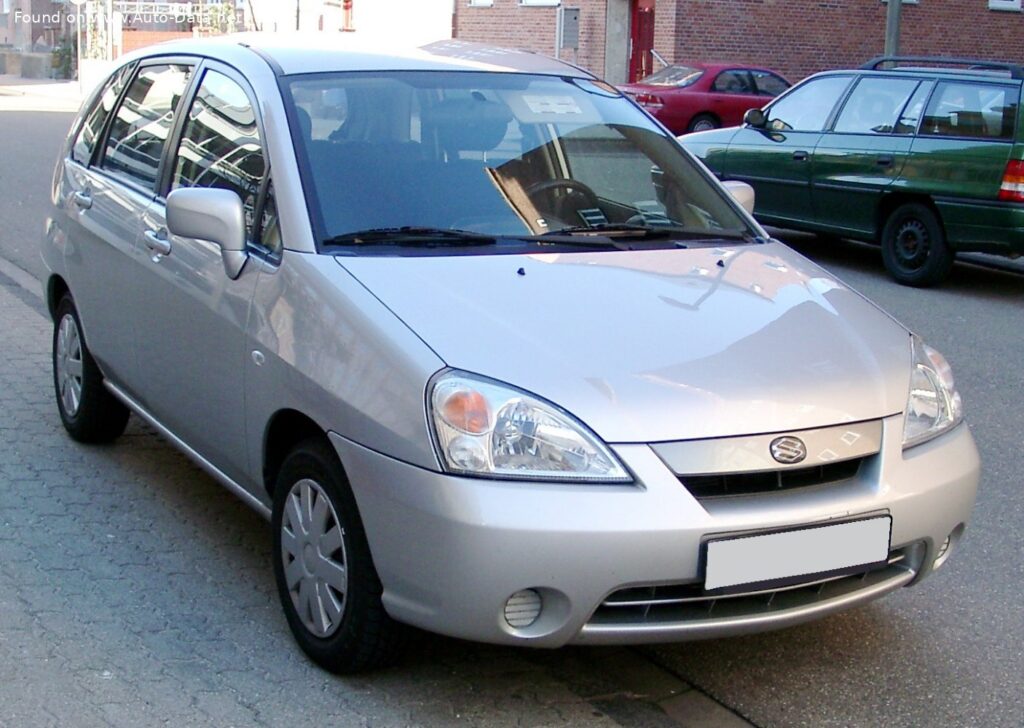
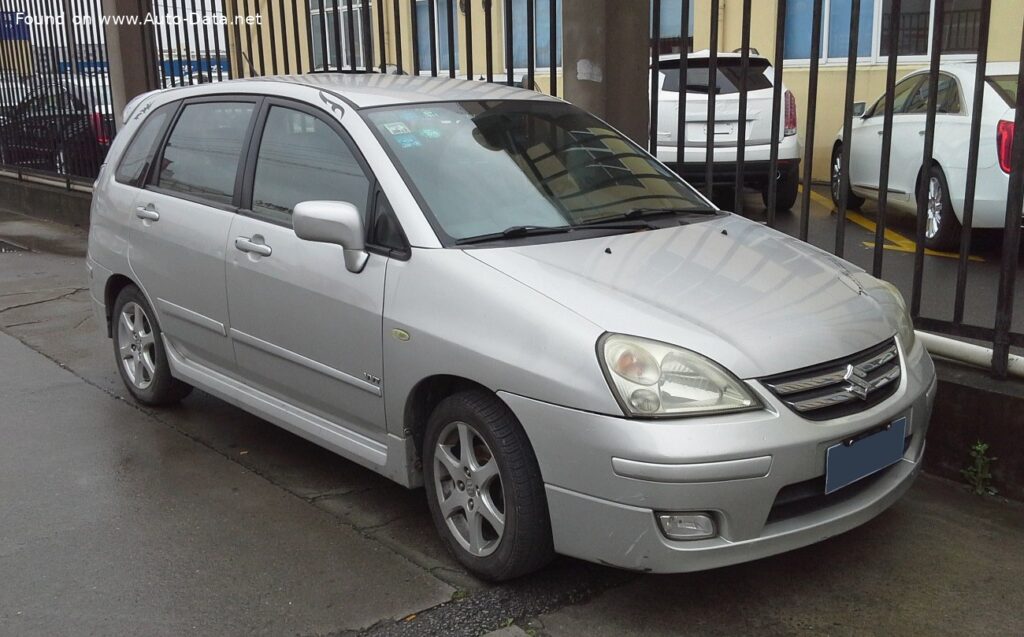
The Suzuki Liana Wagon I (facelift 2004) retained the practical and understated design language of its pre-facelift predecessor, with subtle updates aimed at refreshing its appearance. As a 5-door station wagon (often referred to as an “estate” in European markets), its primary design objective was utility and versatility. The facelift typically included revised front and rear bumpers, updated grille designs, and new headlight and taillight clusters, giving it a slightly more modern and refined look without departing from its functional aesthetic. The overall silhouette remained tall and boxy, a deliberate choice to maximize interior space and cargo volume.
Measuring 166.54 inches (4230 mm) in length, 66.54 inches (1690 mm) in width, and 61.02 inches (1550 mm) in height, the Liana Wagon occupied a compact footprint, making it easy to maneuver in crowded urban environments. Its relatively long wheelbase of 97.64 inches (2480 mm) contributed to a stable ride and a surprisingly spacious cabin for its exterior dimensions, comfortably accommodating five occupants. The elevated roofline further enhanced headroom for all passengers, a common Suzuki characteristic aimed at improving comfort.
Inside, the Liana’s cabin was characterized by its straightforward layout and durable materials. While not luxurious, the interior was designed for functionality and ease of use, with logically placed controls and clear instrumentation. The station wagon body style naturally offered excellent cargo flexibility, with a generous trunk area that could be expanded by folding down the rear seats, making it suitable for families, small businesses, or those with active lifestyles. Standard features for the 2004 facelift model typically included power windows, central locking, and an audio system. Safety was addressed with the inclusion of an Anti-lock Braking System (ABS) as a standard assisting system, providing improved stopping performance and stability during emergency braking maneuvers, a crucial feature for a family-oriented vehicle of its time.
Technical Specifications
| Category | Specification | US Equivalent / Notes |
|---|---|---|
| General Information | ||
| Brand | Suzuki | |
| Model | Liana | |
| Generation | Liana Wagon I (facelift 2004) | |
| Type (Engine) | 1.6i (107 Hp) | |
| Start of Production | 2004 year | |
| End of Production | 2007 year | |
| Powertrain Architecture | Internal Combustion engine | |
| Body type | Station wagon (estate) | |
| Seats | 5 | |
| Doors | 5 | |
| Performance Specs | ||
| Fuel consumption (economy) – urban | 8.8 l/100 km | 26.7 US mpg |
| Fuel consumption (economy) – extra urban | 5.8 l/100 km | 40.6 US mpg |
| Fuel consumption (economy) – combined | 7 l/100 km | 33.6 US mpg |
| Fuel Type | Petrol (Gasoline) | |
| Maximum speed | 170 km/h | 105.63 mph |
| Emission standard | Euro 4 | |
| Weight-to-power ratio | 11.5 kg/Hp | 87 Hp/tonne |
| Weight-to-torque ratio | 8.5 kg/Nm | 117.1 Nm/tonne |
| Engine Specs | ||
| Power | 107 Hp @ 5500 rpm. | |
| Power per liter | 67.5 Hp/l | |
| Torque | 144 Nm @ 4000 rpm. | 106.21 lb.-ft. @ 4000 rpm. |
| Engine layout | Front, Transverse | |
| Engine Model/Code | M16A | |
| Engine displacement | 1586 cm³ | 1.6 Liters / 96.78 cu. in. |
| Number of cylinders | 4 | |
| Engine configuration | Inline | |
| Cylinder Bore | 78 mm | 3.07 in. |
| Piston Stroke | 83 mm | 3.27 in. |
| Compression ratio | 9.7:1 | |
| Number of valves per cylinder | 4 | |
| Fuel injection system | Multi-port manifold injection | |
| Engine aspiration | Naturally aspirated engine | |
| Valvetrain | DOHC | |
| Engine oil capacity | 4.1 l | 4.33 US qt |
| Coolant | 6.9 l | 7.29 US qt |
| Space, Volume and Weights | ||
| Kerb Weight | 1230 kg | 2711.69 lbs. |
| Dimensions | ||
| Length | 4230 mm | 166.54 in. |
| Width | 1690 mm | 66.54 in. |
| Height | 1550 mm | 61.02 in. |
| Wheelbase | 2480 mm | 97.64 in. |
| Drivetrain, Brakes and Suspension Specs | ||
| Drivetrain Architecture | Internal combustion engine (ICE) drives the front wheels | |
| Drive wheel | Front wheel drive | |
| Number of gears and type of gearbox | 5 gears, manual transmission | |
| Assisting systems | ABS (Anti-lock braking system) |
Legacy and Market Impact
The Suzuki Liana, particularly the Wagon variant, carved out a niche for itself as a highly practical, reliable, and affordable family car in its target markets. While it never achieved the widespread recognition or sales volume of segment leaders like the Ford Focus or Opel Astra in Europe, or the Toyota Corolla in Asia, its strength lay in its no-nonsense approach to motoring. Suzuki’s reputation for building robust and long-lasting vehicles resonated with buyers who prioritized durability and low running costs over cutting-edge design or premium features.
In the compact station wagon segment, the Liana Wagon competed against a diverse array of vehicles. In Europe, its rivals included the Skoda Octavia Combi, Toyota Corolla Wagon, Honda Civic Aerodeck, and various offerings from Ford and Opel. What set the Liana apart was often its competitive pricing and the perceived bulletproof reliability of its mechanicals, a hallmark of Suzuki engineering. It was a car that appealed to a pragmatic buyer base, offering ample space for a family and their gear without breaking the bank.
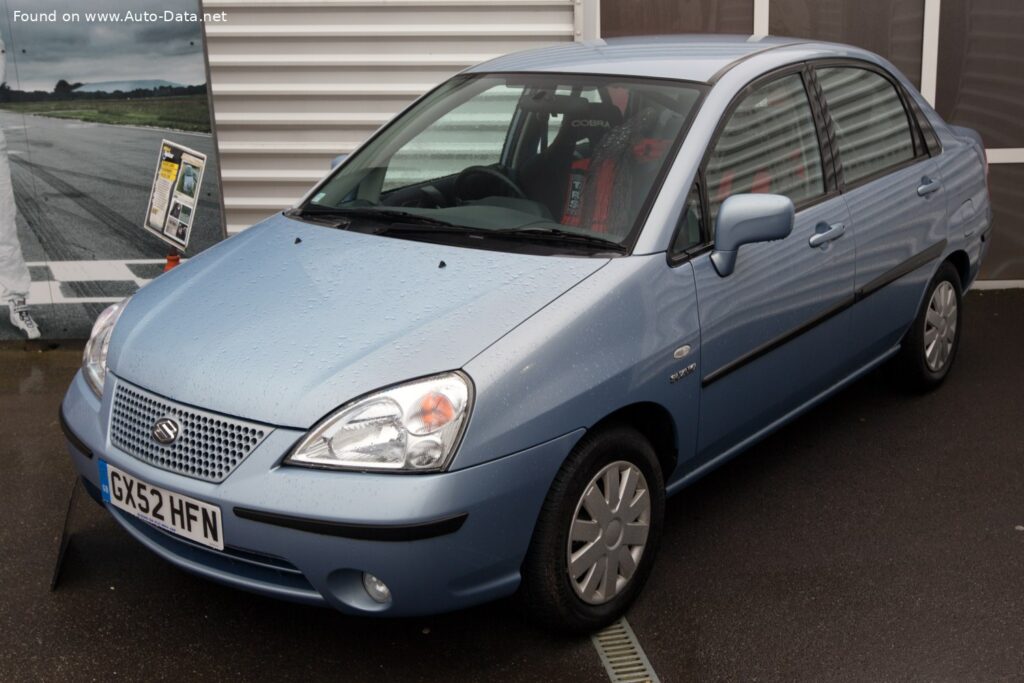
Perhaps one of the most enduring, albeit unconventional, aspects of the Liana’s legacy for a global audience, particularly those in English-speaking countries, stems from its role as the “Reasonably Priced Car” on the immensely popular British automotive show, Top Gear. From 2002 to 2005, the Liana was the vehicle of choice for celebrity guests to set lap times around the Top Gear test track. This exposure, while often played for laughs due to the car’s utilitarian nature, inadvertently showcased the Liana’s robust build quality and predictable handling characteristics, as it endured countless laps by drivers of varying skill levels without significant mechanical issues. This unique association gave the Liana a level of pop culture recognition it might not have otherwise achieved, especially outside its primary sales regions.
Ultimately, the Suzuki Liana Wagon I (facelift 2004) represented Suzuki’s commitment to providing accessible, functional, and dependable transportation. It was a workhorse designed for everyday life, embodying the brand’s core values of practicality and value. Its legacy is one of quiet competence, serving countless families diligently and reliably, and for a brief period, entertaining millions as a celebrity lap timer, proving its mettle in a way few other compact wagons ever could.