The Suzuki Liana Wagon I (facelift 2004) 1.6i (107 Hp) 4WD: A Global Compact Utility
The Suzuki Liana, known in some markets as the Suzuki Aerio, represented Suzuki’s venture into the compact car segment, offering a practical and value-oriented solution for families and individuals. The first generation, designated Liana Wagon I, received a notable facelift in 2004, enhancing its appeal and updating its aesthetics and features. This article focuses on the specific variant, the Suzuki Liana Wagon I (facelift 2004) 1.6i (107 Hp) 4WD, a five-door station wagon that was produced from 2004 to 2007. While not a household name in the North American market, the Liana carved out a significant niche in Europe, Asia, and other global markets as a reliable, economical, and surprisingly versatile compact vehicle, particularly lauded for its available all-wheel-drive system. It aimed to deliver a blend of urban maneuverability with the cargo capacity of a wagon and the added traction of AWD, all within a competitive price point.
Engine and Performance of the Suzuki Liana Wagon I (facelift 2004) 1.6i (107 Hp) 4WD
At the heart of the Suzuki Liana Wagon I (facelift 2004) 1.6i (107 Hp) 4WD lies the M16A engine, a robust and well-regarded 1.6-liter (1586 cm3 or 96.78 cubic inches) inline four-cylinder powerplant. This naturally aspirated engine features a Double Overhead Camshaft (DOHC) valvetrain with four valves per cylinder, ensuring efficient breathing and a responsive character. Fuel delivery is managed by a multi-port manifold injection system, a common and reliable setup for its era, contributing to its Euro 4 emission standard compliance.
The M16A generates a respectable 107 horsepower at 5500 rpm, providing adequate motivation for the compact wagon. Torque output stands at 106.21 lb.-ft. (144 Nm) achieved at 4000 rpm, offering sufficient pulling power for daily driving and light loads. This power is transferred to all four wheels via a durable 5-speed manual transmission, a choice that emphasizes driver engagement and allows for optimal control over the engine’s power band. The all-wheel-drive (4×4) system was a key differentiator for the Liana in its segment, offering enhanced traction and stability in adverse weather conditions or on unpaved roads, a significant advantage for buyers in regions with varied climates.
In terms of raw performance, the Liana Wagon I 1.6i 4WD has a top speed of approximately 102.53 mph (165 km/h). Its fuel economy figures underscore its practical nature, with a combined rating of 31.8 US mpg (7.4 l/100 km). Urban driving yields about 26.1 US mpg (9 l/100 km), while extra-urban (highway) cruising improves to 36.2 US mpg (6.5 l/100 km). These figures positioned the Liana as an economical choice for its class, balancing reasonable performance with frugal operation. The weight-to-power ratio of 11.5 kg/Hp (87 Hp/tonne) and a weight-to-torque ratio of 8.5 kg/Nm (117.1 Nm/tonne) reflect its lightweight construction and efficient use of its available power.
Design and Features
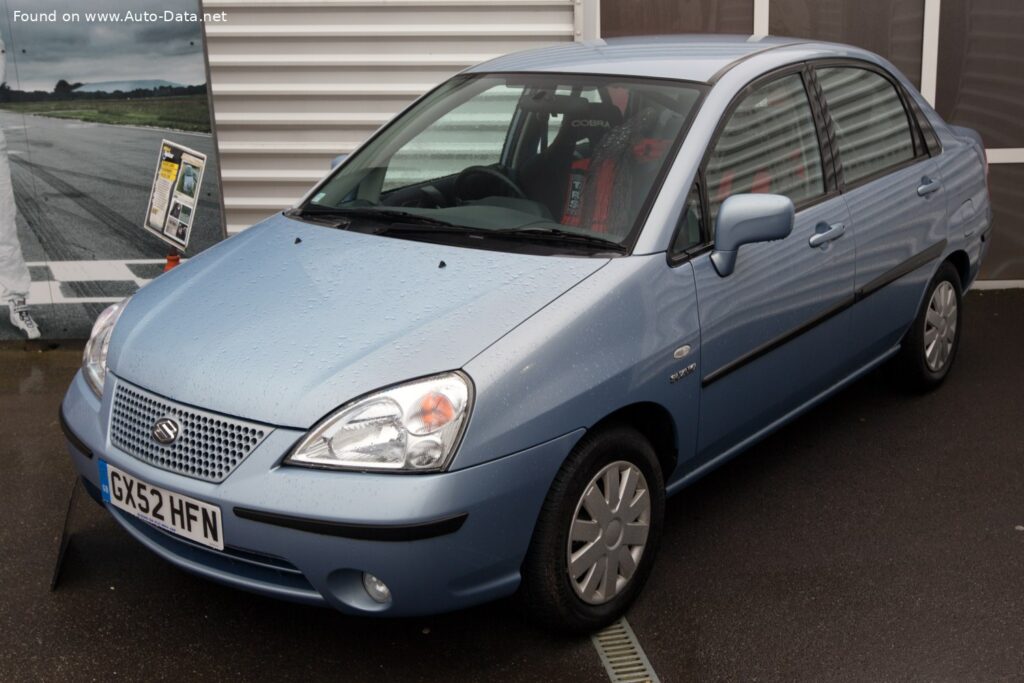
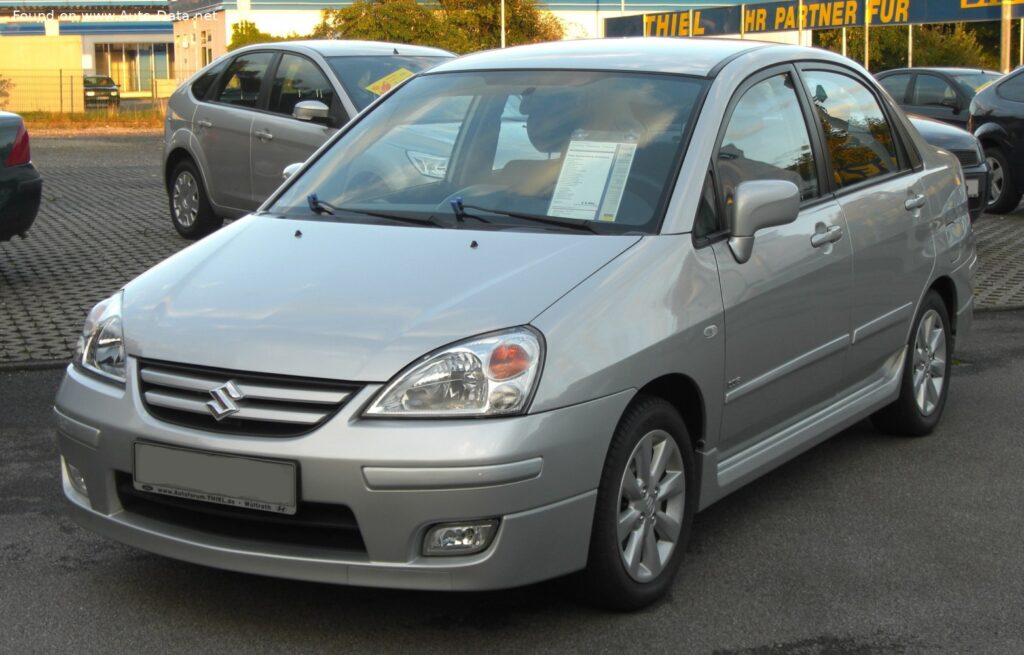
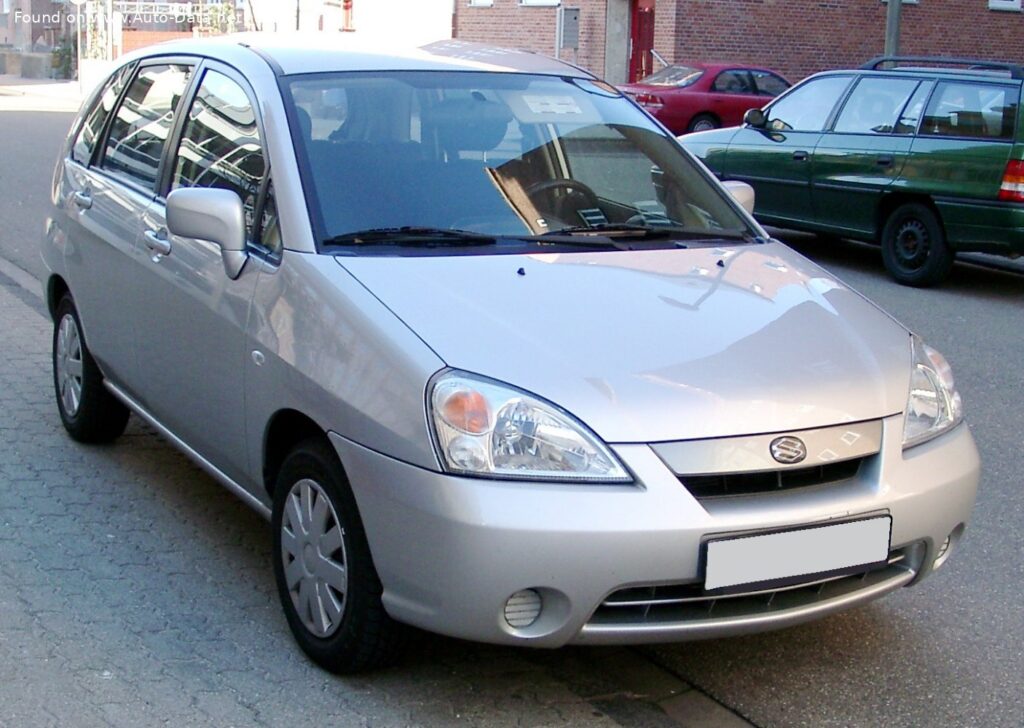
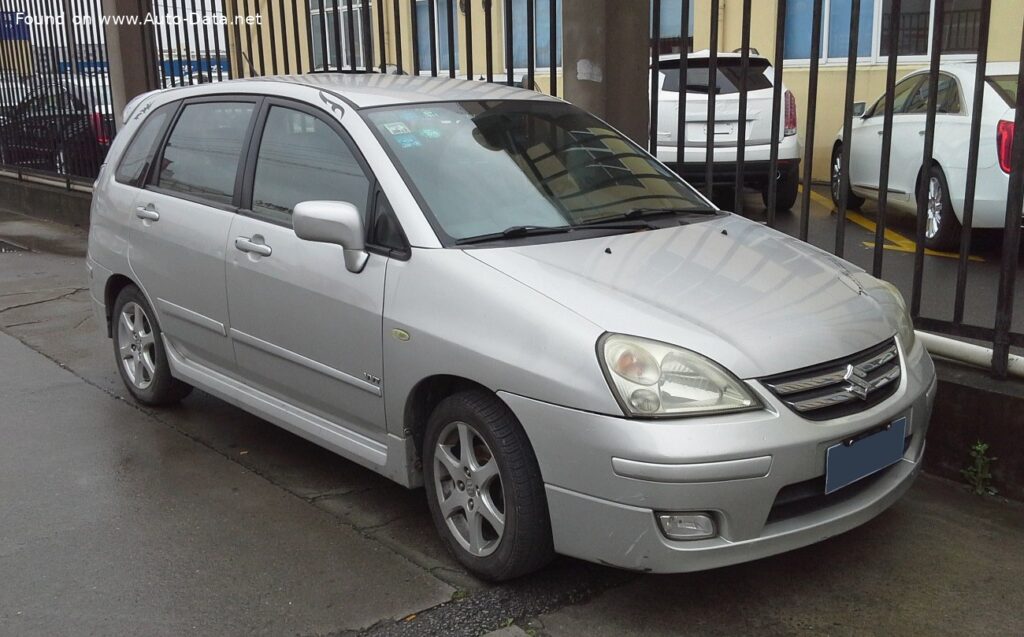
The Suzuki Liana Wagon I (facelift 2004) presented a practical and unassuming design, prioritizing utility and interior space within a compact footprint. As a five-door station wagon, its primary appeal was its versatility and cargo capacity. The 2004 facelift brought subtle but effective updates to the exterior, likely including revised front and rear fascias, grille designs, and lighting clusters, aiming to give the vehicle a more contemporary look in line with Suzuki’s evolving design language.
Measuring 166.54 inches (4230 mm) in length, 66.54 inches (1690 mm) in width, and 61.02 inches (1550 mm) in height, with a wheelbase of 97.64 inches (2480 mm), the Liana Wagon I was commendably compact for a station wagon. This allowed for easy maneuverability in urban environments while still offering a spacious interior for five occupants and their luggage. The elevated height, common for many Suzuki models, contributed to a comfortable ingress/egress and a commanding driving position.
Inside, the Liana Wagon I focused on practicality and ergonomics. While specific features were market-dependent, the general design emphasized straightforward controls and durable materials. The station wagon body type inherently provided a flexible cargo area, easily expandable by folding the rear seats, making it suitable for a variety of family and lifestyle needs.
Safety features for this generation included an Anti-lock Braking System (ABS) as standard, a crucial active safety system for improved braking control during emergency stops. The robust body structure and standard safety equipment of the time aimed to provide a secure environment for its occupants, consistent with the expectations for a family-oriented vehicle in the mid-2000s.
Technical Specifications
| Category | Specification |
|---|---|
| General Information | |
| Brand | Suzuki |
| Model | Liana |
| Generation | Liana Wagon I (facelift 2004) |
| Type (Engine) | 1.6i (107 Hp) 4WD |
| Start of Production | 2004 year |
| End of Production | 2007 year |
| Powertrain Architecture | Internal Combustion engine |
| Body type | Station wagon (estate) |
| Seats | 5 |
| Doors | 5 |
| Performance Specs | |
| Fuel consumption (economy) – urban | 26.1 US mpg (9 l/100 km) |
| Fuel consumption (economy) – extra urban | 36.2 US mpg (6.5 l/100 km) |
| Fuel consumption (economy) – combined | 31.8 US mpg (7.4 l/100 km) |
| Fuel Type | Petrol (Gasoline) |
| Maximum speed | 102.53 mph (165 km/h) |
| Emission standard | Euro 4 |
| Weight-to-power ratio | 11.5 kg/Hp, 87 Hp/tonne |
| Weight-to-torque ratio | 8.5 kg/Nm, 117.1 Nm/tonne |
| Engine Specs | |
| Power | 107 Hp @ 5500 rpm |
| Power per liter | 67.5 Hp/l |
| Torque | 106.21 lb.-ft. (144 Nm) @ 4000 rpm |
| Engine layout | Front, Transverse |
| Engine Model/Code | M16A |
| Engine displacement | 1.6 l (1586 cm3 / 96.78 cu. in.) |
| Number of cylinders | 4 |
| Engine configuration | Inline |
| Cylinder Bore | 3.07 in. (78 mm) |
| Piston Stroke | 3.27 in. (83 mm) |
| Compression ratio | 9.7:1 |
| Number of valves per cylinder | 4 |
| Fuel injection system | Multi-port manifold injection |
| Engine aspiration | Naturally aspirated engine |
| Valvetrain | DOHC |
| Engine oil capacity | 4.33 US qt (4.1 l) |
| Engine oil specification | Not specified |
| Coolant | 7.29 US qt (6.9 l) |
| Space, Volume and Weights | |
| Kerb Weight | 2711.69 lbs. (1230 kg) |
| Dimensions | |
| Length | 166.54 in. (4230 mm) |
| Width | 66.54 in. (1690 mm) |
| Height | 61.02 in. (1550 mm) |
| Wheelbase | 97.64 in. (2480 mm) |
| Drivetrain, Brakes and Suspension Specs | |
| Drive wheel | All-wheel drive (4×4) |
| Number of gears and type of gearbox | 5 gears, manual transmission |
| Assisting systems | ABS (Anti-lock braking system) |
Legacy and Market Impact of the Suzuki Liana Wagon I (facelift 2004)
The Suzuki Liana, particularly in its station wagon guise and with the available all-wheel-drive, played a specific and important role for Suzuki in its target markets outside of the United States. While Suzuki has a strong reputation in the US for motorcycles and ATVs, and previously for compact SUVs like the Vitara/Grand Vitara, its passenger cars like the Liana often found greater traction in Europe, Asia, and Australia, where compact wagons and AWD options in this segment were more highly valued.
The Liana Wagon I (facelift 2004) was primarily known for its practicality, reliability, and value. It wasn’t designed to be a segment leader in terms of performance or luxury, but rather a dependable, no-nonsense family car. Its compact dimensions made it well-suited for congested European cities, while the wagon body style provided the cargo versatility that many families desired without having to step up to a larger, more expensive SUV. The optional all-wheel-drive system, as featured in the 1.6i (107 Hp) 4WD variant, was a significant selling point, offering enhanced grip and peace of mind in snowy or wet conditions, or for those who occasionally ventured onto unpaved tracks. This made it a compelling alternative to more expensive AWD offerings from larger manufacturers.
Competitors in its primary markets included models such as the Toyota Corolla Wagon, Honda Civic Wagon (depending on market), Opel Astra Caravan, Ford Focus Wagon, and various offerings from Skoda and Hyundai. The Liana distinguished itself with its robust, Suzuki-typical engineering, competitive pricing, and the uncommon availability of AWD in such a compact wagon package.
The Liana’s legacy is one of a practical, unpretentious workhorse. It served a demographic looking for an affordable, reliable, and capable vehicle that could handle diverse driving conditions. While it may not have garnered widespread critical acclaim or cult status, its consistent performance and utility cemented its place as a sensible choice for budget-conscious buyers seeking a versatile compact wagon. The 2004 facelift helped keep the model fresh during its production run, ensuring it remained a relevant option until its eventual discontinuation and replacement by models like the Suzuki SX4, which continued Suzuki’s tradition of offering affordable compact cars with available all-wheel drive. The Suzuki Liana Wagon I (facelift 2004) 1.6i (107 Hp) 4WD remains a testament to Suzuki’s commitment to delivering functional and dependable vehicles for a global audience.