
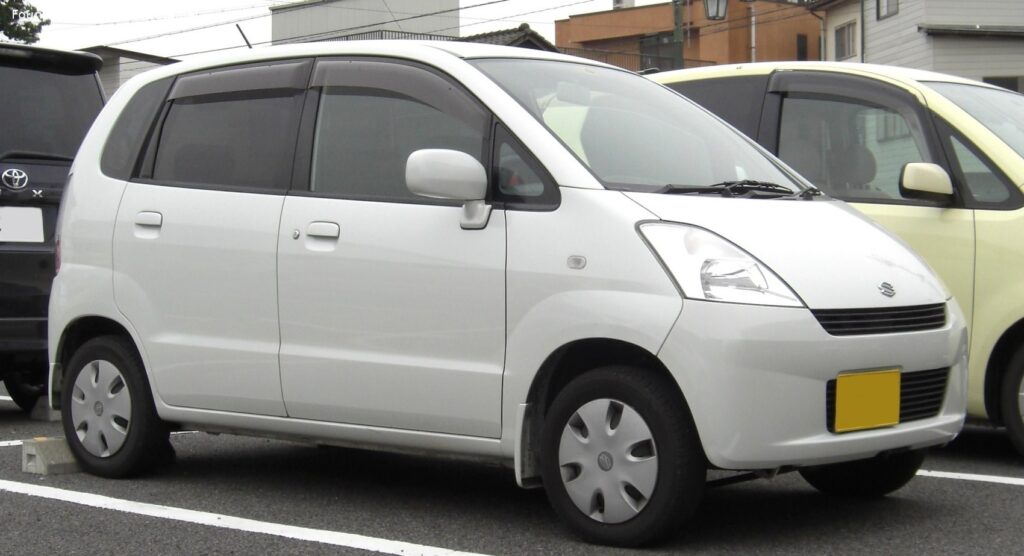
Introduction to the Suzuki MR Wagon 0.7 i 12V (64 Hp) 4WD
The Suzuki MR Wagon, specifically the Suzuki MR Wagon 0.7 i 12V (64 Hp) 4WD variant, represents a quintessential example of the Japanese Kei car segment. Introduced in 2001, the first-generation MR Wagon (codenamed MF21S) was Suzuki’s entry into the burgeoning “tall boy” mini-wagon category, designed to maximize interior space and practicality within the strict dimensional and engine displacement limits imposed by Japanese Kei car regulations. This particular model, produced from 2001 to 2006, offered a compelling blend of compact dimensions, surprising utility, and all-wheel-drive capability, making it a popular choice for urban dwellers and those navigating varied road conditions in its home market. While never officially sold in the United States, the MR Wagon embodies a significant aspect of Japanese automotive culture, showcasing ingenious engineering tailored to specific market needs.
Developed as a joint venture with Nissan, which rebadged the vehicle as the Nissan Moco, the MR Wagon quickly established itself as a versatile and economical option. Its designation “MR” stood for “Mistake Rookie,” a somewhat self-deprecating but ultimately endearing name that hinted at its fresh, unconventional approach to the micro-car segment. This article delves into the technical specifications, design philosophy, and market impact of this unique and highly functional compact vehicle.
Engineering and Performance: The Suzuki MR Wagon 0.7 i 12V (64 Hp) 4WD
Powertrain Configuration and Dynamics
At the heart of the Suzuki MR Wagon 0.7 i 12V (64 Hp) 4WD lies Suzuki’s venerable K6A engine. This powerplant is a 0.7-liter (specifically, 658 cm³ or 40.15 cu. in.) inline three-cylinder unit, meticulously engineered to comply with Japan’s stringent Kei car regulations. Despite its diminutive size, the K6A engine in this configuration is remarkably potent, featuring a DOHC (Double Overhead Camshaft) valvetrain with four valves per cylinder, totaling 12 valves. To extract maximum power from such a small displacement, Suzuki equipped it with a turbocharger and an intercooler, a common strategy in Kei car engineering.
This turbocharged setup allows the engine to produce a robust 64 horsepower at 6500 rpm, which is the maximum permissible power output for a Kei car. Torque figures are equally impressive for its class, delivering 106 Nm (78.18 lb.-ft.) at a relatively low 3500 rpm. This low-end torque, combined with the lightweight nature of the vehicle (kerb weight of 1984.16 lbs. or 900 kg), provides surprisingly sprightly acceleration in urban environments, making it adept at navigating city traffic. The engine’s layout is front, longitudinal, which is somewhat unusual for such a compact front-wheel-drive-based platform, often chosen for packaging advantages, especially with an all-wheel-drive system.
Power is channeled through a conventional 4-speed automatic transmission to an all-wheel-drive (4×4) system. This drivetrain configuration offered enhanced traction and stability, particularly useful in regions with snow or challenging road conditions, further broadening the MR Wagon’s appeal in Japan. The vehicle’s weight-to-power ratio stands at 14.1 kg/Hp (71.1 Hp/tonne), and its weight-to-torque ratio is 8.5 kg/Nm (117.8 Nm/tonne), indicating an efficient use of its modest power and torque. Fuel is delivered via a multi-port manifold injection system, and the engine’s compression ratio is 8.4:1. The engine oil capacity is 3 liters (3.17 US quarts).
Design and Features
Body Type and Interior Practicality
The Suzuki MR Wagon is a 5-door hatchback, a design choice that perfectly encapsulates the Kei car philosophy of maximizing utility within minimal exterior dimensions. Its “tall boy” design, characterized by a relatively high roofline, was a key feature aimed at creating an unexpectedly spacious interior. Despite an exterior length of only 133.66 inches (3395 mm) and a width of 58.07 inches (1475 mm), the MR Wagon offers seating for four occupants comfortably, with ample headroom and decent legroom, thanks to its clever packaging and a wheelbase of 92.91 inches (2360 mm). The height of 62.6 inches (1590 mm) further contributes to its interior volume.
The exterior styling is straightforward and functional, with a friendly, approachable aesthetic that resonated well with its target audience. Large windows ensure good visibility, a crucial aspect for maneuverability in tight urban spaces. The compact dimensions, coupled with a tight turning radius, made the MR Wagon exceptionally nimble and easy to park, a significant advantage in crowded Japanese cities.
Chassis, Suspension, and Safety
Underpinning the MR Wagon’s practicality is a suspension system designed for comfort and city driving. It features coil springs at the front and spring struts at the rear, providing a balanced ride quality. Braking performance is handled by disc brakes on both the front and rear wheels, a notable feature for a car of this class and era, contributing to confident stopping power. An Anti-lock Braking System (ABS) was included as an assisting system, enhancing safety during emergency braking.
Steering is managed by a rack and pinion system with hydraulic power steering, offering light and responsive feedback, ideal for urban driving. The vehicle rides on 14-inch wheels fitted with 155/55 R14 tires, a common size for Kei cars, balancing grip with fuel efficiency. While the MR Wagon predates many of the advanced driver-assistance systems found in modern vehicles, its basic safety features and robust construction for its segment provided adequate protection for its occupants. The max load capacity is 485.02 lbs. (220 kg), and the fuel tank capacity is 7.93 US gallons (30 liters).
Technical Specifications: Suzuki MR Wagon 0.7 i 12V (64 Hp) 4WD (2001-2006)
| Category | Specification | Value |
|---|---|---|
| General Information | ||
| Brand | Suzuki | |
| Model | MR Wagon | |
| Generation | MR Wagon (First Generation) | |
| Type (Engine) | 0.7 i 12V (64 Hp) 4WD | |
| Production Start | 2001 year | |
| Production End | 2006 year | |
| Powertrain Architecture | Internal Combustion Engine | |
| Body type | Hatchback | |
| Seats | 4 | |
| Doors | 5 | |
| Performance Specs | ||
| Fuel Type | Petrol (Gasoline) | |
| Weight-to-power ratio | 14.1 kg/Hp, 71.1 Hp/tonne | |
| Weight-to-torque ratio | 8.5 kg/Nm, 117.8 Nm/tonne | |
| Engine Specs | ||
| Power | 64 Hp @ 6500 rpm. | |
| Power per liter | 97.3 Hp/l | |
| Torque | 106 Nm @ 3500 rpm. (78.18 lb.-ft. @ 3500 rpm.) | |
| Engine layout | Front, Longitudinal | |
| Engine Model/Code | K6A | |
| Engine displacement | 658 cm³ (0.7 liters / 40.15 cu. in.) | |
| Number of cylinders | 3 | |
| Engine configuration | Inline | |
| Cylinder Bore | 68 mm (2.68 in.) | |
| Piston Stroke | 60.4 mm (2.38 in.) | |
| Compression ratio | 8.4:1 | |
| Valves per cylinder | 4 | |
| Fuel injection system | Multi-port manifold injection | |
| Engine aspiration | Turbocharger, Intercooler | |
| Valvetrain | DOHC | |
| Engine oil capacity | 3 l (3.17 US qt) | |
| Space, Volume and Weights | ||
| Kerb Weight | 900 kg (1984.16 lbs.) | |
| Max. weight | 1120 kg (2469.18 lbs.) | |
| Max load | 220 kg (485.02 lbs.) | |
| Fuel tank capacity | 30 l (7.93 US gal) | |
| Dimensions | ||
| Length | 3395 mm (133.66 in.) | |
| Width | 1475 mm (58.07 in.) | |
| Height | 1590 mm (62.6 in.) | |
| Wheelbase | 2360 mm (92.91 in.) | |
| Front track | 1295 mm (50.98 in.) | |
| Rear (Back) track | 1290 mm (50.79 in.) | |
| Drivetrain, Brakes and Suspension Specs | ||
| Drive wheel | All-wheel drive (4×4) | |
| Number of gears and type of gearbox | 4 gears, automatic transmission | |
| Front suspension | Coil spring | |
| Rear suspension | Spring Strut | |
| Front brakes | Disc | |
| Rear brakes | Disc | |
| Assisting systems | ABS (Anti-lock braking system) | |
| Steering type | Steering rack and pinion | |
| Power steering | Hydraulic Steering | |
| Tires size | 155/55 R14 | |
| Wheel rims size | 14 | |
Legacy and Market Impact
The Suzuki MR Wagon, including the 0.7 i 12V (64 Hp) 4WD model, carved out a significant niche in the highly competitive Japanese Kei car market. Its primary market was Japan, where Kei cars benefit from lower taxes, reduced insurance costs, and exemptions from certain parking regulations, making them incredibly attractive for urban and suburban residents. The MR Wagon’s practical design, fuel efficiency, and compact footprint made it an ideal daily driver, especially for young families, commuters, and those needing a secondary vehicle.
Its reputation was built on reliability, affordability, and clever interior packaging. Suzuki, a veteran in the small car segment, leveraged its expertise to create a vehicle that was both economical to own and surprisingly versatile. The addition of an all-wheel-drive option, as seen in this specific variant, further enhanced its appeal in regions of Japan that experience heavy snowfall or require extra traction.
Competitors in its segment included other popular Kei wagons like the Daihatsu Move, Honda Life, and Mitsubishi eK Wagon. Each offered their own take on the “tall boy” Kei car formula, but the MR Wagon distinguished itself with its distinctive styling, robust K6A engine, and the option of a capable 4WD system. Its collaboration with Nissan, resulting in the Nissan Moco, also expanded its market reach and brand recognition within Japan.
The first-generation MR Wagon’s historical significance lies in its contribution to the evolution of the modern Kei car. It showcased how manufacturers could innovate within strict regulatory boundaries to deliver vehicles that were not only practical and efficient but also desirable. While the Suzuki MR Wagon 0.7 i 12V (64 Hp) 4WD remains an exotic sight outside of Japan, its engineering ingenuity and market success underscore Suzuki’s prowess in designing and manufacturing highly effective compact automobiles for specific global needs. The legacy of this generation paved the way for subsequent iterations of the MR Wagon, continuing Suzuki’s tradition of excellence in the micro-car segment.
