
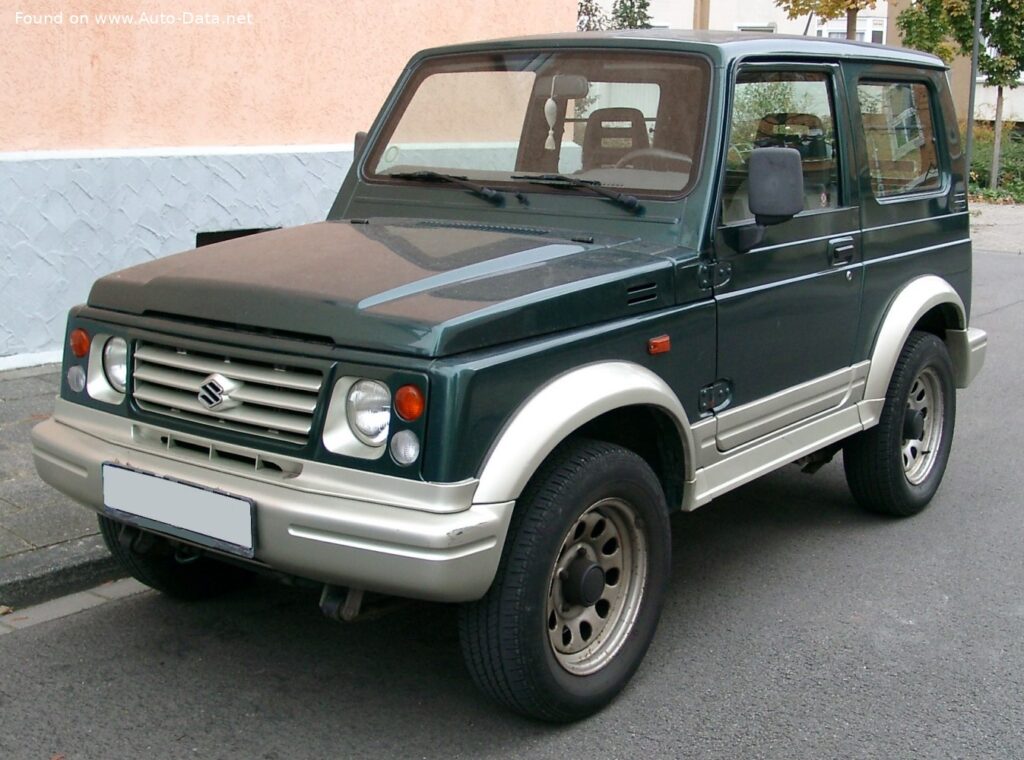
Introduction to the Suzuki Samurai (SJ) 1.3 (SJ 413) (70 Hp)
The Suzuki Samurai (SJ) 1.3 (SJ 413) (70 Hp), produced from 1991 to 2003, represents a significant chapter in the history of compact, capable off-road vehicles. Known for its rugged simplicity and exceptional agility, the Suzuki Samurai (SJ) carved out a unique niche in the global automotive landscape, particularly appealing to enthusiasts seeking an affordable and highly customizable platform for outdoor adventures. This specific variant, featuring a 1.3-liter engine generating 70 horsepower, embodies the later evolution of the SJ series, refining its powertrain while retaining the core characteristics that made the Samurai a legend.
Originally conceived as a global utility vehicle, the Samurai gained immense popularity in various markets, including North America, Europe, and Asia, where its compact dimensions and robust four-wheel-drive system proved ideal for navigating challenging terrains. Its unpretentious design and mechanical straightforwardness contributed to its enduring appeal, fostering a dedicated community of owners and modifiers. Despite its humble origins, the Suzuki Samurai (SJ) became synonymous with accessible off-roading, challenging the perception that serious trail capability required a hefty price tag or large footprint.
The Enduring Legacy of the Suzuki Samurai (SJ)
The Suzuki Samurai (SJ) holds a distinctive place in automotive history, particularly in the United States, where it arrived in 1985. It quickly gained traction as an affordable alternative to larger, more expensive sport utility vehicles. Its lightweight construction, short wheelbase, and high ground clearance made it exceptionally adept at navigating tight trails and overcoming obstacles that would challenge many full-sized trucks. This prowess earned it a reputation as a serious off-road machine, capable of tackling terrains far beyond what its modest dimensions might suggest.
Beyond its off-road capabilities, the Samurai’s appeal also stemmed from its utilitarian design. It was a vehicle built for purpose, with an emphasis on function over luxury. This simplicity translated into reliability and ease of maintenance, qualities highly valued by owners who often pushed their vehicles to their limits. The Samurai’s modular design also made it a favorite among aftermarket enthusiasts, with a vast array of parts and modifications available to enhance its performance, appearance, and utility.
Engine & Performance
At the heart of the Suzuki Samurai (SJ) 1.3 (SJ 413) (70 Hp) lies a 1.3-liter (specifically, the SJ 413 designation) internal combustion engine. This naturally aspirated, gasoline-fueled powerplant was engineered for reliability and torque delivery in low-speed, off-road conditions, rather than outright highway speed. Generating 70 horsepower, this engine provided a significant upgrade over earlier 1.0-liter units, offering improved performance without sacrificing the Samurai’s characteristic fuel efficiency and mechanical simplicity.
The engine’s naturally aspirated design means it relies solely on atmospheric pressure to draw air into its cylinders, eschewing turbochargers or superchargers. While this might limit peak power output compared to forced-induction engines, it contributes to greater mechanical reliability and a more linear power delivery, which is often preferred in technical off-road driving. The 70 horsepower, combined with the Samurai’s lightweight body and robust gearing, including a low-range transfer case, allowed it to crawl over obstacles and ascend steep inclines with surprising ease. Its powertrain architecture, focused on a traditional internal combustion engine, underscored its role as a straightforward, dependable workhorse, perfectly suited for the demands of the trail.
Design & Features
The Suzuki Samurai (SJ) is instantly recognizable by its classic off-road vehicle body type: a compact, 3-door design. This configuration, while offering seating for four, prioritizes maneuverability and ruggedness. Its boxy silhouette and flat panels are not merely aesthetic choices; they are functional elements that contribute to its off-road prowess. The short overhangs facilitate steep approach and departure angles, crucial for navigating challenging terrain without scraping the bumpers, while the narrow body allows it to squeeze through tight trails.
The interior, designed for practicality, features seating for four occupants, though rear passenger space is somewhat limited, typical for a compact off-road vehicle of its era. The focus was on durability and ease of cleaning, with robust materials capable of withstanding the rigors of outdoor use. While modern conveniences like advanced infotainment systems or extensive driver-assistance features were absent, the Samurai offered the essentials: a straightforward dashboard, manual controls, and excellent visibility, all contributing to a pure driving experience. Its robust ladder frame chassis and solid axles, characteristic of true off-roaders, provided the structural integrity and articulation necessary for serious trail performance, further cementing its reputation as a no-nonsense adventure vehicle.
Technical Specifications for the Suzuki Samurai (SJ) 1.3 (SJ 413) (70 Hp)
| Category | Specification |
|---|---|
| Brand | Suzuki |
| Model | Samurai |
| Generation | Samurai (SJ) |
| Type (Engine) | 1.3 (SJ 413) (70 Hp) |
| Start of production | 1991 year |
| End of production | 2003 year |
| Powertrain Architecture | Internal Combustion engine |
| Body type | Off-road vehicle |
| Seats | 4 |
| Doors | 3 |
| Fuel Type | Petrol (Gasoline) |
| Power | 70 Hp |
| Engine aspiration | Naturally aspirated engine |
Market Impact and Enduring Appeal
The Suzuki Samurai (SJ) made a significant splash in various markets worldwide, including a memorable, albeit controversial, run in the United States. Its introduction in the mid-1980s offered American consumers an unprecedented blend of affordability, fuel efficiency, and genuine off-road capability in a compact package. It quickly became a popular choice for budget-conscious adventurers, college students, and those seeking a versatile utility vehicle. The Samurai’s low purchase price and simple mechanics meant it was accessible to a broad demographic, fostering a vibrant aftermarket and a passionate enthusiast base.
However, the Samurai’s journey in the US market was not without its challenges. A highly publicized controversy regarding its perceived rollover risk, primarily driven by a Consumers Union report in 1988, severely impacted its sales and public image. Despite Suzuki’s strong defense and subsequent vindication in court, the damage was done, leading to a significant decline in its popularity and eventually its withdrawal from the US market in 1995. Nevertheless, the Samurai continued its production globally until 2003, maintaining strong sales in regions like Europe, Asia, and Latin America, where its robust nature and utility were highly valued.
Globally, the Suzuki Samurai competed with other compact off-roaders such as the Lada Niva, Daihatsu Rocky, and various Jeep models, often outperforming them in terms of agility and modification potential due to its lighter weight and simple design. Its enduring appeal lies in its fundamental design principles: a body-on-frame construction, solid axles, and a capable four-wheel-drive system with a low-range transfer case. These features, combined with its compact size, make it an ideal platform for extreme off-road customization, ensuring a strong presence in the classic off-road scene today.
Today, the Suzuki Samurai (SJ) is revered as a classic, cult-favorite off-roader. Its legacy is one of rugged dependability, accessible adventure, and a testament to the idea that true capability doesn’t always come in the largest or most expensive package. Its historical significance is undeniable, having paved the way for future compact SUVs and demonstrating the demand for nimble, go-anywhere vehicles. The 1.3-liter (SJ 413) (70 Hp) variant, in particular, is remembered as a refined iteration of this iconic vehicle, offering a balance of power and efficiency that continued to serve its dedicated owners well into the new millennium and beyond.
