
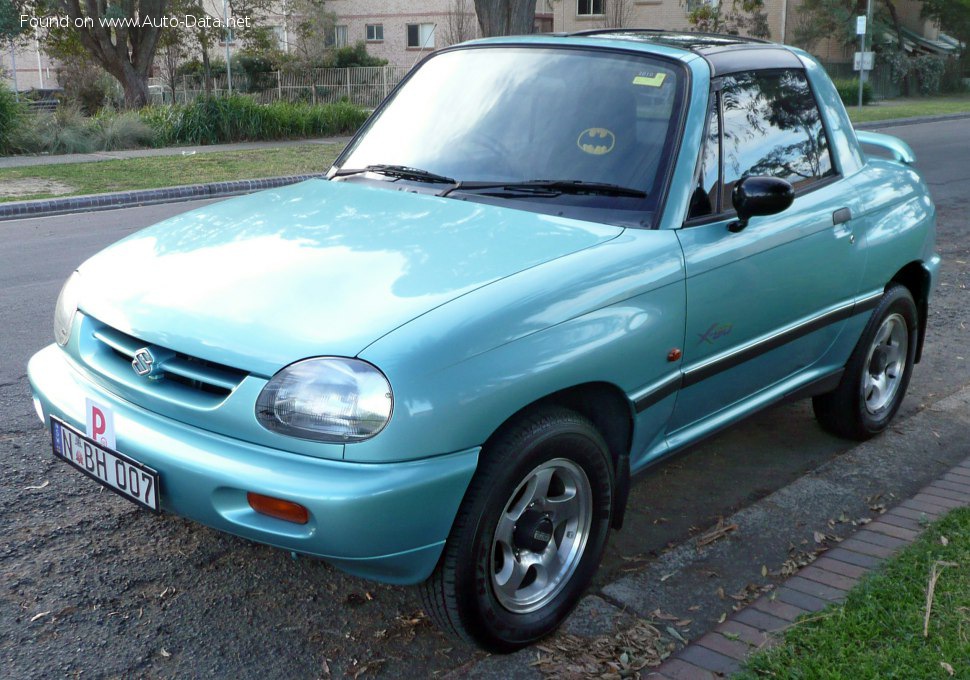
The Suzuki X-90 (EL) 1.6 i 16V (97 Hp) 4×4 represents a fascinating, albeit short-lived, chapter in automotive history, embodying Suzuki’s adventurous spirit and willingness to experiment with unconventional vehicle concepts. Launched in 1995 and produced until 1997, this unique model defied easy categorization, blending elements of a compact SUV, a two-seater sports car, and even a targa-top convertible. Positioned as a lifestyle vehicle, the X-90 was designed to appeal to a niche market seeking something distinctive and fun, rather than purely practical. While the official documentation sometimes classified its body type as a “sedan” due to its fixed roof structure, its two-door, two-seat configuration and robust 4×4 capabilities firmly placed it in the realm of mini-SUVs or quirky personal urban cruisers. Its compact dimensions and robust mechanical underpinnings, largely derived from the proven Suzuki Vitara (known as the Sidekick in North America), provided a foundation for both on-road agility and light off-road capability, making it a truly versatile, if misunderstood, vehicle for its era.
Engine and Performance Characteristics of the Suzuki X-90 (EL) 1.6 i 16V (97 Hp) 4×4
At the heart of the Suzuki X-90 (EL) 1.6 i 16V (97 Hp) 4×4 lies the venerable G16B engine, a 1.6-liter (1589 cubic centimeters or 96.97 cubic inches) inline-four cylinder unit known for its reliability and efficiency. This naturally aspirated powerplant features a single overhead camshaft (OHC) valvetrain with four valves per cylinder, totaling 16 valves. Fuel delivery is handled by a multi-port manifold injection system, ensuring precise fuel metering and combustion. With a compression ratio of 9.5:1, the engine produces a respectable 97 horsepower at 5600 rpm and 97.36 pound-feet of torque at 4000 rpm. This power output, combined with the vehicle’s relatively light kerb weight of 2425.08 pounds (1100 kg), results in a weight-to-power ratio of 11.3 kg/Hp, or 88.2 Hp per tonne, and a weight-to-torque ratio of 8.3 kg/Nm, or 120 Nm per tonne. These figures contribute to the X-90’s sprightly, if not blistering, performance.
Power is transmitted to all four wheels via a robust 5-speed manual transmission, enabling the X-90 to tackle diverse driving conditions, from urban commutes to unpaved trails. The all-wheel-drive (4×4) powertrain architecture, a hallmark of Suzuki’s SUV heritage, provides enhanced traction and stability. In terms of acceleration, the X-90 takes 13.3 seconds to reach 100 km/h (62 mph) from a standstill, with a calculated 0-60 mph time of 12.6 seconds. The top speed is rated at 93.21 mph (150 km/h). Fuel economy, while not a primary selling point for a 4×4 in the mid-90s, was reasonable for its class. In urban driving, the X-90 achieved approximately 24 US mpg (9.8 liters per 100 km), while on the extra-urban cycle, it improved to about 35.1 US mpg (6.7 liters per 100 km). The engine oil capacity is 4.2 liters (4.44 US quarts), and the cooling system holds 5.3 liters (5.6 US quarts) of coolant, ensuring adequate thermal management for both routine driving and more demanding conditions.
Design and Features of the Suzuki X-90 (EL)
The Suzuki X-90 (EL) stands out with its truly distinctive design, a bold departure from conventional automotive styling of the mid-1990s. Measuring 146.06 inches (3710 mm) in length, 66.73 inches (1695 mm) in width, and 61.22 inches (1555 mm) in height, with a wheelbase of 86.61 inches (2200 mm), the X-90 was remarkably compact. Its defining characteristic was its two-door, two-seat body, often described as a targa-top coupe or a mini-SUV-convertible. The removable T-tops allowed for an open-air driving experience, adding to its recreational appeal. This unusual combination of a compact SUV chassis with a sporty, open-top body made it a unique offering in the market, often drawing comparisons to vehicles like the Geo Tracker (also a Suzuki product) but with a more integrated, coupe-like aesthetic. The X-90’s design was characterized by its rounded lines, short overhangs, and a somewhat whimsical appearance that polarized opinions, making it a love-it-or-hate-it proposition.
Despite its playful exterior, the X-90 incorporated practical features and safety considerations typical of its era. Standard equipment included hydraulic power steering, providing a responsive and manageable driving experience, especially in urban environments or during off-road excursions. The braking system comprised disc brakes at the front and drum brakes at the rear, augmented by an Anti-lock Braking System (ABS), which was a significant safety feature for the time. The suspension setup featured wishbones at the front and coil springs at the rear, contributing to a relatively comfortable ride quality for a vehicle of its size and type, while also offering reasonable articulation for light off-road use. The vehicle rode on 195/65 R15 S tires mounted on 15-inch wheel rims, providing a good balance of grip and ride comfort. Inside, the two-seater cabin was functional, prioritizing driver and passenger comfort for its intended use as a recreational vehicle. The trunk space, while limited due to its compact size, offered 8.37 cubic feet (237 liters) of storage, suitable for weekend bags or groceries. The fuel tank capacity of 11.1 US gallons (42 liters) provided a decent range for its intended use. The X-90’s short production run and limited sales figures ultimately cemented its status as a collector’s item and a testament to Suzuki’s willingness to push design boundaries.
Technical Specifications: Suzuki X-90 (EL) 1.6 i 16V (97 Hp) 4×4
| Brand | Suzuki |
| Model | X-90 |
| Generation | X-90 (EL) |
| Type (Engine) | 1.6 i 16V (97 Hp) 4×4 |
| Start of production | 1995 year |
| End of production | 1997 year |
| Powertrain Architecture | Internal Combustion engine |
| Body type | Sedan (2 Doors, 2 Seats) |
| Fuel consumption (economy) – urban | 24 US mpg (9.8 l/100 km) |
| Fuel consumption (economy) – extra urban | 35.1 US mpg (6.7 l/100 km) |
| Fuel Type | Petrol (Gasoline) |
| Acceleration 0 – 60 mph | 12.6 sec |
| Acceleration 0 – 100 km/h | 13.3 sec |
| Maximum speed | 93.21 mph (150 km/h) |
| Weight-to-power ratio | 11.3 kg/Hp, 88.2 Hp/tonne |
| Weight-to-torque ratio | 8.3 kg/Nm, 120 Nm/tonne |
| Power | 97 Hp @ 5600 rpm |
| Power per litre | 61 Hp/l |
| Torque | 97.36 lb.-ft. @ 4000 rpm (132 Nm @ 4000 rpm) |
| Engine layout | Front, Longitudinal |
| Engine Model/Code | G16B |
| Engine displacement | 96.97 cu. in. (1589 cm3) |
| Number of cylinders | 4 |
| Engine configuration | Inline |
| Cylinder Bore | 2.95 in. (75 mm) |
| Piston Stroke | 3.54 in. (90 mm) |
| Compression ratio | 9.5:1 |
| Number of valves per cylinder | 4 |
| Fuel injection system | Multi-port manifold injection |
| Engine aspiration | Naturally aspirated engine |
| Valvetrain | OHC |
| Engine oil capacity | 4.44 US qt (4.2 l) |
| Coolant | 5.6 US qt (5.3 l) |
| Kerb Weight | 2425.08 lbs. (1100 kg) |
| Max. weight | 2998.29 lbs. (1360 kg) |
| Max load | 573.2 lbs. (260 kg) |
| Trunk (boot) space – minimum | 8.37 cu. ft. (237 l) |
| Fuel tank capacity | 11.1 US gal (42 l) |
| Length | 146.06 in. (3710 mm) |
| Width | 66.73 in. (1695 mm) |
| Height | 61.22 in. (1555 mm) |
| Wheelbase | 86.61 in. (2200 mm) |
| Front track | 56.1 in. (1425 mm) |
| Rear (Back) track | 56.3 in. (1430 mm) |
| Minimum turning circle (turning diameter) | 32.15 ft. (9.8 m) |
| Drive wheel | All wheel drive (4×4) |
| Number of gears and type of gearbox | 5 gears, manual transmission |
| Front suspension | Wishbone |
| Rear suspension | Coil spring |
| Front brakes | Disc |
| Rear brakes | Drum |
| Assisting systems | ABS (Anti-lock braking system) |
| Steering type | Steering rack and pinion |
| Power steering | Hydraulic Steering |
| Tires size | 195/65 R15 S |
| Wheel rims size | 15 |
