
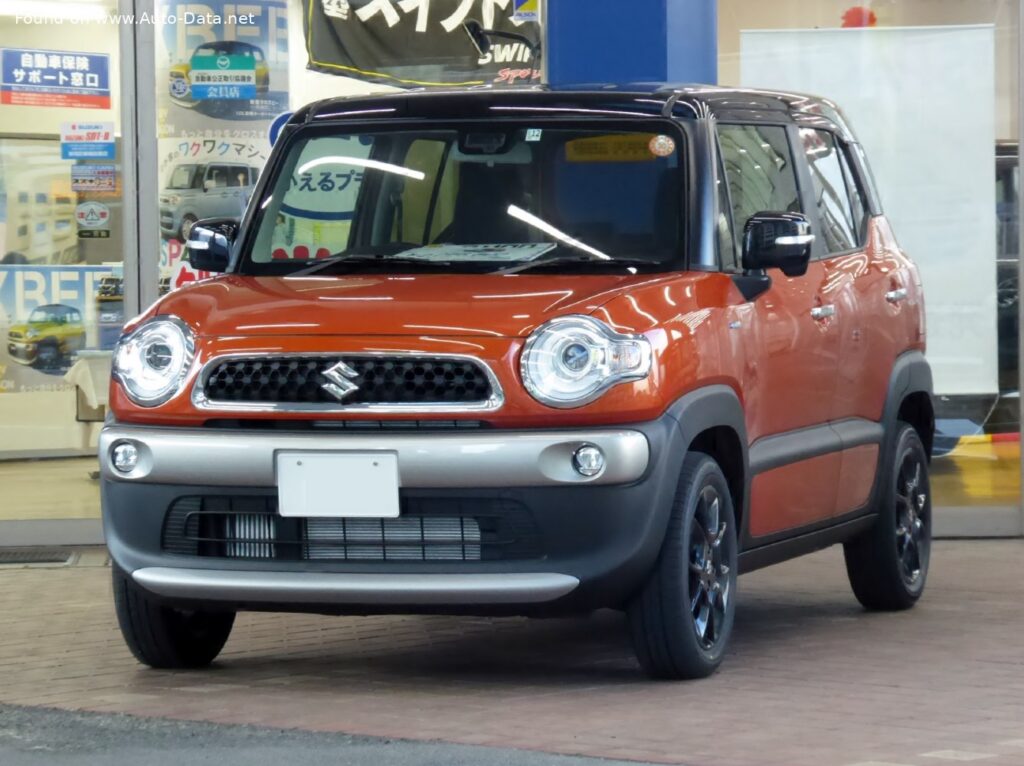
The Suzuki Xbee 1.0i (99 Hp) Mild Hybrid Automatic represents a distinctive and strategically important model within Suzuki’s lineup, particularly for the Japanese domestic market (JDM). Launched in December 2017, this first-generation Xbee carved out a unique niche as a compact crossover, blending the practicality and elevated driving position of an SUV with the nimble dimensions and fuel efficiency demanded by urban environments. Its design philosophy clearly targeted consumers seeking a versatile, stylish, and economical vehicle that could navigate crowded city streets with ease while offering a sense of adventure. The Xbee is a testament to Suzuki’s expertise in developing compact vehicles, integrating advanced mild-hybrid technology to enhance both performance and environmental responsibility, making the Suzuki Xbee a compelling option in its segment.
Engine & Performance of the Suzuki Xbee
At the heart of the Suzuki Xbee 1.0i (99 Hp) Mild Hybrid Automatic lies a sophisticated powertrain architecture classified as an MHEV (Mild Hybrid Electric Vehicle). This system, often referred to as a power-assist hybrid or battery-assisted hybrid vehicle (BAHV), is engineered to deliver an optimal balance of power, efficiency, and low emissions. The internal combustion engine (ICE) component is a 1.0-liter (996 cm³ or 60.78 cu. in.) K10C inline-three unit, mounted transversely at the front of the vehicle. This diminutive engine is a marvel of modern engineering, featuring a DOHC (Double Overhead Camshaft) valvetrain with VVT (Variable Valve Timing), direct fuel injection, and, critically, a turbocharger complemented by an intercooler. These technologies allow the engine to produce a robust 99 horsepower at 5500 rpm, a remarkable output for its displacement, translating to an impressive 99.4 horsepower per liter.
The K10C engine generates a substantial 110.63 lb.-ft. of torque, available across a broad and usable band from 1700 to 4000 rpm. This wide torque plateau is particularly beneficial for city driving and provides responsive acceleration without the need for high engine speeds. Complementing this internal combustion engine is an electric motor, model/code WA05A, which is ingeniously integrated into the transmission. While the electric motor’s individual output is modest at 3 horsepower at 1000 rpm and 36.88 lb.-ft. of torque at a very low 100 rpm, its role in the mild-hybrid system is crucial. It primarily functions as a starter-generator, assisting the gasoline engine during acceleration, providing an initial torque boost, and enabling smoother engine restarts in stop-start scenarios. This seamless integration ensures that the system power also peaks at 99 horsepower at 5500 rpm, with a combined system torque of 110.63 lb.-ft. available between 1700-4000 rpm, identical to the ICE output, indicating the electric motor’s supportive, rather than primary, propulsion role.
Power is delivered to the front wheels via a smooth and efficient 6-speed automatic transmission. This drivetrain architecture ensures that both the ICE and electric motor work in a mixed mode, driving the front wheels collaboratively to maximize efficiency. The Xbee’s performance metrics are noteworthy for its class: a weight-to-power ratio of 9.7 kg/Hp (or 103.1 Hp/tonne) and a weight-to-torque ratio of 6.4 kg/Nm (or 156.3 Nm/tonne). These figures suggest a lively and agile driving experience, particularly given the vehicle’s compact dimensions and curb weight of just 2116.44 lbs. (960 kg).
Fuel economy is a significant highlight of the Suzuki Xbee’s mild-hybrid system. Operating on regular unleaded gasoline, the Xbee achieves an impressive 37.3 US mpg in urban driving conditions and an even better 44.4 US mpg on the extra-urban cycle. These figures underscore the effectiveness of the mild-hybrid system in reducing fuel consumption and emissions, making the Xbee an economical choice for daily commuting and longer journeys. The 8.45 US gallon (32 liter) fuel tank, while compact, provides a reasonable driving range given the vehicle’s exceptional fuel efficiency.
Design & Features of the Suzuki Xbee
The Suzuki Xbee’s design is a compelling blend of SUV ruggedness and compact car charm, tailored specifically for the demands of the urban landscape in its primary markets. Classified as a SUV/Crossover, the Xbee offers a distinctive aesthetic that stands out. Its compact dimensions are a key attribute, with an overall length of 148.03 inches (3760 mm), a width of 65.75 inches (1670 mm), and a height of 67.13 inches (1705 mm). These measurements ensure excellent maneuverability and ease of parking in congested areas, a critical factor for many drivers.
Despite its compact footprint, the Xbee maximizes interior space, offering seating for four occupants across five doors, making it a practical choice for small families or individuals needing versatile cargo and passenger capacity. The wheelbase of 95.87 inches (2435 mm) contributes to a stable ride, while the front track of 57.48 inches (1460 mm) and rear track of 57.87 inches (1470 mm) ensure confident handling. A ground clearance of 7.09 inches (180 mm) provides a useful advantage for navigating uneven roads or light off-road conditions, reinforcing its crossover credentials without compromising its urban agility. The minimum turning circle of 30.84 feet (9.4 meters) further highlights its excellent maneuverability, making tight U-turns and parking maneuvers effortless.
The chassis and suspension system of the Suzuki Xbee are designed for comfort and control. It features an independent McPherson strut setup at the front, a common and effective design known for its balance of ride quality and handling precision. The rear suspension utilizes a torsion beam, which is a space-efficient and robust solution, well-suited for compact vehicles. Braking performance is handled by ventilated discs at the front, offering superior heat dissipation for consistent stopping power, complemented by disc brakes at the rear. An essential safety feature, ABS (Anti-lock Braking System), is standard, ensuring controlled braking even in emergency situations.
Steering is managed by an electric power steering system, employing a rack and pinion setup. Electric power steering provides light effort at low speeds for easy parking and maneuvering, while firming up at higher speeds for better road feel and stability. The Xbee rides on 16-inch wheel rims, shod with 175/60 R16 82H tires. This tire size provides a good balance between ride comfort, grip, and fuel efficiency, aligning with the vehicle’s overall design philosophy. The Xbee’s thoughtful engineering and compact, yet spacious, design make it a highly functional and appealing option for those seeking a modern, efficient, and versatile vehicle.
Technical Specifications
| Brand | Suzuki |
| Model | Xbee |
| Generation | Xbee |
| Type (Engine) | 1.0i (99 Hp) Mild Hybrid Automatic |
| Start of production | December, 2017 year |
| Powertrain Architecture | MHEV (Mild Hybrid Electric Vehicle, power-assist hybrid, battery-assisted hybrid vehicles, BAHV) |
| Body type | SUV, Crossover |
| Seats | 4 |
| Doors | 5 |
| Fuel consumption (economy) – urban | 6.3 l/100 km (37.3 US mpg) |
| Fuel consumption (economy) – extra urban | 5.3 l/100 km (44.4 US mpg) |
| Fuel Type | Petrol (Gasoline) |
| Weight-to-power ratio | 9.7 kg/Hp (103.1 Hp/tonne) |
| Weight-to-torque ratio | 6.4 kg/Nm (156.3 Nm/tonne) |
| Electric motor 1 power | 3 Hp @ 1000 rpm |
| Electric motor Torque | 50 Nm @ 100 rpm (36.88 lb.-ft. @ 100 rpm) |
| Electric motor model/code | WA05A |
| Electric motor location | Integrated into the transmission |
| System power | 99 Hp @ 5500 rpm |
| System torque | 150 Nm @ 1700-4000 rpm (110.63 lb.-ft. @ 1700-4000 rpm) |
| Internal combustion engine power | 99 Hp @ 5500 rpm |
| Power per liter | 99.4 Hp/l |
| Internal combustion engine torque | 150 Nm @ 1700-4000 rpm (110.63 lb.-ft. @ 1700-4000 rpm) |
| Engine layout | Front, Transverse |
| Engine Model/Code | K10C |
| Engine displacement | 996 cm³ (60.78 cu. in.) |
| Number of cylinders | 3 |
| Engine configuration | Inline |
| Cylinder Bore | 73 mm (2.87 in.) |
| Piston Stroke | 79.4 mm (3.13 in.) |
| Compression ratio | 10:1 |
| Number of valves per cylinder | 4 |
| Fuel injection system | Direct injection |
| Engine aspiration | Turbocharger, Intercooler |
| Valvetrain | DOHC, VVT |
| Engine oil capacity | 2.9 l (3.06 US qt) |
| Coolant capacity | 4.3 l (4.54 US qt) |
| Kerb Weight | 960 kg (2116.44 lbs.) |
| Fuel tank capacity | 32 l (8.45 US gal) |
| Length | 3760 mm (148.03 in.) |
| Width | 1670 mm (65.75 in.) |
| Height | 1705 mm (67.13 in.) |
| Wheelbase | 2435 mm (95.87 in.) |
| Front track | 1460 mm (57.48 in.) |
| Rear (Back) track | 1470 mm (57.87 in.) |
| Ride height (ground clearance) | 180 mm (7.09 in.) |
| Minimum turning circle (turning diameter) | 9.4 m (30.84 ft.) |
| Drivetrain Architecture | ICE and electric motor drive front wheels in mixed mode |
| Drive wheel | Front wheel drive |
| Number of gears and type of gearbox | 6 gears, automatic transmission |
| Front suspension | Independent type McPherson |
| Rear suspension | Torsion |
| Front brakes | Ventilated discs |
| Rear brakes | Disc |
| Assisting systems | ABS (Anti-lock braking system) |
| Steering type | Steering rack and pinion |
| Power steering | Electric Steering |
| Tires size | 175/60 R16 82H |
| Wheel rims size | 16 |
