
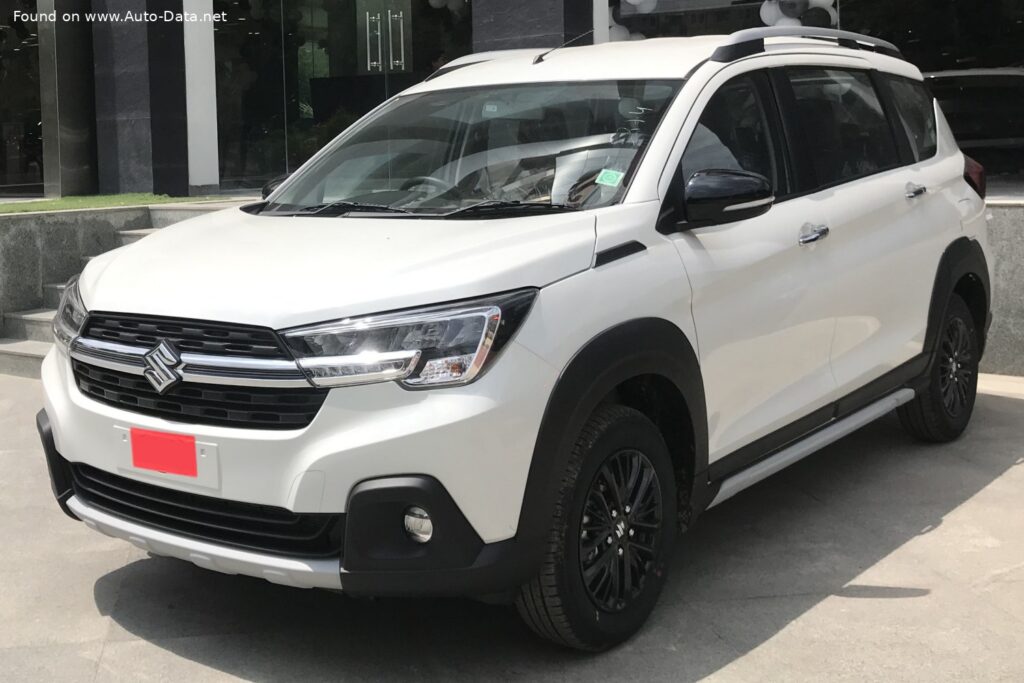
The Suzuki XL6 1.5 (105 Hp) Mild Hybrid Automatic represents a compelling entry in the rapidly expanding compact SUV and crossover segment, particularly within markets like India and Southeast Asia where its blend of practicality, efficiency, and comfort resonates strongly with family-oriented buyers. Launched in August 2019 and produced until April 2022, this generation of the XL6 carved out a niche as a premium six-seater offering, distinguishing itself from its stablemates with enhanced styling and a focus on an elevated in-cabin experience. Positioned as a versatile urban cruiser capable of accommodating more passengers than typical compact SUVs, the XL6 combined Suzuki’s renowned reliability with modern mild-hybrid technology, showcasing the brand’s commitment to fuel efficiency and reduced environmental impact. Its powertrain architecture, classified as a Mild Hybrid Electric Vehicle (MHEV), leverages a power-assist system with a battery-assisted hybrid setup to optimize performance and economy, making it a pragmatic choice for consumers navigating congested cityscapes and seeking cost-effective daily mobility.
Powertrain and Performance of the Suzuki XL6 1.5 (105 Hp) Mild Hybrid Automatic
At the heart of the Suzuki XL6 1.5 (105 Hp) Mild Hybrid Automatic lies a meticulously engineered powertrain designed for both efficiency and dependable performance. The vehicle is propelled by Suzuki’s K15B engine, a 1.5-liter (1462 cm3 or 89.22 cu. in.) naturally aspirated inline-four gasoline engine. This unit is configured with a front, transverse layout, and features four cylinders, each equipped with four valves, culminating in a total of 16 valves. With a bore of 74 mm (2.91 in.) and a piston stroke of 85 mm (3.35 in.), the engine achieves a compression ratio of 10.5:1, indicative of its optimized combustion efficiency. Fuel is delivered via a multi-port manifold injection system, ensuring precise fuel-air mixture for consistent power delivery.
The K15B engine generates a respectable 105 horsepower at 6000 rpm, translating to a power-per-liter output of 71.8 Hp/l. Torque peaks at 138 Nm (101.78 lb.-ft.) at 4400 rpm, providing ample low-to-mid range grunt for urban driving and highway cruising. What truly sets this XL6 variant apart is its Mild Hybrid Electric Vehicle (MHEV) powertrain architecture. This system integrates an electric motor directly into the transmission, which works in conjunction with the internal combustion engine to drive the front wheels. Power for the electric motor is stored in a compact Lithium-ion (Li-Ion) battery. The MHEV system functions primarily as a power-assist hybrid, meaning the electric motor aids the gasoline engine, particularly during acceleration and stop-start traffic, to enhance fuel economy and reduce emissions. It also facilitates a Start & Stop System, automatically shutting off the engine when the vehicle comes to a halt and restarting it seamlessly, further contributing to fuel savings.
Power is transmitted to the front wheels via a smooth 4-speed automatic transmission. While a 4-speed unit might seem modest by contemporary standards, it is well-suited to the engine’s power band and the vehicle’s intended urban and light highway usage, prioritizing smooth shifts and durability. The mild-hybrid system ensures that the internal combustion engine and electric motor work in a mixed mode, optimizing power delivery and efficiency. The combined fuel consumption is rated at an impressive 5.6 liters per 100 kilometers, equivalent to 42 US miles per gallon, making it a highly economical choice in its segment. Adherence to the BS VI emission standard highlights its compliance with stringent environmental regulations, a crucial factor in many global markets. With a kerb weight of 1190 kg (2623.5 lbs.), the XL6 boasts a weight-to-power ratio of 11.3 kg/Hp (88.2 Hp/tonne) and a weight-to-torque ratio of 8.6 kg/Nm (116 Nm/tonne), indicating a balanced performance characteristic for its class.
Design, Ergonomics, and Features of the Suzuki XL6
The Suzuki XL6 presents a distinctive and robust design that clearly differentiates it within the Suzuki lineup, positioning it as a more premium and rugged-looking alternative to its stablemates. Classified as an SUV/Crossover, its body type features five doors and a practical six-seat configuration, emphasizing its role as a family-friendly vehicle designed for comfort and utility. The exterior styling incorporates a bolder front fascia, characterized by a prominent grille and signature LED lighting elements, giving it a more assertive road presence. Roof rails and protective cladding around the wheel arches further enhance its SUV aesthetic.
Dimensionally, the XL6 is designed for both interior space and maneuverability. It measures 4445 mm (175 in.) in length, 1775 mm (69.88 in.) in width, and 1700 mm (66.93 in.) in height. A generous wheelbase of 2740 mm (107.87 in.) is crucial for passenger comfort, particularly for the second and third rows, and contributes to a stable ride. The front track is 1510 mm (59.45 in.), while the rear track is 1520 mm (59.84 in.), ensuring a confident stance on the road. Despite its capacity, the XL6 maintains a minimum turning circle of 10.4 meters (34.12 ft.), making it surprisingly agile in urban environments and tight parking situations.
Inside, the XL6 prioritizes passenger comfort and versatility. The six-seat layout typically features captain’s chairs in the second row, offering superior comfort and individual space compared to a bench seat. This configuration also facilitates easier access to the third row. The cargo area is highly adaptable, offering a minimum trunk space of 209 liters (7.38 cu. ft.) with all seats in use. When the third row is folded, this expands significantly to 692 liters (24.44 cu. ft.), providing ample room for luggage, groceries, or larger items, underscoring its utility as a multi-purpose vehicle. The fuel tank capacity is a practical 45 liters (11.89 US gallons), offering a decent range given its excellent fuel economy.
The chassis and suspension setup are engineered for a comfortable ride and predictable handling. The front suspension features independent McPherson struts with coil springs, a widely adopted design known for its balance of comfort and control. At the rear, a torsion beam setup with coil springs provides a compact and robust solution. Braking performance is handled by ventilated discs at the front, offering strong stopping power, complemented by reliable drum brakes at the rear. An Anti-lock Braking System (ABS) is a standard assisting system, preventing wheel lock-up during hard braking and enhancing directional stability, a critical safety feature for modern vehicles. Steering is managed by a rack and pinion system with electric power steering, providing light effort at low speeds for easy maneuvering and a more weighted feel at higher speeds for stability. The vehicle rides on 185/65 R15 tires, mounted on 15-inch wheel rims, a combination that offers a good balance of ride comfort, durability, and cost-effectiveness.
Technical Specifications
| Brand | Suzuki |
| Model | XL6 |
| Generation | XL6 |
| Type (Engine) | 1.5 (105 Hp) Mild Hybrid Automatic |
| Start of production | August, 2019 year |
| End of production | April, 2022 year |
| Powertrain Architecture | MHEV (Mild Hybrid Electric Vehicle, power-assist hybrid, battery-assisted hybrid vehicles, BAHV) |
| Body type | SUV, Crossover |
| Seats | 6 |
| Doors | 5 |
| Fuel consumption (economy) – combined | 5.6 l/100 km (42 US mpg / 50.4 UK mpg / 17.9 km/l) |
| Fuel Type | Petrol (Gasoline) |
| Emission standard | BS VI |
| Weight-to-power ratio | 11.3 kg/Hp (88.2 Hp/tonne) |
| Weight-to-torque ratio | 8.6 kg/Nm (116 Nm/tonne) |
| Battery technology | Lithium-ion (Li-Ion) |
| Electric motor 1 | Integrated into the transmission |
| Power | 105 Hp @ 6000 rpm |
| Power per litre | 71.8 Hp/l |
| Torque | 138 Nm @ 4400 rpm (101.78 lb.-ft. @ 4400 rpm) |
| Engine layout | Front, Transverse |
| Engine Model/Code | K15B |
| Engine displacement | 1462 cm3 (89.22 cu. in.) |
| Number of cylinders | 4 |
| Engine configuration | Inline |
| Cylinder Bore | 74 mm (2.91 in.) |
| Piston Stroke | 85 mm (3.35 in.) |
| Compression ratio | 10.5:1 |
| Number of valves per cylinder | 4 |
| Fuel injection system | Multi-port manifold injection |
| Engine aspiration | Naturally aspirated engine |
| Engine oil capacity | 3.1 l (3.28 US qt / 2.73 UK qt) |
| Coolant | 4 l (4.23 US qt / 3.52 UK qt) |
| Engine systems | Start & Stop System |
| Kerb Weight | 1190 kg (2623.5 lbs.) |
| Max. weight | 1740 kg (3836.04 lbs.) |
| Max load | 550 kg (1212.54 lbs.) |
| Trunk (boot) space – minimum | 209 l (7.38 cu. ft.) |
| Trunk (boot) space – maximum | 692 l (24.44 cu. ft.) |
| Fuel tank capacity | 45 l (11.89 US gal / 9.9 UK gal) |
| Length | 4445 mm (175 in.) |
| Width | 1775 mm (69.88 in.) |
| Height | 1700 mm (66.93 in.) |
| Wheelbase | 2740 mm (107.87 in.) |
| Front track | 1510 mm (59.45 in.) |
| Rear (Back) track | 1520 mm (59.84 in.) |
| Minimum turning circle (turning diameter) | 10.4 m (34.12 ft.) |
| Drivetrain Architecture | The Internal combustion engine (ICE) and electric motor drive the front wheels of the car with the ability to work only in mixed mode. |
| Drive wheel | Front wheel drive |
| Number of gears and type of gearbox | 4 gears, automatic transmission |
| Front suspension | Coil spring, Independent type McPherson |
| Rear suspension | Coil spring, Torsion |
| Front brakes | Ventilated discs |
| Rear brakes | Drum |
| Assisting systems | ABS (Anti-lock braking system) |
| Steering type | Steering rack and pinion |
| Power steering | Electric Steering |
| Tires size | 185/65 R15 |
| Wheel rims size | 15 |
