
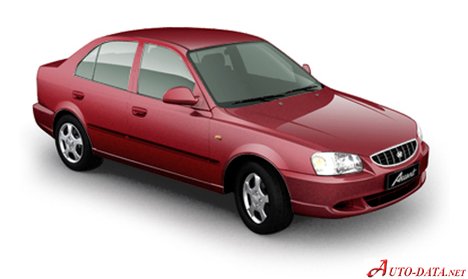
The TagAz Accent II 1.5 (102 Hp) holds a unique position in the automotive history of the early 21st century, particularly within the Russian and Commonwealth of Independent States (CIS) markets. Produced by the Taganrog Automobile Plant (TagAz) from 2001 to 2012, this vehicle was essentially a rebadged and locally assembled second-generation Hyundai Accent (known internally as the LC series). While the Hyundai Accent enjoyed global recognition, the TagAz variant was specifically tailored and marketed for its regional demand, offering a proven, reliable, and cost-effective compact sedan solution for a broad demographic. It represented a practical choice for consumers seeking a durable and economical vehicle, reflecting the design and engineering philosophies of its South Korean progenitor but adapted for local production and market conditions. Its long production run underscores its sustained popularity and utilitarian appeal in an evolving automotive landscape, solidifying its role as a workhorse in its segment.
Engine and Performance of the TagAz Accent II 1.5 (102 Hp)
At the heart of the TagAz Accent II 1.5 (102 Hp) lies a robust and well-proven powertrain, designed for efficiency and reliability in everyday driving scenarios. The vehicle is equipped with a 1.5-liter, naturally aspirated, inline four-cylinder gasoline engine. This unit delivers a respectable 102 horsepower at 5800 revolutions per minute (rpm), providing ample power for urban commuting and highway travel within its class. The engine features a Double Overhead Camshaft (DOHC) valvetrain with four valves per cylinder, a configuration that enhances engine breathing and contributes to its smooth power delivery across the rev range. With a compression ratio of 10:1 and direct fuel injection, the engine was engineered to optimize combustion efficiency and fuel economy, adhering to the Euro 3 emission standard prevalent during its initial production years.
Performance figures for the TagAz Accent II 1.5 (102 Hp) demonstrate a balanced approach, prioritizing usability over outright speed. The sedan accelerates from 0 to 60 miles per hour in approximately 10 seconds, a competitive figure for a compact car of its era and market segment. Its maximum speed is rated at 112.47 miles per hour (181 km/h), making it capable of sustained highway speeds. The engine’s power delivery is channeled through a five-speed manual transmission, driving the front wheels. This drivetrain architecture, combined with a relatively light curb weight of 2347.92 lbs (1065 kg), contributes to a weight-to-power ratio of 10.4 kg/Hp, or 95.8 Hp per tonne, indicating a nimble feel for its size.
Fuel economy was a key selling point for the TagAz Accent II. The combined cycle fuel consumption is rated at 7.5 liters per 100 kilometers, which translates to an impressive 31.4 US miles per gallon (37.7 UK mpg). In urban driving conditions, it achieves 23.8 US mpg (9.9 l/100 km), while extra-urban driving sees consumption improve to 38.6 US mpg (6.1 l/100 km). These figures highlight its economical operation, a crucial factor for budget-conscious consumers in its primary markets. The 45-liter (11.89 US gallon) fuel tank ensures a practical driving range between fill-ups, further enhancing its appeal as a dependable daily driver.
Design and Features
The TagAz Accent II maintains the timeless and practical design language of the second-generation Hyundai Accent, characterized by its straightforward and functional sedan body type. With four doors and seating for five occupants, it prioritizes interior space and utility within its compact footprint. The exterior dimensions are modest yet well-proportioned for urban maneuverability and ease of parking: a length of 166.73 inches (4235 mm), a width of 65.75 inches (1670 mm), and a height of 54.92 inches (1395 mm). The wheelbase measures 96.06 inches (2440 mm), contributing to a stable ride and adequate interior volume for its class. The front track is 56.5 inches (1435 mm), and the rear track is 56.1 inches (1425 mm), providing a solid stance on the road.
Inside, the Accent II offers a pragmatic and user-friendly cabin. While perhaps not adorned with the most luxurious materials, the interior is designed for durability and ease of maintenance, reflecting its role as an affordable and reliable vehicle. The focus is on ergonomic controls and clear instrumentation, ensuring a comfortable driving experience. The seating arrangement comfortably accommodates five adults, making it suitable for families or shared transportation. The trunk space is ample for daily needs, further underscoring its utilitarian design philosophy.
From a chassis and suspension perspective, the TagAz Accent II employs a well-regarded setup for its segment. The front suspension features an independent McPherson strut system with coil springs and an anti-roll bar, a common and effective design known for its balance of comfort and handling. The rear suspension is an independent multi-link spring suspension, also equipped with a stabilizer. This independent rear setup is a notable feature for a compact car of its era, often contributing to improved ride quality and better road holding compared to simpler torsion beam arrangements. Braking is handled by disc brakes at the front and drum brakes at the rear, a conventional and reliable combination for a vehicle of this performance level. The steering system is a rack and pinion type, augmented by hydraulic power steering, which provides driver assistance and makes maneuvering at low speeds less strenuous. The vehicle rides on 175/70 R13 tires mounted on 5.0J x 13 wheel rims, a practical size that offers a good balance of comfort, grip, and affordability for tire replacement.
Technical Specifications
| Brand | TagAz |
| Model | Accent |
| Generation | Accent II |
| Type (Engine) | 1.5 (102 Hp) |
| Start of production | 2001 year |
| End of production | 2012 year |
| Powertrain Architecture | Internal Combustion engine |
| Body type | Sedan |
| Seats | 5 |
| Doors | 4 |
| Fuel consumption (economy) – urban | 9.9 l/100 km (23.8 US mpg) |
| Fuel consumption (economy) – extra urban | 6.1 l/100 km (38.6 US mpg) |
| Fuel consumption (economy) – combined | 7.5 l/100 km (31.4 US mpg) |
| Fuel Type | Petrol (Gasoline) |
| Acceleration 0 – 60 mph | 10 sec |
| Acceleration 0 – 100 km/h | 10.5 sec |
| Maximum speed | 181 km/h (112.47 mph) |
| Emission standard | Euro 3 |
| Weight-to-power ratio | 10.4 kg/Hp, 95.8 Hp/tonne |
| Power | 102 Hp @ 5800 rpm |
| Engine layout | Front, Transverse |
| Number of cylinders | 4 |
| Engine configuration | Inline |
| Cylinder Bore | 75 mm (2.95 in.) |
| Piston Stroke | 83 mm (3.27 in.) |
| Compression ratio | 10:1 |
| Number of valves per cylinder | 4 |
| Fuel injection system | Direct injection |
| Engine aspiration | Naturally aspirated engine |
| Valvetrain | DOHC |
| Engine oil capacity | 3.3 l (3.49 US qt) |
| Kerb Weight | 1065 kg (2347.92 lbs) |
| Max. weight | 1555 kg (3428.19 lbs) |
| Max load | 490 kg (1080.27 lbs) |
| Fuel tank capacity | 45 l (11.89 US gal) |
| Length | 4235 mm (166.73 in.) |
| Width | 1670 mm (65.75 in.) |
| Height | 1395 mm (54.92 in.) |
| Wheelbase | 2440 mm (96.06 in.) |
| Front track | 1435 mm (56.5 in.) |
| Rear (Back) track | 1425 mm (56.1 in.) |
| Drivetrain Architecture | The Internal combustion engine (ICE) drives the front wheels of the vehicle. |
| Drive wheel | Front wheel drive |
| Number of gears and type of gearbox | 5 gears, manual transmission |
| Front suspension | Independent, type McPherson with coil spring and anti-roll bar |
| Rear suspension | Independent multi-link spring suspension with stabilizer |
| Front brakes | Disc |
| Rear brakes | Drum |
| Steering type | Steering rack and pinion |
| Power steering | Hydraulic Steering |
| Tires size | 175/70 R13 |
| Wheel rims size | 5.0J x 13 |
