
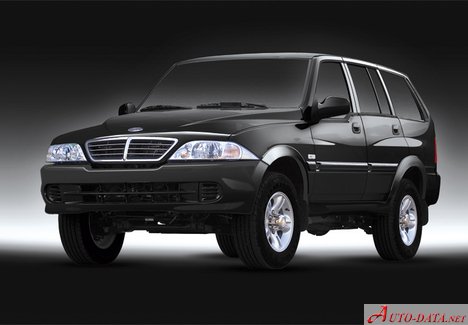
The TagAz Road Partner, specifically the 3.2-liter variant with 220 Hp, represents a noteworthy chapter in the Russian automotive landscape, produced by the TagAZ (Taganrog Automobile Plant) between 2008 and 2011. This particular generation of the Road Partner was an off-road vehicle designed to offer robust utility and capable performance in its primary market, which predominantly included Russia and neighboring countries. While not a model widely available in the United States, its engineering lineage traces back to the first-generation SsangYong Musso, a popular South Korean SUV known for its rugged construction and Mercedes-Benz licensed powertrain. The TagAz Road Partner aimed to provide a cost-effective, durable, and versatile vehicle for consumers seeking a practical workhorse or a capable family SUV, adapting a proven platform for local market demands. Its positioning was clearly in the utility segment, emphasizing reliability and all-terrain capability over luxurious appointments, a common characteristic for vehicles serving diverse road conditions in its region.
The TagAz Road Partner: A Robust Off-Road Proposition
The TagAz Road Partner stood out in its segment primarily due to its sturdy construction and a powertrain designed for resilience. As an off-road vehicle, it was engineered to tackle challenging terrains, a necessity in many parts of its target market. The vehicle’s design philosophy centered on practicality and durability, making it a suitable choice for both urban environments and more adventurous excursions. Its production run, though relatively short, allowed the TagAz Road Partner to establish itself as a recognizable presence, offering a compelling blend of power and utility. The focus on a proven mechanical foundation, coupled with local manufacturing, allowed TagAZ to deliver a vehicle that met specific market requirements, including affordability and ease of maintenance.
Engine and Performance
At the heart of the TagAz Road Partner 3.2 (220 Hp) Automatic lies a formidable 3.2-liter (3199 cm³, or 195.21 cu. in.) naturally aspirated inline-six gasoline engine. This powerplant delivered a substantial 220 horsepower at 6500 rpm, providing ample thrust for both on-road cruising and off-road maneuvering. Torque figures were equally impressive, peaking at 226.43 lb.-ft. (307 Nm) at 4700 rpm, ensuring strong pulling power across a wide rev range. The engine featured a Dual Overhead Camshaft (DOHC) valvetrain with four valves per cylinder, indicative of a design aimed at efficient combustion and power delivery. Fuel was supplied via a multi-port manifold injection system, a reliable and well-understood technology for its era. With a compression ratio of 10:1, the engine was tuned to run on standard gasoline fuel.
Despite the “Automatic” designation in the model name, the provided technical specifications explicitly state that this variant was equipped with a 5-speed manual transmission, directing power to an all-wheel-drive (4×4) system. This combination suggested a driver-focused experience, allowing for precise control over power delivery, particularly beneficial in off-road scenarios where gear selection is critical. Performance figures for the Road Partner 3.2 were respectable for an SUV of its size and type. It could accelerate from 0 to 60 mph in a swift 9.7 seconds, with 0 to 62 mph (100 km/h) taking 10.2 seconds. Its maximum speed was recorded at 116.82 mph (188 km/h), demonstrating its capability for highway travel. The vehicle adhered to the Euro 3 emission standard, reflecting its compliance with environmental regulations pertinent to its production period.
Fuel economy, as expected for a large-displacement, naturally aspirated off-road vehicle from this era, was moderate. The combined fuel consumption was rated at 14.3 US mpg (16.4 l/100 km). In urban driving conditions, this figure dropped to 11.5 US mpg (20.4 l/100 km), while extra-urban driving yielded a more efficient 16.3 US mpg (14.4 l/100 km). The vehicle’s fuel tank capacity of 19.02 US gallons (72 liters) provided a decent cruising range, essential for journeys in regions with sparser fuel infrastructure.
Design and Features
The TagAz Road Partner adopted a classic off-road vehicle body type, characterized by its rugged and functional aesthetic. With five doors and seating for five occupants, it was designed to be a practical family vehicle or a reliable companion for demanding tasks. Its dimensions — a length of 183.31 inches (4656 mm), a width of 73.39 inches (1864 mm), and a height of 68.31 inches (1735 mm) — gave it a commanding presence on the road while ensuring ample interior space. The wheelbase of 103.54 inches (2630 mm) contributed to both ride stability and off-road articulation, crucial for navigating uneven terrain.
Inside, the Road Partner offered significant cargo versatility. The minimum trunk (boot) space was a generous 27.55 cu. ft. (780 liters), which could be expanded to a cavernous 63.92 cu. ft. (1810 liters) with the rear seats folded, making it highly adaptable for carrying large items, sports equipment, or extensive luggage. Despite its utilitarian focus, the vehicle incorporated essential safety and convenience features for its time. An Anti-lock Braking System (ABS) was standard, enhancing braking control and safety, especially in challenging conditions. Steering was managed by a rack and pinion system, assisted by hydraulic power steering, ensuring a responsive and manageable driving experience even with the vehicle’s considerable curb weight of 4210.83 lbs. (1910 kg).
The exterior design emphasized durability, with robust bodywork and a high ground clearance. The tire size of 235/70 R16 further underscored its off-road credentials, providing a good balance of grip and ride comfort across various surfaces. The minimum turning circle of 39.04 feet (11.9 m) was reasonable for a vehicle of its size, aiding maneuverability in tighter spots.
Chassis and Drivetrain
The chassis and drivetrain of the TagAz Road Partner were engineered to deliver robust off-road capability while maintaining acceptable on-road manners. The vehicle featured an all-wheel-drive (4×4) system, providing enhanced traction and stability across diverse driving conditions, from slippery roads to challenging trails. This permanent or selectable all-wheel-drive system was a cornerstone of its utility, allowing drivers to confidently tackle unfavorable weather or terrain.
The suspension system was designed to absorb significant impacts and provide a comfortable ride despite its rugged nature. The front suspension utilized an independent torsion bar setup with double wishbones, offering precise wheel control and improved handling characteristics. At the rear, a dependent, multi-link spring suspension system with telescopic shock absorbers was employed. This configuration provided a balance between load-carrying capacity, articulation for off-road obstacles, and ride comfort for passengers. The combination of independent front and dependent rear suspension is typical for capable SUVs, blending modern handling with traditional ruggedness.
Braking performance was handled by ventilated discs at the front and disc brakes at the rear, complemented by the aforementioned ABS. This setup ensured effective stopping power, critical for a vehicle of this weight and capability. The front track measured 59.45 inches (1510 mm) and the rear track 59.84 inches (1520 mm), contributing to the vehicle’s stable footprint. Overall, the chassis and drivetrain components were selected to provide a reliable, durable, and competent platform for the demanding environments the TagAz Road Partner was intended to conquer.
Technical Specifications
| Brand | TagAz |
| Model | Road Partner |
| Generation | Road Partner |
| Type (Engine) | 3.2 (220 Hp) Automatic |
| Start of production | 2008 year |
| End of production | 2011 year |
| Powertrain Architecture | Internal Combustion engine |
| Body type | Off-road vehicle |
| Seats | 5 |
| Doors | 5 |
| Fuel consumption (economy) – urban | 20.4 l/100 km (11.5 US mpg) |
| Fuel consumption (economy) – extra urban | 14.4 l/100 km (16.3 US mpg) |
| Fuel consumption (economy) – combined | 16.4 l/100 km (14.3 US mpg) |
| Fuel Type | Petrol (Gasoline) |
| Acceleration 0 – 100 km/h | 10.2 sec |
| Acceleration 0 – 62 mph | 10.2 sec |
| Acceleration 0 – 60 mph (Calculated) | 9.7 sec |
| Maximum speed | 188 km/h (116.82 mph) |
| Emission standard | Euro 3 |
| Weight-to-power ratio | 8.7 kg/Hp, 115.2 Hp/tonne |
| Weight-to-torque ratio | 6.2 kg/Nm, 160.7 Nm/tonne |
| Power | 220 Hp @ 6500 rpm. |
| Power per litre | 68.8 Hp/l |
| Torque | 307 Nm @ 4700 rpm. (226.43 lb.-ft. @ 4700 rpm) |
| Engine layout | Front, Longitudinal |
| Engine displacement | 3199 cm³ (195.21 cu. in.) |
| Number of cylinders | 6 |
| Engine configuration | Inline |
| Cylinder Bore | 89.9 mm (3.54 in.) |
| Piston Stroke | 84 mm (3.31 in.) |
| Compression ratio | 10:1 |
| Number of valves per cylinder | 4 |
| Fuel injection system | Multi-port manifold injection |
| Engine aspiration | Naturally aspirated engine |
| Valvetrain | DOHC |
| Engine oil capacity | 6.7 l (7.08 US qt) |
| Kerb Weight | 1910 kg (4210.83 lbs.) |
| Max. weight | 2520 kg (5555.65 lbs.) |
| Max load | 610 kg (1344.82 lbs.) |
| Trunk (boot) space – minimum | 780 l (27.55 cu. ft.) |
| Trunk (boot) space – maximum | 1810 l (63.92 cu. ft.) |
| Fuel tank capacity | 72 l (19.02 US gal) |
| Length | 4656 mm (183.31 in.) |
| Width | 1864 mm (73.39 in.) |
| Height | 1735 mm (68.31 in.) |
| Wheelbase | 2630 mm (103.54 in.) |
| Front track | 1510 mm (59.45 in.) |
| Rear (Back) track | 1520 mm (59.84 in.) |
| Minimum turning circle (turning diameter) | 11.9 m (39.04 ft.) |
| Drive wheel | All wheel drive (4×4) |
| Number of gears and type of gearbox | 5 gears, manual transmission |
| Front suspension | Independent torsion bar, double wishbone |
| Rear suspension | Dependent, multi-link spring with telescopic shock absorbers |
| Front brakes | Ventilated discs |
| Rear brakes | Disc |
| Assisting systems | ABS (Anti-lock braking system) |
| Steering type | Steering rack and pinion |
| Power steering | Hydraulic Steering |
| Tires size | 235/70 R16 |

