
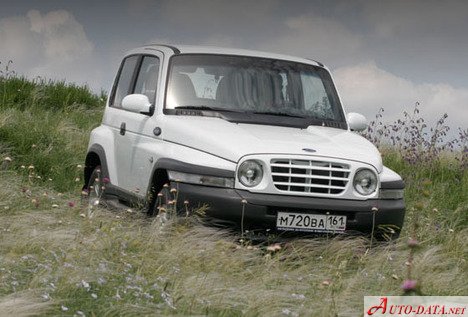
The TagAz Tager 2.9 D (120 Hp) 4×4 represents a rugged and utilitarian off-road vehicle that was produced by the Russian automotive manufacturer TagAZ (Taganrog Automobile Plant) between 2008 and 2012. Essentially a rebadged and locally assembled version of the first-generation SsangYong Korando, the Tager was designed to cater to a market segment demanding robust, capable, and relatively affordable 4×4 transport. While never officially sold in the United States, its mechanical underpinnings and design philosophy resonate with the classic American SUV ethos of durability and go-anywhere capability. The TagAz Tager 2.9 D (120 Hp) 4×4 was particularly aimed at consumers in Russia and neighboring markets who required a vehicle capable of navigating challenging terrains, prioritizing functionality and strength over luxury or advanced technological amenities.
Engineering and Performance of the TagAz Tager
At the heart of the TagAz Tager 2.9 D (120 Hp) 4×4 lies its robust powertrain, specifically the 2.9-liter inline-five diesel engine. This unit was known for its durability and torque delivery, characteristics highly valued in an off-road vehicle. With a displacement of 2874 cubic centimeters (175.38 cubic inches), the engine produced a respectable 120 horsepower at 4000 revolutions per minute. More critically for an off-roader, it delivered a substantial 188.82 lb.-ft. of torque at a relatively low 2800 rpm, ensuring ample pulling power for challenging ascents or towing. The engine’s configuration as a front, longitudinal layout, combined with its inline five-cylinder design, contributed to a balanced and sturdy powertrain architecture.
The diesel engine featured a modern Diesel Commonrail fuel injection system and a DOHC (Double Overhead Camshaft) valvetrain with four valves per cylinder, indicative of a design focused on efficiency and smooth operation despite its naturally aspirated nature. A high compression ratio of 22:1 further optimized the combustion process for diesel fuel. Power was channeled through a 5-speed manual transmission to an all-wheel-drive (4×4) system, providing the necessary traction and control for diverse driving conditions, from paved roads to unpaved trails. This setup underscored the vehicle’s primary purpose as a capable off-road machine rather than a speed demon.
Performance figures for the TagAz Tager 2.9 D (120 Hp) 4×4 were modest by contemporary standards but entirely appropriate for its segment. It could accelerate from 0 to 60 mph in approximately 15.7 seconds, with a maximum speed of 93.21 mph. These figures highlight its focus on rugged utility over outright speed. Fuel economy, a crucial consideration for any vehicle, especially a diesel, was reasonable for its class and weight. The combined fuel consumption was rated at 28.3 US mpg (8.3 liters per 100 km), with urban driving yielding 20.6 US mpg and extra-urban conditions improving to 36.2 US mpg. With a 70-liter (18.49 US gallons) fuel tank, the Tager offered a decent range, an important factor for adventure seekers.
Design, Features, and Robustness of the TagAz Tager
The TagAz Tager inherited its distinct styling and robust body-on-frame construction from its SsangYong Korando predecessor. It presented itself as a classic 3-door off-road vehicle, designed to accommodate five occupants. Its exterior dimensions – a length of 170.47 inches, a width of 72.48 inches, and a height of 72.44 inches – contributed to a compact yet commanding presence. The wheelbase of 97.64 inches, combined with front and rear tracks of 59.45 inches and 59.84 inches respectively, provided a stable platform for off-road excursions.
The design ethos of the Tager was overtly functional, emphasizing practicality and durability. The body type, an off-road vehicle, signified its intended use in more demanding environments. Its curb weight of 4034.46 lbs (1830 kg) further underscored its solid construction. The interior offered a practical layout, with a minimum trunk (boot) space of 12.36 cubic feet (350 liters), expandable to a generous 42.38 cubic feet (1200 liters) with the rear seats folded, allowing for ample cargo capacity for gear or supplies. This flexibility was key for users who needed to transport equipment for work or leisure.
Underneath, the TagAz Tager featured a suspension system built for resilience. The front utilized a double wishbone setup, known for its ability to provide good wheel control and absorption of road imperfections. The rear suspension comprised a dependent spring system complemented by a transverse stabilizer, designed to handle heavy loads and maintain stability over uneven terrain. Braking performance was handled by ventilated discs at the front and solid discs at the rear, offering reliable stopping power. The steering system was a rack and pinion type, assisted by hydraulic power steering, providing a direct and communicative feel to the driver, which is advantageous in off-road scenarios where precise control is paramount. While not equipped with the advanced safety features of modern SUVs, its fundamental design focused on mechanical integrity and driver control in challenging conditions.
Technical Specifications
| General Information | |
| Brand | TagAz |
| Model | Tager |
| Generation | Tager |
| Type (Engine) | 2.9 D (120 Hp) 4×4 |
| Start of Production | 2008 year |
| End of Production | 2012 year |
| Powertrain Architecture | Internal Combustion engine |
| Body Type | Off-road vehicle |
| Seats | 5 |
| Doors | 3 |
| Performance Specs | |
| Fuel Consumption (Economy) – Urban | 11.4 l/100 km (20.6 US mpg) |
| Fuel Consumption (Economy) – Extra Urban | 6.5 l/100 km (36.2 US mpg) |
| Fuel Consumption (Economy) – Combined | 8.3 l/100 km (28.3 US mpg) |
| Fuel Type | Diesel |
| Acceleration 0 – 60 mph | 15.7 sec |
| Maximum Speed | 150 km/h (93.21 mph) |
| Weight-to-Power Ratio | 15.3 kg/Hp, 65.6 Hp/tonne |
| Weight-to-Torque Ratio | 7.1 kg/Nm, 139.9 Nm/tonne |
| Engine Specs | |
| Power | 120 Hp @ 4000 rpm |
| Power per Liter | 41.8 Hp/l |
| Torque | 256 Nm @ 2800 rpm (188.82 lb.-ft. @ 2800 rpm) |
| Engine Layout | Front, Longitudinal |
| Engine Displacement | 2874 cm3 (175.38 cu. in.) |
| Number of Cylinders | 5 |
| Engine Configuration | Inline |
| Cylinder Bore | 89 mm (3.5 in.) |
| Piston Stroke | 92.4 mm (3.64 in.) |
| Compression Ratio | 22:1 |
| Number of Valves per Cylinder | 4 |
| Fuel Injection System | Diesel Commonrail |
| Engine Aspiration | Naturally aspirated engine |
| Valvetrain | DOHC |
| Engine Oil Capacity | 8 l (8.45 US qt) |
| Space, Volume and Weights | |
| Kerb Weight | 1830 kg (4034.46 lbs) |
| Trunk (Boot) Space – Minimum | 350 l (12.36 cu. ft.) |
| Trunk (Boot) Space – Maximum | 1200 l (42.38 cu. ft.) |
| Fuel Tank Capacity | 70 l (18.49 US gal) |
| Dimensions | |
| Length | 4330 mm (170.47 in.) |
| Width | 1841 mm (72.48 in.) |
| Height | 1840 mm (72.44 in.) |
| Wheelbase | 2480 mm (97.64 in.) |
| Front Track | 1510 mm (59.45 in.) |
| Rear (Back) Track | 1520 mm (59.84 in.) |
| Drivetrain, Brakes and Suspension Specs | |
| Drive Wheel | All wheel drive (4×4) |
| Number of Gears and Type of Gearbox | 5 gears, manual transmission |
| Front Suspension | Double wishbone |
| Rear Suspension | Dependent spring suspension with transverse stabilizer |
| Front Brakes | Ventilated discs |
| Rear Brakes | Disc |
| Steering Type | Steering rack and pinion |
| Power Steering | Hydraulic Steering |
